Wall Street rebounded on Monday, led by technology, and Europe closed firmly higher. The ASX is still pointed at a marginally lower open, with futures down about 0.1%, because every market is waiting on the same decision: the Federal Reserve on 28 October, followed by the European Central Bank and the Bank of Japan.
The S&P 500 added 0.70% to 7,676.77, while London’s FTSE 100 gained 0.72%. Both moves were solid. Neither settled the bigger question.
That question is rates. With Brent crude near US$115.81 a barrel and the US 10-year Treasury yield sitting just under 5%, what the Fed says about December matters more than its expected October hold. The figures in this global markets wrap are Monday’s closes, reported on Tuesday 27 October 2026.
Here is what drove prices across the US, Europe and Australia, and which decision points to track before the week’s central bank cluster lands.
Why oil and yields, not earnings, set the tone before the Fed
On the scoreboard, Monday looked like a clean risk-on session. Seven of 11 S&P 500 sectors gained, led by technology and industrials, and the STOXX 600 rose on strength in defence and travel stocks.
| Market | Level | Move |
|---|---|---|
| S&P 500 | 7,676.77 | +0.70% |
| Nasdaq Composite | 26,169.38 | About +0.8% |
| Dow Jones | 52,361.58 | +0.28% |
| STOXX 600 | 640.66 | +0.77% |
| FTSE 100 | 10,767.30 | +0.72% |
| ASX 200 | About 8,810 | About +0.2% |
The ASX 200 showed more strain than its close suggests. It fell as much as 0.8% intraday before miners offset bank losses. In Europe, defence climbed about 2.6% and travel and leisure nearly 2%, while energy slipped about 0.2%.
The less comfortable truth sits beneath the rebound. Oil near US$115 lifts fuel and transport costs, and Reuters reported one-year inflation swaps (market contracts that price expected inflation) at 2.80%. When expectations climb like that, the Fed has less room to signal relief.
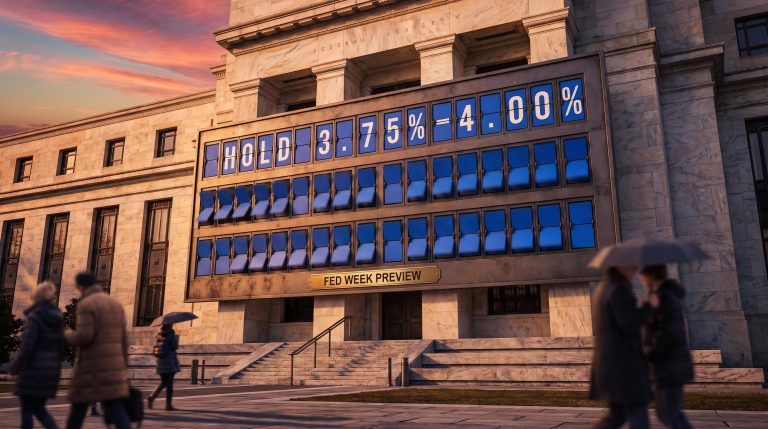
Markets price roughly an 85% chance of a hold at 3.75%-4.00% and 15% for a hike, according to ActivTrades. In a Reuters poll, 94 of 100 economists expect a hold yet still see a December increase. The risk is the language, not the decision.
The Fed rate hike outlook is split between officials who still pencil in another increase this year and traders who see an October hold as near certain, a gap that explains why December language matters more than this week’s decision.
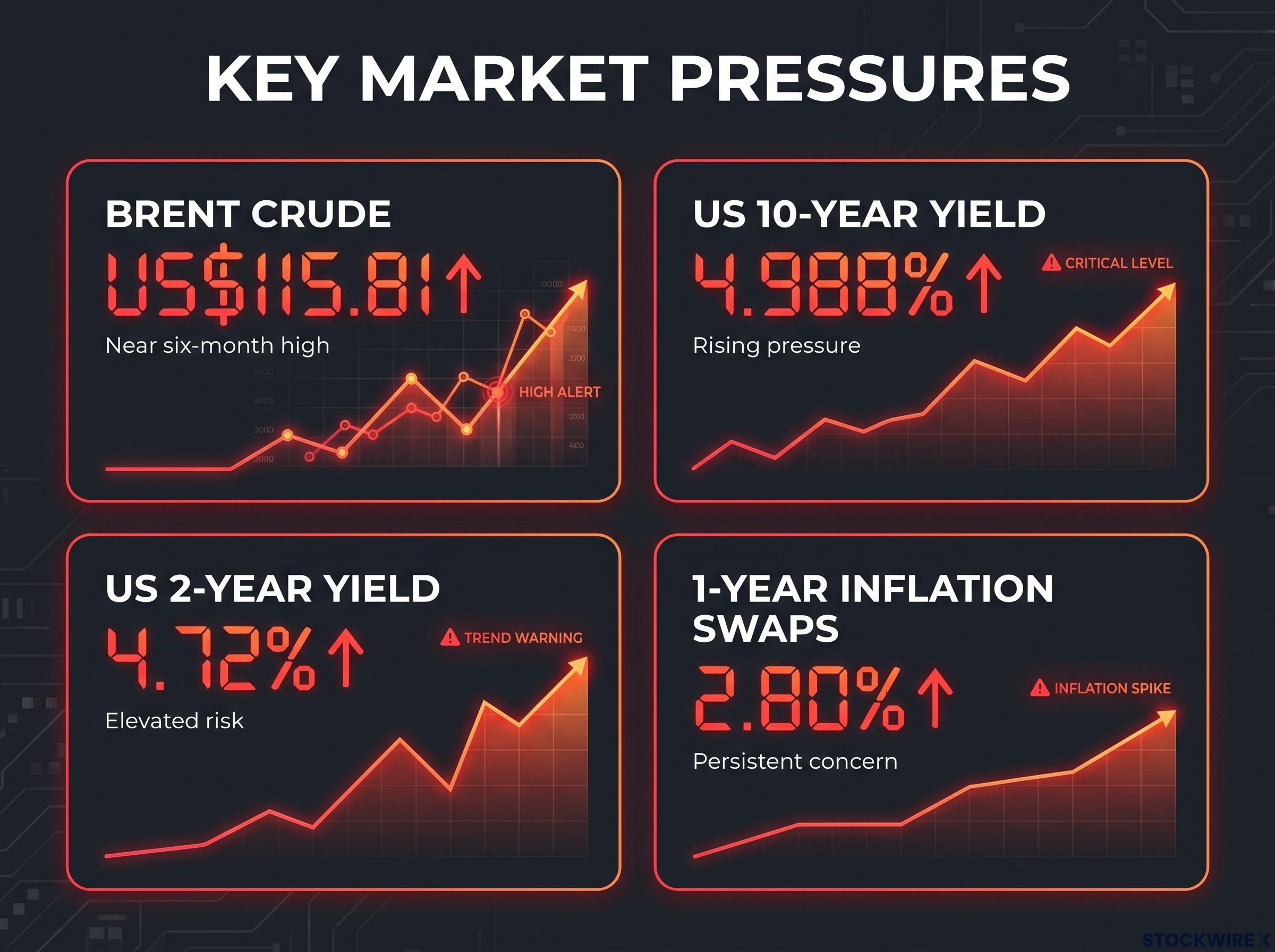
With the 10-year at 4.988% and the 2-year near 4.72%, any hawkish hint could hit growth stocks and the Australian dollar first. Treat this rebound as conditional rather than settled.
Commodities and currencies
- Brent: US$115.81 at settlement, down 0.78%, off a six-month high on hopes for Qatari mediation with Tehran.
- Gold: about US$4,014, up 0.46% at settlement.
- Iron ore: US$89.80/t, down 0.9% (ABC Markets).
- Copper and aluminium: levels not available; copper rose about 0.5%, aluminium fell nearly 1.5%.
- AUD: about 70.2 US cents, down 0.2%.
Sources differ: the original source put gold futures at US$4,038 and iron ore futures just under US$91/t, gaps that likely reflect futures versus settlement pricing.
Meta, SpaceX and Computacenter: the AI trade now runs on financing
Meta Platforms closed down 1.9% after launching about US$35 billion in common and convertible preferred stock, plus an at-the-market programme (shares sold gradually into the market) of up to US$60 billion. The combined potential raise is US$95 billion.
The larger tranche starts only after non-voting Class C shares begin trading, expected in Q1 2027, a structure that preserves Mark Zuckerberg’s voting control. Final terms are not set.
Meta was not alone. Three deals point in the same direction:
- Meta: up to US$95 billion in equity; a profitable platform seeking outside capital.
- SpaceX: an Apollo Global Management affiliate will buy chips and servers and lease them back, with about US$40 billion in principal over leases of slightly more than five years, starting H1 2027. Elon Musk called it debt; the filing describes a finance lease. Shares slipped just under 0.5%.
- Computacenter: lifted its FY2026 adjusted pre-tax profit outlook to at least £425 million, its fourth upgrade this year. Shares closed up more than 13% (Reuters cited 6.3% earlier in the session).
Demand is intact; Computacenter’s upgrade proves it. Funding is the strain. Nvidia rose about 2.4% to US$216.00 after three losing weeks, and Tesla jumped more than 5% on a Barclays upgrade.
Investors are now judging AI spenders on free cash flow, return on invested capital and borrowing costs, not on revenue growth alone, which helps explain why Meta fell on its financing plans even as demand for AI infrastructure remains strong.
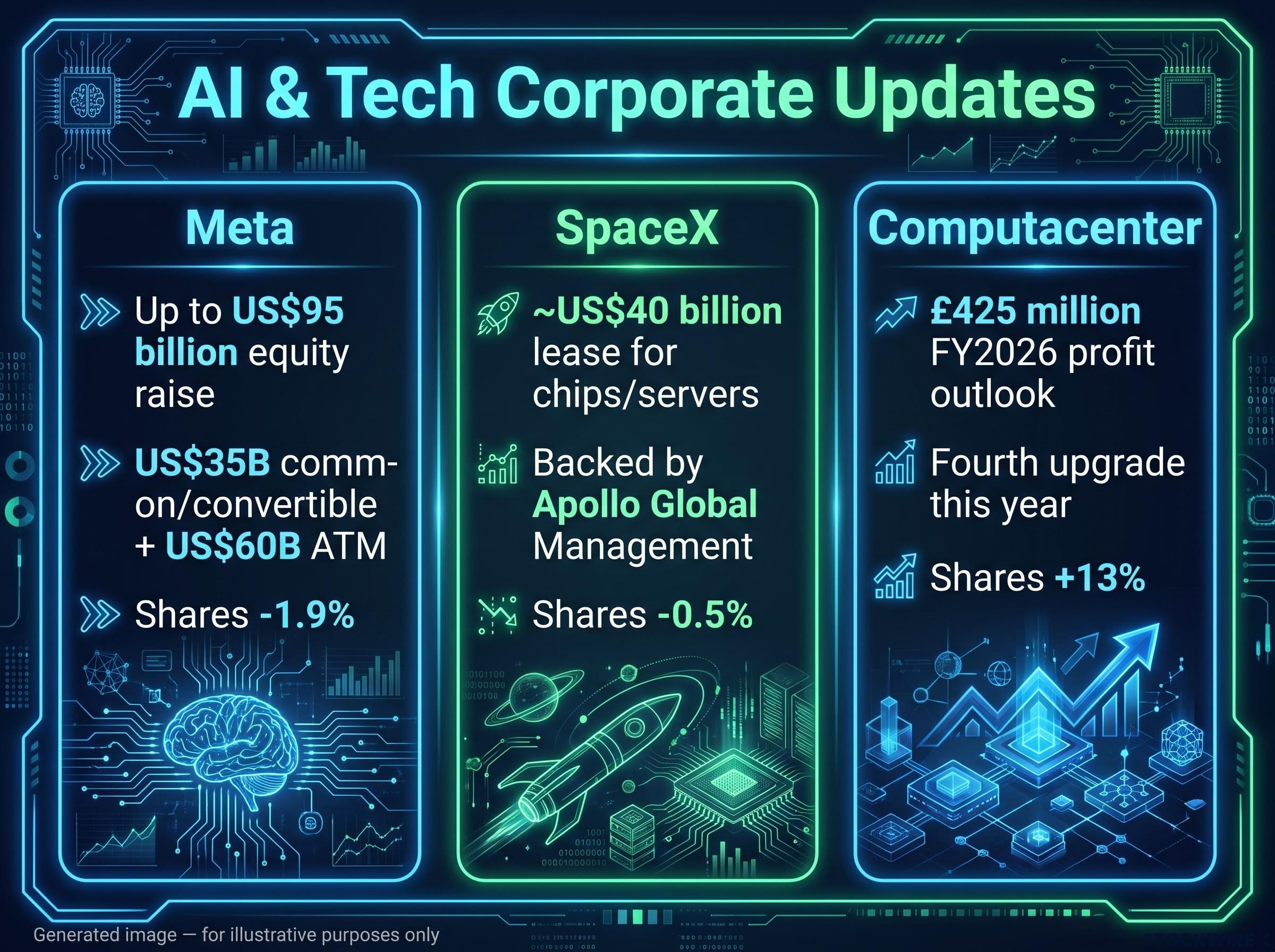
If even the richest platforms need external money, your AI exposure is partly a credit and rates bet, more sensitive to this week’s yields than earnings alone suggest.
Who sees what in the AI trade
Bank of America’s Vivek Arya calls the trade “resilient”, while flagging neocloud credit failures and higher rates as risks.
Nvidia’s Jensen Huang argues capital scarcity is already holding back AI growth. Musk goes further:
Elon Musk on specialised cloud providers More than 200 firms could face “guppy-level death and consolidation” as lenders pull back.
Citadel’s Ken Griffin likens GPUs to airline seats: cheap marginal supply means prices can fall sharply if capacity outruns demand.
What to watch this week: the Fed, ECB, Bank of Japan and Australian updates
The week’s events now matter more than Monday’s moves.
| Event | Date | Expectation |
|---|---|---|
| CSL AGM | 27 October, 10:00 a.m. AEDT | FY2026 accounts; not an earnings release |
| Federal Reserve | 28 October | Hold at 3.75%-4.00% |
| Bank of Canada | 28 October | Consensus not available |
| European Central Bank | 29 October | Generally expected to hold |
| Bank of Japan | 30 October | Generally expected to hold |
| RBNZ | This week | 2.75% to 3.00%, about 80%-85% priced |
A hawkish Fed would likely lift the US dollar, pressure gold through higher yields and weigh on the AUD. Holds from the ECB and BoJ would keep the dollar story in Washington’s hands.
CSL held its AGM at Sofitel Melbourne on Collins, with online participation. Australian companies report on a July-June year, so Q1 FY2027 means July-September 2026; a full list of local reporters this week was not available.
Ranked by likely market impact, the risks are:
- A Fed signal that December tightening is live.
- A 10-year yield break above 5%, though a Reuters survey on 7 October saw a median of about 5.00% by year-end, a path oil or term premium pressure could upset.
- A breakdown in Qatari-mediated talks, sending Brent higher and pitting rate pressure against safe-haven demand for gold.
For you, the Fed’s December wording will likely set the direction of the dollar, gold and the AUD for the rest of the week.
What the week’s decisions can and cannot change
Monday’s rebound was real, but it rests on two fragile supports: oil staying off its highs and the Fed avoiding a hawkish turn.
Three variables will tell you which way it breaks. Brent moving back toward its six-month high would revive inflation fears. A 10-year yield above 5% would pressure growth stocks and AI financing costs. Fed language on December will decide whether the dollar strengthens against gold and the AUD.
The decision point is whether your positioning assumes the calm holds, or allows for it not to.
For readers wanting precedent for a 5% yield test, our detailed coverage of Treasury yields and tech valuations shows how the August bond selloff compressed growth multiples and hit AI infrastructure names.
This article is for informational purposes only and should not be considered financial advice. Investors should conduct their own research and consult with financial professionals before making investment decisions. Past performance does not guarantee future results, and forecasts are subject to market conditions and various risk factors.