
Meta beat earnings and still lost roughly 6-7% of its value. Revenue climbed 26% to $64.6B, yet free cash flow, the cash left after paying for operations and investment, swung to -$2.12B. That reaction is the clearest signal yet of how the AI spending boom is being repriced, and many investors are reading it as noise.
The four largest hyperscalers, the giant cloud operators that rent computing power, are projected to spend roughly $720-750B in 2026. Spending is now outrunning the cash these businesses generate. Bond issuance has surged, and one specialised AI cloud provider has bonds yielding around 16%.
Whether this build-out helps or hurts your portfolio depends on telling the sturdy parts from the fragile ones.
Here is a three-phase map of where the money is flowing, a working method for reading credit signals, and five tests for separating value traps from genuine opportunities.
Where is the AI money flowing next? Three phases of the spending boom
The AI build-out works like a relay race. Each phase runs until it hits a wall, and that wall hands the baton to the next set of beneficiaries.
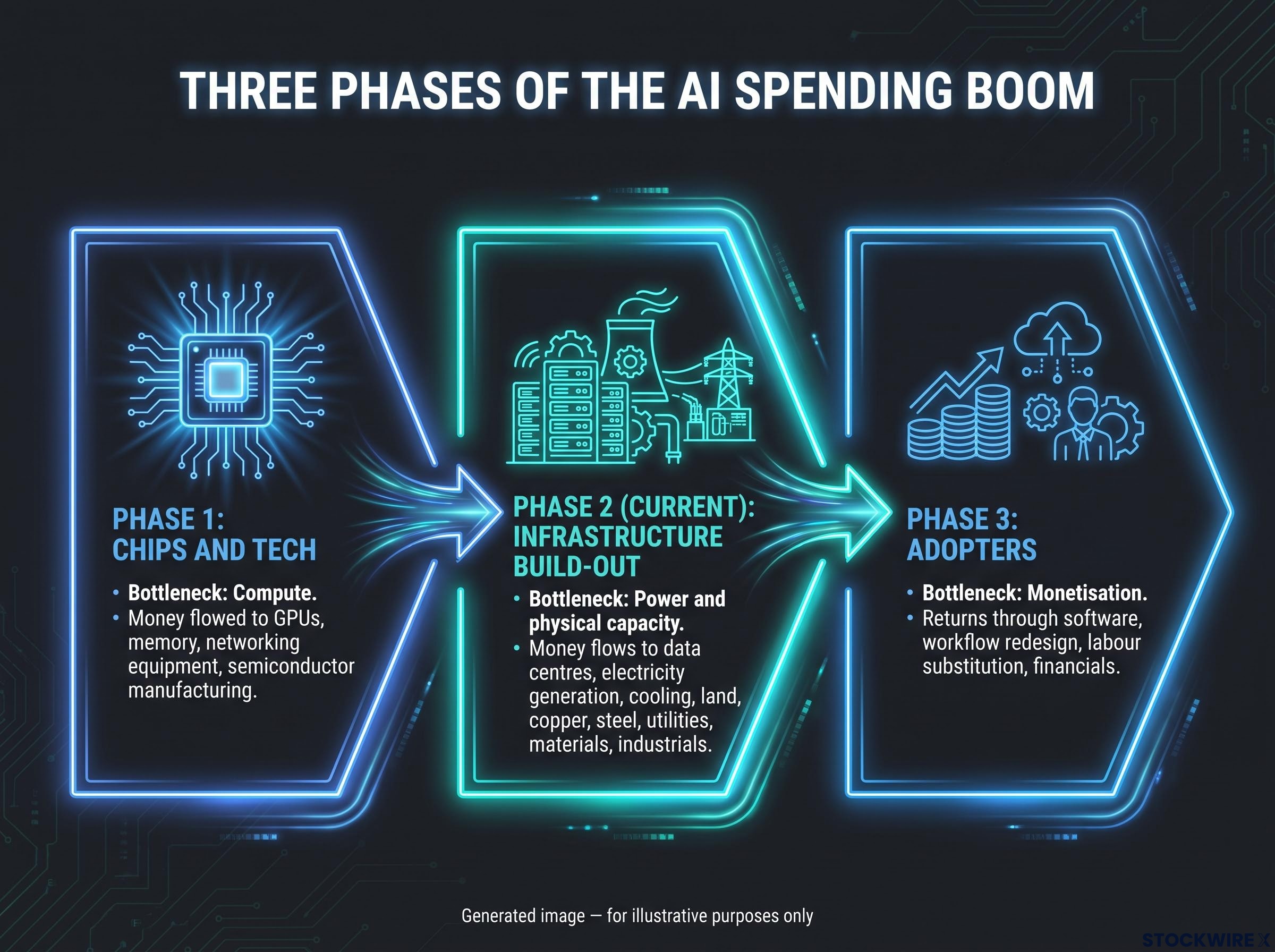
- Chips and tech. The bottleneck was compute. Money flowed to GPUs, memory, networking equipment and semiconductor manufacturing.
- Infrastructure build-out (current phase). The bottleneck moved to power and physical capacity: data centres, electricity generation, cooling, land, copper and steel. Utilities, materials and industrials benefit.
- Adopters. The bottleneck becomes monetisation. Companies outside tech must earn returns on the installed capacity through software, workflow redesign and labour substitution, with financials and software among the likely winners.
David Bush of Trajan Wealth argues that utilities, materials and industrials now behave like growth stocks in this second phase. He adds that he would reassess them if infrastructure spending slowed, so the trade only holds while the spending does.
Utilities, materials and industrials benefit because power and cooling are the binding constraints on deployment, and grid interconnection delays make those bottlenecks structural rather than cyclical.
The scale of that spending is stark.
| Company | 2026 capex | Context |
|---|---|---|
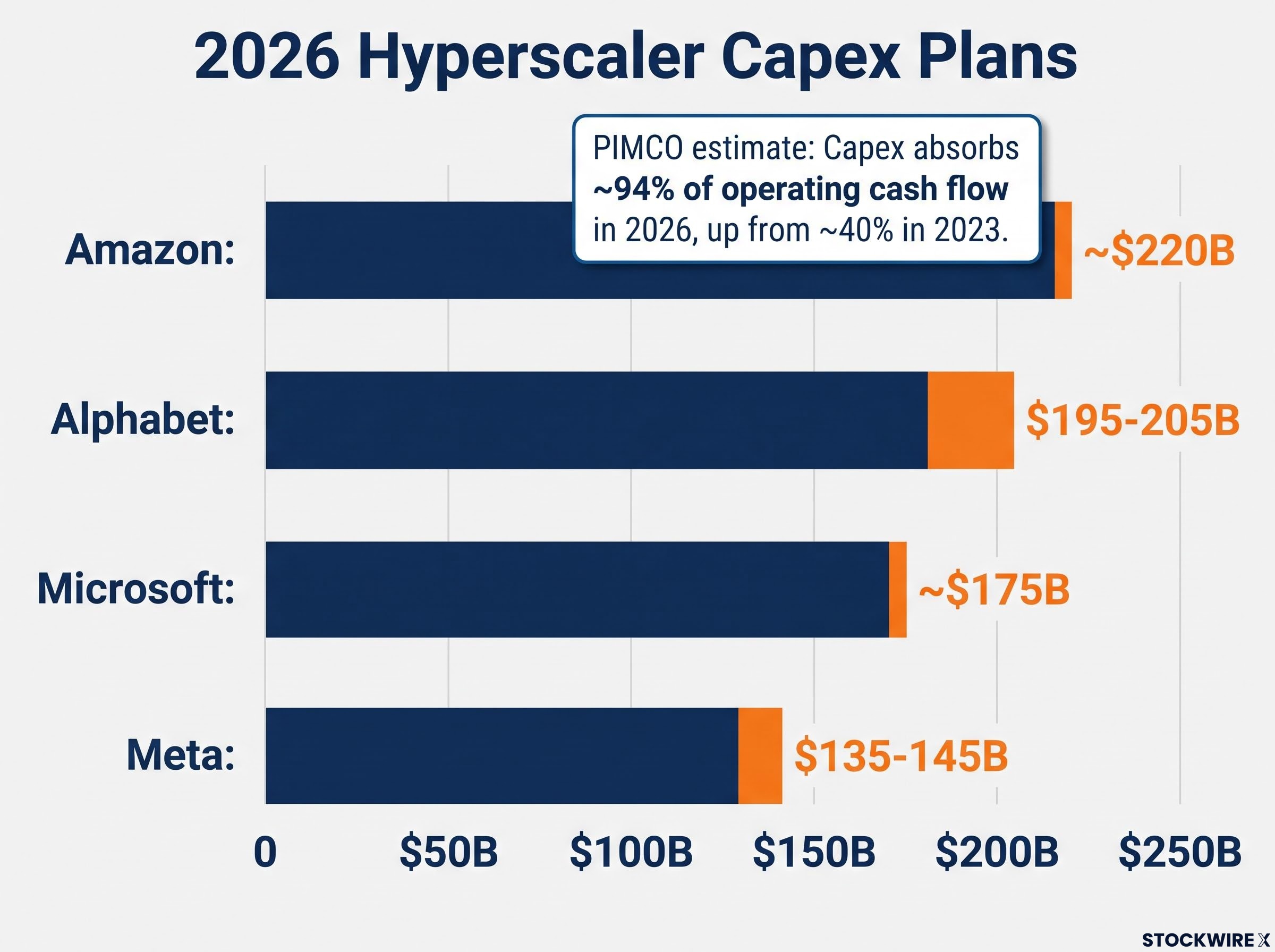
| Microsoft | ~$175B | Cut from ~$190B due to an accounting change; underlying plans unchanged |
| Alphabet | $195-205B | Range raised |
| Amazon | ~$220B | Supersedes an earlier $200B Reuters figure; up from $131B in 2025 |
| Meta | $135-145B | Lower end raised from $130B |
BofA Global Research puts five-company spending, including Oracle, at about $795B. Meta’s third quarter shows what that costs: capex of roughly $34.9B against strong revenue.
Meta Q3 2026: Free cash flow of -$2.12B, despite revenue up 26%.
The market now punishes capex that outruns cash flow even when revenue is strong. You should expect that earnings volatility to persist for the next couple of years, as Bush warns, with misses and guidance cuts punished quickly.
Bush compares the race to the dot-com search contest, where Google emerged ahead of Netscape, AOL and Yahoo. The winner is not yet clear, and this time China is a competitor.
Structural build-out or bubble?
The Bank for International Settlements (BIS) and the International Monetary Fund (IMF) flag leverage and concentration, warning that a partly debt-financed build-out could amplify a downturn if firms cut spending at once. The structural reading treats AI as a general-purpose technology needing years of power and network investment.
Reuters adds useful nuance. Today’s leaders have revenue, cash flow and balance sheets many dot-com firms lacked, so the real question is returns on the next hundreds of billions, not solvency.
When big ASX news breaks, our subscribers know first
How does debt turn capex into earnings strain?
Start with the comfort: the largest hyperscalers are nowhere near insolvency. The strain shows up elsewhere, in the gap between what they spend and what they earn.
Goldman Sachs expects capex of about $750B against operating cash flow of about $778B in 2026, with debt funding roughly one-third of spending. PIMCO estimates capex could absorb about 94% of operating cash flow, up from around 40% in 2023. When spending eats nearly all internal cash, the shortfall must come from bonds, private credit or off-balance-sheet deals.
The BIS, in its 28 June 2026 report, described the boom as increasingly debt-financed and labelled leases and private credit a form of “shadow borrowing”. That debt also competes with other investment-grade bonds and Treasuries for buyers, a crowding-out effect Bush highlights.
| Metric | Figure | Source |
|---|---|---|
| Amazon, Alphabet, Meta, Oracle bonds to 7 July 2026 | ~$194B (up 79% on ~$108B in all of 2025) | Research reporting |
| 2026 hyperscaler bonds trading above issue yield | 78 of 91 | Research reporting |
| Share of 2026 capex debt-funded | ~one-third | Goldman Sachs |
| Capex as share of operating cash flow | ~94% vs ~40% in 2023 | PIMCO |
Seventy-eight of 91 bonds trading at higher yields means buyers who lent this year are already sitting on losses. Lenders are asking for more.
What a widening spread actually tells you
A bond’s yield is the annual return a lender earns at today’s price. A spread is the extra yield over a safe benchmark such as Treasuries. A credit default swap (CDS) is a contract that pays out if a borrower defaults, so its price tracks how much protection costs.
A wider spread can mean:
- Higher perceived default risk
- Liquidity stress, where bonds are hard to sell
- Compensation for concentration in one sector or issuer
Compare Oracle with Alphabet. Oracle carries about $130B of debt, roughly 4.3x EBITDA (earnings before interest, tax, depreciation and amortisation), and its bonds yield about 7-8%. Alphabet and Amazon bonds yield around 2.5-3.5%.
Credit markets are already ranking AI spenders by balance-sheet strength. Morgan Stanley calls this growing “dispersion”. Owning “AI exposure” without checking the issuer’s funding profile means carrying risk you may not have priced, though CDS markets can be thin and distorted by hedging demand.
What do CoreWeave’s bonds reveal about credit risk?
That vocabulary gets its sharpest test with CoreWeave, where the numbers look alarming at first glance.
Why the signal is alarming
| Measure | Latest figure |
|---|---|
| Debt load | ~$50B |
| 2031 bond yield | ~16% (other bonds ~15-16%) |
| Five-year CDS | ~1,000-1,200 bp |
| Expected Q3 interest expense | $860M-$940M |
| Full-year 2026 capex | $35B-$39B (Q3: $11.5B-$13.5B) |
| Return on invested capital | Below 10% |
Bush charted CoreWeave’s yield nearly 500 basis points above the CCC curve despite a B+ rating. Both B+ and “junk” sit below investment grade, so the labels agree. Reuters, on 15-16 October 2026, described sharply increased creditor concern.
CoreWeave’s five-year credit default swap pricing near 1,000 basis points implies a better than 50% default probability, a financing stress signal rather than a forecast of default, and one that moved before the shares did.
Interest expense: $267M in Q2 2025 rose to $640M in Q2 2026.
Here is the test to carry forward. A business earning under 10% on its capital while borrowing near 16% must lift returns well above current levels to service its debt. Apply that comparison to any leveraged AI infrastructure name you hold.
Why the signal may be overstated
Bush is explicit that he is not predicting default; his point is that bond markets often flag corporate health early. The caveats are real:
- CoreWeave is a highly leveraged specialist, not a diversified hyperscaler
- Its collateral is fast-depreciating equipment, and customer concentration is high
- Its bonds are less liquid and vulnerable to forced selling
- Thin CDS markets distort readings, and some AI financing is backed by long-term contracts
CoreWeave also says it cut its weighted-average cost of debt by nearly 300 bp, saving about $1.1B a year, and has secured more than $32B in capital.
Why it still should not be dismissed
Debt service is fixed. If hyperscalers delay orders, revenue could fall while interest bills keep arriving, and you should hold both readings rather than panic or shrug.
Is a cheap AI-disrupted stock a value trap or an opportunity? The Intuit test
A falling price-to-earnings (P/E) ratio looks like a bargain. Intuit shows why that shortcut fails, and Bush frames it as a thought exercise, not a recommendation.
Fear that generative AI could weaken tax and accounting franchises drove the sell-off. One illustration: a Meta AI agent reportedly matched invoices in about 10 minutes, a task that would take days. Bush counters that Intuit is more likely to gain efficiencies from AI.
| Measure | Figure | Caveat |
|---|---|---|
| Share price | ~$308, ~63% below peak | Reuters: down 44%+ YTD by 25 August; Bush cited ~50% |
| Forward P/E | ~13x | Other reporting ~21.9x |
| FY2026 revenue / net income | ~$21.4B / ~$4.6B | Reported |
| FY2026 free cash flow | ~$6B-$8.6B | Varies by period and definition |
| FY2027 guidance | EPS $22.88-$23.12; revenue $23.28B-$23.51B | ~9-10% growth |
Slower customer growth, weaker TurboTax Standard and more than 3,000 job cuts sharpen the question. Run the five tests:
- Feature or workflow? Opportunity if embedded in tax and compliance workflows; trap if a simple feature.
- Proprietary data and trust? Opportunity if regulation and customer history defend it; trap if not.
- Customer growth? Opportunity if users hold; trap if lower tiers churn.
- Free cash flow after AI investment? Opportunity if cash stays strong; trap if it disappears.
- Valuation versus durable earnings? Opportunity if earnings hold; trap if the denominator shrinks.
A low multiple only means cheap if the earnings behind it last. Apply these tests to any beaten-down software or financial holding before treating the discount as a bargain.
The same test on other software names
Adobe and Salesforce look attractive if AI lifts retention and pricing power, but become traps if features commoditise and seats fall. Atlassian wins if developer usage rises and loses if paid collaborators shrink. PayPal benefits if AI cuts service costs, yet suffers if switching becomes easier.
Goldman Sachs applies a similar discipline, arguing that cheap valuations are insufficient without quantified additive AI revenue that lifts growth above what the existing business would deliver alone, a standard only Microsoft and ServiceNow currently meet.
What the AI spending boom demands from investors, and what it does not
The physical build-out may be structurally necessary even as individual debt structures and valuations prove fragile. CoreWeave is an early stress case, Meta shows cash-rich firms can still post negative free cash flow, and Intuit shows a lower price can mean opportunity or rational repricing.
Rather than predict the outcome, watch three variables:
- Hyperscaler capex guidance
- Bond spreads and issuance cover ratios
- Free cash flow after AI investment
Bush’s advice is to avoid overreacting to tech sell-offs while staying alert to what credit markets signal first.
This article is for informational purposes only and should not be considered financial advice. Investors should conduct their own research and consult with financial professionals before making investment decisions. Past performance does not guarantee future results. Financial projections are subject to market conditions and various risk factors.