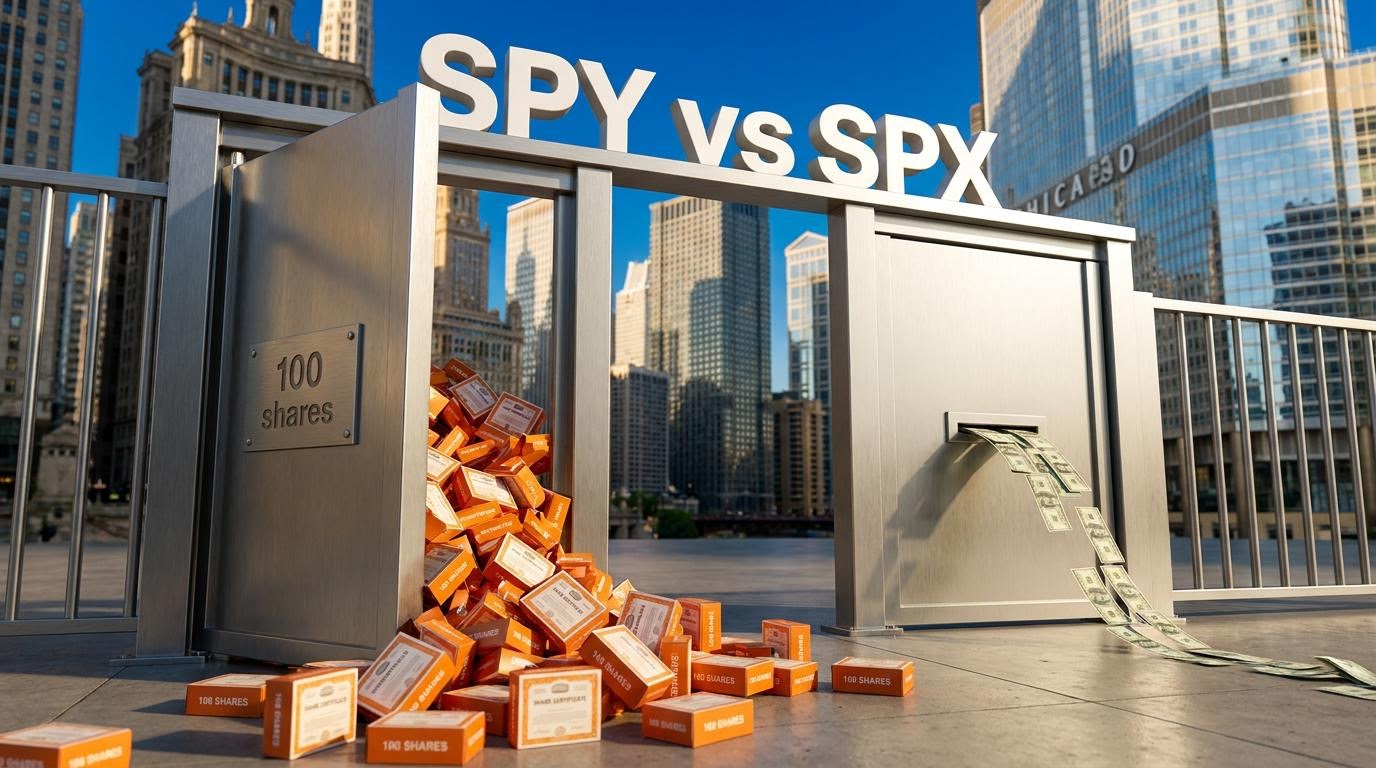
Most beginners pick an S&P 500 option by strike and price, and never ask whether the contract could leave them holding 100 shares of something they never meant to own. That one question is what separates SPY and SPX options, and the answer changes what you have to manage once the trade is on.
Both products give you exposure to the S&P 500, which is why so many traders treat them as interchangeable. They are not. Settlement, exercise style, contract size and US tax treatment all differ, and each difference affects your risk.
The index product is hardly niche. Cboe reported that SPX averaged about 4.63 million contracts a day in August 2026.
This guide gives you a clear way to decide between SPY, SPX and the smaller XSP. It also shows you how to size a defined-risk SPX trade starting from the most you could lose, rather than the premium you hope to collect.
What actually separates SPY options from SPX options?
Start with the practical consequence. With SPY, shares can land in your account. With SPX, they cannot.
One presenter who collaborated with tastytrade and Cboe reduces the whole comparison to a single pre-trade test:
The pre-trade question Could this option leave me holding shares? With SPY, yes. With SPX, no.
The reason sits in the product structure. SPY is an exchange-traded fund (ETF), a fund that trades on an exchange like a stock and is built to follow the S&P 500. SPY options are contracts on shares of that fund, and each contract covers 100 ETF shares.
SPX options reference the index itself. There are no index shares to deliver, so SPX options settle in cash. Cash settlement means that at expiration you receive or pay money based on the index level, and no stock changes hands.
Here is what happens to an in-the-money call at expiration under each product:
- SPY call: if exercised, you receive 100 SPY shares per contract and must pay for them or manage the resulting position.
- SPX call: you receive cash equal to the distance the settlement value sits beyond the strike, multiplied by 100. Nothing else lands in your account.
So the choice is about what you are managing, not about which product fixes a weak market view. Neither does that.
Choosing SPX removes share logistics from your trade. It does not remove market loss, which remains entirely yours.
When big ASX news breaks, our subscribers know first
How do exercise style, early assignment and settlement timing change your risk?
Once you know how each product settles, the next question is when exercise can happen. That timing creates two operational risks, one unique to SPY and one unique to standard SPX.
SPY options are American-style, meaning the holder can exercise at any time before expiration. If you have sold an option, you can be assigned early. SPX options are European-style, meaning exercise can happen only at expiration, so short SPX options face no early assignment.
Early assignment on SPY
The risk is sharpest for short in-the-money calls ahead of an ex-dividend date. The sequence is mechanical:
- Your short SPY call is in the money.
- Its remaining extrinsic value (the part of the option price above its intrinsic worth) falls below the upcoming dividend.
- The holder exercises early to acquire shares and collect the dividend.
- You are assigned and must deliver 100 SPY shares per contract, or cover a short-stock position you never planned to hold.
Cboe states that early exercise becomes likely when the dividend exceeds the option’s remaining time value. If you do not own the shares, step four becomes a capital problem as well as a surprise.
The AM-settlement trap on standard SPX
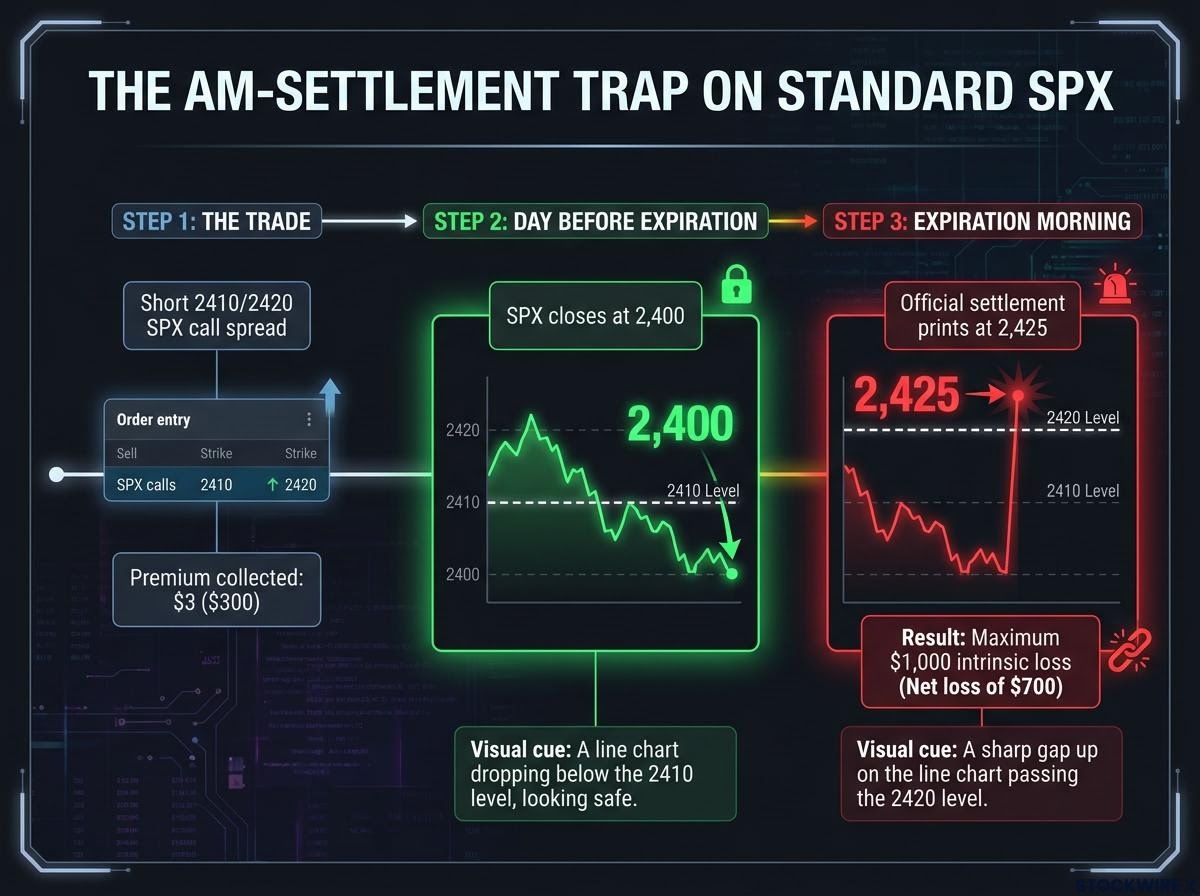
Here is the surprise: European exercise does not make SPX risk-free at expiration. Standard monthly SPX is AM-settled, meaning its final value is calculated from the opening prices of the component stocks on expiration morning. It also stops trading the business day before.
tastytrade gives an example of a short 2410/2420 SPX call spread that collected $3 ($300). SPX closed at 2,400 the day before expiration and the spread looked safe. The index opened about 15 points higher, but the official settlement value printed at 2,425.
The spread hit its maximum $1,000 intrinsic loss, a net loss of about $700 after the credit. That is a settlement-value risk, not early assignment.
By contrast, SPXW (the weekly and end-of-month SPX series) and XSP are PM-settled, using last reported sales prices on expiration day.
| Contract | Exercise style | Settlement type | Settlement timing |
|---|---|---|---|
| SPY | American | Physical delivery of ETF shares | Shares delivered on exercise or assignment |
| SPX standard | European | Cash | AM-settled; stops trading the prior business day |
| SPXW | European | Cash | PM-settled; trades until 4:00 p.m. ET on expiration |
| XSP | European | Cash | PM-settled; stops at 4:00 p.m. ET on expiration |
If you hold standard SPX into expiration, calculate your risk from the official settlement value, not the opening print you see on screen.
For readers wanting to see how the opening auction can push settlement through a short strike, our deep-dive into AM-settled SPX expirations explains how the official settlement value is built from opening trade prices.
How big is each contract, and how liquid are the choices?
Timing risk matters, but size is often the first thing that rules a product in or out. SPX, SPY and XSP all use a 100 multiplier. Because the index level is about ten times SPY’s share price, one SPX contract is roughly ten times larger.
At an illustrative S&P 500 level of 7,500, Cboe’s tool shows about $750,000 of reference notional for one SPX contract. The comparable figure for SPY or XSP is about $75,000.
That gap is the reason XSP exists. Cboe lists XSP at one-tenth the size of SPX, roughly $10 per index point, with the same cash settlement and European exercise.
The XSP Mini-SPX specifications show the same European exercise and cash settlement as SPX, applied to one-tenth of the index value, which is why you can scale your exposure down without changing how the contract settles.
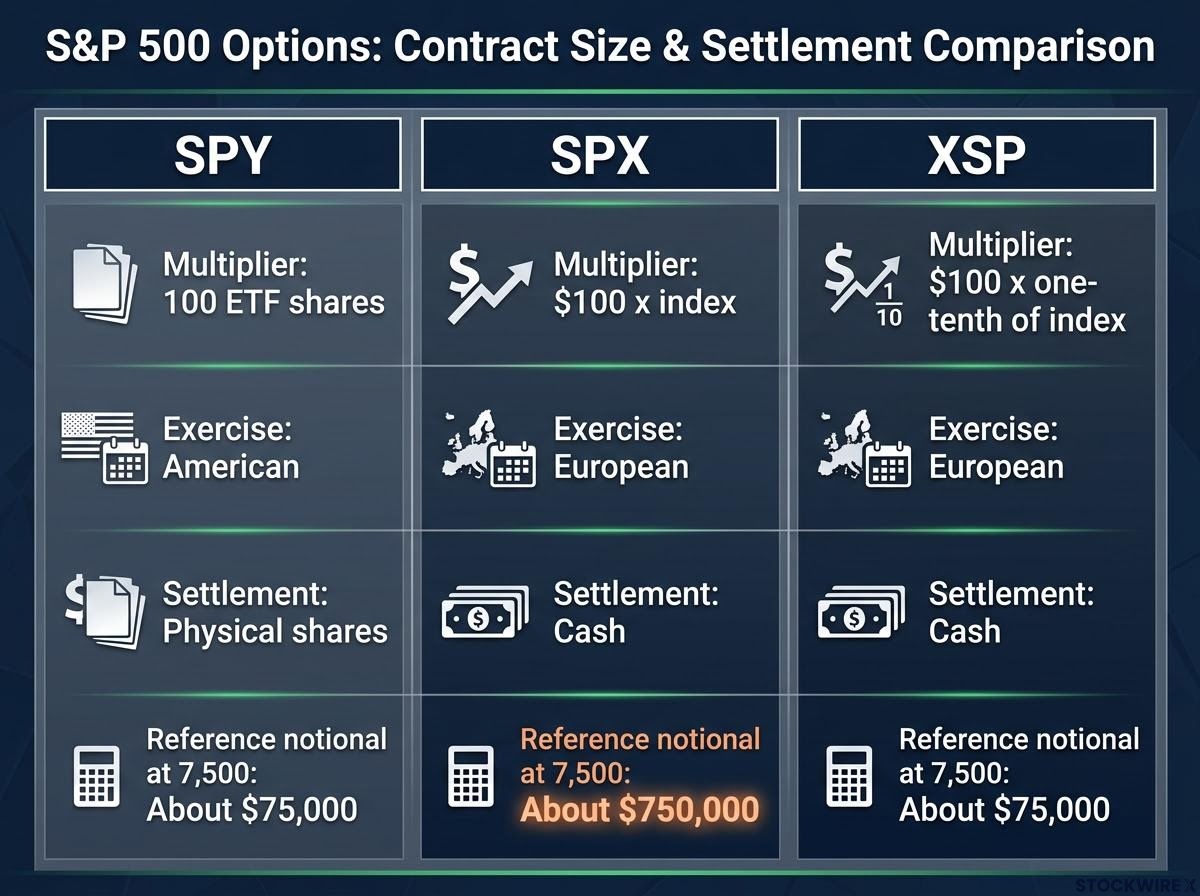
| Contract | Multiplier | Reference notional at 7,500 | Settlement | Trading hours |
|---|---|---|---|---|
| SPX | $100 x index | About $750,000 | Cash | 9:30 a.m. to 4:15 p.m. ET, plus global hours |
| XSP | $100 x one-tenth of index | About $75,000 | Cash | 9:30 a.m. to 4:15 p.m. ET, plus global hours |
| SPY | 100 ETF shares | About $75,000 | Physical shares | Equity-option hours |
Reference notional is not the option’s price, and it is not your maximum loss on a spread. It tells you that a single SPX contract may carry far more exposure than your account is built for.
On liquidity, Cboe reported SPX average daily volume of about 4.63 million contracts and XSP of about 241,000 in August 2026. SPX averaged 4.9 million in Q3 2026, its second-best quarter on record. Cboe’s releases did not provide a separate recent monthly SPY figure. Per Cboe’s comparison, SPX and SPXW offer weekly, daily and month-end expirations, while SPY lists Monday, Wednesday, Friday, third-Friday and month-end expirations.
Liquidity checks before you click
Heavy aggregate volume does not guarantee you a good fill on your specific spread. Before you trade, check:
- How wide the gap is between buying and selling prices on each option you would trade
- What the combined spread would cost or pay as a single package
- Whether setting your own price cap or floor gets you in at a level you accept
SPX and XSP also trade during Cboe’s global session, 8:15 p.m. to 9:25 a.m. ET. Quotes and liquidity can differ by session, so run the same checks overnight.
How does US tax treatment differ, and how much should it drive your choice?
For many US traders, tax is SPX’s most talked-about selling point. The appeal is real.
Under IRS Publication 550, a nonequity option (one not on a narrow-based stock index or a single company’s stock) is a Section 1256 contract. Broad-based index options such as SPX are generally treated this way. Section 1256 gains and losses are taxed as 60% long-term and 40% short-term, regardless of how long you held the position.
There is also a mark-to-market rule: contracts held at year-end are generally treated as sold at fair market value on the last business day of the tax year. You report these on Form 6781.
SPY options are different. Fidelity, in material updated 13 August 2026, and Option Alpha both note that SPY is an ETF option and generally follows ordinary equity-option holding-period rules.
| Feature | SPX options | SPY options |
|---|---|---|
| Tax category | May qualify as Section 1256 contract | Ordinary equity-option rules |
| Long/short-term split | 60% long-term, 40% short-term | Based on holding period |
| Year-end treatment | Marked to market | Taxed when closed |
| Wash-sale rule | Does not apply | Generally applies |
Now the caveats. Eligibility depends on your circumstances and the specific contract. Although wash-sale rules do not apply to Section 1256 contracts, Section 1092 straddle rules can still defer or recharacterise losses, and mixing SPX with offsetting positions can create mixed-straddle issues.
Tax is secondary The 60/40 split may lower your tax bill if you qualify, but it will not rescue a trade that does not fit your risk or your account. Consult a qualified tax professional before relying on it.
How do you choose, and how do you build a defined-risk SPX trade?
With settlement, size and tax covered, the decision becomes practical. Pick the product whose structure you can manage, then size the trade from its worst case.
A simple way to choose
Use SPY if you want ETF access, finer strike increments, or deliberate share exposure such as covered calls. Use SPX if you want cash settlement and no early assignment, and the contract size fits your account. Use XSP if you want SPX’s structure at one-tenth the notional.
If you do want deliberate share exposure through SPY, remember that selling puts or calls on shares leaves your full equity downside intact, and strategies like the wheel only cushion that risk with premium rather than hedging it.
There is a fair counterpoint. Option Alpha and broker education note that SPY’s smaller increments and penny premiums allow more precise sizing, while SPX’s minimum $5-wide spreads can force you to take on more risk.
| Product | Best-fit use | Sizing rule | Main caveat |
|---|---|---|---|
| SPX | Larger accounts wanting cash settlement | Width x $100, less credit | Large contracts; AM-settlement risk on standard series |
| XSP | Smaller accounts wanting SPX structure | Width x about $10, less credit | Smaller, not inherently safer |
| SPY | ETF access and deliberate share exposure | Width per 100-share contract | Must finance or liquidate 100 shares if assigned |
Sizing a defined-risk spread from maximum loss
The presenter builds every trade in the same order:
- Decide the position you want.
- Set the size you can afford.
- Fix your maximum loss.
- Choose direction and expiration.
- Pick structure and strikes from what the market offers.
- Place a limit order, or pass if risk or price do not fit.
For a credit spread, maximum loss equals strike width minus credit, times $100. A 10-point SPX spread carries $1,000 of gross exposure before credit; a 50-point spread carries nearly $5,000. A five-point XSP spread carries about $50.
Size from the worst-case settlement loss, not the premium collected, because that full amount is real account risk. Defined risk is a cap, not a promise of a small loss.
Multiple lots multiply the maximum loss, and several correlated spreads can lose together in one large index move. XSP shrinks the numbers, but it does not remove gap, expiration or liquidity risk.
Matching the product to the position you actually want
The right product is the one whose settlement, size and risk you can manage, not the one that sounds more sophisticated.
Keep three points in front of you. SPY brings shares and possible early assignment. SPX and XSP bring cash settlement and European exercise. And your maximum loss must fit your account before you choose a single strike.
Before your next trade, ask whether the option could leave you holding shares. Then confirm the maximum loss you can genuinely afford to lose in full.
This guide is educational and is not personal tax or trading advice. For tax questions, consult a qualified professional.
This article is for informational purposes only and should not be considered financial advice. Investors should conduct their own research and consult with financial professionals before making investment decisions. Past performance does not guarantee future results. Financial projections are subject to market conditions and various risk factors.
—