Annaly Capital Management paid shareholders a $0.75 quarterly dividend last quarter and still delivered an economic return of -7.6%. AGNC Investment paid $0.36 while its tangible book value fell $1.45 per share. If you buy mortgage REITs for income, those two numbers should make you stop.
A large cash yield and a positive return are not the same thing. In Q3 2026 the two pulled sharply apart.
The trigger was the bond market. According to Chris Whalen, the 10-year Treasury yield touched 5.36% on 7 October 2026, its highest level since 2002. It has since hovered between roughly 4.96% and 5.15%, and that run gave these stocks the hardest stress test they have faced in years.
This guide gives you a practical checklist for reading any mortgage REIT quarter. It uses Annaly, AGNC and UWM Holdings as live examples, so you can tell whether a dividend is being earned or quietly paid out of your own capital.
What happens to mortgage REITs when Treasury yields rise?
The short answer is that book value falls. To read a quarter properly, you need to know why.
How the income is made
A mortgage REIT (real estate investment trust) mostly owns agency mortgage-backed securities (MBS). These are bundles of home loans guaranteed by government-sponsored agencies. The company earns the spread, which is the gap between the yield on those securities and the cost of the money it borrows to buy them.
The 10-year Treasury yield is the benchmark that drives mortgage pricing, which is why a move to 5.36% flows straight into the value of the mortgage securities these companies own.
That spread is thin, so the company uses leverage, meaning borrowed money. Typical agency leverage runs at roughly five to eight times equity. When spreads are stable, this produces double-digit returns on equity. When conditions turn, the same leverage magnifies losses in five ways:
- MBS prices fall as yields rise
- Funding costs climb
- Financing spreads widen
- Prepayment and convexity effects weaken hedges
- Hedge gains come in smaller than asset losses
Why book value is the number to watch
Book value is the net worth of the portfolio per share: assets at market value minus liabilities. Price-to-book compares the share price with that figure. A ratio above 1x means you pay a premium, and below 1x means a discount.
Whalen notes that Annaly traded near 2x book during COVID, around 1.2x earlier in 2026, and roughly at book value now. Those swings tell you about investor appetite for income as much as about the portfolio itself.
The Treasury surrogate view Chris Whalen describes Annaly as a Treasury surrogate: a company that owns government-insured securities and adds leverage on top.
The government guarantee protects against default, not against price moves. In 2022, an analysis of that rate shock found that even a REIT with roughly 100% hedge coverage could suffer large book-value losses. The cause was basis risk: agency MBS spreads widened against Treasuries, and the hedges could not cover that gap.
Owning these stocks is closer to holding a leveraged bet on bond prices and spreads than to holding a bond. The dividend is only half of what you are buying.
When big ASX news breaks, our subscribers know first
What did Annaly, AGNC and UWM report for the latest quarter?
With that model in mind, the Q3 2026 results read very differently from the dividend headlines. Annaly reported on 20 October, AGNC on 19 October and UWM, in preliminary form, on 23 October.
| Company | Book value per share | Quarterly change | Economic return | Dividend status |
|---|---|---|---|---|
| Annaly (NLY) | $17.86 | -11.4% | -7.6% | $0.75 quarterly |
| AGNC (AGNC) | $7.13 (tangible) | -$1.45 (-16.9%) | -12.7% | $0.36 quarterly, paid $0.12 monthly |
| UWM Holdings (UWMC) | n/a (not reported) | n/a | n/a | Suspended |
UWM figures are preliminary and unaudited. The release did not report book value per share.
Annaly held up best of the three. Its book value still fell more than 11%, but its economic return was the smaller loss. Whalen said Annaly handled the quarter better than its peers did.
AGNC took the sharper hit. Its tangible book dropped from $8.58 to $7.13, and management attributed the result to mortgage assets underperforming its interest-rate hedges. That is basis risk showing up in a live quarter.
UWM is a different kind of business. It originates mortgages rather than holding a leveraged bond book, and its preliminary numbers show revenue of $800-825 million, net income of $205-220 million, adjusted EBITDA (earnings before interest, tax, depreciation and amortisation) of $170-190 million and originations of $33.4 billion. Even so, the dividend is suspended.
For Annaly and AGNC, the payout was fully paid and you still ended the quarter worse off. That gap between dividends paid and book value lost is the benchmark to use for every future quarter.
How do servicing assets and strategy choices change the picture?
Annaly and AGNC faced the same rate shock with different structures. UWM answered it with a capital decision. Neither approach makes a company immune.
Annaly’s servicing cushion
Mortgage servicing rights (MSRs) are the right to collect payments on home loans in exchange for a fee. When rates rise, fewer borrowers refinance or repay early, so those fee streams last longer and gain value.
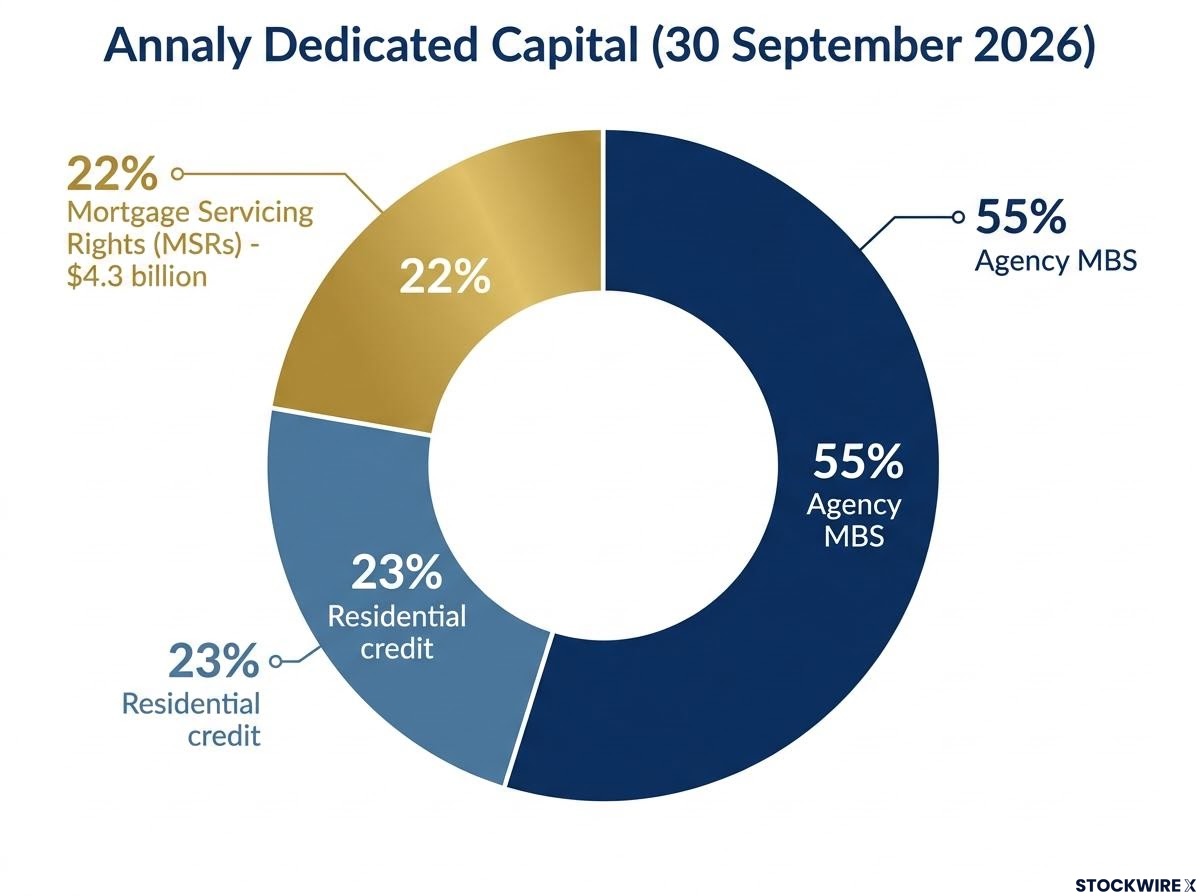
At 30 September 2026, Annaly held $4.3 billion of MSRs, or 22% of dedicated capital. Agency MBS made up 55% and residential credit 23%, and the MSR portfolio grew by about $250 million, or 6%, during Q3. Whalen counts this roughly 20% servicing allocation among his reasons for favouring Annaly.
The cushion has limits:
- Benefit: slower prepayments can lift MSR values as rates rise
- Benefit: gains can partly offset losses on the bond portfolio
- Risk: valuations are sensitive to shifts in prepayment speeds
- Risk: servicing costs, illiquidity and regulation can erode returns
UWM’s rights offering and dividend pause
UWM chose a different route. It suspended its quarterly dividend, announced on 5 August 2026, and moved towards strengthening its balance sheet and reducing debt.
UWM rights offering terms Up to $400 million. Record date 2 October 2026. Eligible Class A holders may subscribe for 0.57 shares per right, priced at the greater of $2.00 or 85% of the ten-trading-day volume-weighted average price (VWAP), with a further $400 million backstop commitment.
A raise priced at a discount brings in capital, but it can dilute holders who do not take up their rights.
UWM’s pause sits within wider mortgage stress, where lending volume no longer guarantees profit once hedging costs and balance-sheet pressure bite, as its Q2 net loss of $451.9 million on $39.7 billion of originations showed.
A servicing-heavy platform may cushion your book value in a rate spike, but it will not prevent losses. A discounted equity raise can shrink your stake if you hold the shares and stay on the sidelines.
Is a 12-14% yield attractive income or a warning sign?
The appeal is easy to see. Whalen cited Annaly’s common yield at 12-14%, and Annaly’s own release puts the annualised yield on its $0.75 dividend at 15.88%. The gap between those figures most likely reflects the share price used at the time each was calculated.
For context, the 10-year Treasury pays around 5%. A REIT paying double that looks like an obvious upgrade.
It is not that simple. Yield is calculated from share price, not book value. When the price falls on fears of book losses or a dividend cut, the yield rises automatically. A high number can reflect stress just as easily as generosity.
You also cannot quote AGNC’s current yield without a current share price. Its $0.36 quarterly payout was outweighed by the $1.45 fall in tangible book.
Why history argues against bond-like treatment In 2022, roughly full hedge coverage did not stop large book-value losses because agency MBS spreads widened. The historical record argues against treating a 12-14% yield as bond-like income.
Whalen still sees mortgage REITs as income vehicles. He holds Annaly as his largest position, says he would buy more below book value, and finds preferreds attractive. Even a committed holder, though, frames the case around valuation rather than the yield alone.
Risks behind the yield
- Dividend cuts: spread volatility can force sudden reductions, as UWM’s suspension shows
- Book-value erosion: AGNC lost $1.45 of tangible book against $0.36 paid out
- Leverage: it magnifies spread and mark-to-market losses
- Dilution: UWM’s discounted rights offering illustrates the risk
- Fed-policy shifts: rate hikes raise funding costs, and surprise easing can speed up prepayments
- Spread volatility: hedging Treasury duration does not hedge MBS basis risk
- Liquidity shocks: the 2020 COVID crisis forced deleveraging, and Securities and Exchange Commission (SEC) risk disclosures warn that hedges can fail or become costly in rapid moves
A 12-14% yield tells you the market is pricing in risk to book value or the dividend. Treat it as payment for carrying that risk, not as a safe coupon.
Where does the 10-year yield go next, and how should you evaluate these stocks?
Your outcome depends heavily on rates. Federal Reserve H.15 data shows a 5.13% daily average for 21 October and a latest reading of 4.96%.
The Federal Open Market Committee (FOMC) raised its target range by 25 basis points to 3.75%-4.00% on 16 September 2026. In a Reuters poll published on 20 October, 94 of 100 economists expected a hold at the 27-28 October meeting. Nearly 60% expected the policy rate to peak at 4.00%-4.25%.
Three views on the 10-year
| View | Source | Reasoning | Implication for mortgage REITs |
|---|---|---|---|
| Near 5% or higher | Chris Whalen | Inflation, oil and fiscal pressure keep long yields high; a fall may need an event such as an AI-company default prompting Fed purchases, which Chairman Kevin Warsh is expected to avoid | Continued pressure on valuations, financing costs and dividend coverage |
| Towards 4% | Ralph Oligario, formerly of Friedman Billings Ramsey | Core inflation excluding energy forces easing; real rates of 1% imply roughly 4% yields | Supports MBS prices and book value, though a disorderly rally can cause prepayment and convexity problems |
| Hold now, later uncertainty | Reuters poll, 20 October 2026 | No October change, with a December hike possible | Long-end volatility persists |
Neither path is guaranteed, and both carry costs for leveraged MBS holders. These views are speculative and may change as market conditions develop.
A checklist for reading the next quarter
Apply these seven checks whichever way yields move:
- Economic return: dividends plus the change in book value
- Book-value direction: rising, flat or falling
- Leverage: how many times equity is borrowed
- Hedge coverage: the share of rate exposure that is hedged
- MBS basis exposure: sensitivity to spread widening
- MSR allocation: the size of any servicing cushion
- Premium or discount to book: what you are paying for the net assets
Set the results against the alternatives. Treasuries pay less but carry government backing and no corporate leverage. Investment-grade corporates add credit risk with less rate sensitivity. Preferreds rank ahead of common equity but face call and rate risk, while common REIT shares offer the highest potential cash yield with full exposure to book value.
Book-value direction and leverage matter most. Together they show whether the dividend is funded by earnings or by your own capital. Whalen also suggests keeping a modest share in assets such as gold and real estate alongside income holdings for diversification.
For readers wanting to see how hidden short-volatility exposure sits inside mortgage holdings, our full explainer on interest rate options shows how long options can offset the convexity risk in MBS.
What the quarter changes, and what it does not
Rising yields cut book values at both Annaly and AGNC in Q3 2026, yet demand for income has not gone away. Both companies kept paying large dividends while delivering negative economic returns. UWM took a third path, pausing its payout to repair its balance sheet.
The decision in front of you is whether you want leveraged rate exposure in exchange for high income, and how much of your portfolio that bet deserves. Size the position for the book-value risk, not for the yield.
Three catalysts come next: the 27-28 October FOMC meeting, UWM’s final earnings and rights offering result, and next quarter’s book values.
This article is for informational purposes only and should not be considered financial advice. Investors should conduct their own research and consult with financial professionals before making investment decisions. Past performance does not guarantee future results.