Ninety-four of 100 economists polled by Reuters expect the Federal Reserve to hold rates at its 27-28 October 2026 meeting. TD Securities agrees, but its strategists argue that this widely expected pause is the more hawkish outcome, because skipping an October Fed rate hike now raises the odds of bigger moves later.
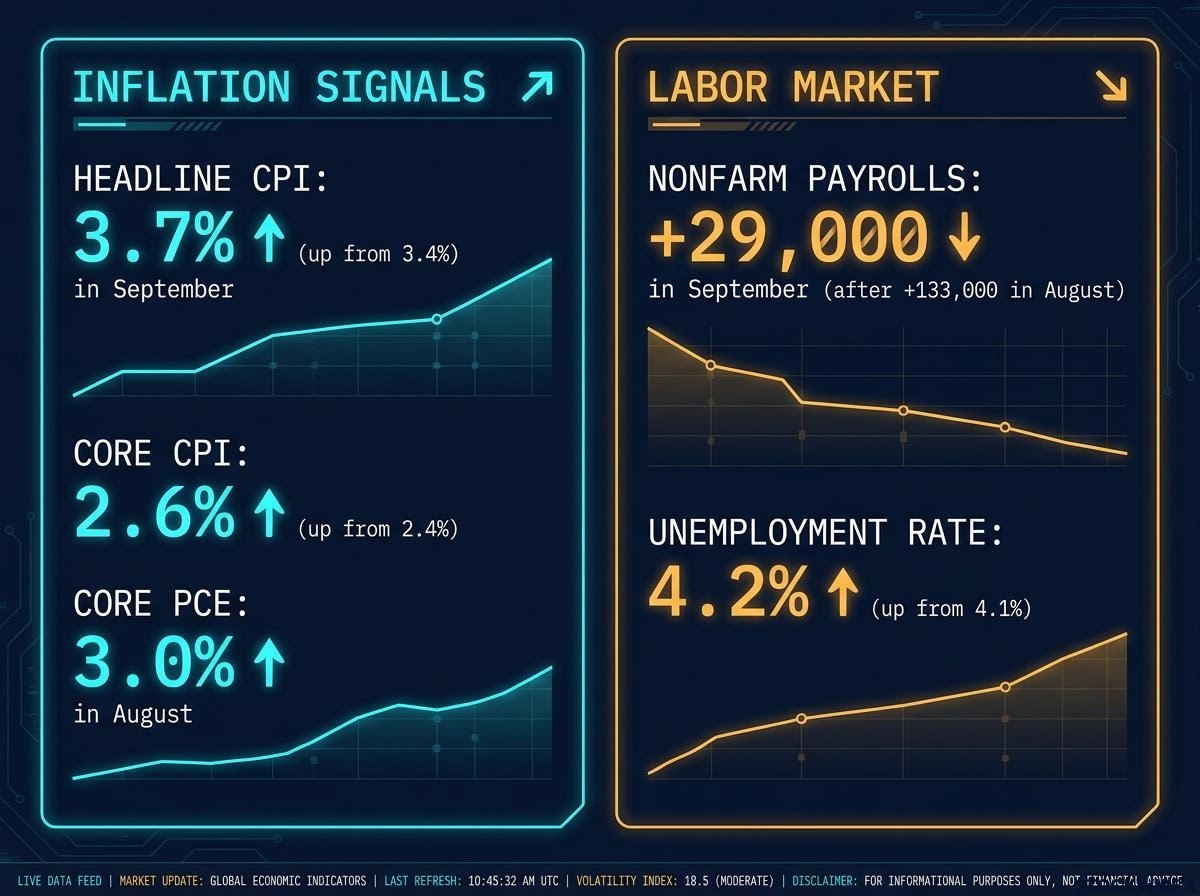
The backdrop explains the tension. The Fed raised its target range to 3.75%-4.00% in September. Since then, headline inflation has accelerated to 3.7% and payroll growth has slowed to just +29,000. When TD refers to rates holding at “4.00%”, it means the upper bound of that range.
The decision lands next week. The meeting outcome matters less than the policy lag, the Chair’s communication style and the market pricing around it.
This analysis gives you a way to read all three, along with the specific data prints that could turn a quiet pause into a sharp repricing.
Why would the Fed pause now, and what does TD expect next?
On paper, the case for hiking again looks strong. Inflation is rising, core measures sit above target and the Fed’s own September statement left the door open to further increases. A pause seems to contradict all of that.
The FOMC voting structure matters here: only 12 members vote at each meeting, so the comments from non-voting regional presidents are context rather than binding signals about the next hike.
The labour data resolves the contradiction:
- Headline CPI (consumer price index, the main US inflation gauge): 3.7% year-on-year in September, up from 3.4%
- Core CPI (excluding food and energy): 2.6%, up from 2.4%
- Core PCE (the Fed’s preferred inflation measure): 3.0% in August
- Nonfarm payrolls: +29,000 in September, after a downwardly revised +133,000 in August
- Unemployment rate: 4.2%, up from 4.1%
TD’s call and the logic behind it
TD expects a hold in October, followed by hikes in December 2026 and March 2027. Its strategists originally expected tightening to continue this month. The weak September payrolls report changed that view.
TD’s reading is that the labour market is resilient but not overheating. That supports raising rates once a quarter rather than at every meeting. A pause on these terms is a considered choice.
It is also a delay. TD sees a December hike as close to unavoidable once October is skipped, so the pause shifts the timing of tightening more than it removes it.
How the rest of the Street compares
| Voice | October call | Later path | Stated reasoning |
|---|---|---|---|
| TD Securities | Hold | Hikes in December and March 2027 | Labour market resilient, not overheating |
| Goldman Sachs (Jan Hatzius) | Hold | “Second and final” hike in December | Warsh’s refusal to pre-commit fits a hold |
| UBS Global Wealth Management | Hold | Adds a March 2027 hike | Price pressures broadening |
| Citigroup | Hold | December 25bp hike, then hold | September inflation well above expectations |
| John Williams, NY Fed | No urgency | Year-end hike possibly necessary | Hawkish bias without an immediate move |
Markets agree. CareEdge Global, reported by ANI on 22 October, put the hold probability at 78.4%. A December 25bp hike carried about an 89.5% probability as of 15 October.
The only real divergence is how long the hiking runs. Goldman stops in December, while TD and UBS extend into March. For you, that means the hold is already in prices, and the open question is the length of the cycle.
When big ASX news breaks, our subscribers know first
How can a pause leave the Fed behind the curve?
“Behind the curve” describes a central bank that responds to inflation too slowly and is forced to catch up. To see how a pause gets there, start with lag.
Policy lag is the delay between a rate change and its full effect on spending, hiring and prices. The September hike is the live example: it has not fully passed through the economy yet, which is partly why the Fed can justify waiting.
Milton Friedman’s idea of long and variable lags explains why the Fed can justify waiting on the September hike, and why any misjudgement of timing can be costly in either direction.
Four ways waiting narrows the margin for error
- Lags: If inflation is already broadening, older and looser settings keep supporting demand while the Fed waits for clearer evidence.
- Inflation expectations: Repeated pauses with inflation well above 2% can lead households and firms to expect persistent price rises, which feed into wage demands and long-term yields.
- Credibility: Calling inflation too high while delaying action invites doubts about the Fed’s resolve.
- Larger catch-up move: If data reaccelerates, markets may shift from pricing 25bp to pricing 50bp.
That last step is where TD’s warning sits.
TD Securities on the behind-the-curve risk TD argues that a single clearly poor inflation reading, or a series of firm jobs figures, would be enough for traders to assign greater odds to a 50bp increase at coming meetings.
A 50bp repricing would likely lift short-term yields and the dollar, tighten financial conditions quickly and raise volatility across equities, credit and emerging markets. A pause does not cause inflation. It narrows the margin for error, so a later move can be more abrupt than an earlier, smaller one.
If you hold rate-sensitive assets, the October decision itself is not the main risk. The risk is how fast pricing could move if the next CPI or jobs report surprises.
What 2021-22 does and does not teach
In 2021-22, inflation first looked tied to temporary supply disruptions. Persistent demand, a tight labour market and broadening price pressures then forced rapid tightening.
That episode is a caution rather than a prediction. Tariffs and energy shocks can lift headline inflation without lasting demand pressure, and the Fed has to judge which kind of inflation it is facing.
What does a Warsh Fed without forward guidance mean for market pricing?
Forward guidance is when a central bank signals its likely future rate path in advance. Chair Kevin Warsh has rejected it.
“I don’t prejudge meetings,” said Kevin Warsh, Chair of the Federal Reserve (CNBC, 16 October 2026).
In remarks published by the Federal Reserve on 28 August, Warsh said he would rather markets respond to economic data than to an announced path. BNY wrote on 20 October that he was unlikely to signal the October decision in advance. Goldman’s Hatzius reads that refusal to pre-commit as consistent with a hold.
Colleagues have filled the gap. Williams, Vice Chair Philip Jefferson and Governor Christopher Waller have each signalled patience or data dependence. Politico flagged the resulting risk: if officials signal patience and then hike unexpectedly, credibility suffers.
The practical effects:
- Less predictability between meetings
- Heavier weight on CPI, payrolls and PCE releases
- Higher volatility as markets try to infer how the Committee reacts to data
Investors are still adjusting to the forward guidance overhaul, since each data release now lands with no Fed-provided buffer and carries greater pricing weight than it did under earlier chairs.
A 78% hold probability tells you the outcome is largely priced. Without guidance, the post-meeting press conference and the next data prints are likely to move markets more than usual. TD adds a twist: a firm stance on inflation from the Chair might calm doubts about the Fed’s resolve, yet leave traders expecting additional rate rises.
The policy-error balance
The Fed can get this wrong in either direction. If policy is too tight, further hikes could push a cooling labour market toward recession, given that +29,000 payrolls print. If it is too loose, persistent inflation could require larger and more damaging hikes later.
There is also a fair counter-argument. Core inflation, payrolls and unemployment are sending different signals, and one hot CPI report should not drive an overreaction. A pause gives the Fed time to separate lasting inflation from temporary energy or tariff effects.
Which data points could turn a pause into a repricing before the next meeting?
The base case already enjoys high probability, so only a surprise changes pricing materially. Three releases matter, in calendar order:
- October payrolls, measured against +29,000 and 4.2% unemployment
- September core PCE, measured against 3.0%
- October CPI, measured against 3.7% headline and 2.6% core
| Scenario (illustrative, not a forecast) | Data trigger | Likely market read | Rate path implied |
|---|---|---|---|
| Base case | Data near current levels | Pause confirmed | 25bp in December and March |
| Hot data | CPI above 3.7%, strong payrolls | Behind-the-curve concerns | Rising 50bp pricing |
| Soft data | Weaker jobs, cooling core | Cycle near its end | December hike questioned |
A December hike sits near 89.5%. Markets see a strong possibility of a March 2027 move, but no precise probability is available. Eugenio Aleman, chief economist at Raymond James, holds the minority hawkish view: broadening inflation could even lift the odds of an October hike.
Treat the next CPI and payrolls reports as the real decision points. The October meeting is mostly a confirmation of what is already priced.
What the pause changes, and what it does not
The October hold is widely expected and defensible. TD’s point is that it moves risk to December, March and the data released in between.
Three ideas carry the argument. Policy lag makes timing matter. The behind-the-curve risk is about how fast rates rise, not which direction they move. And without forward guidance, the data and the press conference carry more weight than usual.
Your decision point is monitoring rather than prediction. Watch the next CPI and payrolls prints against the reference levels above, and consider how exposed your portfolio is to rising yields and a stronger dollar. Forecasts can shift quickly as new data arrives.
Past performance does not guarantee future results. Financial projections are subject to market conditions and various risk factors. This article is for informational purposes only and should not be considered financial advice. Investors should conduct their own research and consult with financial professionals before making investment decisions.
—