The dollar gained about 0.45% against the Swiss franc on Friday, 23 October 2026, while US Treasury yields fell. Most currency traders work from a simple rule: lower US yields mean a weaker dollar. Today’s USD/CHF move broke that rule, and any forecast for the pair that leans only on yields now needs revisiting.
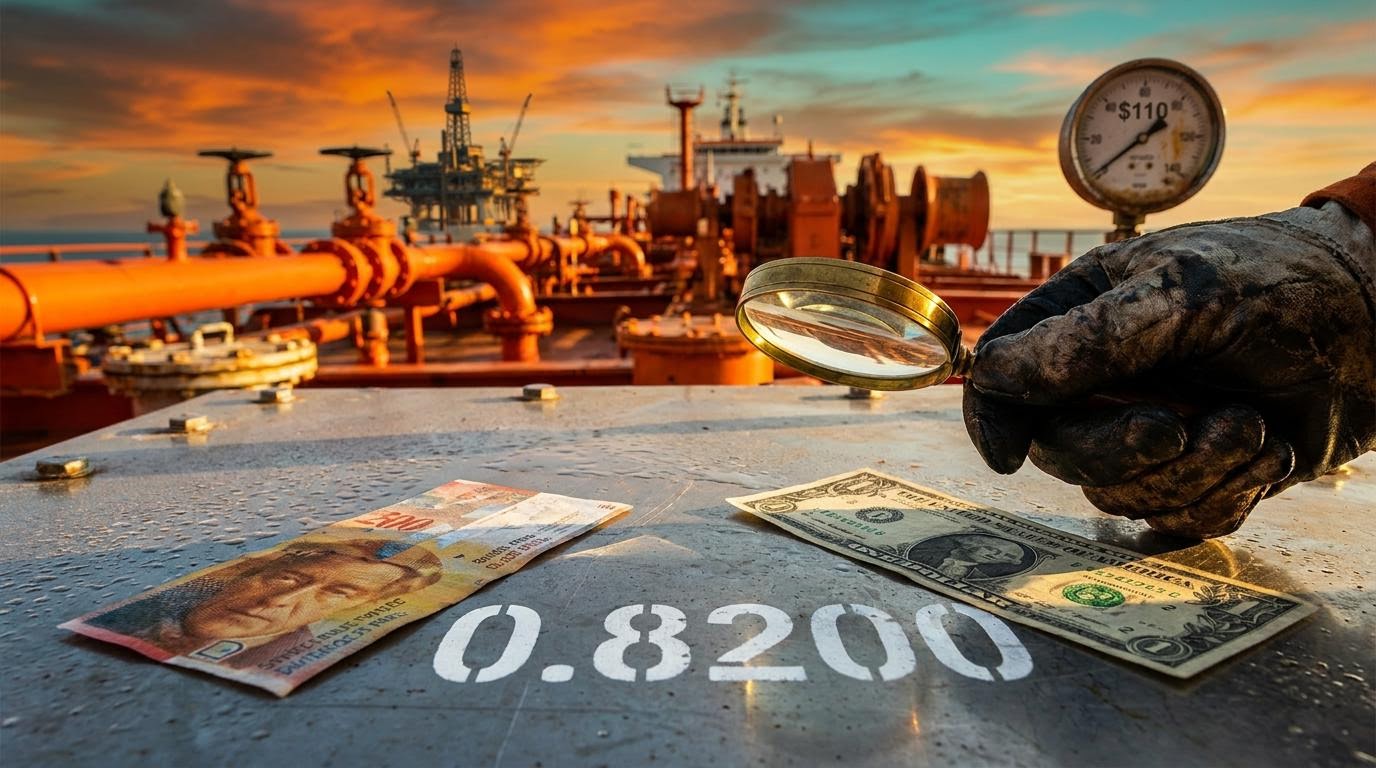
Two pressures sit behind the move. Brent crude is trading above $110 a barrel on fears over the Strait of Hormuz and attacks on Saudi oil facilities. In France, the 10-year government bond yield touched 5.14% on Thursday before easing to around 5.07% today.
These forces pull the franc in opposite directions. Oil hurts Switzerland, while French debt stress tends to send European money into Swiss assets.
Here is how to read those macro drivers alongside the chart, including why 0.8200 has become the level that every analyst’s map depends on.
Why is USD/CHF rising when Treasury yields are falling?
The contradiction is real. USD/CHF traded near 0.8242 on Friday after a Thursday high of 0.8247, rebounding from support around 0.8200. Over the same period, US Treasury yields moved lower. The research did not confirm the precise size of that move, only its direction.
If yields drove the pair, it should have fallen. It rose instead, which points to a different engine: relative safe-haven demand. A safe-haven currency is one that investors buy when they want to protect their money during market stress.
The oil channel
Brent climbed to a five-month high on Friday, trading around $113-$114.40, according to FXStreet. Reuters had it at $110.11 on 21 October. Shipping data firm Kpler counted at least 18 attacks on vessels over two weeks and put Hormuz flows at about 9.4 million barrels per day, roughly 70% of pre-war levels.
That hurts Switzerland. The country imports its energy, so expensive oil erodes its terms of trade, which is the price of what a country sells abroad compared with what it buys. The US exports energy and is far less exposed.
The liquidity channel
The dollar is a crisis currency in its own right. Here is how the pair can climb while yields drop:
- Investors buy dollars for liquidity, meaning cash they can move quickly in deep markets.
- The same investors buy Treasuries as a haven, which pushes yields down.
- Switzerland’s energy dependence dents the franc’s appeal relative to the dollar.
- The Swiss National Bank’s (SNB) 0% policy rate encourages traders to borrow in francs to fund other positions, which adds steady selling pressure.
The ECB’s risk-off finding European Central Bank research published on 2 June 2026 found that in global risk-off episodes, both the dollar and the franc typically gain while Treasury yields fall. The franc’s average gain is about 0.7%, against roughly 0.1% for the euro.
What this tells you is that in an energy-led shock, a falling US yield is not a bearish signal for USD/CHF. A model built on yields alone could point you the wrong way. Oil prices, liquidity stress and relative haven flows are better variables to watch.
Earlier this month, falling Treasury yields and a retreat from risk handed the franc broad gains even after hotter US inflation data, showing how quickly haven flows can override the data.
When big ASX news breaks, our subscribers know first
How oil, French debt stress and the franc’s haven status pull in different directions
If oil explains the dollar’s edge, France explains why the franc has not simply collapsed. The franc earned its haven status over decades through political stability, low inflation and a large current account surplus. When Europe wobbles, money tends to flow into Swiss assets.
The franc’s haven status rests on deep FX turnover, large SNB reserves and a strong correlation with the euro, which is why it hedges European stress better than it hedges broad global shocks.
France is wobbling. Reuters reported the 10-year OAT (French government bond) yield at 5.002% on 21 October, the highest since July 2002. It reached 5.14% on Thursday before easing to around 5.07-5.08% today. The gap over German yields neared 180 basis points, the widest since 2011-12. A basis point is one-hundredth of a percentage point.
The causes are a large deficit, a weakened government struggling to pass a budget, uncertainty before a contested election, and widespread protests. The franc has gained more than 2% against the euro this month. ING’s Francesco Pesole described EUR/CHF as a historically clean hedge for euro-area fiscal risk.
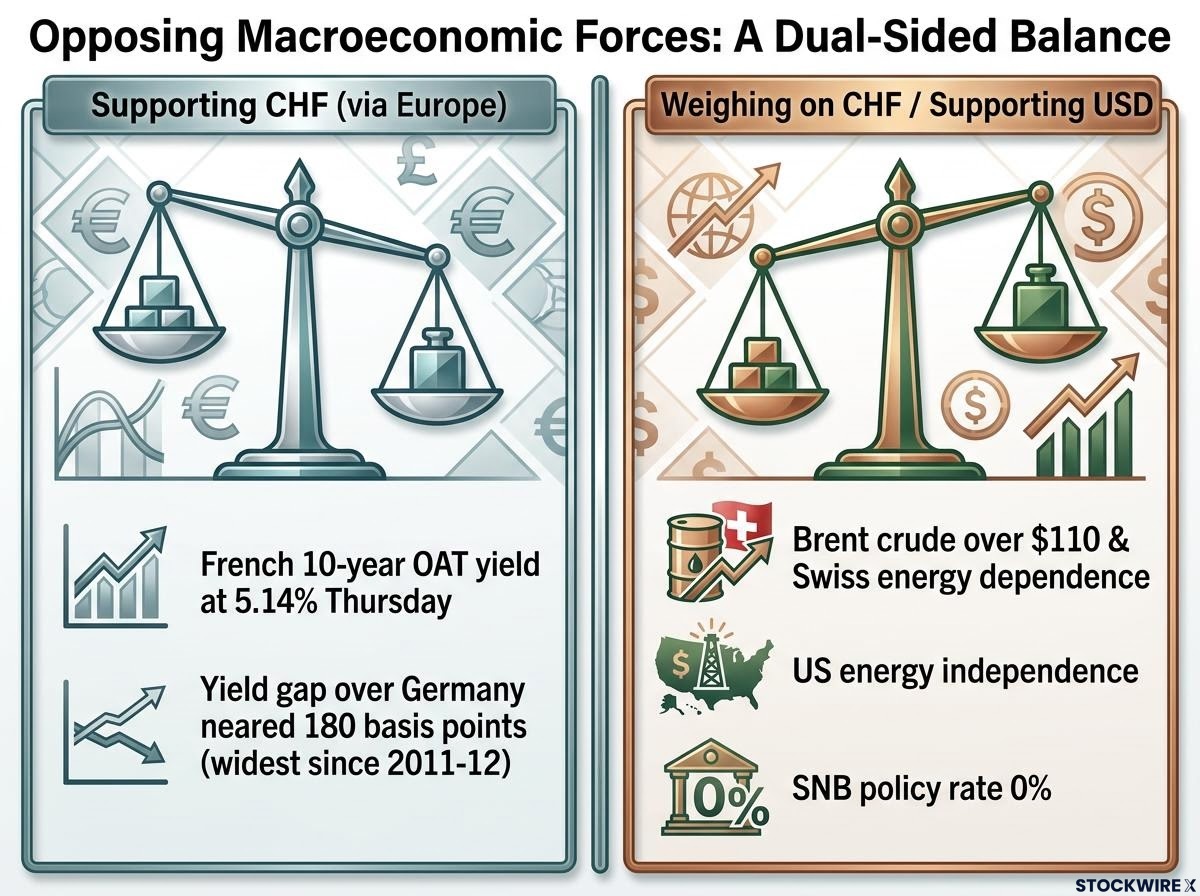
| Channel | Likely effect on CHF |
|---|---|
| Global risk aversion | Supports CHF |
| Swiss energy dependence | Weighs on CHF |
| French fiscal stress | Supports CHF against EUR |
| US energy independence and dollar liquidity | Can support USD against CHF |
| Imported Swiss inflation | May eventually lead the SNB to tolerate a firmer franc, but gives no immediate lift |
What history says
Haven status has never guaranteed gains against the dollar:
- 2022: The energy shock pushed the Fed into aggressive tightening. USD/CHF traded near parity and at times reached about 1.02.
- 2010-12: Euro-area sovereign stress sent the franc sharply higher against the euro, not necessarily against the dollar.
Société Générale’s Kit Juckes argued that the franc’s funding-currency role can produce gradual weakness punctuated by sharp rebounds during stress. For you, the lesson is clear. French turmoil is best expressed through EUR/CHF, not assumed to lift the franc against the dollar.
What do the USD/CHF levels say? A technical read of support and resistance
The macro story gives the pair a direction. The chart shows where that story would be confirmed or rejected.
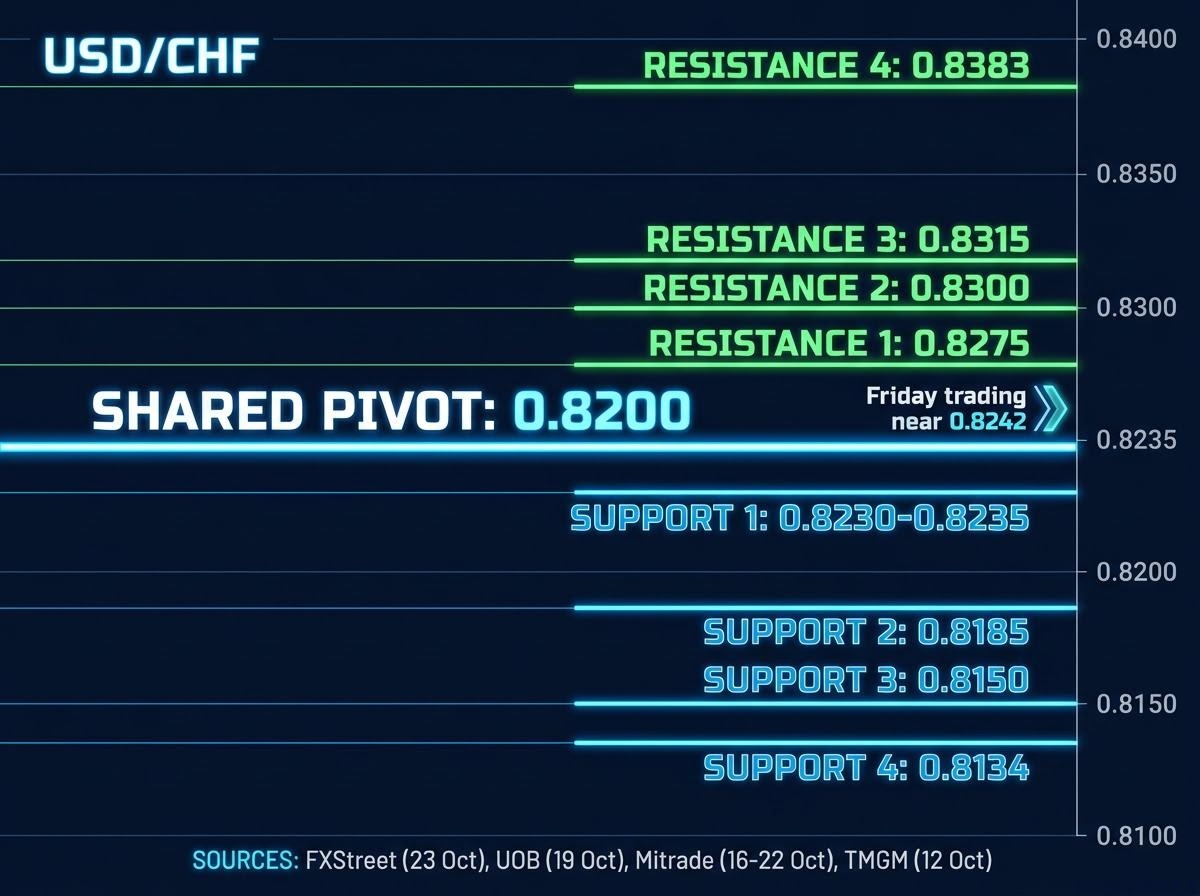
The shared pivot Every source reviewed treats 0.8200 as the level that defines the near-term structure for USD/CHF.
Near-term levels
FXStreet’s Friday analysis, produced with the help of an AI tool, reads the bias as modestly bullish. Holding above 0.8230 shifts focus to the weekly highs at 0.8275, then about 0.8315. Below that, support sits near 0.8185, then 0.8150.
Momentum has steadied. The 4-hour Relative Strength Index (RSI), a gauge of buying and selling pressure from 0 to 100, has returned near 50. The MACD, an indicator that tracks shifts in trend momentum, has turned positive.
Mitrade flagged 0.8230-0.8235 as a near-term pivot, where a 38.2% Fibonacci retracement (a level measuring how much of a prior move has reversed) meets the 200-period moving average. Below 0.8200, its next marker is the 50- and 100-day averages near 0.8134.
| Source | Support | Resistance | Interpretation |
|---|---|---|---|
| FXStreet, 23 October | 0.8185, then 0.8150 | 0.8275, then 0.8315 | Modestly bullish while above 0.8230 |
| UOB, 19 October | 0.8200 | 0.8300 | Bearish over one to three weeks; range 0.8220-0.8270 |
| Mitrade, 16-22 October | 0.8230-0.8235, 0.8200, then 0.8134 | Not specified | 0.8200 is psychological and trend support |
| TMGM, 12 October | 0.8200 | 0.8383 | Break above the 1 October high improves bullish structure |
Where the sources disagree
UOB’s bearish call came on 19 October, before oil’s latest leg higher. FXStreet’s bullish read came today. The gap reflects timing more than conflicting logic.
The SNB adds context. It said the franc had fallen about 3% on a trade-weighted basis since June and that heightened intervention readiness was no longer necessary.
The SNB’s move away from heightened intervention readiness reflects a bank that fights franc strength mainly through foreign-exchange purchases, and that avoids announcing targets so speculators have no fixed level to attack.
Treat these levels as a map, not a prediction. A close above 0.8275-0.8300 would tell you oil-driven dollar demand is overpowering franc haven demand. A clean break below 0.8200, towards 0.8130-0.8100, would restore the franc-supportive scenario.
What could break the rebound? Risks to a bullish USD/CHF view
The momentum case rests on one condition: the oil headline staying hot. Several events could remove that support, ranked here by how directly they would hit the oil premium or franc demand.
- Hormuz de-escalation or a ceasefire. This would cut the oil-risk premium and remove the dollar’s main edge.
- Oil-supply normalisation. Reuters reported on 4 October that the G7 had decided to tap strategic reserves and that Saudi exports might be recovering.
- Faster Fed easing expectations. These could reassert the US rate disadvantage and drag the pair lower.
- French political resolution. A budget deal or calmer streets could narrow the OAT-Bund spread and reduce haven buying.
- SNB intervention. Currency purchases or verbal warnings would limit franc strength.
- Negative-rate speculation. The 0% rate leaves room for such talk if the franc surges, although no current SNB decision points that way.
The first risk carries a twist.
The delayed-effect warning Société Générale’s Kit Juckes said an end to the conflict would initially support risk appetite and might not help the franc straight away. Over time, though, lower oil and a softer dollar could turn franc-positive.
That timing matters for you. A ceasefire headline may not knock USD/CHF lower on the day, so an early reaction could be misleading. The real test may come weeks later.
These scenarios are speculative and depend on geopolitical and policy developments. Past performance does not guarantee future results.
Reading the USD/CHF outlook: what to watch and what would change the view
The rebound is a relative haven trade, driven by oil, dollar liquidity and Switzerland’s energy exposure. It does not signal that US yields must rise, and reading it that way risks a mistimed call.
The decision points are straightforward. 0.8200 is the pivot. A move through 0.8275-0.8300 would extend the rebound, while a clean break lower would hand control back to the franc.
Three variables will tell you which way the balance tips:
- Hormuz and Brent headlines
- The direction of the French-German spread
- SNB or Fed signals on intervention and rates
Keep these alongside the price levels and you will hold a view with clear invalidation points, rather than a one-way bet.
This article is for informational purposes only and should not be considered financial advice. Investors should conduct their own research and consult with financial professionals before making investment decisions.