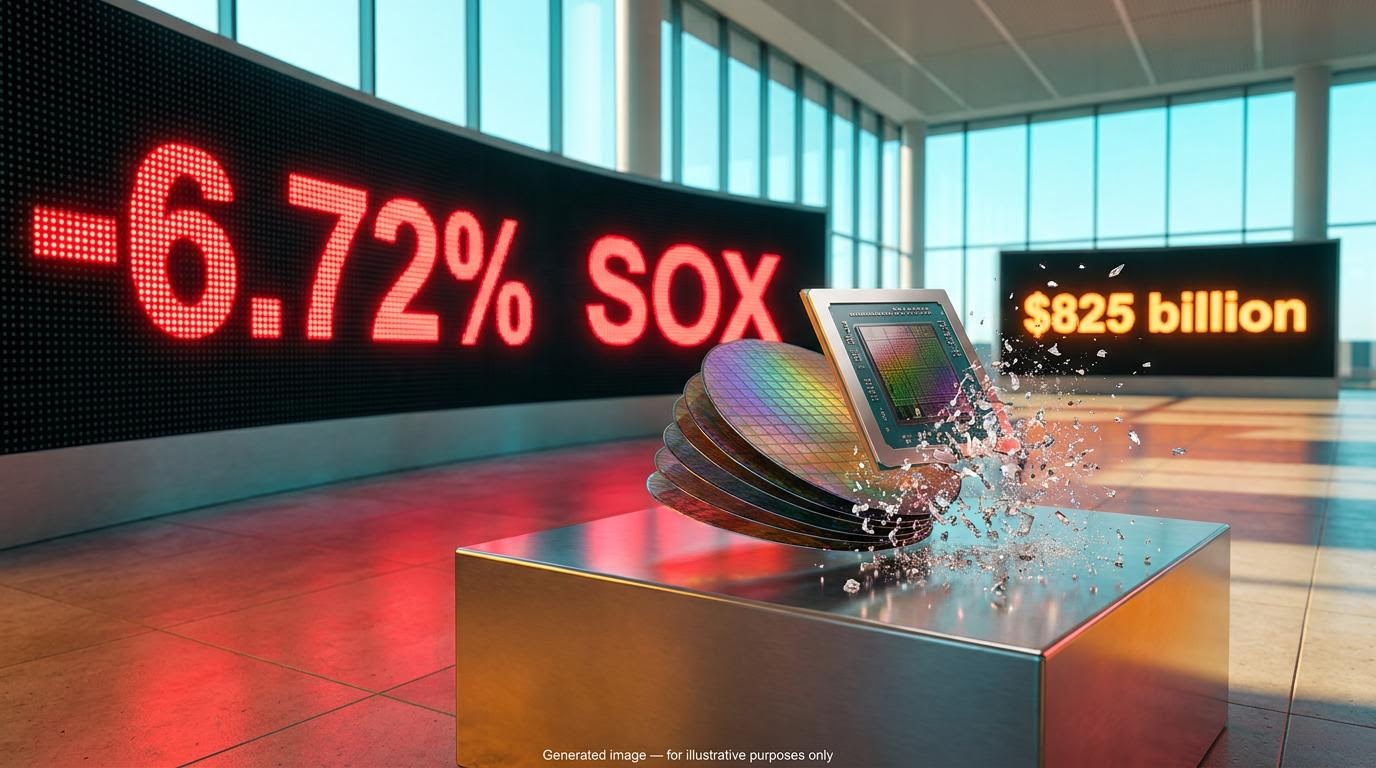
The Philadelphia Semiconductor Index (SOX) fell 6.72% on Thursday, 22 October 2026, its worst session since June. At the same time, the 10-year Treasury yield slid to a roughly one-month low as money left chip stocks for government bonds and the AI bubble debate moved back to the centre of the market.
The trigger came from Meta Platforms. The company lifted the low end of its 2026 capital expenditure range to $135 billion and disclosed about $825 billion of lease and contractual commitments. Capital expenditure, or capex, is money spent on physical assets such as data centres and chips. A growth story became a question about who pays for AI infrastructure.
Friday’s futures were mixed, so neither side has a clear verdict yet. Here is how to separate a positioning pullback from a structural shift, and which variables decide the outcome.
Where the damage landed: chips, CoreWeave and a bond market bid
The selling was fast and concentrated in one corner of the market. According to Deutsche Bank analysts, renewed worries about AI-driven growth wiped out the optimism built earlier in the week.
| Asset | Close or level | Move |
|---|---|---|
| SOX | 10,731.98 | Down 6.72% |
| Nasdaq Composite | 26,008.86 | Down 694.00 points (2.60%) |
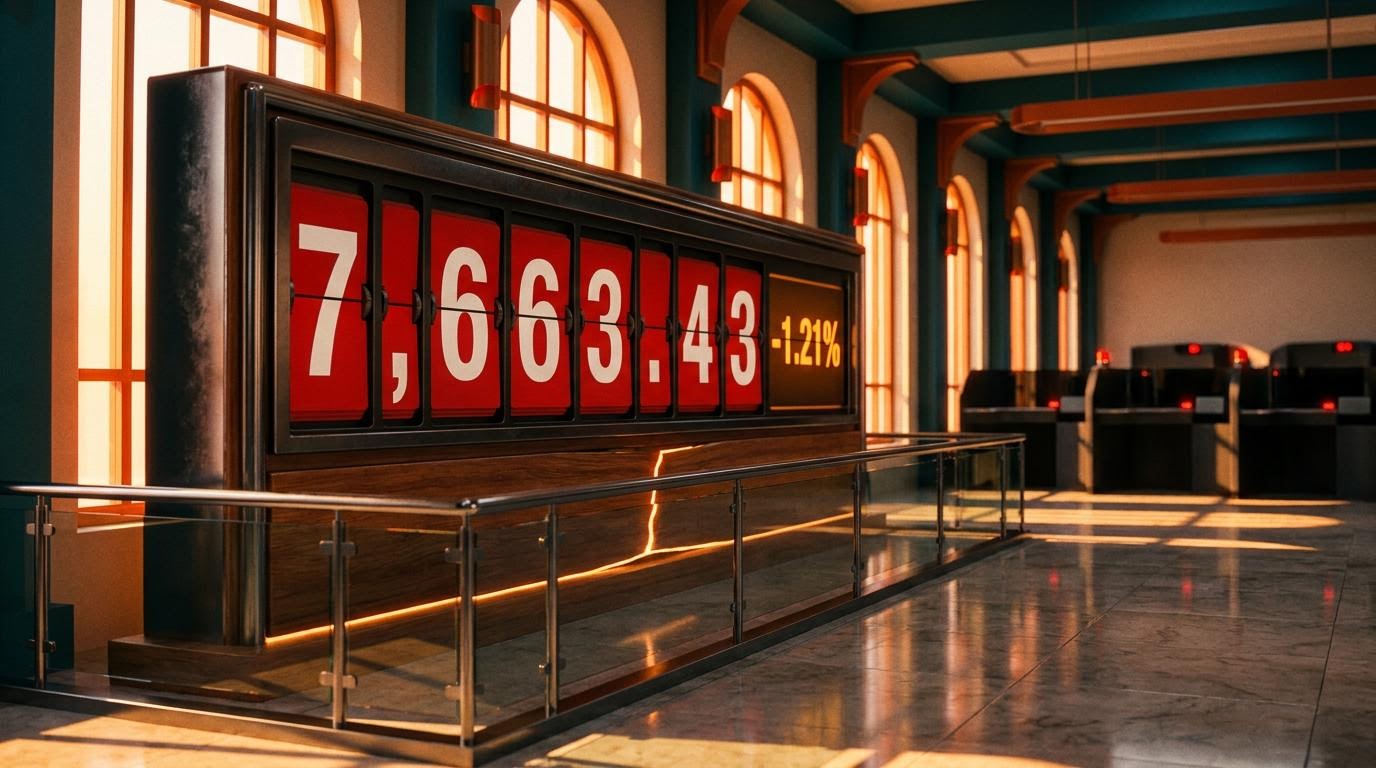
| S&P 500 | 7,663.43 | Down 1.21% |
| Dow | Not available | Up 0.02% |
| Nvidia / AMD / Micron | Not available | Down 4.4% / 8.1% / 6.3% |
| CoreWeave | Lowest since May 2025 | Down 10.06% |
Western Digital also ranked among the leading decliners. CoreWeave, the debt-heavy cloud provider, sent the sharpest signal of credit stress.
The Dow barely moved. That tells you this was an unwind of one specific trade, so it is worth checking how much of your portfolio, including index funds, rides on the same AI bet.
Bonds caught the bid. The 10-year yield fell more than 10 basis points to close near 4.965%, with rising Middle East tensions adding to the safe-haven demand. A basis point is one hundredth of a percentage point.
The FOMC September minutes, published on 7 October, noted that the AI buildout was adding to cost pressures, which helps explain why bond investors treat heavy infrastructure spending as an inflation and financing question as well as a growth story.
Friday’s futures: no clear verdict
- 1:48 a.m. EDT (TipRanks): Nasdaq-100 up 0.05%, S&P 500 down 0.11%, Dow down 0.29%
- Later (Investing.com via Yahoo Finance): all three broadly flat
- European hours (FXStreet): Dow down 0.37%, S&P 500 down 0.07%, Nasdaq 100 up 0.16%
The yield bounced to about 4.98%. There is no confirmed rebound and no follow-through either.
When big ASX news breaks, our subscribers know first
Why Meta’s disclosure turned into a financing scare
The figure that rattled investors was $825 billion, up from about $700 billion. Meta’s capex range now sits at $135-145 billion, and its shares fell about 8%, according to Reuters, the steepest one-day drop since July.
Meta also approved a new Class C non-voting share class, which the company said could eventually support hundreds of billions of dollars in financing. In effect, that opens a door to raising money by issuing shares.
Record credit stress Meta’s five-year credit default swap spread, the annual cost of insuring its debt against default, widened to a record 114.79 basis points.
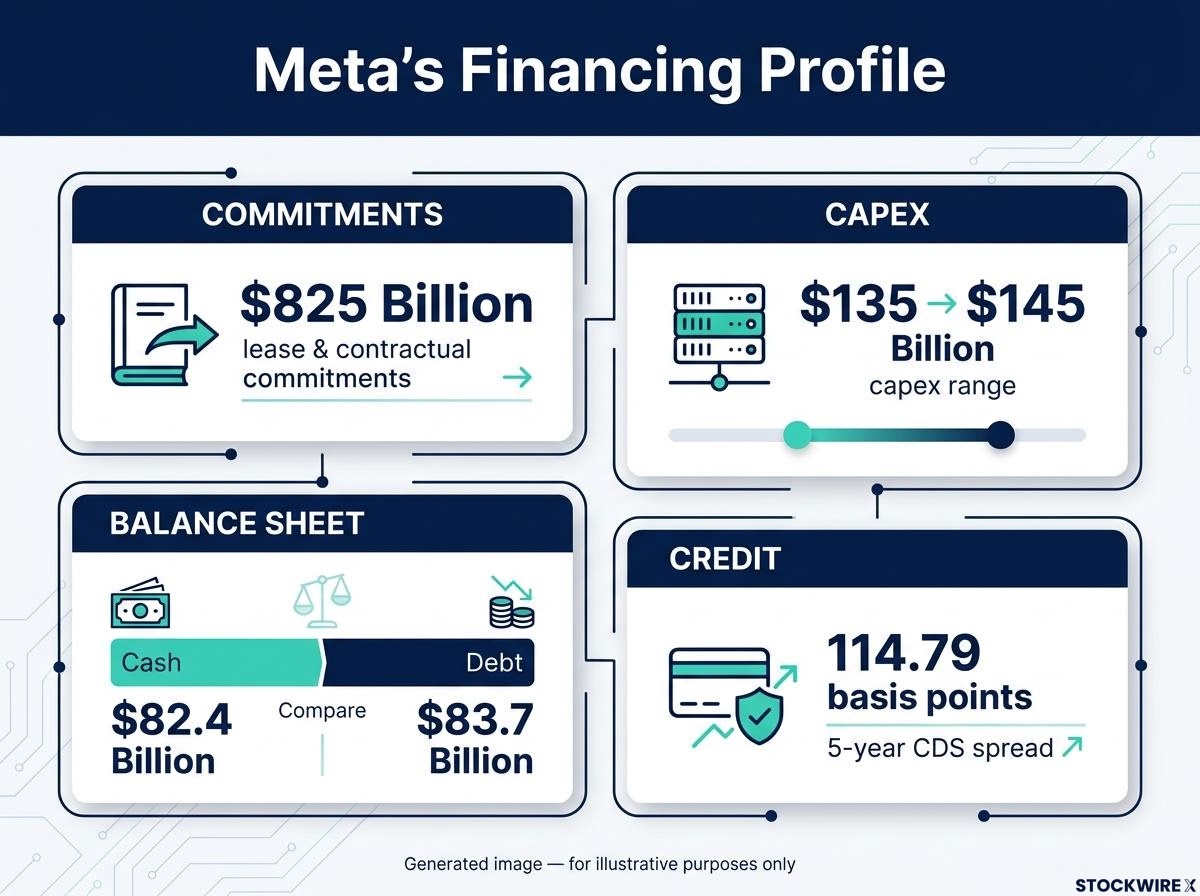
Meta held about $82.4 billion in cash and marketable securities against $83.7 billion of debt. One balance sheet had become a proxy for how the whole sector funds itself.
Meta’s capex of $34.91 billion outran its operating cash flow of $32.79 billion, leaving negative free cash flow where a year earlier it was positive, which explains why a revenue beat could not protect the share price.
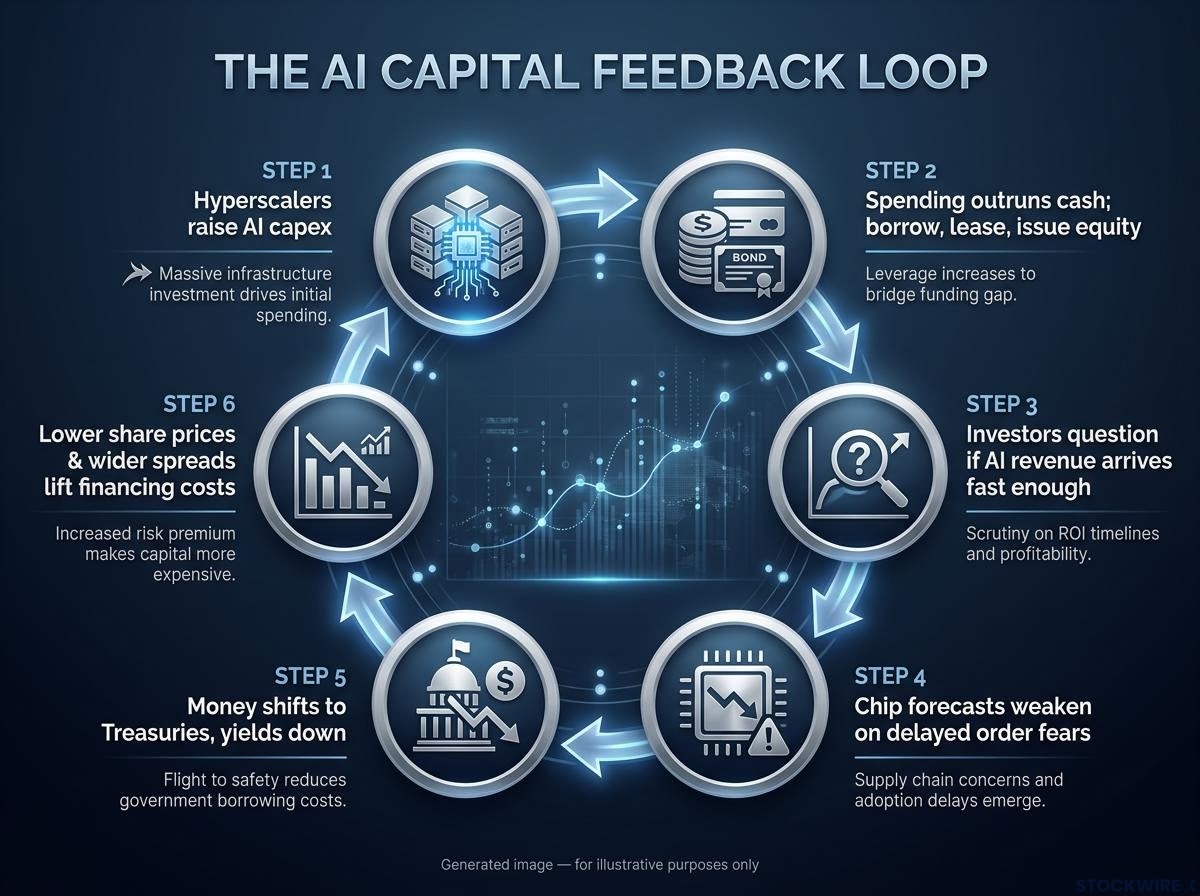
The chain from capex to Treasuries
- Hyperscalers, the largest cloud operators, raise AI capex.
- Spending outruns internal cash, so they borrow, lease or issue equity.
- Investors question whether AI revenue arrives fast enough to service the debt.
- Chip forecasts weaken on fears of delayed orders, even with strong current results.
- Money shifts into Treasuries, pushing yields down.
- Lower share prices and wider spreads lift financing costs, feeding the loop.
Oracle, Alphabet, Amazon and Meta have issued more than $228 billion of bonds in 2026, about 10% of the global investment-grade market, CNBC reported on 19 October. CoreWeave carries about $50 billion of debt, and its 2031 bonds yield near 15%. It is far riskier than cash-rich hyperscalers, so its stress should not be generalised to Meta, Microsoft, Alphabet or Amazon.
The question for any AI-linked holding is no longer “is AI real?” It is “who funds it, and at what price?”
What the AI bubble debate looks like after Thursday
Strategists split on how deep this goes
- Deutsche Bank: Henry Allen called the selloff relatively contained, with no broad spread to Europe or the global economy.
- JPMorgan: Nikolaos Panigirtzoglou warned of a slower rebound than July’s, citing weaker dip-buying, smaller buybacks, less short positioning and more leveraged ETF assets.
- Goldman Sachs: Prime-brokerage data showed unusually severe losses at long-short funds, tied to payoff doubts alongside elevated inflation and borrowing costs.
- Morningstar: The tests are earnings conversion, enterprise adoption and consumer monetisation.
Stanley Druckenmiller has framed the risk differently. He has argued that bubbles do not end after six months and that an AI bubble could run at least two and a half years, as the DotCom era did. He holds Palantir and Nvidia.
Druckenmiller’s thesis AI can create extraordinary economic value without rewarding every investor who finances the expansion.
That is a risk thesis, not evidence that demand has disappeared.
How the valuations compare with DotCom
Nvidia trades at about 25 times forward earnings and about 17.1 times trailing sales. The Nasdaq 100 traded near 60 times earnings at the DotCom peak, against about 25 times in mid-2023.
| View | Main argument | Caveat |
|---|---|---|
| Productivity revolution | Real cloud usage and revenue growth support demand | Real value does not guarantee every investor a return |
| Earnings and financing bubble | Commitments and financing costs outrun proven returns | A risk thesis, not proof of collapsing demand |
| DotCom or telecom parallel | Useful capacity, poor returns for early financiers | Leaders have far larger profits than DotCom entrants |
| Positioning correction | No broad global contagion | JPMorgan sees weaker dip-buying |
Nvidia’s earnings multiple sits far below DotCom extremes, but its sales multiple stays demanding. Treat this as an expectations and capital-cycle risk, not a mechanical repeat of 2000.
Pullback or regime change? The test cases from past AI scares
History offers some comfort. On 27 January 2025, news of China’s low-cost DeepSeek model knocked Nvidia and related stocks down as much as about 20%. Most later recovered.
The July 2026 selloff also reversed. JPMorgan uses it as the comparison point, and that is where the comfort ends.
The dip-buyers are thinner this time, buybacks have faded, and leverage is higher. The risks are also more concrete: overbuilding, falling hardware prices, model commoditisation, slower monetisation, customer concentration, power constraints, refinancing costs and dilution. The best reading is a sharp, financing-led correction with structural potential, not proof AI has failed.
What would change the picture
- Hyperscaler cash flow: whether guidance shows spending funded by operations rather than new debt
- AI monetisation: whether revenue from AI products keeps pace with capex
- Semiconductor order durability: whether chipmakers report delayed or cancelled orders
Credit spreads and CoreWeave’s bond yields offer the earliest read. Past recoveries do not guarantee this one, so check the cash-flow and order data before assuming the same outcome.
Readers weighing chip order risk can use our deep-dive into Truist’s semiconductor cycle research, which explains why chip stocks have typically peaked after revenue growth does.
Past performance does not guarantee future results. Forward-looking views cited here are speculative and subject to change.
What the selloff settles, and what it leaves open
Thursday settled one thing: financing and the timing of returns now move AI stocks as much as demand does. Friday’s flat futures show the market has not yet decided whether that is a temporary scare or a lasting reset.
The evidence points to a sharp correction with structural potential, neither a replay of 2000 nor proof that AI has failed. The signals to track are Meta’s and its peers’ next financing moves, CoreWeave’s bond yields and chipmakers’ order commentary. Those will show which way the debate breaks before any position change makes sense.
This article is for informational purposes only and should not be considered financial advice. Investors should conduct their own research and consult with financial professionals before making investment decisions.