A confidence vote that passes 280 to 58 usually reads as a clean win. Yet a day after Romania’s parliament backed its new government on 20 October, the 10-year yield on Romania government bonds still sits near 7.1%, and all three major rating agencies keep negative outlooks on the country. The market is relieved, but the problem it was worried about has not been resolved.
Yesterday’s vote ended roughly five months of deadlock and installed a minority government under Prime Minister Luca Niculescu. Romania’s credit standing remains thin. Moody’s rates the country Baa3, one notch above junk (sub-investment grade).
The clock is already running. The 2027 budget is expected by 31 December 2026, and the rating agencies have made clear that this deadline matters more to them than the vote did.
Here is what the market is actually pricing, which indicators decide whether Romanian debt keeps its investment-grade status, and the signposts worth tracking between now and year-end.
Why a government that survived its vote is still a fragile one
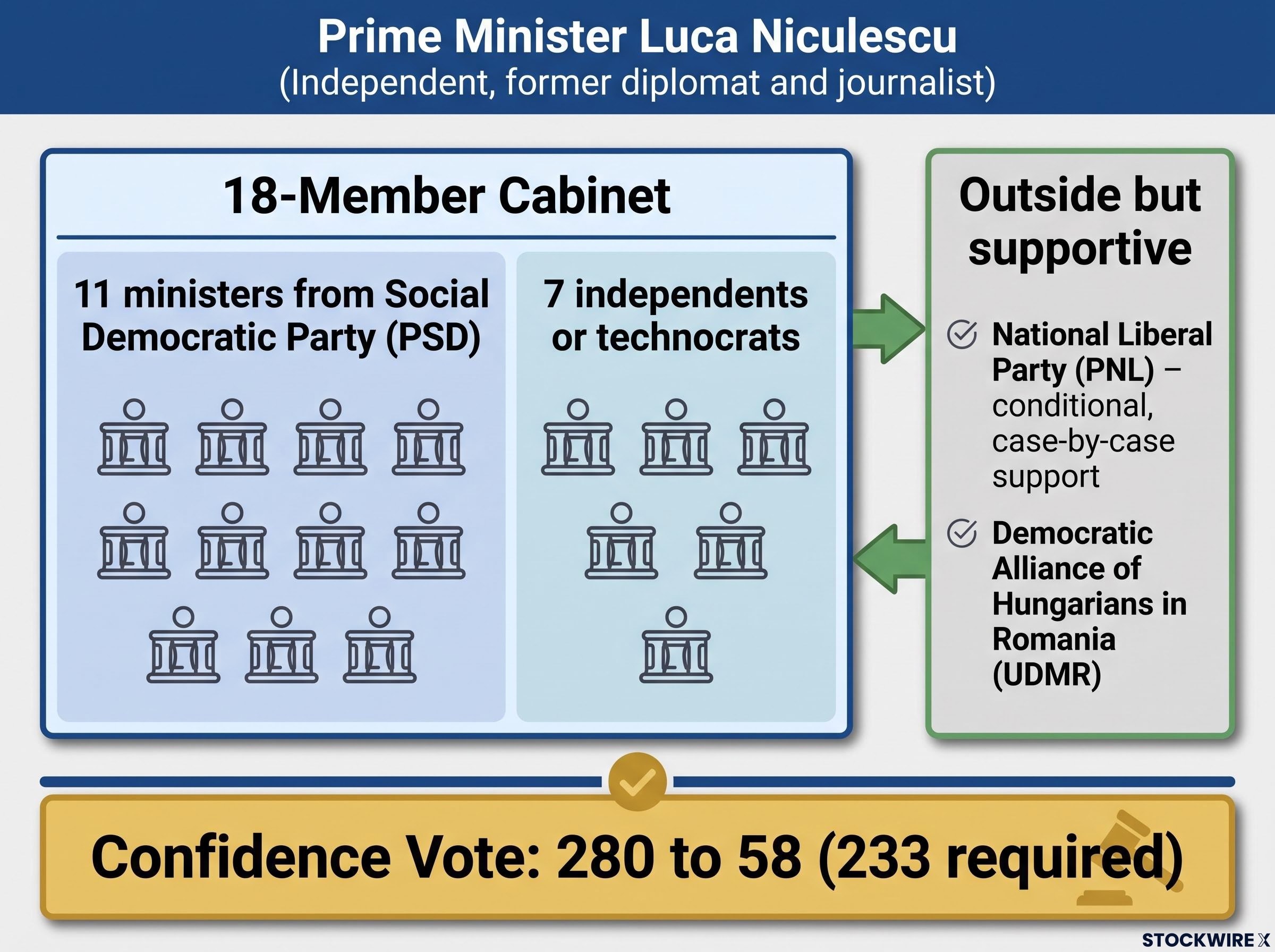
280 votes, against the 233 required. On the surface, Niculescu has a margin of 47 to spare and a parliament willing to give him a chance.
The margin hides how the support was assembled. Niculescu is an independent, a former diplomat and journalist. He replaces the National Liberal Party (PNL) government of Ilie Bolojan, which was dismissed on 5 May 2026. His 18-member cabinet is not a coalition in the usual sense.
Who holds the leverage
The structure splits the parties into those inside the cabinet and those holding leverage from outside it:
- Inside the cabinet: 11 ministers from the Social Democratic Party (PSD) and seven independents or technocrats
- Outside but supportive: the PNL and the Democratic Alliance of Hungarians in Romania (UDMR), which backed the investiture without taking ministries
- Conditional: PNL support is offered case by case, described as a “vote of necessity”
- Smaller additional support: national-minority MPs and the United for Romania group
That conditional PNL backing is the weakest joint in the frame. A party that votes bill by bill can withdraw support on the exact measures it dislikes most. Strategists at Societe Generale described the stability as delicate and dependent on PNL and UDMR.
Shared policy is not what binds these parties. Fear binds them: fear of snap elections and of gains by the populist Alliance for the Union of Romanians (AUR).
POLITICO, 20 October: The arrangement amounts to a six-month truce while longer-term terms are negotiated, not a settled coalition.
For you, the read is straightforward. This government can likely pass routine legislation, but it may struggle once austerity measures start to hurt. That pressure point arrives with the budget.
Romania is not alone in facing a budget test under a minority government; France’s 2027 budget faces a similar risk of rollover, and analysts there warn it could leave the deficit near 6.0% of GDP.
When big ASX news breaks, our subscribers know first
What does Moody’s Baa3 negative outlook actually mean for Romania?
Baa3 is Moody’s lowest investment-grade rating. One step lower and Romania’s debt would be classed as speculative, widely called junk. A negative outlook signals that the agency’s next move is more likely to be a downgrade than an upgrade unless conditions improve.
Romania carries that combination at all three agencies, and each one is watching for something specific.
| Agency | Rating | Outlook | Latest action | Key condition |
|---|---|---|---|---|
| Moody’s | Baa3 | Negative | Affirmed August 2026 | 2027 budget passed before 31 December and implemented |
| S&P Global | BBB- | Negative | Affirmed 2 October 2026 | A credible 2027-28 budget framework |
| Fitch | BBB- | Negative | Retained in latest reported review | Continued progress on fiscal consolidation |
Moody’s called the government’s formation positive, but it named timely passage and implementation of the budget as the decisive test. It said adoption before year-end is necessary to avoid rating risk. The agency projects the deficit, measured under the European System of Accounts (ESA), the EU’s standard accounting method, falling from 7.9% of GDP in 2025 to 5.8% in 2026 and 5.5% in 2027.
S&P’s baseline already assumed Romania would form a government able to adopt a credible 2027-28 framework. In other words, the vote only met expectations that were already built into its rating. A prolonged process or a failed framework could trigger further pressure.
The S&P affirmation of Romania at BBB- with a negative outlook rests on elevated implementation risks for fiscal consolidation, which is why a government with a credible policy framework matters more to the agency than the size of any single parliamentary majority.
With negative outlooks everywhere, Romania has no ratings cushion. Treat any slippage in the budget timetable as a direct threat to investment-grade status, not a technical delay.
What a junk downgrade would trigger
Losing investment grade would set off a chain of consequences. Funds whose mandates allow only investment-grade debt may be forced to sell. Romania could lose eligibility for investment-grade bond indices, which would reduce demand from passive funds.
Auctions would likely need bigger concessions to attract buyers, and spreads would widen. Higher funding costs would then worsen the very deficit the agencies are watching. ING warned that losing investment grade would likely renew pressure on both the leu and the bonds.
The fiscal arithmetic behind the rating risk
The deficit numbers show both progress and fragility. Romania cut its shortfall from 9.3% of GDP in 2024 to 7.9% in 2025, a real improvement that still leaves the gap far above the EU’s 3% reference value.
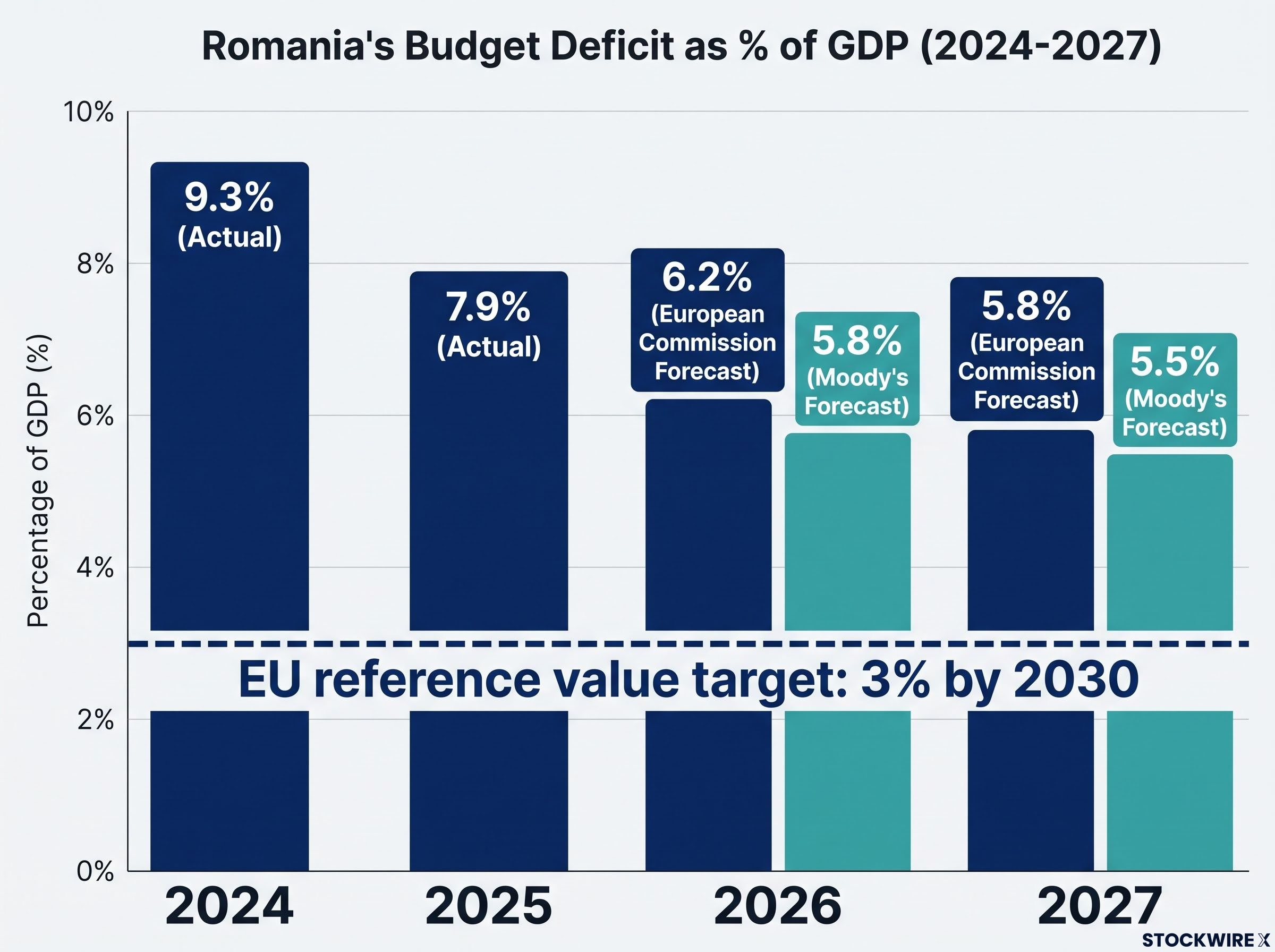
| Year | Actual or forecast | Commission | Moody’s |
|---|---|---|---|
| 2024 | Actual | 9.3% | 9.3% |
| 2025 | Actual | 7.9% | 7.9% |
| 2026 | Forecast | 6.2% | 5.8% |
| 2027 | Forecast | 5.8% | 5.5% |
The European Commission‘s Spring 2026 figures form the official policy baseline, while Moody’s numbers are the agency’s own forecast. The gap between them tells you the consolidation path is credible on paper but sensitive to assumptions. Small revenue shortfalls could matter more than their size suggests.
Romania is under the EU’s excessive deficit procedure (EDP), the process Brussels uses to push member states with oversized deficits back below 3%. Under a plan approved in early 2025, Romania aims to get there by 2030. The plan caps net-expenditure growth at 2.8% in 2025, 2.6% in 2026, 4.6% in 2027, 4.4% in 2028, 4.2% in 2029 and 4.0% in 2030.
The country’s structural weaknesses make those caps hard to meet: high financing needs, rising interest costs, and twin deficits on both the budget and the external account. The PSD wants a budget plan ready by 1 December without extra tax increases, which narrows the options.
Political delay can turn into higher yields through six steps:
- Political fragility slows decisions.
- The budget is delayed or diluted.
- The borrowing requirement grows.
- More bond supply lifts the risk premium.
- Higher yields raise debt-service costs.
- The deficit widens, inviting further rating pressure.
That chain is why the budget is a market event. It sets bond supply and risk premia, and it decides whether the deficit path stays on track.
What Romania government bonds and the leu are pricing right now
Trading Economics put the 10-year yield at 7.14% on 21 October, while other reporting cited about 7.12%. Either way, the yield sits close to 7.1%. The euro buys about 5.33 leu, a figure from a single source, after the pair held below 5.35 during the 9-19 October rally.
Because bond yields move inversely to price, a Romanian 10-year yield near 7.1% reflects what buyers demand to hold the debt; the reason behind any rise matters as much as its direction.
The path to these levels was volatile. Reuters reported on 1 October that yields had climbed 60-80 basis points (hundredths of a percentage point) in two weeks to one-year highs. After S&P’s affirmation, Bloomberg reported the yield falling 12 basis points to 7.24%, with the Finance Ministry raising more than planned at auction.
Societe Generale linked EUR/RON below 5.35 and yields below 7.10% to hopes of ending the deadlock. The question is whether that move reflects confidence or simply relief.
The optimistic case:
- EU-fund inflows support the fiscal profile, which ING cites as a reason for no immediate rating change
- Fear of snap elections keeps the mainstream parties aligned
- S&P’s affirmation suggests the risk of an immediate downgrade has receded
- The deficit is already falling
The sceptical case:
- The rally may reflect relief rather than durable confidence
- PNL support is conditional and case by case
- Austerity could weigh on growth
- The six-month truce and negative outlooks leave core risks unresolved
Reuters: The central question is whether the government can deliver credible fiscal adjustment, not whether it can survive a confidence vote.
A yield near 7.1% still carries a substantial risk premium. The market is paying you to carry political and rating risk, not pricing that risk away.
What to watch before 31 December
- 1 December budget plan: a credible draft would be a pass; a delay or a plan reliant on optimistic revenue would be a deterioration.
- PNL voting behaviour: consistent support on fiscal measures is reassuring, while abstentions on key bills would be an early warning.
- EUR/RON and the 10-year yield: holding below 5.35 and around 7.10% suggests calm; a break higher would signal renewed stress.
- Agency commentary: any Moody’s or S&P remarks on the budget timetable.
What a December budget pass would settle, and what it would leave open
The confidence vote removed formation risk. Sovereign-credit risk now depends on budget delivery and on whether the PSD, PNL and UDMR hold together through austerity.
A budget passed on time would ease the immediate downgrade pressure and give the Finance Ministry visibility on financing. It would not settle implementation through 2027, the expiry of the six-month truce, or the negative outlooks at all three agencies.
If you follow Romanian debt, the decision points are clear. Watch the 1 December draft, how PNL votes on fiscal bills, EUR/RON against 5.35 and the 10-year yield against 7.10%. A slipped timetable or a defecting partner would change the view faster than any headline vote count.
Investors exploring how sovereign risk is being repriced across Europe will find our detailed coverage of the ECB’s French debt warning, which shows how spreads inverted the usual eurozone hierarchy.
This article is for informational purposes only and should not be considered financial advice. Investors should conduct their own research and consult with financial professionals before making investment decisions. Past performance does not guarantee future results. Financial projections are subject to market conditions and various risk factors.