
Microsoft has reportedly walked away from its deal to anchor Nscale‘s planned 90 MW data centre at Loughton, Essex, according to The Telegraph. The report lands as Nscale tries to complete its IPO on the New York Stock Exchange at a valuation reported to be as high as $35 billion.
Microsoft has not commented publicly. The news also arrives two days after CoreWeave fell almost 12% in a single session, and nine days after Firmus pulled its ASX float.
Together, these events test one question: do headline contract values in AI infrastructure turn into powered, financed, operating sites?
Here is what the reported exit changes for Nscale’s listing, where the real risk sits in its contract book, and which signals matter when you judge any AI infrastructure float.
Why Microsoft’s reported exit matters more than one Essex site
Nscale’s defence came quickly. The company said it remains committed to Loughton and the UK, is exploring alternative power sources and other UK sites, and that the London-wide grid problem has no impact on its other contracts.
Nscale on Microsoft The company describes its relationship with Microsoft as “strong and long-term.”
That answers one question. It leaves the harder one open.
According to The Telegraph, UK Power Networks indicated enough grid capacity might not arrive until the early-to-mid 2030s. The paper gave no definite commercial reason for Microsoft’s exit beyond delays and power difficulties. The confirmed project facts:
- Planned capacity of 90 MW
- 23,000 Nvidia AI chips Microsoft had agreed to rent
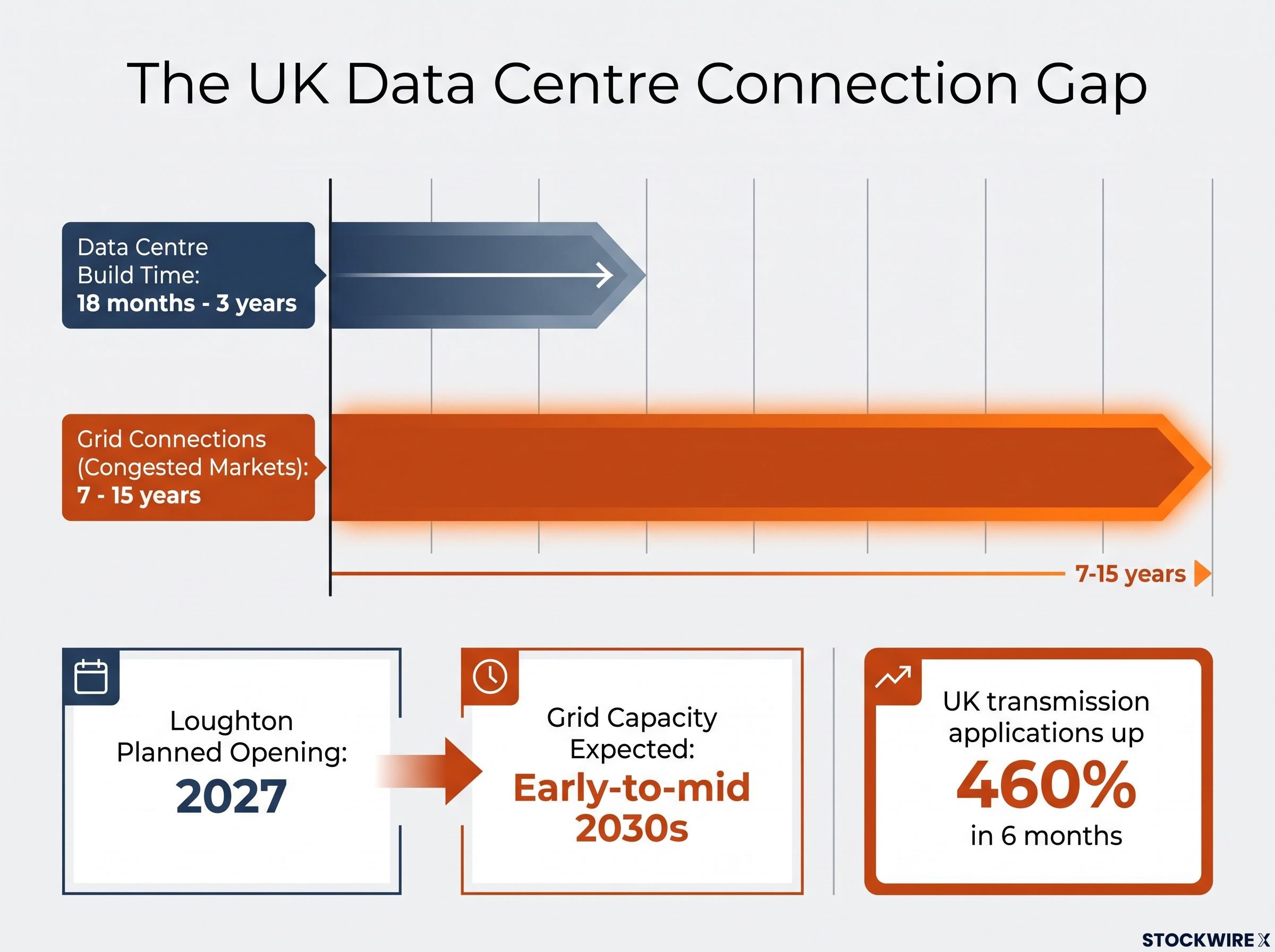
- Planned opening in 2027
- Grid capacity possibly not available until the early-to-mid 2030s
An anchor tenant is the main customer whose commitment helps a developer raise project finance and justify equipment purchases. Losing one while grid access is uncertain hits financing and timetable at once.
For you, the read is simple: Nscale’s reassurance covers whether Microsoft stays a customer elsewhere. It does not say whether this site will be energised on time, and that is what drives the financing.
When big ASX news breaks, our subscribers know first
What the Nscale IPO filing says about contract quality
Nscale filed its S-1, the US registration statement for a public offering, on 18 September, proposing an NYSE listing under ticker NSCL. It is reportedly seeking about $3 billion. The filing left the share count and price range blank, so both the raise and the valuation remain reported targets.
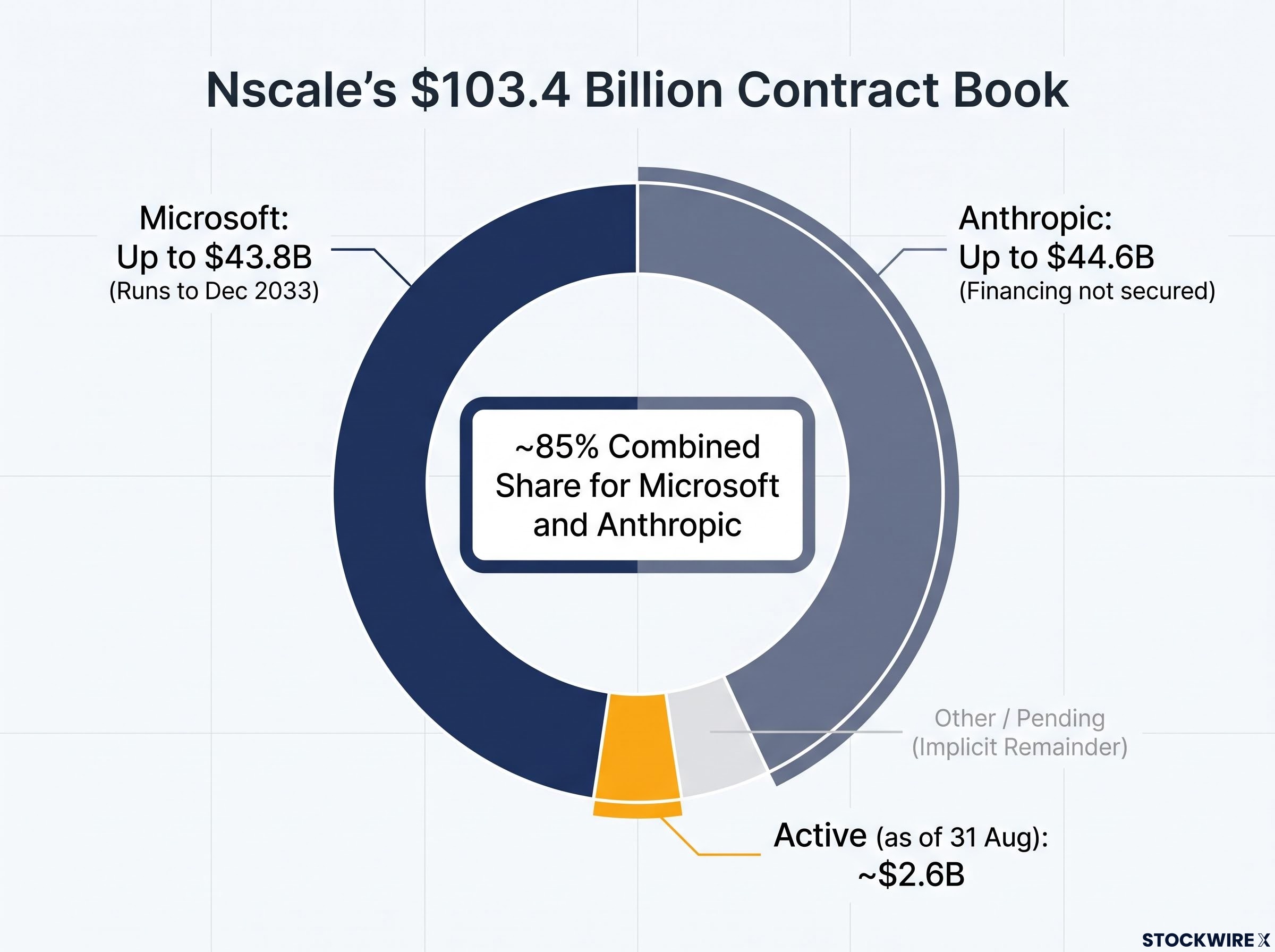
The headline contract book is $103.4 billion in active and contracted customer value. Now apply the qualifiers.
| Customer or item | Reported value | Share or status | Key condition |
|---|---|---|---|
| Microsoft | Up to $43.8B | Part of about 85% combined share | Runs through December 2033 |
| Anthropic | Up to $44.6B | Part of about 85% combined share | Binding financing not yet secured; delivery milestones; mostly Monarch, West Virginia |
| Active as of 31 August | About $2.6B | Operating revenue base | Only portion live |
| Norway flagship | About 6.4 MW of 30 MW | About six months late | Commissioning still under way |
Two customers account for most of the book, and the larger contract is conditional. Only about $2.6 billion was active. Nscale also announced roughly $3.36 billion in convertible financing on 25 September.
The contract book is dominated by two counterparties, and with only a small fraction of contracted value active and no binding financing for the Monarch campus, the conversion from backlog to revenue is the central valuation question.
Norway as a delivery test
Bloomberg reported the Glomfjord flagship running about six months behind schedule, with cooling leaks, regulatory issues, construction delays and a fire cited. Milestone-based contracts carry penalty and termination exposure, so slippage like this matters.
The valuation depends on converting conditional contracts into delivered capacity. The figure to track is operating megawatts, not contracted value.
CoreWeave and Firmus: the market backdrop Nscale is walking into
CoreWeave closed down 11.91% on 16 October, taking its weekly fall to about 25%. Reuters tied the sell-off to its roughly $50 billion debt load, higher borrowing costs and doubts about how fast cash flow arrives. The credit picture:
- Bonds yielding around 15%
- Five-year default insurance above 1,000 basis points, touching 1,194.5 intraday
- About $35.6 billion of debt, with $7.5 billion due within 12 months
- Roughly $18 billion raised through debt, equity and convertibles
Microsoft itself fell only 1.93% that day, to about $529.05.
Firmus withdrew its ASX IPO on 9 October after cutting its indicative price from $11 to $8.25 (Australian dollars) and lowering its target valuation by about 25%. Founders had aimed for up to about $44 billion; it will now seek private funding.
The bulls are not silent.
Cantor Fitzgerald’s Brett Knoblauch argued investors are over-focused on CoreWeave’s debt and are underappreciating improving fundamentals, unit economics and asset-backed financing.
Evercore reportedly kept an outperform rating, and one published reading framed Firmus as resistance to aggressive pricing rather than weaker compute demand. For you, capital remains available to credible operators, but at a higher price.
Grid delays: why UK data centre projects keep slipping
Loughton is not an isolated misstep. The sequence that leaves a site with a customer but no power looks like this:
- Developers apply for grid capacity before projects are ready.
- Speculative schemes enter the same queue.
- Network operators must plan substations and cables around all of them.
- A data centre takes roughly 18 months to three years to build, while European connections take two to ten years, often seven to fifteen in congested markets.
UK policy response
The UK government said transmission demand-connection applications rose 460% in six months, contributing to waits of up to 15 years. Proposals include tighter queue entry, priority access for AI Growth Zones, credible-milestone requirements with possible deposits or penalties, and letting developers build their own high-voltage assets. Ofgem is developing a framework called “Curate, Plan and Connect” with government and network companies.
Structural versus cyclical
Capacity Global called Europe’s problem a structural mismatch, not a temporary bottleneck. Higher rates and tighter credit then make each delay costlier.
Capacity Global’s view fits a wider structural grid crisis, in which AI racks draw several times more power than traditional cloud workloads and force operators to secure firm supply years in advance.
Power access, not demand, is now the scarce asset. Sites that control energisation carry a premium; those that do not carry timing risk.
What to watch before the Nscale IPO prices
Loughton alone does not invalidate the listing; large Microsoft and Anthropic commitments sit elsewhere. It does weaken the assumption that headline value converts smoothly into cash flow. Signals to track:
- Any Microsoft statement on Loughton
- Anthropic financing and milestone progress
- Norway commissioning toward 30 MW
- The final price range and share count
- Alternative power for Loughton
No attributable analyst target revision for Nscale has surfaced since the report. With about 85% customer concentration, weigh the final prospectus against these signals rather than the headline order book.
What the Loughton exit changes, and what it does not
Microsoft’s exit remains a reported event, and Nscale’s position that the wider relationship is intact still stands. What has shifted is the burden of proof: the listing’s fate rests on financing and delivery, not the $103.4 billion headline.
This article is for informational purposes only and should not be considered financial advice. Investors should conduct their own research and consult with financial professionals before making investment decisions. Reported valuations and terms are speculative and subject to change.
The next verifiable milestone is either the final pricing terms or a Microsoft statement. Whichever comes first will show how much of this story the market has priced.