
Home values are falling, mortgage applications at the big four have dropped by roughly 15%, and the instinct is to sell. History disagrees. National home values sit about 5% below their March 2026 peak, yet in most past housing corrections, Australian bank shares finished higher by the time prices bottomed.
That does not make the majors a bargain. Morningstar’s Q4 2026 market outlook, published on 15 October 2026, rates all four major banks at one or two stars. Each trades at a premium of at least 17% to fair value, meaning the share price sits well above Morningstar’s estimate of what the business is worth.
If you hold bank shares, directly or through an index fund, misreading this cycle carries a cost. You might sell into a slowdown that never reaches the loan book, or you might hold an expensive stock because “banks always recover.”
This analysis separates the signals of a volume and valuation problem from the signals that would mark a credit-loss problem. It also sets out which numbers deserve your attention over the coming months.
What is slowing, and how far has it gone?
Credit and prices
The slowdown appears at every level of the data. Housing credit growth eased to 0.5% month-on-month in July 2026, down from a 0.7% peak in December 2025. Home values fell 1.1% in September 2026, the sixth consecutive monthly decline according to Cotality, leaving them 5.2% below the March peak and flat over the year.
Three overlapping forces are driving the slowdown:
- Tighter money: The Reserve Bank of Australia (RBA) lifted the cash rate by 25 basis points to 4.60% on 30 September 2026.
- Investor tax changes: From 1 July 2027, negative gearing (deducting rental losses against wages and other income) will generally be restricted to new builds. The 50% capital gains tax discount will be replaced by indexation, which taxes only gains above inflation. Holdings acquired before 12 May 2026 are protected.
- Softer prices: Six months of falls have cooled buyer urgency.
The tax changes start next July, but investors are already pulling back. The RBA’s Financial Stability Review on 1 October 2026 expects investor lending to moderate further. Morningstar forecasts fiscal 2027 credit growth of only about 2-3%, assuming investor lending falls about 30%.
One number has held. Unemployment was 4.6% in September (ABS, 15 October 2026), and the rental vacancy rate of 2.0% remains below the 3.3% pre-COVID average.
Bank-level applications
The weakness shows up clearly in each bank’s mortgage applications.
| Bank | Change in mortgage applications |
|---|---|
| CBA | Down about 15% since May (17% year-on-year) |
| NAB | Down about 15% |
| Westpac | Down about 20% |
| ANZ | Down about 12% |
Sources: Yahoo Finance Australia (CBA); Reuters, 25 August 2026 (NAB, Westpac, ANZ).
Reuters noted that reported results remained comparatively strong despite the falls. The squeeze is on how much new lending the banks can write, and that weighs on growth forecasts and valuations well before it touches the existing loan book.
When big ASX news breaks, our subscribers know first
Why slower lending squeezes margins first, then eases the pressure
Fewer applications do more than shrink loan growth. They change how banks compete, and the effect arrives in two stages. The key measure is net interest margin (NIM): the gap between what a bank earns on loans and what it pays for funding, expressed as a percentage of its lending assets.
The near-term squeeze
- Fewer borrowers means banks fight harder for each one, using lower rates, cashback offers and refinancing incentives.
- Deposit rates stay high because banks still need to keep their funding.
- Margins narrow even while loan quality holds up.
Morningstar links the roughly 15% fall in applications directly to this kind of competition. Recent results show the split: CBA’s NIM slipped 3 basis points to 2.05%, while ANZ’s rose 6 basis points to 1.70%, with its second-half FY2026 margin at 1.73%.
The margin expansion never arrived at any of the majors despite the highest cash rate in over a decade, which is why volume weakness now falls on earnings with no pricing offset.
The later relief
- Slower lending means banks need to raise fewer new deposits.
- Competition for savers and term deposits cools.
- Funding costs ease and margins recover, which limits the downside.
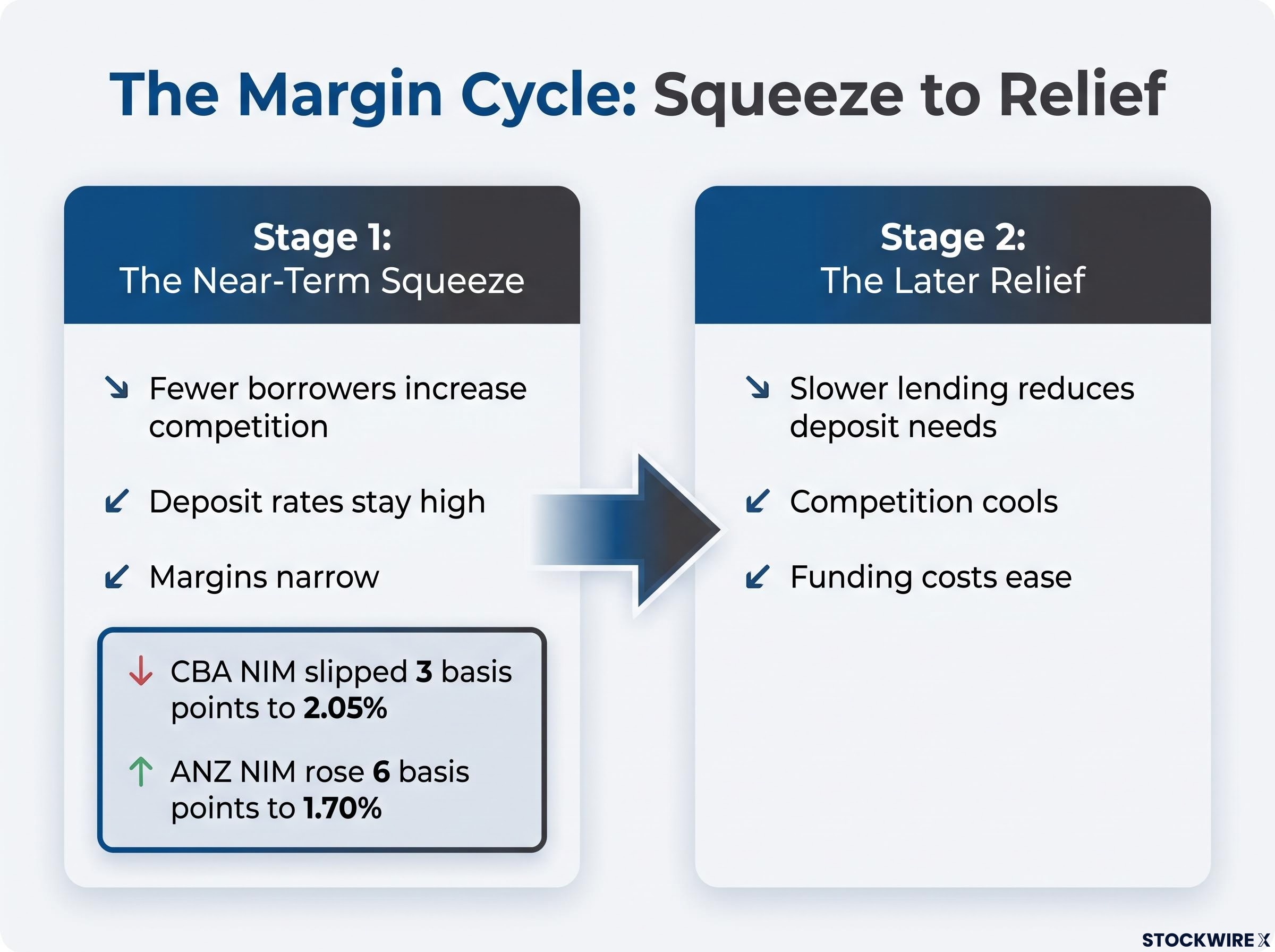
The timing gap Mortgage price competition can bite straight away, but relief on deposit costs only shows up once banks’ funding needs have clearly slowed.
Credit quality is not where the pressure sits. CBA’s home-loan arrears (repayments overdue) are 0.73% and personal-loan arrears are 1.72%. Westpac and ANZ reported modest rises in overdue housing loans, and Morningstar describes bad debts as normalising rather than spiking.
What this means for you is that a bank can post clean credit numbers and still disappoint, because the earnings risk lies in pricing. Secondary coverage suggests the sell-side debate centres on whether margin gains can offset weak volumes. Morningstar’s view is that the market is not yet pricing that risk properly.
Do falling house prices actually sink bank shares?
The intuition feels obvious: banks lend against houses, so falling houses mean falling banks. The record says otherwise.
The historical pattern In four of five Australian housing corrections of at least 5% since 1980, equities were higher by the time house prices bottomed, according to Morningstar.
The reasoning is simple. Shares price expected earnings rather than this month’s auction results. The existing mortgage book keeps generating interest, and when unemployment is low, borrowers keep paying.
| Episode | What happened to housing | What helped banks |
|---|---|---|
| 2022-23 | Capital-city prices down 9% from peak; new loan commitments down 26.3% year-on-year; refinancing up 28.5% (EY); credit growth slowed from an 8% peak to 5.8% by February 2023 | Higher rates, fixed-to-variable borrower migration, and favourable funding and deposit pricing |
| 2017-19 | Weak conditions under tighter lending standards | Contained credit losses; a less direct comparison given different rate settings |
The pattern has limits. It fails when falling prices combine with:
- rising unemployment
- forced sales
- materially higher arrears
At that point the problem moves from slower volumes to losses on loans already written.
History also has nothing to say about price. Morningstar’s weighted-average price-to-fair-value ratio for the majors eased to 1.33 in Q2 2026 from 1.41. CBA derated while ANZ rallied, narrowing CBA’s relative premium, though Morningstar still considers it unjustified.
The read you should take is that a housing downturn alone is not a sell signal. However, paying a premium of 17% or more assumes the slowdown costs the banks very little, and the evidence does not support that assumption.
For readers weighing whether a 17% premium is justified, our detailed coverage of bank stock valuation sets out a six-step framework for stress-testing any bank position.
What would turn a valuation problem into a credit problem?
The main trigger
About two-thirds of bank lending is secured against residential property, according to Morningstar, so the route from housing weakness to bad debts matters. That route runs through jobs. Borrowers who keep their income keep paying, even when their home is worth less.
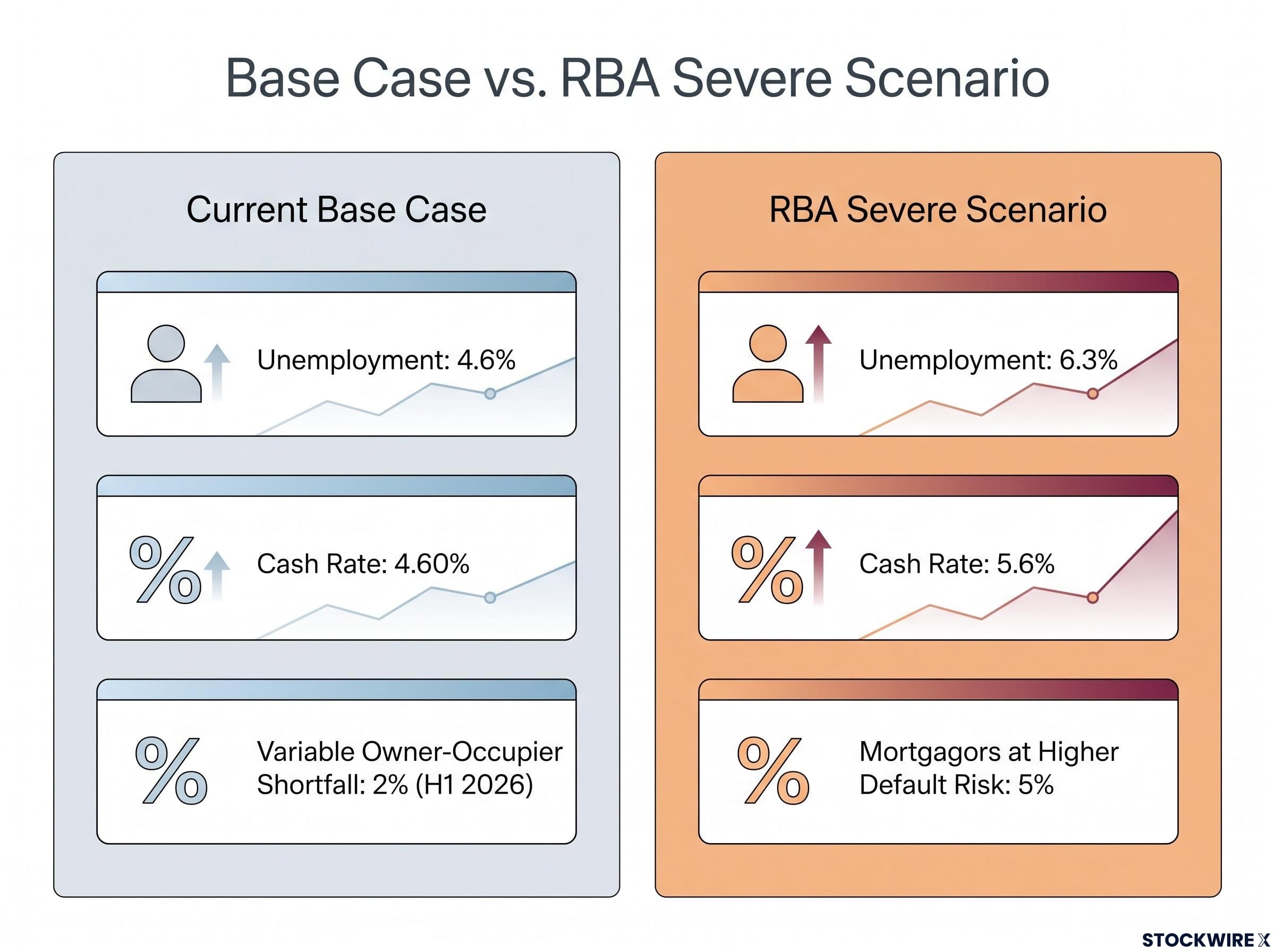
The RBA estimates that about 2% of variable-rate owner-occupier borrowers faced a cash-flow shortfall in H1 2026. Renters are under greater pressure, with HILDA survey data cited by the RBA showing about 15% of renters in shortfall against 4% of mortgage holders.
RBA severe scenario If unemployment rose to 6.3% and the cash rate reached 5.6%, about 5% of mortgagors could face higher default risk.
Other risks to the base case
Ranked by how close each sits to actual credit losses:
- Unemployment rising from 4.6%, the direct channel to defaults.
- Further rate rises. The RBA’s 13 October 2026 minutes keep another hike on the table, which would stretch borrowers further.
- Oversupply. Morningstar’s forecast assumes none, yet vacancies have already risen from 1.5% to 2.0%.
- Weaker population growth, which would remove support for owner-occupier lending.
- Index concentration. Banks make up almost 25% of the ASX benchmark, so a derating would hit index investors hard.
The offsetting facts are substantial. The banks are well capitalised, lending standards remain sound, and the RBA does not forecast a banking crisis. If you hold bank exposure, watch the unemployment rate more closely than house prices, because it decides whether you face a few soft years or real losses.
The wider recession risk matters here because weakening consumer sentiment and housing wealth feed into the unemployment path that decides whether a valuation problem becomes a credit problem.
What the slowdown changes for bank investors, and what it does not
The slowdown is real and probably not fully priced, but while unemployment stays near 4.6%, it remains a growth and valuation story rather than a credit-loss story. The bear case rests on premiums of at least 17% and one or two star ratings. The bull case rests on contained arrears, strong capital and eventual relief on deposit costs.
Three variables will show which case is winning:
- Monthly unemployment data from the ABS
- Arrears trends in each bank’s results
- Mortgage-pricing competition in margin disclosures
The question is not whether the banks survive. It is whether today’s entry price suits your risk tolerance.
This article is for informational purposes only and should not be considered financial advice. Investors should conduct their own research and consult with financial professionals before making investment decisions. Past performance does not guarantee future results, and forecasts are subject to market conditions and various risk factors.