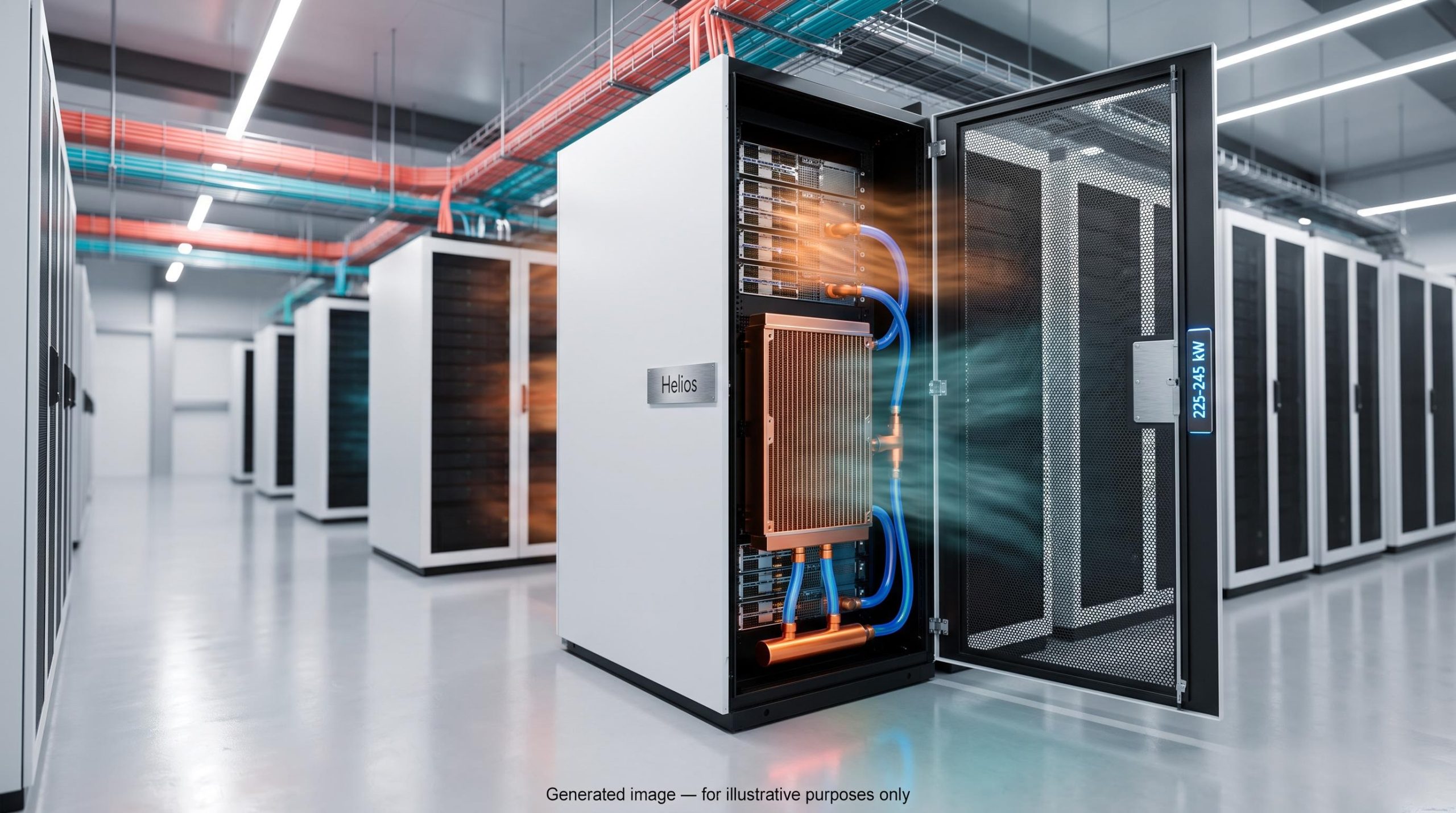
Liquid cooling is supposed to solve the heat problem in AI data centres. It does not, entirely. Even when cold plates carry heat away from the chips, a rack drawing roughly 225-245 kW still leaks warm air into the room, and on 13 October 2026, nVent and AMD announced how they plan to deal with that leftover heat in the Helios rack.
The question matters because AI buildouts are now limited by cooling and power as much as by chip supply. The fastest processors are useless if a data hall cannot remove the heat they produce or deliver the electricity they need.
Grid queues and power and water access increasingly decide how fast AI capacity can be built, with modern racks pulling up to 140 kW against 2-4 kW for legacy cloud racks.
The new unit is being shown at the OCP Global Summit in San Jose, which runs from 12-16 October 2026. As of 15 October 2026, it is a demonstration and integration announcement. It is not yet a priced, shipping product.
You will see what the rear door heat exchanger does inside Helios, how it compares with rival approaches, and where the line sits between what you can and cannot conclude from the news as an investor.
What did nVent and AMD actually announce?
What is confirmed
nVent is integrating a DC-powered dual rear door heat exchanger (RDHx) into AMD’s Helios Rackscale AI platform. An RDHx is a cooling unit that replaces the back door of a server rack and removes heat from the air leaving it. nVent built this one for Helios’s double-wide Open Rack Wide (ORW) rack, a wider rack format developed through the Open Compute Project.
According to nVent, the unit includes air-temperature and humidity sensors, plus fan-speed control based on differential pressure (the difference in air pressure across the door). The company says you can start with a single rack and expand gradually.
Room-neutral design In nVent’s description, the door absorbs the warmth that direct-to-chip liquid cooling does not remove, then sends cooled air back into the room so the rack stays room-neutral.
Room-neutral means the rack adds no net heat to the surrounding space. The demonstration is set for nVent’s Booth #A9 at the summit, on an ORW rack alongside Helios manifolds, bus bars and power shelves.
What is not yet disclosed
That is where the confirmed details stop. As of 15 October 2026, neither company has published:
- A commercial availability date
- Heat-removal capacity
- An RDHx-specific rack power rating
- Price
- Order status
- A production date
- Coolant-flow specifications
Follow-up coverage from Investing.com and Data Center Dynamics repeated the integration details but added no performance rating.
Those gaps tell you this is an early signal of design direction, not evidence of revenue. Treat it as a look at where AI rack engineering is heading, rather than a line item you can add to a sales forecast.
When big ASX news breaks, our subscribers know first
How does a rear door heat exchanger work alongside direct-to-chip cooling?
Here is the puzzle. If cold plates sit directly on the GPUs and CPUs and pull heat away through liquid, why does a rack still need a cooled door?
The answer is that the processors are not the only parts that get hot. Direct-to-chip cooling uses cold plates, metal blocks with liquid flowing through them, mounted on the highest-power chips. They remove most of the semiconductor heat before it reaches the air. Most is not all.
The Uptime Institute cooling survey shows why rear door units matter at this density: even in a 130 kW GPU rack, roughly 39 kW of heat can still end up in the air, and that is the load a door must handle.
Where the leftover heat comes from
In a partially liquid-cooled rack, heat still escapes to the air from:
- Memory and voltage-regulation components
- Networking and switch trays
- Power-conversion components
- Fans and leakage from servers that are only partly liquid-cooled
- General exhaust air
Helios makes this residual heat a serious matter. It is a 44 RU rack (RU means rack unit, a standard measure of height), roughly 1.2 m wide, drawing about 225-245 kW under load. Even a small percentage of that escaping as warm air adds up to a lot of heat in a data hall.
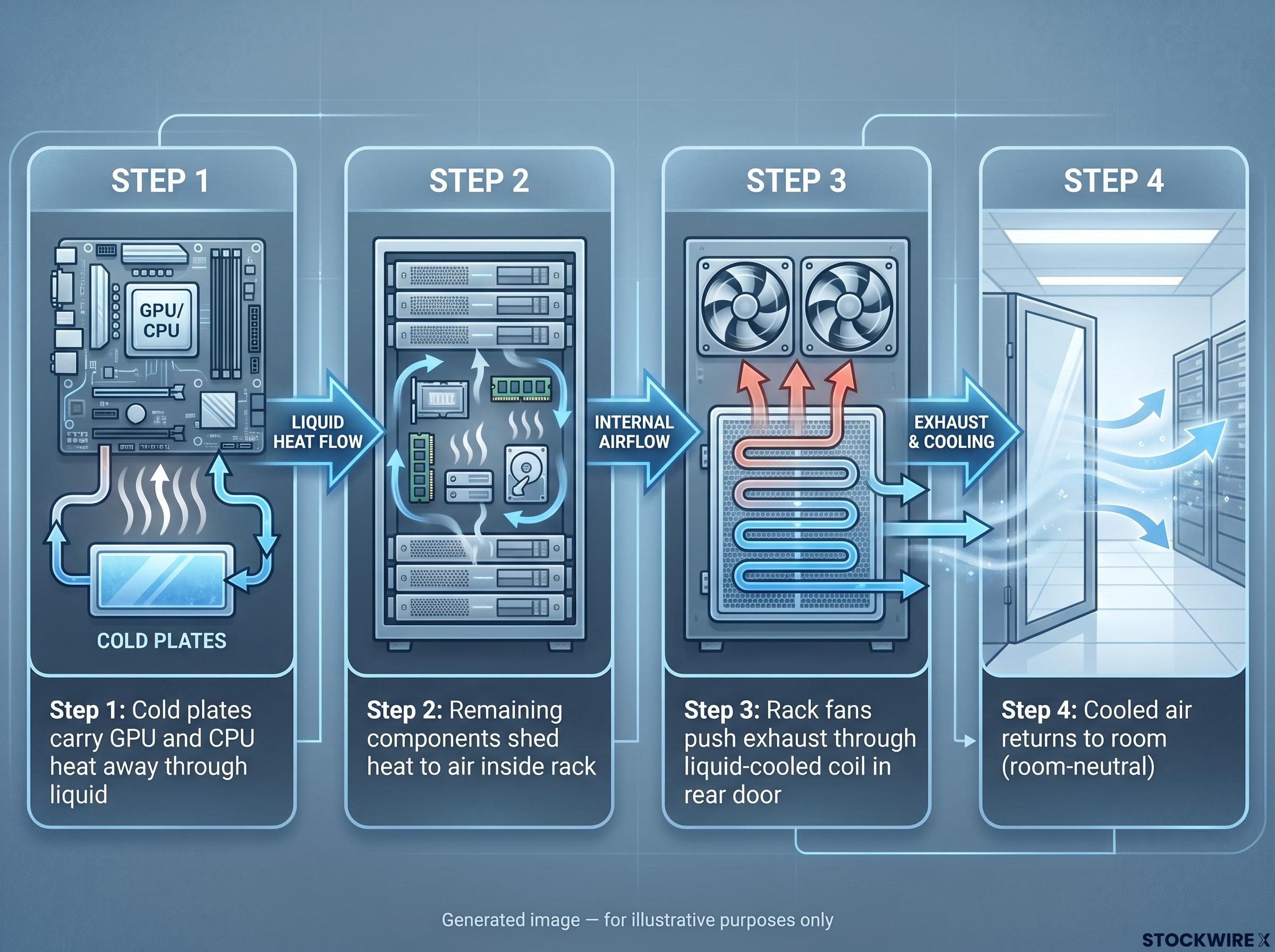
The heat removal sequence works like this:
- Cold plates carry most of the GPU and CPU heat away through liquid.
- The remaining components shed heat into the air inside the rack.
- Rack fans push that warm exhaust through the liquid-cooled coil in the rear door, which absorbs the heat.
- Cooled air returns to the room, leaving it room-neutral.
The result is a hybrid design. Liquid handles the heat at the source, and the door stops the leftovers from becoming the building’s problem.
Why DC power distribution matters
The “DC-powered” label is not a minor detail. Above about 200 kW, converting electricity repeatedly from alternating current (AC) to direct current (DC) wastes energy, adds cabling and creates more heat. Helios uses a 50 V liquid-cooled DC bus bar, a solid conductor that distributes power through the rack. Because the nVent door runs on DC, it can draw from that same distribution rather than needing its own AC circuit.
This points to a broader lesson. AI rack cooling operates across four layers: chip-level cooling, rack-level residual heat control, facility-level heat rejection (coolant distribution units, or CDUs, plus chillers and dry coolers), and rack-scale electrical distribution. “Liquid versus air” is the wrong question. When you read any cooling supplier’s claim, ask which layer it actually addresses.
What is inside the Helios rack, and how does it compare with rival designs?
Inside the rack
The scale of Helios explains why its cooling needs are so demanding. AMD combines its Instinct GPUs, EPYC CPUs, Pensando networking and the ROCm open software stack into a single rack-scale system.
| Component | Helios specification |
|---|---|
| GPUs | 72 AMD Instinct MI455X |
| CPUs | 18 EPYC “Venice”, up to 256 cores each |
| HBM4 memory | Up to 31 TB |
| Performance | Up to 1.4 exaFLOPS FP8; 2.9 exaFLOPS FP4 |
| Bandwidth | 260 TB/s scale-up; 43 TB/s scale-out |
| Rack power | About 225-245 kW under load |
According to Converge Digest, production shipments began in September 2026, with the ramp expected through Q4 2026 and H1 2027. Yahoo Finance named OpenAI, Meta, Microsoft, Oracle and Anthropic as initial customers. Installation volumes per customer have not been disclosed.
How rivals compare
Set against competing products, the power gap stands out.
| Vendor | Approach | Power level | Distinction |
|---|---|---|---|
| nVent and AMD Helios | Direct-to-chip plus dual DC rear door | About 225-245 kW rack | Hybrid design aiming for room neutrality |
| Nvidia GB200/GB300 NVL72 | Liquid-cooled 72-GPU rack | Roughly 120-140 kW | Similar GPU count, lower power |
| Vertiv | Liebert XDR rear door | Typically about 30-35 kW per rack | Suits retrofit and mixed environments |
| Schneider Electric | Motivair ChilledDoor3 | Up to 75 kW per rack in one comparison | Higher-capacity rear door within a broader portfolio |
Treat these rear door figures as indicative. Capacity depends on water temperature, airflow, rack design and facility equipment.
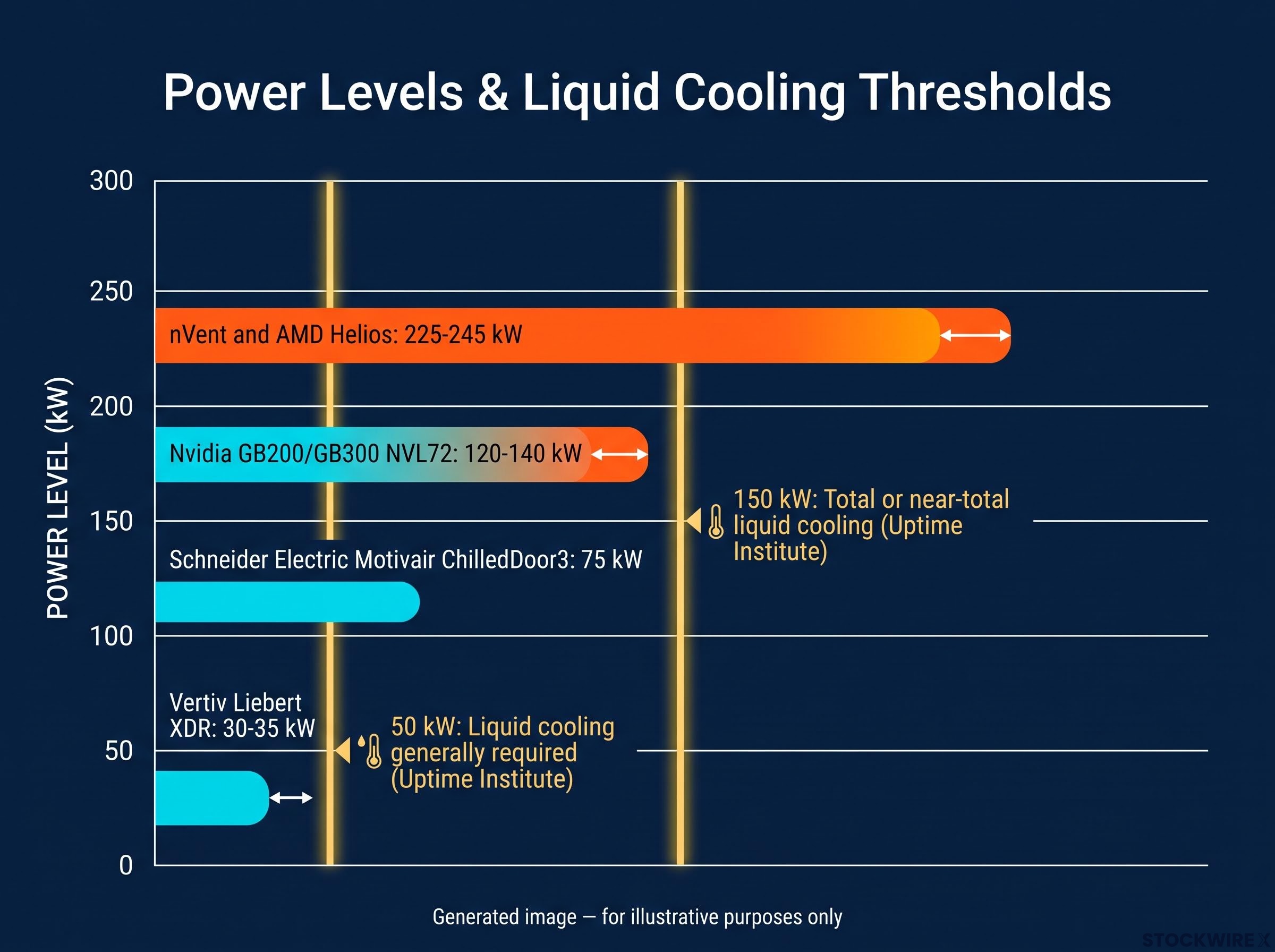
Even allowing for that, a door rated at 30-35 kW or 75 kW belongs to a different class from a 225-245 kW rack. That gap tells you why a purpose-built, DC-powered door was needed rather than an off-the-shelf retrofit. It does not prove nVent’s door outperforms rivals, because nVent has not published a capacity figure.
Why is cooling now a bottleneck, and what should investors take from this?
The bottleneck
The industry-wide constraint is well documented. The Uptime Institute, a data centre research and standards body, has set out where air cooling runs out of road.
Uptime Institute thresholds Liquid cooling is generally required for racks above roughly 50 kW, and racks approaching 150 kW or more will generally need total or near-total liquid cooling.
Helios sits well above both lines. Uptime’s 2025 Global Data Center Survey also identified power availability and legacy infrastructure as growing barriers. Uptime analyst Jacqueline Davis has said AI training clusters are pushing densities beyond conventional design assumptions, speeding adoption of cold plates and rear-door systems.
For investors, the bottleneck increasingly sits in the physical infrastructure layer, where power availability and energy storage constrain hyperscaler spending more than software or silicon does.
Reading the investor case
nVent’s numbers show the demand is real. The company expects 2026 data-centre sales above $2 billion, reported a backlog of about $2.5 billion after Q2, guides to 32%-34% organic sales growth and expects adjusted EPS of $5.00-$5.10. Its Blaine 2 liquid-cooling facility in Minnesota is expected to open in H1 2027.
None of that comes from the Helios collaboration, which has no disclosed orders. Management estimates liquid cooling at about 10%-15% of data-centre cooling, and no authoritative current figure for the market’s size was found in public sources.
Revenue is also not interchangeable across the market. Rear doors suit retrofit and mixed environments, while new hyperscale halls lean on direct-to-chip cooling, CDUs and liquid-cooled power.
| Bullish reading | Sceptical reading |
|---|---|
| Racks above 150 kW need near-total liquid cooling (Uptime) | No RDHx capacity, price, orders or availability disclosed |
| Helios offers a credible rack-scale alternative to Nvidia | AMD faces execution and ecosystem risk against Nvidia |
| nVent backlog about $2.5B, growth guidance 32%-34% | High expectations raise valuation and backlog-conversion risk |
| Open Rack Wide designs may aid interoperability | Standards for busbar voltages, coolant temperatures and connectors remain incomplete |
| Closed-loop systems can cut onsite water use | Andy Masley notes lower water use can require more electricity for heat rejection |
For you as an investor, the thesis that cooling is a genuine constraint is well supported. This announcement alone does not show which supplier captures the revenue.
This article is for informational purposes only and should not be considered financial advice. Investors should conduct their own research and consult with financial professionals before making investment decisions. Past performance does not guarantee future results. Financial projections are subject to market conditions and various risk factors.
What the preview settles, and what the next few months must prove
The engineering logic holds up. A rack drawing this much power leaves residual heat that cold plates cannot catch, and a DC-powered rear door sharing Helios’s power distribution is a credible way to keep that heat out of the room.
The commercial case is another matter. Until specifications, pricing and orders appear, you are looking at a design direction rather than a revenue stream.
Four signals will tell you whether that changes:
- Published RDHx capacity and an availability date
- AMD’s Helios ramp through Q4 2026 and H1 2027
- The opening of nVent’s Blaine 2 facility
- Progress on rack and cooling standardisation
If those arrive on schedule, the collaboration earns a place in your thesis. If they stall, the cooling trend remains intact, but this particular bet stays unproven.
—