TSMC posted its sixth consecutive record quarter, with revenue up 50.9% year on year and net profit up 68.7%. Its Taiwan-listed shares still closed about 2% lower on Thursday, 15 October 2026, as the wider chip selloff swallowed the earnings beat.
That outcome challenges a common assumption: that a company beating forecasts should see its stock rise.
The timing matters. On 14 October, the Philadelphia Semiconductor Index (SOX) fell 4.3%, its sixth straight decline. TSMC reported in the middle of a broad rout in chip stocks.
If you read the drop as a verdict on TSMC’s business alone, you risk selling a sound position for the wrong reason, or missing the real warning signs inside the numbers.
Here is a framework for separating what a company reported from what the market is pricing, using this week’s TSMC reaction as the worked example.
Why can a record quarter still be a disappointment?
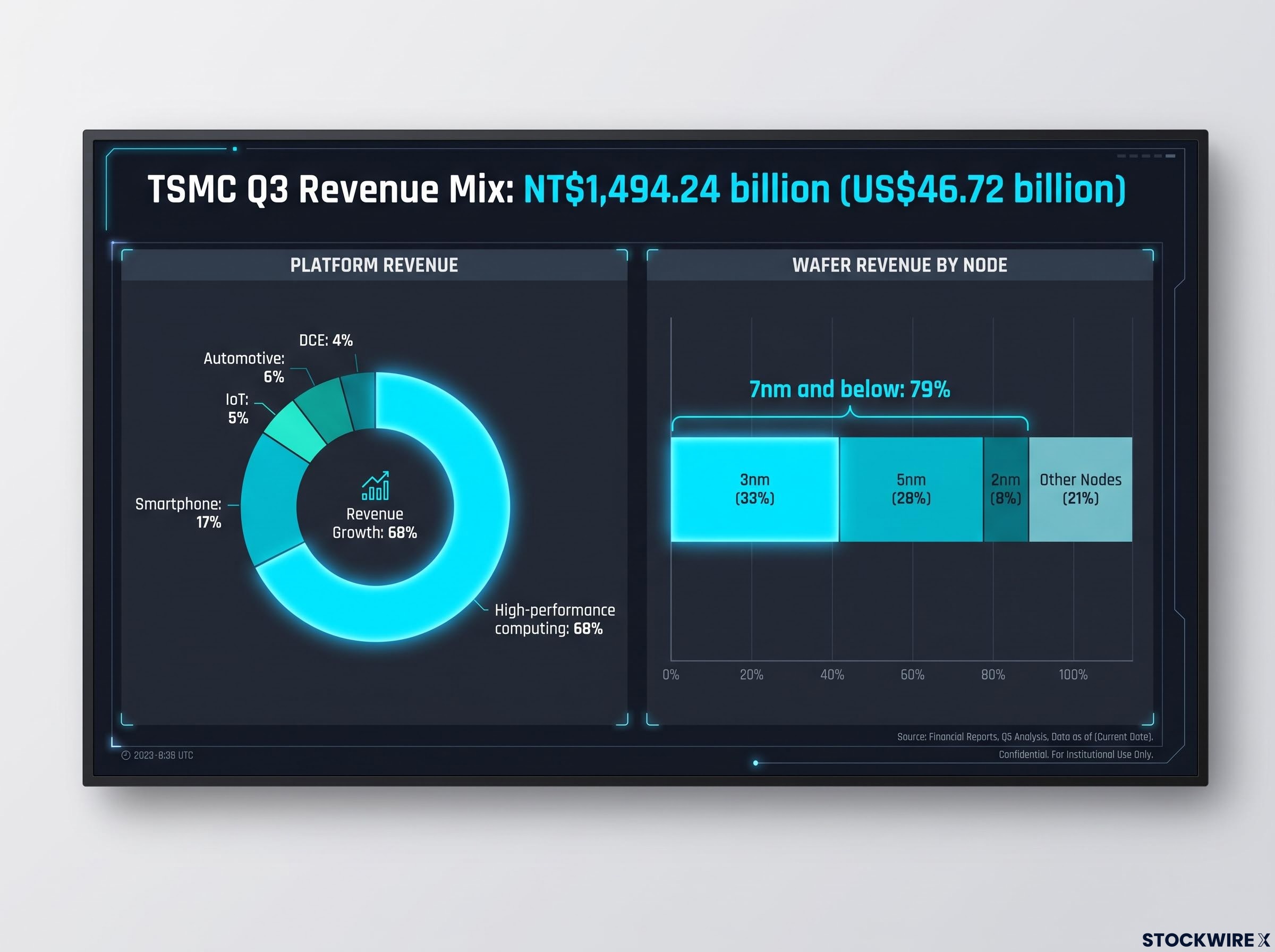
On almost any measure, the quarter was exceptional. Revenue reached NT$1,494.24 billion (US$46.72 billion), up 17.6% on the previous quarter. Net profit came in at NT$763.06 billion, and earnings per American depositary receipt (ADR) were US$4.60. An ADR is a certificate that lets US investors trade shares in a foreign company.
Management also guided fourth-quarter revenue to US$52.3-54.3 billion and held 2026 capital expenditure at US$60-64 billion.
Now look at how far those results actually beat forecasts.
| Metric | Reported | Consensus or context | Read |
|---|---|---|---|
| Net profit | NT$763.06B | NT$746.3B (LSEG) | About 2.2% above |
| ADR EPS | US$4.60 | About US$4.42-4.45 | Modest beat |
| Gross margin | 66.4% | Down from the previous quarter | TSMC attributed the dip to the 2nm ramp |
The consensus figure needs a caveat. Reuters cited NT$740.8 billion on 8 October before updating it to NT$746.3 billion, and the later number is the one that applies here.
The bar TSMC faced Bloomberg described TSMC as facing a “high bar” to calm jitters across global AI stocks, with investors looking for clearer evidence on margins, future demand and how long AI spending can last.
Earnings beat vs expectations beat
An earnings beat means reported profit came in above analysts’ published forecasts. An expectations beat means the result, together with the outlook, came in above what investors had already built into the share price.
TSMC achieved the first but not clearly the second. According to Stock Analysis, the stock trades at roughly 20 times forward earnings, with consensus already expecting about 34% EPS growth in 2027. Commentary described the quarter as a “story already told,” the kind of setup where traders sell on good news.
The expectations gap explains why a 2% profit beat can coexist with a falling share price: the market had already paid for exceptional results, so only a change in the outlook would have moved the stock higher.
The gap between the two kinds of beat widens as a company grows. A larger, more highly valued company has less room to surprise, so the market shifts its focus to incremental upside, margins and how long customers keep spending.
A beat of about 2% tells you the market was already paying for exceptional results. The useful question is whether the quarter changed the outlook, not whether it topped the consensus.
When big ASX news breaks, our subscribers know first
What else hit chip stocks on the same day?
The selloff was well under way before TSMC released a single number. Two separate pressures had been building since 13 October, one from the macroeconomy and one specific to the sector.
| Security | Move on 14 October |
|---|---|
| SOX index | Down 4.3% to 11,684.4 |
| NVIDIA | Down 3.2% |
| AMD | Down 5.7% |
| Broadcom | Down 3.1% |
| ASML | Down 3.9% |
| Super Micro Computer | Down 8.4% |
Rates and the cost of the AI buildout
Hotter-than-expected inflation pushed Treasury yields higher and revived talk of a rate hike. CME FedWatch put the odds of a quarter-point hike on 28 October at 53.7%, up from 22.1% a day earlier, while Reuters cited about 40%. The figures differ because they come from different instruments and moments, but markets priced a better than 95% chance of at least one hike by year-end.
Rate expectations reach AI valuations through a chain of effects:
- Higher expected rates raise discount rates, so future earnings are worth less today.
- Higher yields make long-duration growth stocks less attractive than bonds and cash.
- Capital-intensive AI infrastructure becomes more expensive to build.
- Debt-funded expansion gets harder to justify, weakening the perceived demand chain.
- Valuation compression can outweigh near-term earnings growth.
Reports tied the selloff to concerns about “AI-driven debt financing,” which points to the deeper question of whether the buildout can earn its cost of capital.
Historical data on rate hike cycles shows that the early equity dip is mostly a valuation repricing driven by higher discount rates, which is why a hike scare can hit growth stocks hard without signalling weaker earnings.
The CXMT headline and why analysts doubted it
ChangXin Memory Technologies (CXMT) said it had made progress on a 4F² DRAM design, a cell layout that packs memory into roughly one-third less area than the standard 6F² approach. It is targeting a server DDR5 module by the end of 2026, but it has not released full specifications or a launch date, and no one has independently verified the claim.
Memory makers took the heaviest hit. Samsung fell roughly 7% and SK Hynix about 10% on 13 October, with SK Hynix down another 6.06% the next day, although sources give different figures that may reflect different sessions. Rosenblatt’s Kevin Cassidy called the memory selloff “overblown.”
TSMC is mainly a logic foundry, so its direct exposure to memory is lower. Its valuation multiple compressed along with the rest of the sector anyway.
If rates and a memory headline were enough to move the whole sector in one session, you should treat TSMC’s one-day move as sector beta, the share of a stock’s move that comes from its sector, rather than as a judgement on its quarter.
Is there a real warning inside the strong numbers?
Dismissing the entire reaction as noise would be too easy. Some of the signals inside the report cut both ways.
Management said it saw no sign of demand weakening and pointed to agentic AI and the adoption of open-source models as drivers. The revenue mix supports that view. High-performance computing made up 68% of platform revenue, and 7nm and below accounted for 79% of wafer revenue (3nm 33%, 5nm 28%, 2nm 8%).
C.C. Wei, Chief Executive Officer (paraphrased) Demand right now is extremely strong, but TSMC is being prudent in its 2027 planning because rising component prices and macro uncertainty are affecting consumer and price-sensitive markets.
Vital Knowledge read the call language as a hint that demand outside AI is softer.
| Issue | Bullish reading | Bearish reading |
|---|---|---|
| Non-AI demand | Weakness sits in lower-growth markets | AI strength may mask softness elsewhere |
| 2027 caution | A conservative baseline leaves room for upside | Could signal a more uneven year |
| CXMT | Unproven and overblown | Signals Chinese progress in memory |
| US$60-64B capex | Extends the technology lead | Raises depreciation, with margin already down |
The capex question is the most evidence-based part of the bear case. The market wants proof that 2nm earns acceptable returns, and the sequential margin dip is the first data point on that question.
The margin pressure from the 2nm production ramp is not new; TSMC flagged in July that ramp costs and overseas fabrication would dilute gross margins through the second half, so the latest dip extends an existing trend.
The balanced reading holds two things at once. AI demand is strong now, but the market has started to price a less certain 2027, a higher cost of capital and a wider range of competitive outcomes.
Concentration in AI can hide softness elsewhere, so you should read the revenue mix behind a record headline as closely as the total.
What do earlier beats-that-fell teach about reading this one?
TSMC is not the first AI leader to beat forecasts and still fall. The pattern has repeated often enough to be useful.
Two precedents from NVIDIA
- 20 November 2024: NVIDIA beat on revenue and earnings and guided above expectations, yet its shares fell about 2% in extended trading.
- August 2025: Revenue rose 56% to US$46.74 billion, just ahead of a Visible Alpha projection of about US$46.52 billion, but the stock weakened because there were no H20 sales to China-based customers.
In both cases, the company executed well on the quarter, and the forward picture still weighed on the shares.
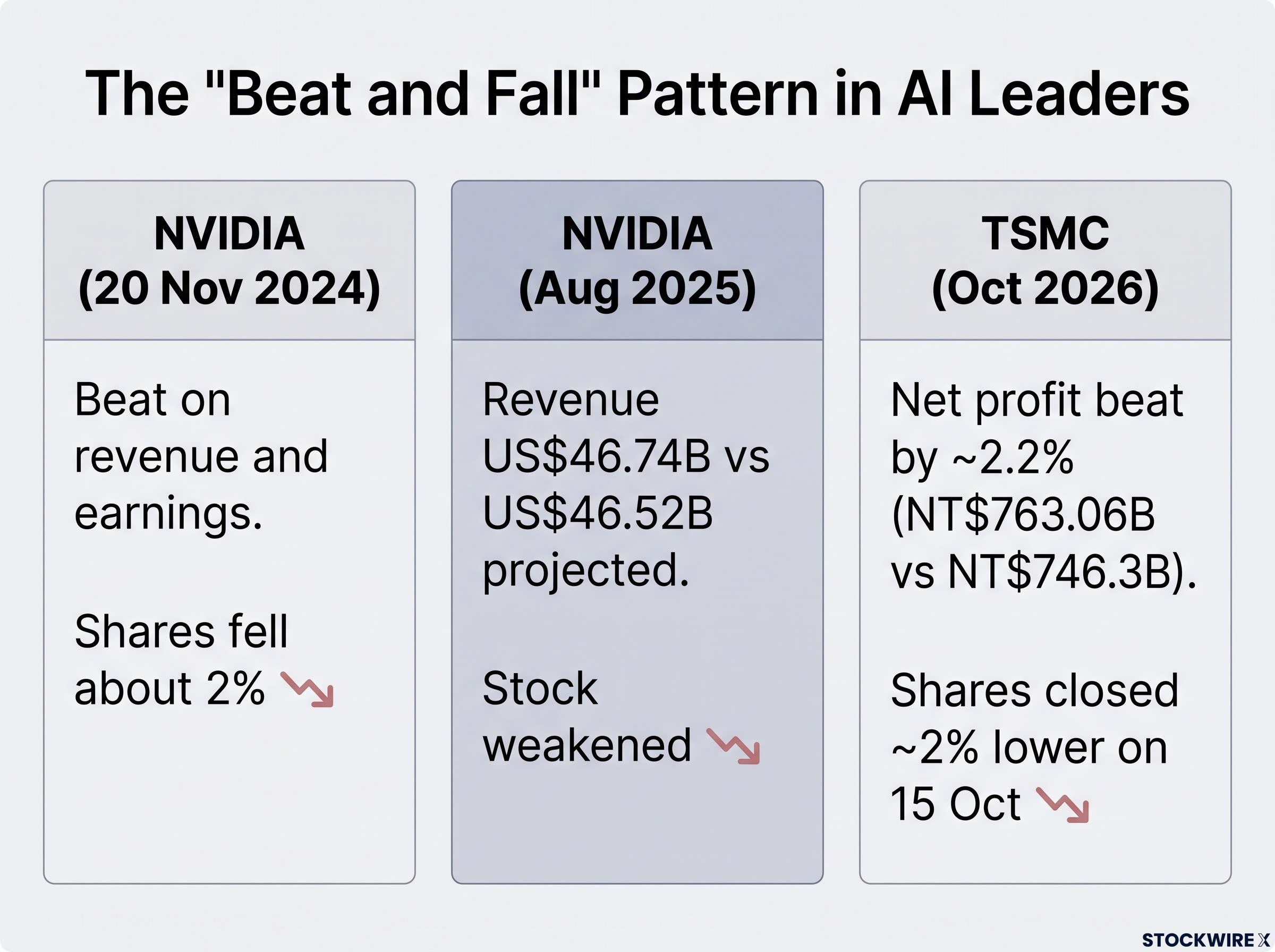
That is the common thread. Execution looks backward, while discount rates, the durability of demand and valuation multiples look forward, and those forward factors set the price.
A checklist for the next beat-and-fall
- Size of the beat: TSMC’s roughly 2% profit beat was small next to the growth already priced in.
- Guidance and commentary: Wei’s prudence on 2027 mattered more than the quarter itself.
- Demand mix: AI made up most of the growth, while non-AI segments showed signs of softness.
- Macro and rates: Rising odds of a Fed hike compressed growth valuations across the sector.
- Sector shocks: The CXMT headline hit memory stocks and dragged the chip complex down with them.
- Valuation multiple: At about 20 times forward earnings, the stock had less room for an ordinary beat.
Before you read a post-earnings drop as a verdict on the company, you should be able to say which of these checks explains it.
What the TSMC reaction changes, and what it does not
The quarter was strong: record revenue, NT$763.06 billion in profit and a 66.4% gross margin. The selloff reflected a repricing of rates, 2027 uncertainty, competitive outcomes and valuation, not a collapse in current AI demand.
The demand signal for this year is unchanged. What has changed is how much certainty the market is willing to pay for.
Three variables will shape the next move: the Fed’s decision on 27-28 October, any hard evidence on CXMT’s specifications and yields, and TSMC’s further commentary on non-AI demand heading into 2027.
For readers wanting to hold chip stocks without letting drawdowns dominate a portfolio, our dedicated guide to core-satellite semiconductor investing explains how to size the position at 3-10%.
This article is for informational purposes only and should not be considered financial advice. Investors should conduct their own research and consult with financial professionals before making investment decisions. Past performance does not guarantee future results. Financial projections are subject to market conditions and various risk factors.