Most people assume enterprise AI is waiting on smarter models. In network operations, that is rarely where it stalls. The sticking point is whether an engineer can defend the answer the AI gives, not whether the model behind it is clever.
Most ASX technology companies now describe some kind of AI capability. You cannot judge the models yourself, but you can judge whether an AI claim is built to survive real production use. That second test matters more for AI network operations than any benchmark score.
This explainer uses one ASX-listed company, FirstWave Cloud Technology (ASX: FCT), as a worked example, not as a recommendation.
Disclosure: StockWire X has a commercial relationship with FirstWave Cloud Technology.
The goal is practical. You will finish with four questions to bring to the next AI announcement that lands in your inbox.
Why an AI answer nobody can defend is not an answer
Why a single model’s answer cannot be inspected
It is 2am, the network is down, and the AI tool tells the engineer the cause is a misconfigured router. The answer sounds confident. The engineer still cannot act on it.
Without the reasoning, the engineer has to re-check the logs, test the devices and rule out alternatives personally. The time saving disappears. Under audit or compliance rules it gets worse, because any action taken on that diagnosis cannot be justified afterwards to auditors or incident reviewers.
If the AI cannot show its reasoning, you are buying a second opinion you still have to verify yourself.
The pilot gap A demonstration needs a plausible answer. Production needs a defensible one.
That gap is why many enterprise AI projects impress in a demo and then stall at the pilot stage. The fix is not a smarter model. It is a different structure.
How several agents leave the working visible
An AI agent is a model that can take actions, such as querying data or running a tool, and then read the result before deciding what to do next. A multi-agent system splits the diagnosis among several of them:
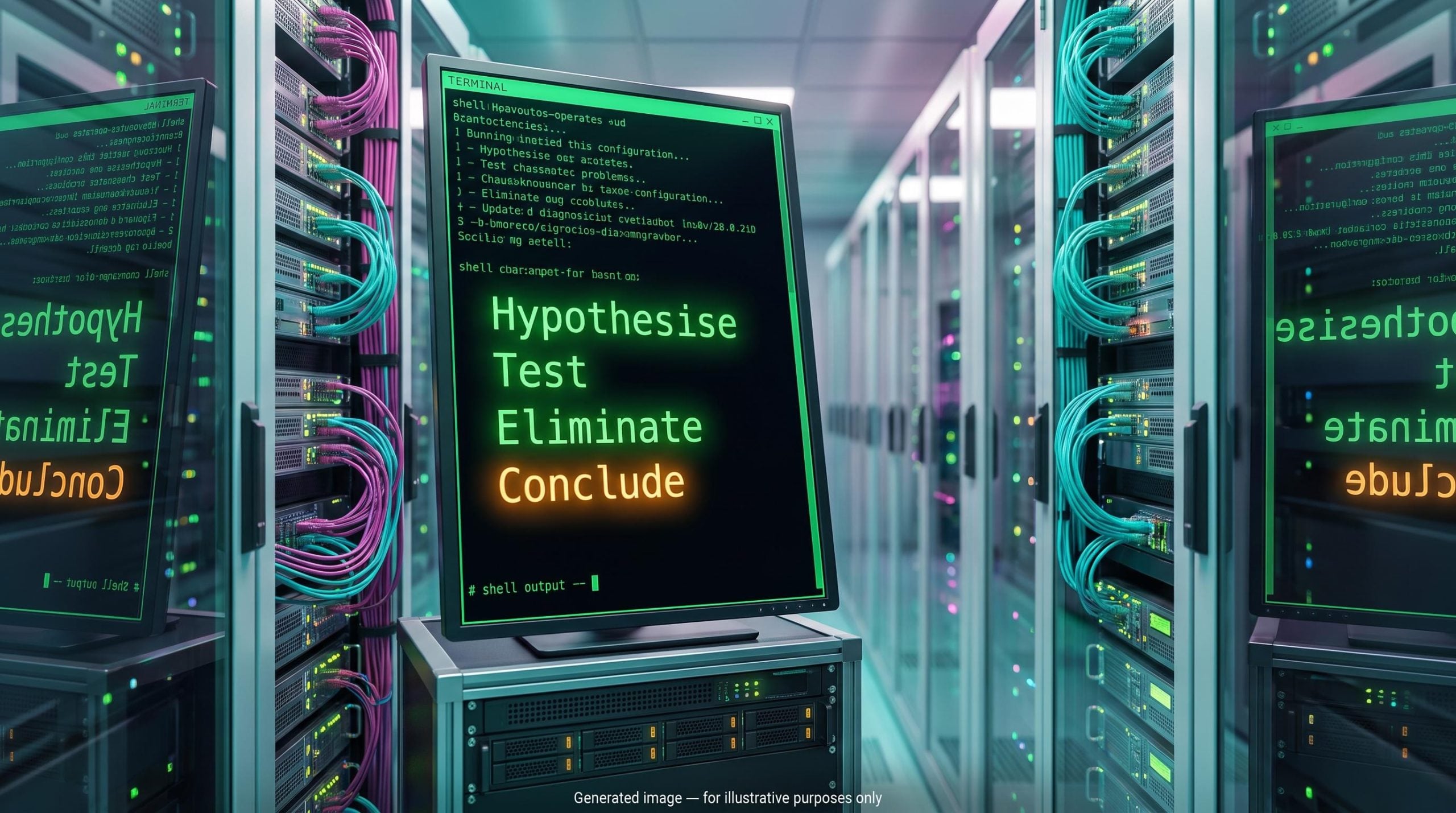
- Hypothesise: one agent proposes a likely cause.
- Test: other agents check it against device history, configuration, telemetry (performance data the network reports automatically) and event logs.
- Eliminate: hypotheses the evidence contradicts are discarded.
- Conclude: the output keeps the full reasoning, including the explanations that were ruled out.
Independent research supports the direction. The 2024 paper “Exploring LLM-Based Agents for Root Cause Analysis” found tool-using agents gained factual accuracy when their reasoning was grounded in real observations. The 2025 “A Survey of AIOps in the Era of Large Language Models”, which reviewed 183 papers from 2020-2024, identified agents and root-cause analysis as major research directions.
FirstWave filed a provisional patent application with IP Australia on 3 September 2026, announced to the ASX on 4 September 2026, for a network monitoring and fault diagnosis system. The company describes it as an LLM-orchestrated multi-agent system that tests competing explanations until it reaches a verified, explainable diagnosis. It was developed with CSIRO and the University of the Sunshine Coast and built into FirstWave’s existing NMIS suite; a provisional patent application confers a priority date only.
Readers who want the original announcement details will find them in our coverage of the provisional patent filing, including the on-premise market the company says it is targeting and the named customers it says requested the capability.
The point to carry forward: always ask whether the working is visible.
When big ASX news breaks, our subscribers know first
Why the AI has to travel to the data
Once you accept that the AI needs a network’s detailed history to reason well, a second problem appears. That data rarely wants to leave the building, for three reasons:
- Sensitivity: a detailed map of a network is also a map of how to attack it.
- Approvals: sending that data to an external AI service may be restricted, or need sign-off slower than an outage.
- Volume cost: continuously shipping large telemetry streams to a cloud service is expensive.
Australian guidance reinforces this. The Australian Signals Directorate’s Information Security Manual (June 2026) asks organisations to keep a register of outsourced cloud services and assess each one’s security, classification and contracts. It warns that general-purpose AI applications create security risks, and that an AI application handling classified information should not directly access external public data sources, third-party cloud services or APIs.
The Digital Transformation Agency’s guidance of 13 October 2025 tells public servants not to enter OFFICIAL: Sensitive or higher information into public generative AI tools. It also asks them to keep human oversight and prefer enterprise-grade options for sensitive work. The rule is not “cloud is banned”: classify the data, authorise the service and keep a human accountable.
Follow that logic and the conclusion arrives on its own. Software already installed, already trusted and already collecting telemetry has an edge over a new AI vendor that must win that access from scratch.
FirstWave makes the same case about itself.
FirstWave states that customer data sits on premise within its software, which it says places it to apply AI to make that data more valuable (company-stated, ASX release, 4 September 2026).
When a vendor says it can diagnose your network, ask where your data goes first. That answer may rule the product out for the most security-conscious, highest-paying customers.
Why software built around a command line suits AI agents
The grammar agents already handle
Most enterprise software is built for people looking at screens. For an AI agent to use it, the vendor must build a separate machine interface, or the agent has to operate the screen like a person, clicking buttons and reading layouts. That is slow and fragile.
A command line works differently. Every action is a typed command and every result comes back as text. OpenAI’s agent documentation describes agents as systems that take actions on a user’s behalf, and agents in general work by proposing a structured action and reading a text result. Text in, text out is how they already operate.
Language models are also trained on large volumes of Unix and Linux material, from shell usage to documentation, so command grammar is something they handle comparatively well. This is fit, not inevitability.
| Attribute | Screen-driven operation | Command-line operation |
|---|---|---|
| How the agent acts | Interprets layouts, icons and clicks | Issues typed, structured commands |
| How results return | Visual state the agent must infer | Text output, readable directly |
| How testable it is | Brittle; breaks when screens change | Scriptable and repeatable |
| What record it leaves | Hard to reconstruct | A log of every command and result |
What the command line leaves behind
Here the argument circles back to trust. Command-line interfaces are structured, composable, automatable, permissionable and auditable. When an agent acts through one, each step becomes a logged text command that an engineer or auditor can read and replay.
Explainability stops being a feature added later. It becomes a by-product of the interface itself.
FirstWave states its software is Unix-based, with the command line as its core interface rather than an afterthought behind a graphical one (company-stated). One caveat: a shell is not automatically safe, since commands can be valid but destructive, permissions can be excessive and attackers can inject instructions, so allow-lists, least privilege and approval gates are still needed.
Once an agent can run commands on your network, AI agent security becomes a governance question as much as a technical one, because you need a registry of authorised agents and a clear owner for each automated workflow.
If an agent can only act through a screen, expect slower, less testable and harder-to-audit automation. Ask whether acting through the product leaves a readable record.
How software earns the right to act on its own
Traditional monitoring software describes what happened. The newer ambition is software that investigates, then fixes.
FirstWave describes adaptive thresholds that learn each device’s normal behaviour and investigate abnormal patterns automatically, along with human-in-the-loop approval workflows. It says approved fixes are captured as operational knowledge for later use (company-described). Governed designs across the industry follow a similar loop: observe, analyse, recommend, approve where required, execute, audit.
Now slow down at the approval step. That pause is not a weakness. It is how autonomy gets earned in infrastructure, and a sensible maturity path looks like this:
- Read-only investigation
- Evidence-backed diagnosis
- Suggested remediation
- Approval-gated execution
- Narrowly scoped autonomous actions that are reversible and audited
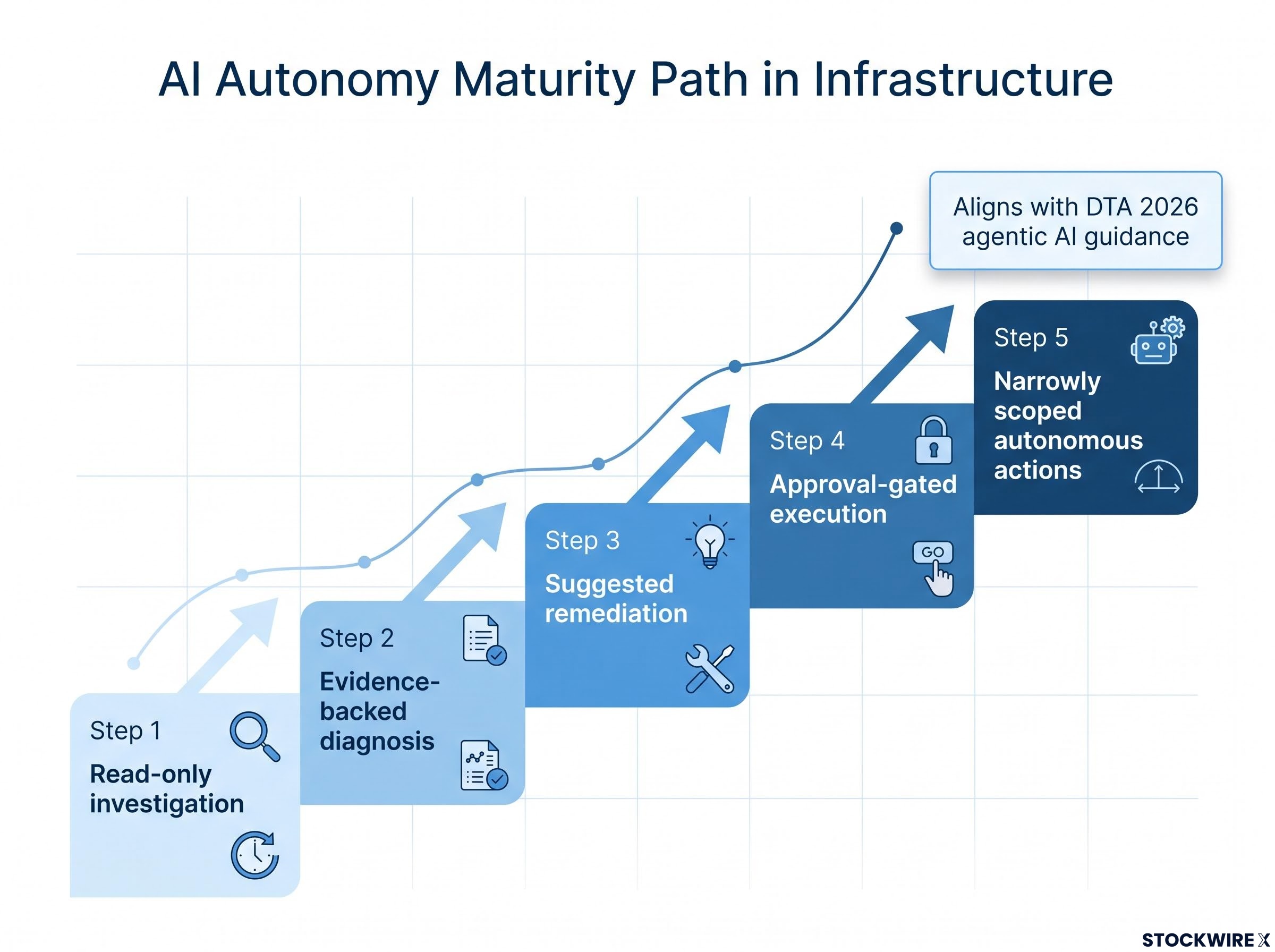
The DTA’s 2026 agentic AI guidance sets the same expectations around human oversight, monitoring, intervention and safe shutdown. This explains why adoption is slow and why autonomous features often launch as optional modules. As at 15 October 2026, FirstWave says its AI fault diagnosis system is being prepared for launch as upsell features or a standalone NMIS module, while its Open-AudIT 7 beta reached customers on 31 August 2026, with a full release scheduled for October but not confirmed at the time of writing.
Preventing an outage is worth more to a customer than describing one, which is why the shift could change what such software sells for over time. When you read that a product “acts autonomously”, ask which actions need approval and what is recorded.
Investors exploring how another ASX-listed software company is monetising agents will find our deep-dive into Xero’s AI agent monetisation strategy, which covers its bundled, add-on and usage-based pricing approach.
Four questions for the next AI announcement, and what the evidence cannot yet tell you
Four questions to bring to the next announcement
- Can the system explain itself? If not, it will struggle to leave pilot where decisions must be justified.
- Does it run where the customer’s data already sits? If data must leave, regulated buyers may be out of reach.
- Does the company already hold the data the AI needs? Years of collection is a different starting point from scratch.
- Is there an interface an agent can drive that leaves a record? That record is the audit trail.
These are filters, not conclusions about any company.
What still limits the case
- A provisional patent application establishes a priority date only; grant and claim breadth remain open.
- Larger vendors with greater resources, including Dynatrace, Datadog, Cisco and ServiceNow, are building AI diagnosis.
- Command-line fit eases extension but does not decide who builds the best one.
- Autonomy adoption cycles in conservative environments can run for years.
- FirstWave’s product is pre-launch, so reception will only show in future results.
Explainability reduces the trust barrier. It does not remove it.
An explained wrong answer is still wrong. A ClickHouse 2026 engineering report tested four frontier models on synthetic anomalies and found none reliably identified all causes without human guidance, with several fixating on an early hypothesis.
The company behind the worked example
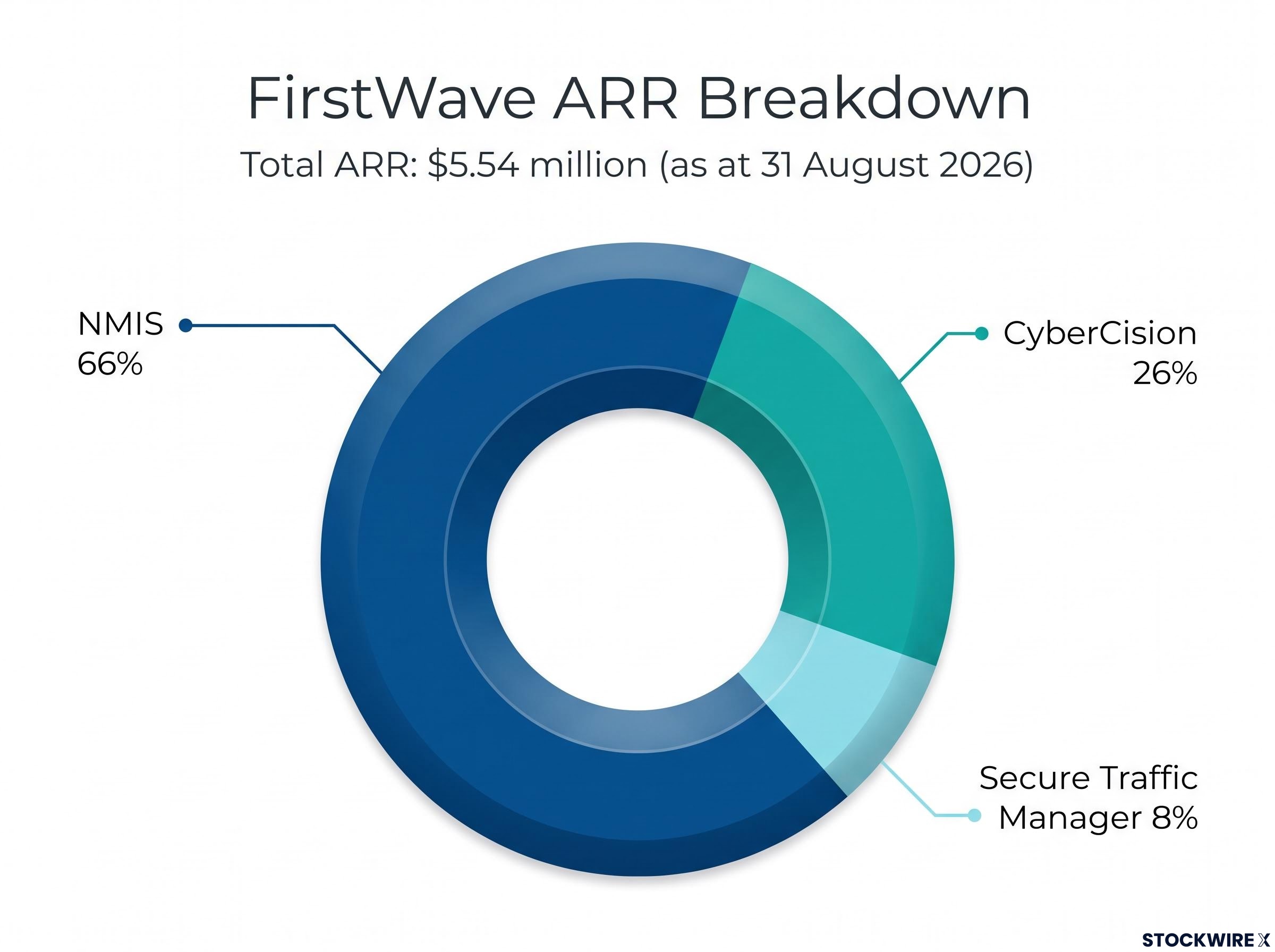
FirstWave is Gold Coast headquartered and has been ASX-listed since 2016, serving managed service providers, carriers, governments and enterprises. Its open-source heritage, with free community editions, built its installed base. According to the company, NMIS contributed 66% of annual recurring revenue (ARR, the yearly value of ongoing subscriptions) of $5.54 million at 31 August 2026, with CyberCision at 26% and Secure Traffic Manager at 8%.
FY26 revenue of about $8.4 million (FY26 annual report) is full-year revenue and includes a one-off perpetual licence to Services Australia of around $1.85 million, so it should not be read as recurring.
This article is for informational purposes only and should not be considered financial advice. Investors should conduct their own research and consult with financial professionals before making investment decisions. These statements are speculative and subject to change based on market developments and company performance.
What trustworthy AI in operational software actually requires
In operational software, AI is mostly waiting for answers that can be trusted, delivered where the data lives, through an interface that leaves a record. Model quality matters less than that combination.
That shifts your view of who may be well placed. Not necessarily the newest entrant, but sometimes software that has sat inside networks for years, built around a command line nobody found interesting.
So the next time a company announces AI, skip asking whether the technology is impressive. Ask whether you could defend its answer to an auditor tomorrow morning.