US inflation came in hotter than forecast on 14 October 2026, yet the dollar finished the next session weaker, not stronger. EUR/USD is holding near 1.1220 in Thursday’s European trading, and the US Dollar Index has slipped about 0.5%.
That reversal sits at the centre of any near-term EUR/USD forecast. Traders are recalculating the odds of a Federal Reserve rate hike at the 27-28 October meeting, now priced at roughly 47-54% depending on the source.
Two more catalysts arrive within 24 hours. US producer price data lands today at 12:30 GMT, and Fed Chair Kevin Warsh speaks in Bangkok on Friday.
Here is what is driving the pair, which levels and events could move it next, and why a single conversation with the IMF chief carries so much weight.
Why is the dollar slipping after a hotter-than-expected CPI?
The consumer price index (CPI), which tracks the change in prices households pay for goods and services, beat forecasts on both headline and core measures. Core strips out volatile food and energy, and it was the bigger surprise.
| Measure | Actual | Forecast | Prior (August) |
|---|---|---|---|
| Headline CPI, YoY | 3.7% | 3.6% | 3.4% |
| Headline CPI, MoM | 0.6% | 0.6% | Not available |
| Core CPI, YoY | 2.6% | 2.5% | 2.4% |
| Core CPI, MoM | 0.3% | 0.2% | Not available |
The dollar rallied at first as yields climbed. Then it rolled over. The US Dollar Index (DXY), which measures the dollar against a basket of major currencies, fell to roughly 102.00, with the dollar down 0.52% against the euro and 0.61% against the Swiss franc. Its only major gain was 0.61% against the Australian dollar.
The logic unwinds in layers:
- December is already priced. Reuters puts the odds of a December hike near 94%, so extra inflation added little new information.
- October remains split. CME FedWatch odds jumped to 53.7% in CNBC’s later report, from 22.1% a day earlier, while Reuters’ earlier read showed 47.1%. Citi expects a December move; TD Securities still expects a hold in October.
- Attention shifted to Warsh. OCBC says markets want hints the Fed could act before December.
- Positioning. Dollar longs had already priced tightening, inviting profit-taking.
ING framed the print as strengthening the case for eventual tightening more than an immediate move. The lesson for you: a hot print no longer guarantees a stronger dollar when the tightening is already in the price. Watch the gap between expectations and data, not the headline alone.
Futures-implied hike probabilities have proved unusually jumpy, swinging by roughly 20 percentage points on a single Fed speech in late September, so the 47-54% range cited today should be treated as fragile.
What could Warsh say on Friday, and how might it move the pair?
If the CPI print could not settle the October question, traders are betting Warsh might.
Who is Kevin Warsh?
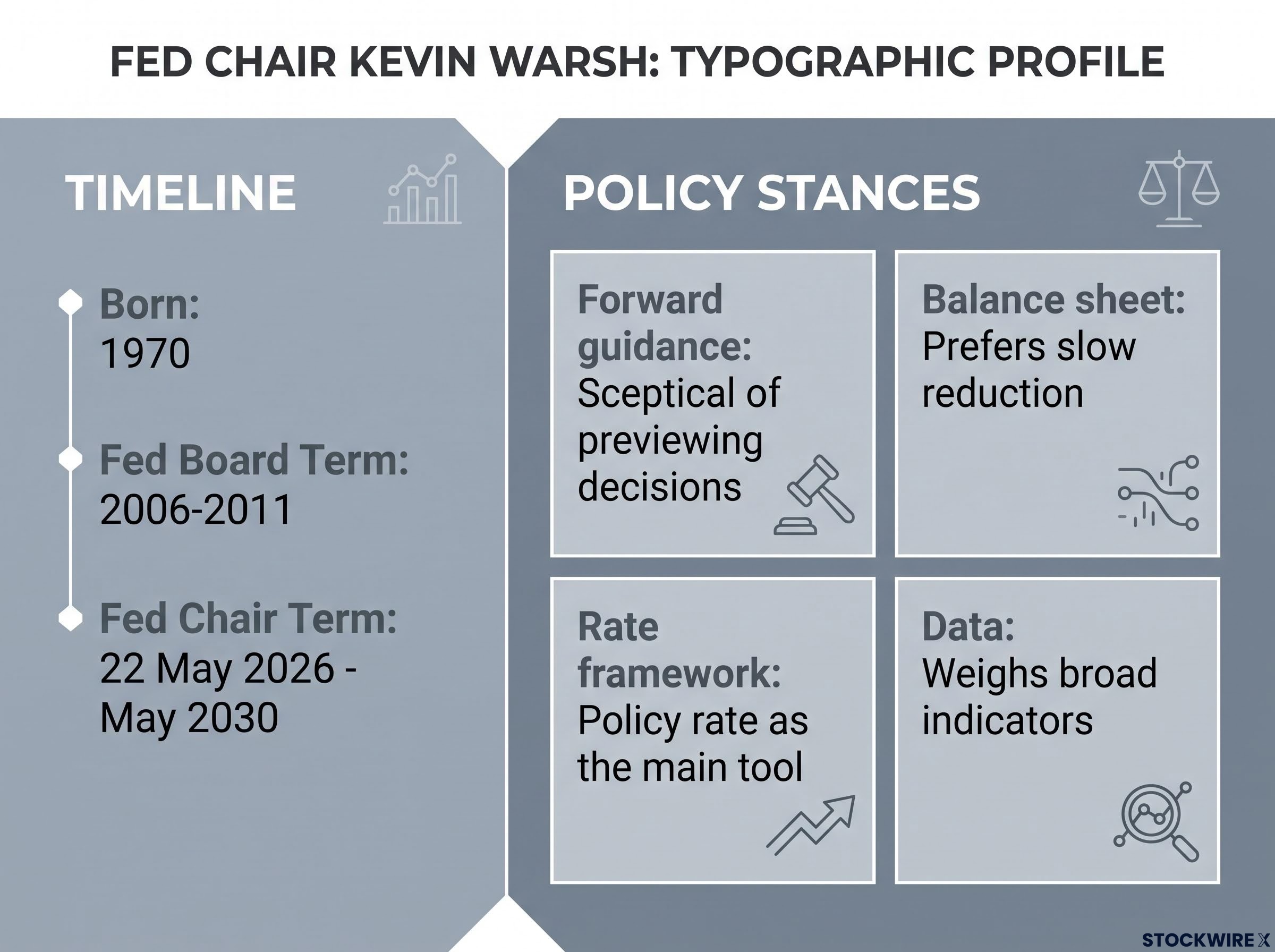
Warsh, born in 1970, was sworn in as Fed Chair on 22 May 2026 for a term running to May 2030. He previously sat on the Fed Board from 2006 to 2011, during the financial crisis.
On 16 October, he joins IMF Managing Director Kristalina Georgieva for a moderator-led fireside chat at the IMF Annual Meetings in Bangkok, livestreamed from 10:30 a.m. local time. One listing gives 03:30, which appears to be GMT.
| Warsh stance | Reported view | Likely currency read-through |
|---|---|---|
| Forward guidance | Sceptical of previewing decisions (Reuters) | Small wording shifts may trigger sharp moves |
| Balance sheet | Long-time critic of its size; prefers slow reduction (PNC) | Gradual approach could soften the dollar |
| Rate framework | Policy rate as the main tool (PNC) | Rate signals dominate dollar reaction |
| Data | Weighs broad indicators, including the dollar and credit (CNBC) | Currency strength may enter his reasoning |
Market precedent According to Franklin Templeton, Warsh’s first major communication came in more hawkish than a consensus expecting a dove, sparking a rates selloff and a stronger dollar.
Hawkish vs patient: two scenarios for the dollar
Reuters has suggested the Warsh Fed could prove less predictable as it reviews communications, data and balance-sheet policy. That makes Friday a fork rather than a forecast.
Hawkish language, or openness to an October move, would likely lift US yields and the dollar, pushing EUR/USD lower. Signals of patience or gradual balance-sheet reduction would likely trim October odds and weaken the dollar.
Before then, today’s producer price index (PPI), which measures prices received by producers, is forecast to ease to 5.3% from 5.4%, with core at 4.4% from 4.6%. Because Warsh avoids pre-commitment, expect volatility around his remarks rather than a clean signal.
Where does EUR/USD go from here: weak euro data and a bearish setup?
The dollar’s wobble flatters the euro more than the euro’s own fundamentals do.
Weak euro-area data and a patient ECB
Eurozone industrial production fell 0.5% in August against expectations of a flat reading, according to TMGM citing Eurostat. July was revised down to -0.3% from -0.1%, marking two straight monthly contractions.
That weakness argues against aggressive tightening from the European Central Bank. Its deposit rate sits at 2.50% after two summer hikes, and most economists in a Reuters poll expect a hold near term, with any move possibly in December. A Fed that tightens while the ECB waits tends to favour the dollar.
Technical picture and the two-way risk
An AI-assisted FXStreet technical section flags a corrective, bearish-leaning setup:
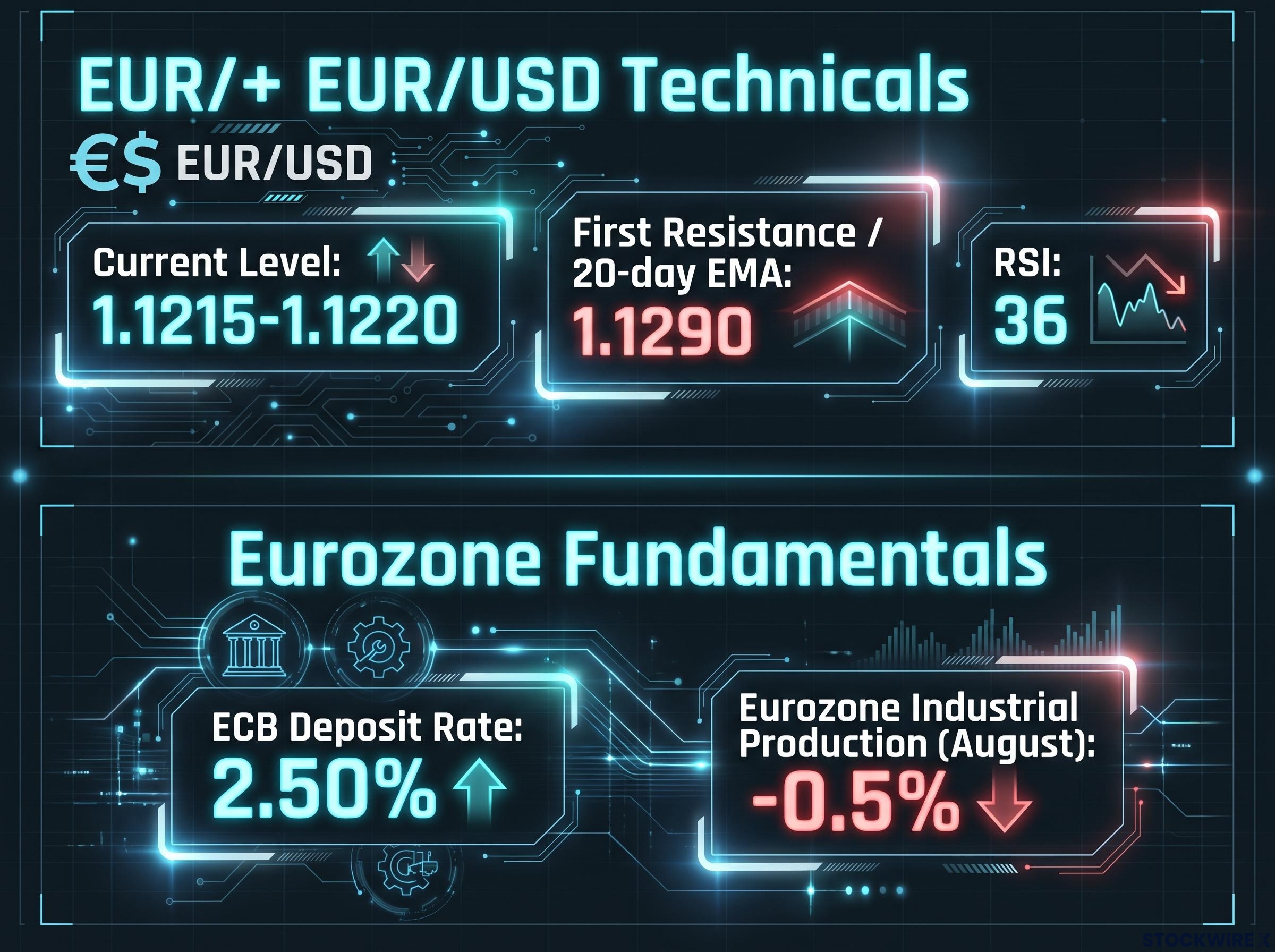
- Current level: 1.1215-1.1220
- 20-day EMA and first resistance: 1.1290 (the exponential moving average weights recent prices more heavily)
- RSI: 36, recovering from oversold but lacking strength (the relative strength index gauges momentum on a 0-100 scale)
Both cases remain live:
- Bear case: Weak euro output restrains the ECB while sticky US inflation keeps the Fed hawkish.
- Bull case: An October hike is not assured, December is largely priced, and Warsh may avoid endorsing an immediate move.
Energy prices cut both ways, adding to euro-area inflation while threatening growth. Until the pair reclaims 1.1290, treat the bias as bearish and any bounce as unproven.
What to watch before the October FOMC
With December largely priced, the pair’s direction depends on whether fresh data and Warsh shift October-hike odds. Three checkpoints arrive quickly:
- Today’s US PPI at 12:30 GMT, where an upside surprise could revive October bets.
- Warsh’s Bangkok remarks on Friday, and whether he opens or closes the door to October.
- Whether EUR/USD can reclaim the 1.1290 20-day EMA.
The outlook is conditional, not a price target. Each checkpoint can confirm or challenge the bearish lean.
This article is for informational purposes only and should not be considered financial advice. Investors should conduct their own research and consult with financial professionals before making investment decisions. Past performance does not guarantee future results, and forward-looking statements are speculative and subject to change based on market developments.