Goldman Sachs beat profit estimates by roughly 30% on Tuesday, and the Dow Jones still could not hold its early gains today. The index closed at 51,671, down 180 points (0.3%), after trading about 500 points higher in the early session.
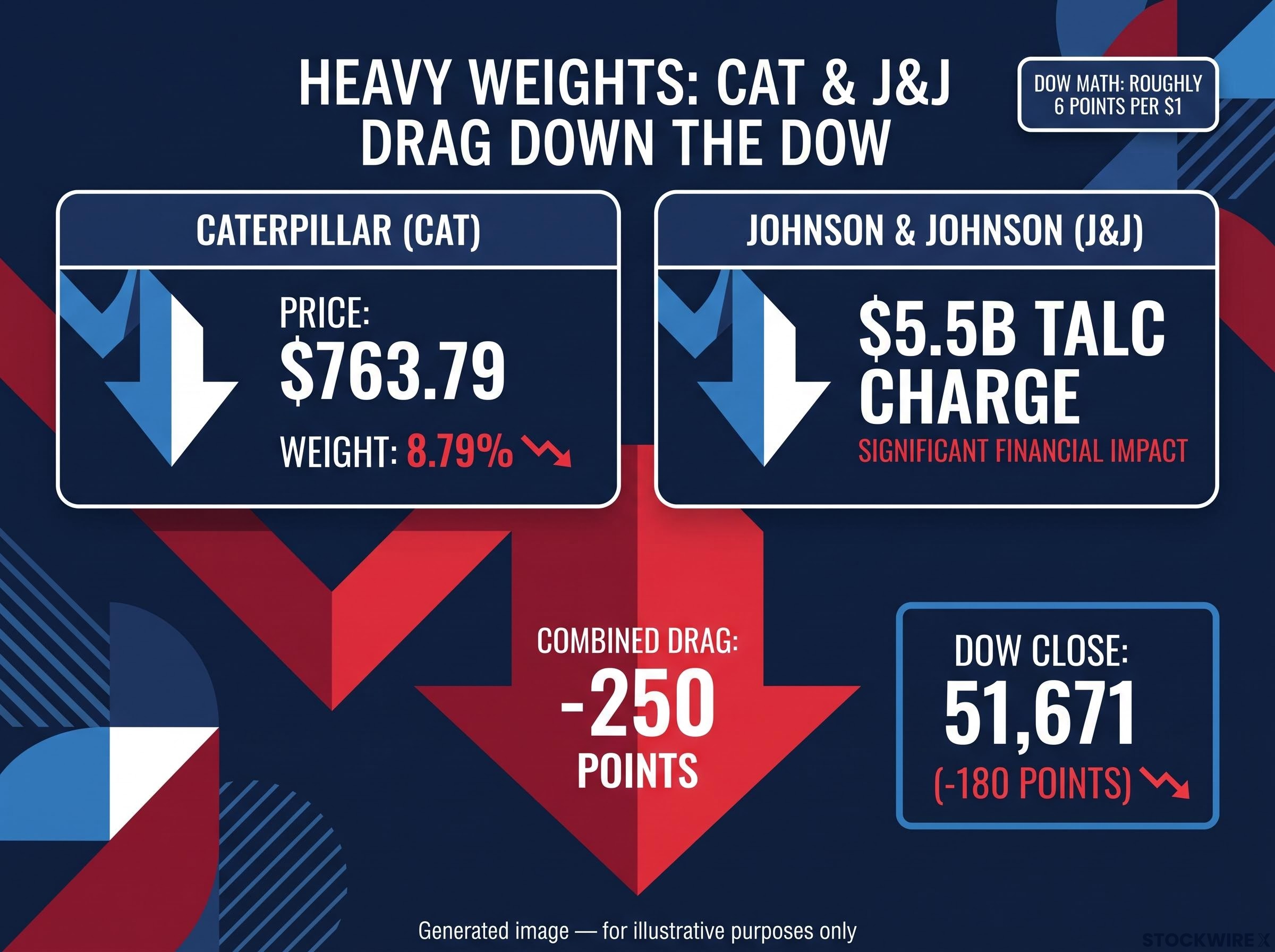
JPMorgan Chase missed on both profit and revenue but raised its outlook for net interest income, the gap between what a bank earns on loans and pays on deposits. Neither bank decided the day. The Dow’s construction did, with Caterpillar and Johnson & Johnson together cutting about 250 points from the index.
Even Goldman’s own finish is unsettled. Reports differ on whether its shares closed higher or lower.
Here is why a strong earnings day for banks ended as a down day for the index, and what the chart now says about the October rally.
Why did the Dow fall when Goldman beat and JPMorgan raised guidance?
On paper, Goldman’s quarter was decisive and JPMorgan’s was a modest stumble.
| Company | Q3 EPS | Consensus EPS | Q3 revenue | Consensus revenue |
|---|---|---|---|---|
| Goldman Sachs | $17.01 | $13.09 | $18.68B | $16.75B |
| JPMorgan Chase | $5.57 | $5.90 | $50.9B | About $51.3B |
The JPMorgan figures follow Barron’s and Yahoo Finance coverage. Other earnings summaries cite $5.75 EPS, so the exact miss depends on the source.
Goldman’s headline looked bigger than its substance. Equities trading revenue jumped 72% to $6.44 billion, while fixed income, currencies and commodities (FICC) revenue slipped 1%. CNBC noted it was Goldman’s 12th straight quarterly beat, and the shares had already rallied about 9% after the prior report.
At their peak, Goldman and UnitedHealth added about 350 Dow points. All of it was gone by the close. Ad-hoc-News reported Goldman finishing up 0.4%, while the original report had it ending lower. JPMorgan’s closing move was not available.
The beats failed to stick for three reasons:
- Anticipated: a dozen consecutive beats and a prior rally left little room for surprise.
- Trading-heavy: the upside came from a volatile, market-dependent business.
- Guidance versus miss: JPMorgan lifted 2026 NII guidance to $106.2 billion from $105.5 billion, and NII excluding markets to $97.2 billion from $96.5 billion, but the current-quarter shortfall dominated.
For you, the lesson is that a beat does not guarantee a rally when expectations run high and the upside comes from trading revenue. The quality of a result matters as much as its size.
Business mix has shaped how the market treats bank beats all year: in July, Goldman rallied 9% while Wells Fargo fell despite topping estimates, showing that investors price the durability of earnings rather than the size of the surprise.
How the Dow’s price weighting turned J&J and Caterpillar into the day’s biggest movers
The arithmetic made Tuesday’s outcome close to inevitable once two expensive stocks turned lower.
How the Dow is calculated
The Dow is a 30-stock price-weighted index, meaning it adds up the share prices of its members and divides by a number called the divisor. A $1 move in any stock shifts the index by the same number of points, whatever the company’s size. The S&P 500, by contrast, is weighted by market capitalisation, and the Dow’s divisor is adjusted for stock splits and other corporate actions.
Sources disagree on the current divisor, but the effect works out to roughly 6 points per dollar. If a stock rises $10, the Dow gains about 60 points.
Roughly 6 points per $1 A $1 move in Goldman moves the Dow as much as a $1 move in any other component.
What drove Tuesday’s moves
| Component | Price | Approx. weight | Session driver |
|---|---|---|---|
| Goldman Sachs | About $890-$895 | 10.3% | Earnings beat, gains faded |
| Caterpillar | $763.79 | 8.79% | Citi target cut |
| Johnson & Johnson | Not yet confirmed | Not yet confirmed | Talc charge |
J&J actually beat and raised. Sales reached $25.4 billion and adjusted EPS came in at $2.59, but a roughly $5.5 billion pretax talc settlement charge cut reported EPS to $0.09. The shares fell 6.1% in one closing report and 6.8% intraday, per Reuters.
Reuters also named Caterpillar a major drag after Citi cut its price target by $150 to $950, questioning whether AI data-centre spending justifies the valuation. Together, the two subtracted about 250 points, more than the Dow’s entire 180-point loss.
Citi’s challenge to AI data-centre spending matters because Caterpillar has been one of the biggest beneficiaries of the buildout, returning over 331% across three years as power and industrial demand surged.
That means a Dow move can say more about a few high-priced stocks than about the economy or the banks. If you want exposure, DIA (an exchange-traded fund that tracks the Dow and trades intraday), futures, options and mutual funds all offer routes in.
Dow Jones today: where the chart stands after the failed rally
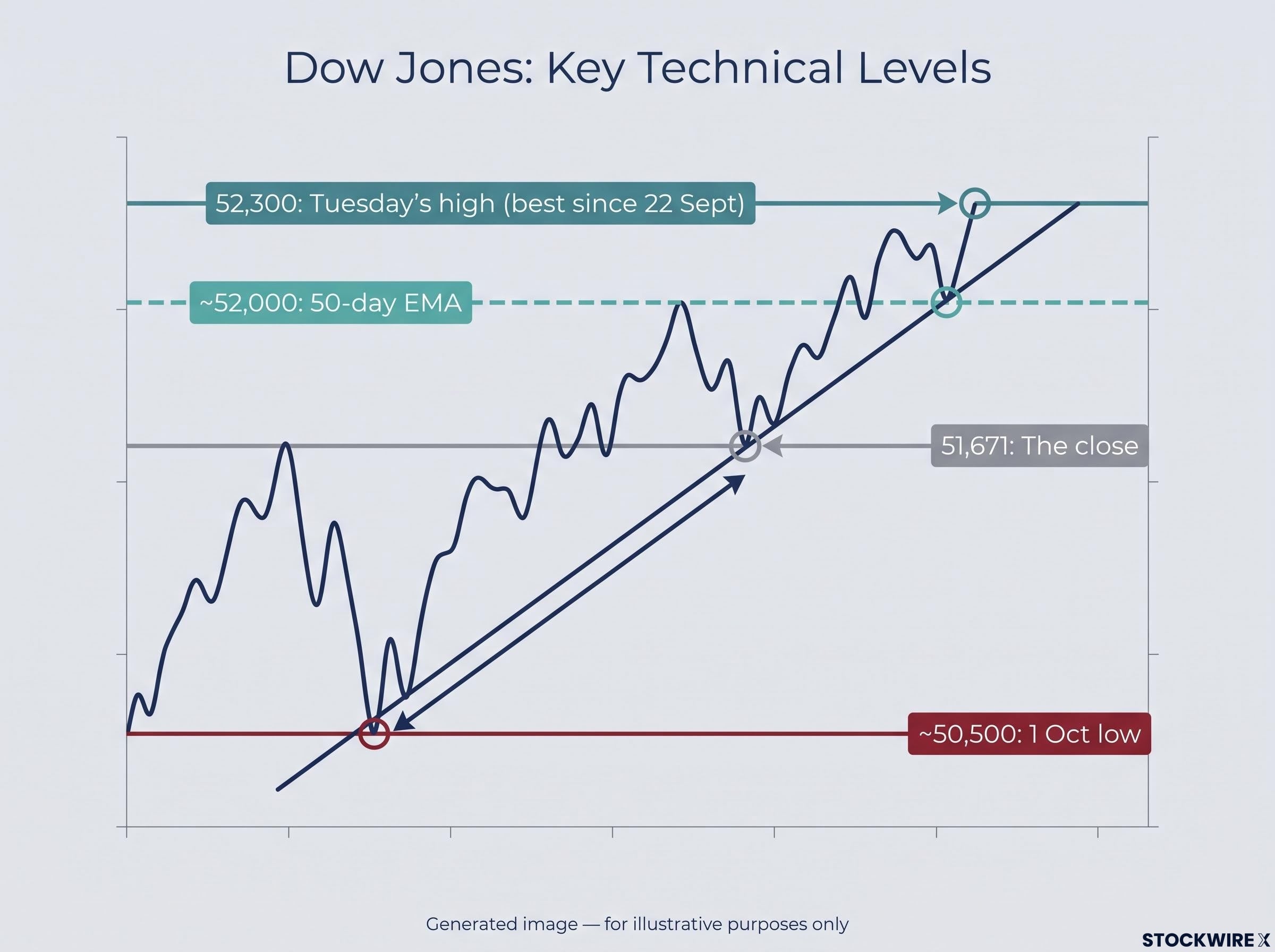
The session began with real promise. Ahead of the opening bell, the Dow climbed to a little over 52,300, roughly 500 points higher than Monday’s finish and the index’s best level since 22 September. It also traded above its 50-day exponential moving average (EMA), an average of recent closes that gives more weight to the latest prices, for the first time in over a month.
Then the sellers arrived. The index slid to a low near 51,600 and closed at 51,671, back below that 52,000 area.
Retracement The Dow has given back over a third of its rally from the 1 October low.
The levels that now matter:
- 52,300: Tuesday’s high
- About 52,000: the 50-day EMA
- 51,671: the close
- Just above 50,500: the 1 October low, sitting just above the 200-day EMA
A break below the 1 October low would weaken the bullish structure. Holding above the 200-day EMA keeps the longer-term support case intact.
The broader market was soft too. At 12:23 p.m. ET, Reuters had the S&P 500 at 7,798.04 (down 0.12%) and the Nasdaq at 27,207.66 (down 0.14%), intraday figures rather than closes, with semiconductor weakness weighing on tech.
Moving averages describe positioning and momentum, not what caused the move, and exact EMA values for the day were not available. Still, the failure at the 50-day line suggests buyers have not regained control. The 200-day EMA area is now the level that decides whether the October rally survives.
Moving averages describe positioning, and Dow Theory adds a confirmation test, requiring the Industrial and Transportation averages to agree before a rally counts as a valid primary trend rather than a short-term bounce.
What Tuesday’s split session means for the next Dow headline
The strongest bank headline did not carry the index because the market questioned its durability. JPMorgan’s guidance could not offset its miss, and price-weighted drops in J&J and Caterpillar did the real damage.
From here, watch whether the 1 October low and 200-day EMA hold, and whether J&J’s talc settlement secures the roughly 95% claimant participation it needs. Also watch whether AI data-centre doubts spread beyond Caterpillar, and whether JPMorgan’s NII guidance proves credible. Earnings, economic data and Federal Reserve policy will shape the sessions ahead.
For readers wanting the full picture, our detailed coverage of the J&J talc settlement explains the 95% participation threshold and the remaining UK exposure that could still reopen the litigation risk.
Past performance does not guarantee future results. These statements are speculative and subject to change based on market developments and company performance.
This article is for informational purposes only and should not be considered financial advice. Investors should conduct their own research and consult with financial professionals before making investment decisions.
—