The rupee closed at ₹95.78 per US dollar on Monday, 12 October, gaining 95 paise (about 1%) in its sharpest single-day rise in more than six months. The trigger was a policy package from the Reserve Bank of India (RBI), not any improvement in the forces that have weighed on the USD INR outlook all year.
That gap is the story. A currency can rally hard on new rules while the pressures beneath it stay exactly where they were.
The RBI unveiled its curbs on dollar demand on 10 October. Two days later, September inflation came in hotter than forecast at 5.54%, and the US Federal Reserve is still talking tough on rates. For anyone tracking the pair from abroad, the money is in separating the one-off policy jolt from the drivers that last. Reported gains ranged from 93 to 96 paise across outlets, with 95 paise the most widely cited figure.
Here is what the data says about whether this rally can hold, and the levels that will settle the question.
Why did the rupee jump 1% in a single session?
A 0.98% move is large for a managed currency like the rupee. The pair extended the gain early on 13 October, trading between 95.66 and 95.78 for a second straight session.
The logic sits in the mechanics. Each measure removes a specific buyer of dollars, or makes it more expensive to bet against the rupee.
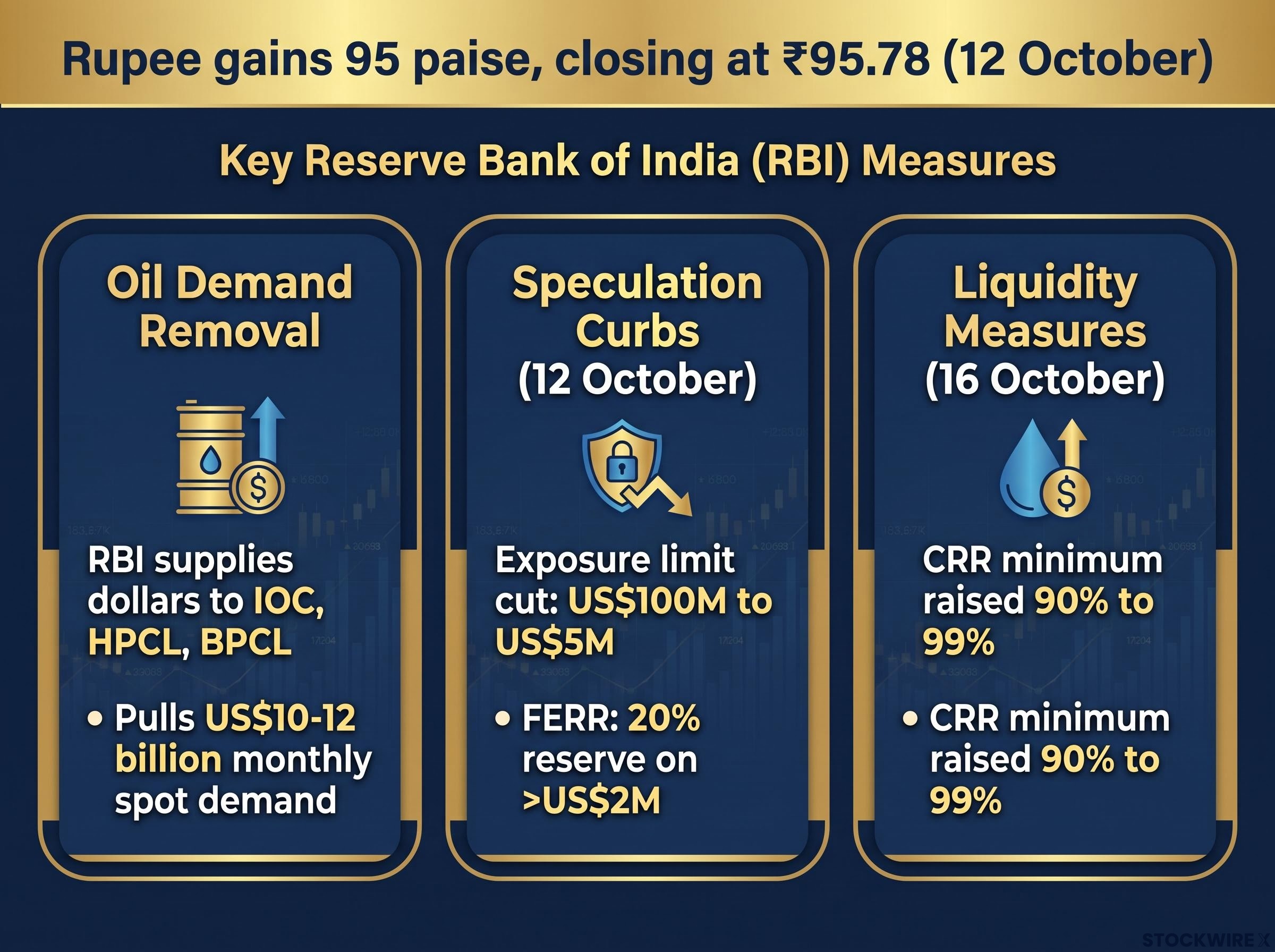
The heaviest lever is the oil facility. The RBI now meets the entire daily dollar needs of Indian Oil (IOC), Hindustan Petroleum (HPCL) and Bharat Petroleum (BPCL) through designated banks. Analysts cited by Moneycontrol estimate this pulls roughly US$10-12 billion of monthly demand out of the spot market, where currencies are bought for immediate delivery.
| Measure | What it does | Pressure it targets | Effective date |
|---|---|---|---|
| Oil-firm dollar facility | RBI supplies full daily dollar needs of IOC, HPCL, BPCL | Large, predictable spot demand | 12 October |
| Rebooking ban | Cancelled INR derivatives cannot be rebooked | Speculative churn | 12 October |
| Exposure threshold | No-underlying limit cut from US$100M to US$5M | Unbacked bets | 12 October |
| Duplicate-hedge undertaking | Users confirm exposure is not hedged elsewhere | Over-hedging | 12 October |
| FERR | 20% cash reserve on contracts above US$2M | Cost of speculation | 12 October |
| CRR maintenance | Daily minimum lifted from 90% to 99% | Excess rupee liquidity | 16 October |
| OMO sale | ₹25,000 crore of bonds sold | Durable liquidity | 13 October |
The Foreign Exchange Risk Reserve (FERR) is a cash deposit dealers must hold with the RBI against rupee-linked derivatives. The Cash Reserve Ratio (CRR) is the share of deposits banks must park with the central bank, and an open market operation (OMO) is the RBI buying or selling government bonds to manage cash in the system. Reuters noted that China has used similar tools to deter one-way bets against the yuan.
What you should take from this: the rally reflects removed demand and costlier speculation. It tells you about market plumbing, not about India’s external position improving.
What the measures do not do
The package does not ban rupee derivatives outright, and maturity rollovers remain permitted. Nomura’s view is that the steps can calm markets without removing the underlying external imbalance.
The RBI’s rupee defence has also included simultaneous intervention in onshore spot and offshore NDF markets, and forward obligations mean the usable reserve buffer is smaller than the headline figure implies.
When big ASX news breaks, our subscribers know first
Does hot inflation make another RBI hike more likely?
September’s consumer price index rose 5.54% year on year, beating a Reuters poll median of about 5.40% and jumping from 4.83% in August. Food inflation climbed to 7.74% from 5.97%.
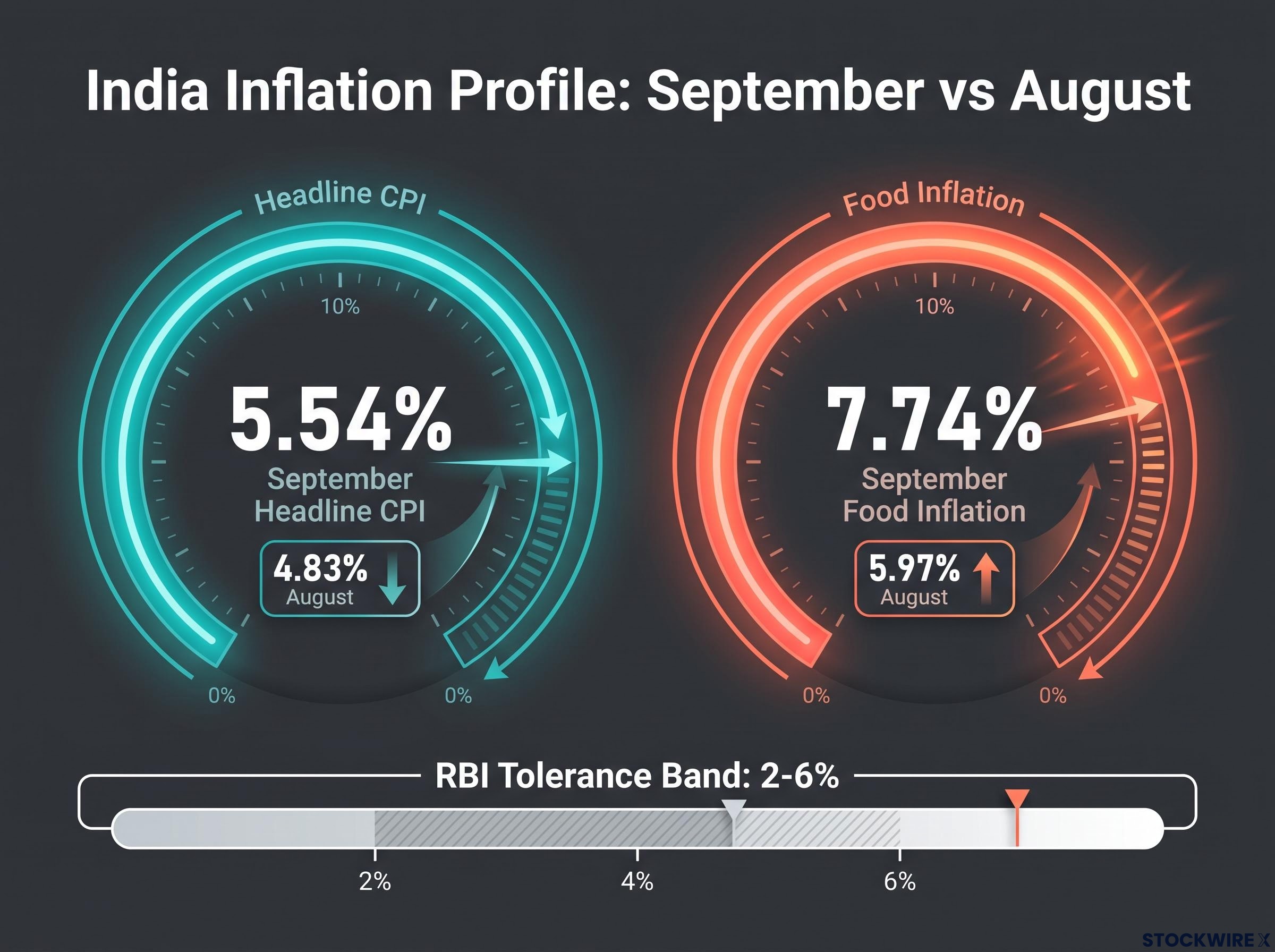
The headline still sits inside the RBI’s 2-6% tolerance band. The trend is the problem.
Inflation has risen every month since January and, according to Societe Generale, has held above the 4% target for four straight months. The bank argues the pressure is spreading beyond food, which makes it harder to dismiss as a passing harvest problem.
SBI Research call SBI Research recommends a pre-emptive 25 basis point hike and says the repo rate could reach 6% by December if inflation stays elevated, with cuts off the table.
The debate splits along these lines:
- Hike case: SBI Research favours tightening now to stay ahead of inflation.
- Hike case: Societe Generale sees recent increases as the start of tightening, not the end.
- Hike case: Reuters-polled economists say the 5.54% print strengthens the argument for more hikes.
- Counter-case: Rate rises are blunt against food and energy shocks and do nothing to lower onion or oil prices.
- Counter-case: Liquidity is already thin. Nomura estimates system liquidity fell from over ₹11 lakh crore in early September to about ₹5 lakh crore in October, and Kotak Mahindra Bank says the new steps could drain roughly ₹1.5 lakh crore more.
A lakh crore equals ₹1 trillion. The link runs both ways: a weaker rupee imports inflation, while higher rates can support the currency by improving the carry, the extra return from holding higher-yielding rupee assets.
A hawkish RBI repricing could in fact lend the rupee structural support, since worsening inflation becomes currency-positive if it triggers a credible rate response from the central bank.
For you, a broadening print means the RBI has less room to ease and more reason to tighten. That supports the rupee, but it raises the risk of over-tightening a system already short of cash.
How hawkish is the Fed, and can the rupee’s gains last?
The domestic picture leans supportive. The external one does not.
Cleveland Fed President Beth Hammack has argued for restrictive policy and warned about an entrenched inflation mindset. Goldman Sachs has resumed forecasting a Fed hike in October, while Bank of America Global Research expects hikes in both October and December.
US September CPI, due 14 October, is still pending. Previews centred on a headline reading near 3.6-3.7%, though one source reports the print at 3.2% against 3.4% in August with core easing; that figure has not been released as of this writing and should be treated with caution until it is.
MUFG says the package reduces immediate demand but is no permanent fix. Nomura describes falling reserves as the RBI’s first line of defence already depleted, with these curbs acting as a second line. The risks are clear:
- Supplying oil firms directly could drain reserves if the shortage persists.
- The 20% FERR may raise hedging costs for genuine importers and exporters.
- The US$5 million threshold could thin out derivative trading and hamper market-makers.
- In 2013, RBI outflow restrictions stirred fears of capital controls, Reuters reported, a reminder that rules can unsettle investors.
You should read the package as a bridge that buys time. Whether the rally survives depends on US yields, oil and foreign inflows, not on further RBI announcements.
What actually drives the rupee
India imports most of its oil, and most trade is priced in US dollars, so higher crude means more dollar buying. The RBI steps in to smooth sharp swings. Interest-rate gaps matter too: higher Indian rates attract carry investors. Foreign investment flows, both into shares and into businesses, add or remove demand for rupees. Higher inflation than in other countries usually weakens the currency, but it can prompt RBI rate hikes that help it.
The package targets the cyclical side (positioning, outflows, liquidity) rather than the structural reliance on imported energy.
Which USD/INR levels matter after the rebound?
FXStreet’s technical read gives the pair a bearish near-term bias, meaning the dollar is leaning lower against the rupee, while it trades below its 20-period exponential moving average (EMA). The EMA is an average of recent prices that gives more weight to the latest ones.
The relative strength index (RSI), a momentum gauge running from 0 to 100, sits around 37-40: below the neutral 50 but not oversold.
| Level | Value | Significance |
|---|---|---|
| Current range | 95.66-95.78 | Post-package trading zone |
| 20-period EMA | 96.00-96.03 | Sustained break above eases bearish bias |
| Support zone | 94.50-95.00 | Recent monthly lows, next downside target |
Technicals sit behind policy and macro drivers. Three catalysts will move the pair first:
- US CPI and Fed signals on further hikes.
- RBI liquidity steps and its next rate decision.
- Oil prices and their pull on dollar demand.
Treat a daily close back above 96.00 as the sign the policy effect is fading. A hold below it suggests the package is still working.
For readers tracking the pair into the next catalyst, our full explainer on the USD/INR outlook covers the 97.00 record high and the 50-day EMA support level.
What the package buys, and what still decides the rupee
The RBI delivered a fast, policy-driven rebound by stripping out oil-firm dollar demand and making speculation dearer. That buys time, not a cure.
Two markers now carry the weight: 96.00 on the pair, and the direction of RBI policy as inflation broadens. The next decision points are the RBI’s response to the 5.54% print and the US data that shapes the Fed’s path. If both lean the rupee’s way, the rally has room; if US yields and oil push higher, the gains could unwind.
Past performance does not guarantee future results. Financial projections are subject to market conditions and various risk factors. These statements are speculative and subject to change based on market developments.
This article is for informational purposes only and should not be considered financial advice. Investors should conduct their own research and consult with financial professionals before making investment decisions.