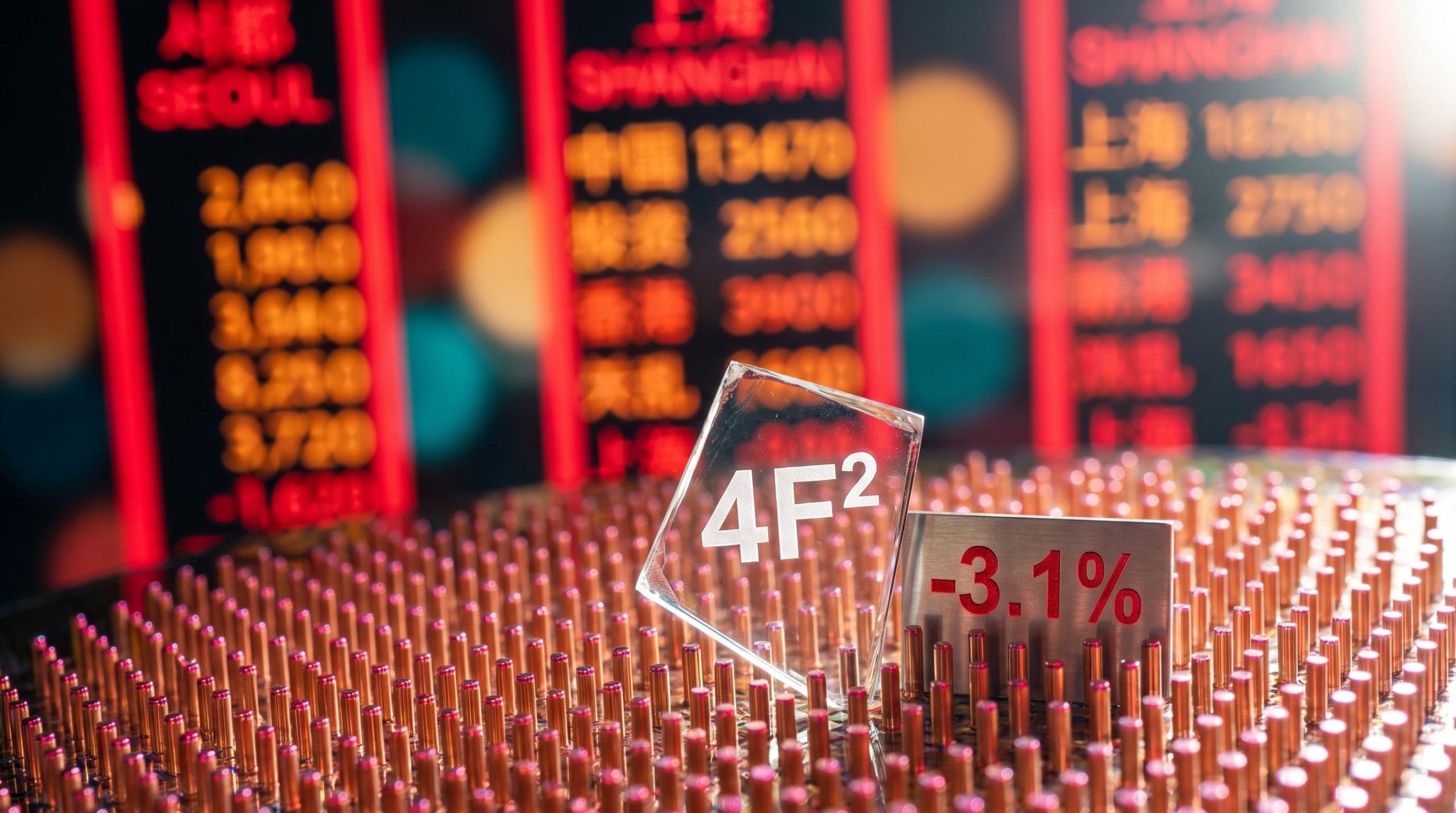
Samsung Electronics fell 3.6%, SK Hynix dropped 3.4% and CXMT slid 3.1% on Monday, 12 October 2026, after the Chinese memory maker outlined a 4F² DRAM cell design that has not yet shipped. A presentation triggered the selloff. No product was released.
CXMT President Dr Cao Kanyu presented the architecture at a weekend conference in Shanghai. DRAM (dynamic random-access memory) is the short-term working memory inside computers and servers. Beyond a target of launching a server-grade DDR5 RDIMM module by the end of 2026, CXMT disclosed no detailed specifications and no exact launch date.
That gap between the claim and the evidence is the story. Below is what the design changes, who is genuinely ahead on it, and how much of Monday’s drop reflects real competitive risk.
Why did Samsung and SK Hynix fall while CXMT fell too?
The odd detail is that the challenger fell alongside the incumbents. If traders had treated the news as a straight win for China and a loss for Korea, CXMT should have risen.
It did not. According to Investing.com reporting, all three stocks closed more than 3% lower in the first session after the 4th Integrated Chip and Chiplet Conference, held in Shanghai on or around 10 October 2026. Because the event fell on a weekend, Monday was the market’s first chance to respond.
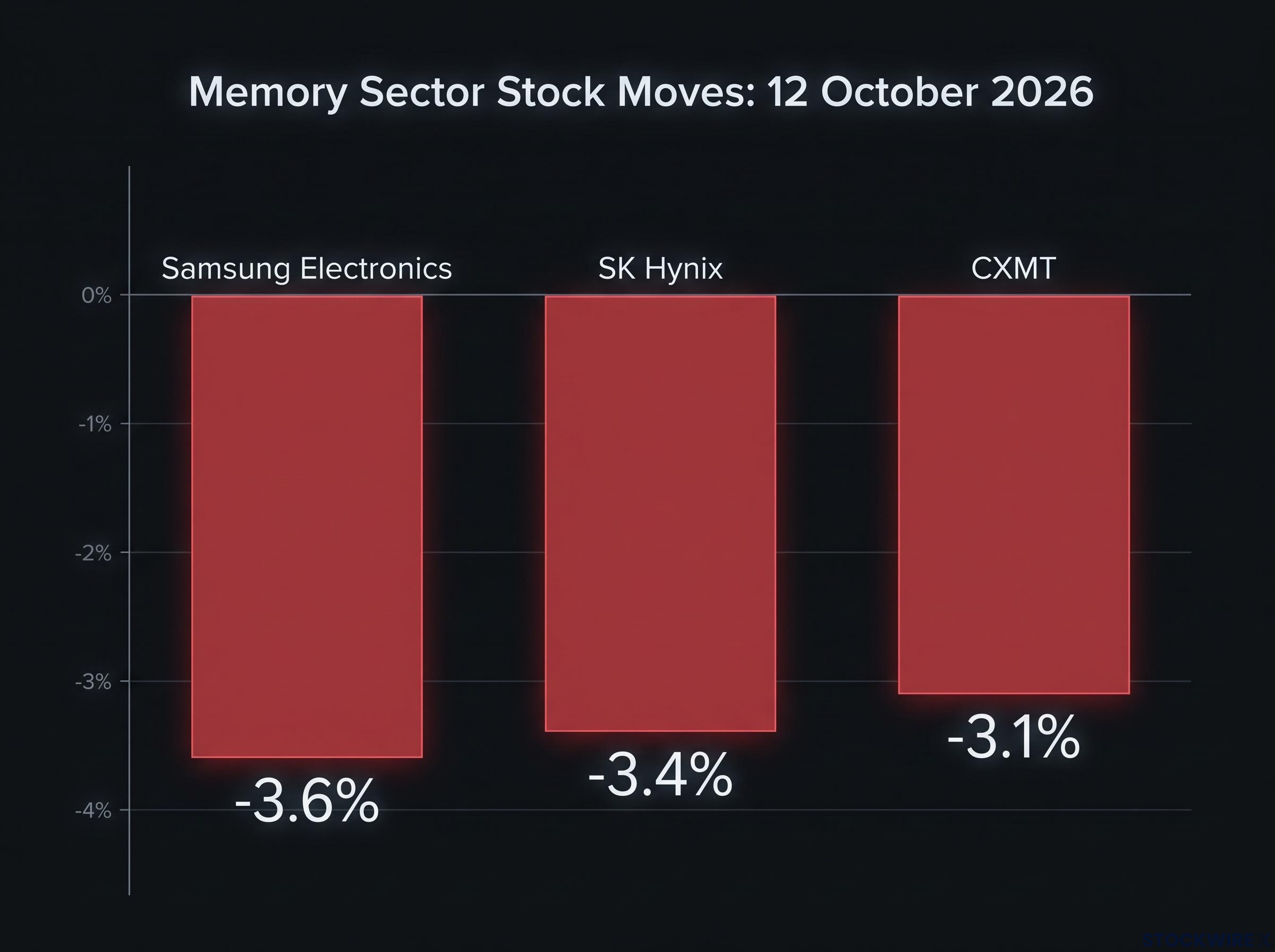
| Company | Move on 12 October 2026 | Closing price | Currency |
|---|---|---|---|
| Samsung Electronics | -3.6% | 252,500 | Won |
| SK Hynix | -3.4% | 1,624,000 | Won |
| CXMT | -3.1% | 49.42 | Yuan |
The trigger was a signal about density and competition, not disclosed product data. CXMT’s own decline points to broad caution across chip stocks, or simple profit-taking, rather than a clean transfer of value from Seoul to Shanghai.
The challenger’s own share price had already been volatile since CXMT’s Shanghai debut in July, when a thin free float amplified a first-day surge of 466%, which helps explain why its stock can fall alongside the incumbents.
That matters for how you read the Korean declines. A same-direction fall tells you the market was pricing uncertainty about memory-sector economics, so the drops are not proof that Samsung or SK Hynix have lost share. Some coverage suggests the reaction may be overstated.
When big ASX news breaks, our subscribers know first
What is 4F² DRAM, and what is CXMT actually claiming?
On paper, the claim is simple: a smaller memory cell. The mechanics explain why that matters.
F is the minimum feature size, the smallest dimension a chipmaker can reliably print. Mainstream commercial DRAM uses a 6F² cell, meaning each cell occupies six of those squared units. A 4F² cell cuts that to four by stacking the transistor and capacitor vertically instead of placing them side by side.
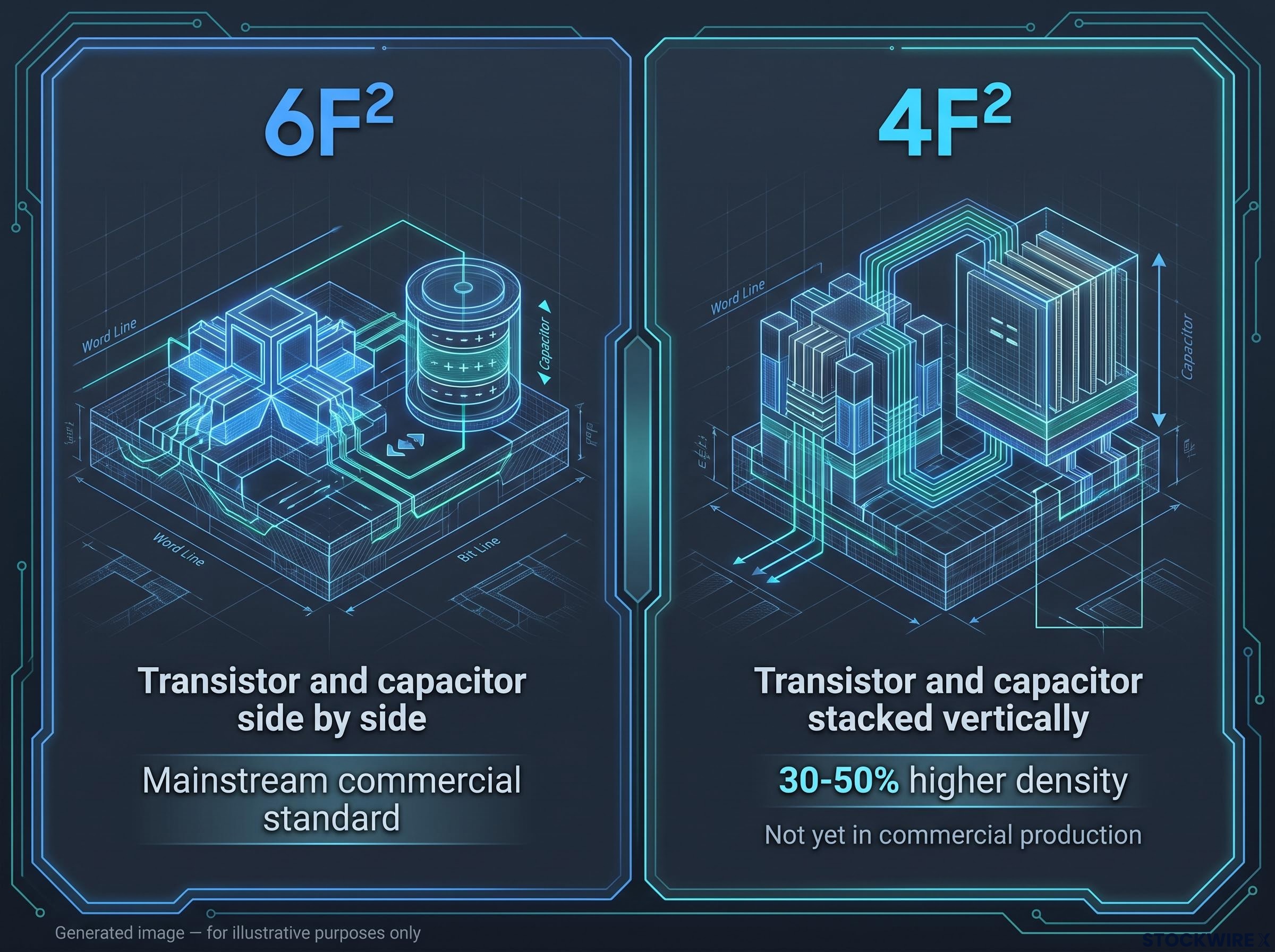
Smaller cells mean more cells per wafer, and more bits from each one. The density gain is cited at roughly 30-50% over 6F², although that figure is an industry estimate, not a CXMT-verified result.
CXMT’s version relies on an in-house Vertical Surrounded Gate (VSG) transistor, which the South China Morning Post renders as “Vertical Surrounding Gate”. A VSG transistor has a gate that wraps around the channel, the path current flows through. That gives tighter electrical control, reducing leakage and short-channel effects, two persistent problems as DRAM shrinks.
| Feature | 6F² | 4F² |
|---|---|---|
| Cell layout | Transistor and capacitor side by side | Transistor and capacitor stacked vertically |
| Relative density | Baseline | Cited at roughly 30-50% higher |
| Process complexity | Mature and established | New process flows, tighter tolerances |
| Current status | Mainstream commercial standard | Not yet in commercial production |
The work is not new. CXMT says it has published more than 300 patents tied to the architecture, with research dating to its founding in 2016 and the first mainland China paper on the topic in 2021.
Higher density only becomes lower cost per bit if CXMT can produce it at good yields and at scale. Treat the 30-50% figure as potential economics, not realised ones.
What has not been disclosed
CXMT has not published:
- Detailed specifications
- Performance metrics
- Power profiles
- Launch volumes
- An exact launch date beyond end-2026
- Qualification results from hyperscalers or server makers
Commercial impact depends entirely on CXMT reaching market and satisfying server customers, who demand reliability, endurance and compatibility.
Who is actually ahead on 4F²: CXMT, Samsung or SK Hynix?
The timeline does most of the work here. CXMT is targeting end-2026. Technical outlets including Tweaktown and Wccftech report that Samsung is not expected to mass-produce 4F² memory until around 2028, as part of a sub-10-nanometre push sometimes linked to its B1b/D0a node.
SK Hynix revealed its own 4F² roadmap in 2025 and has reported progress on vertical-gate designs. Coverage of the CXMT news cites no fixed commercial date.
The “leapfrog” reading Hardware outlets frame a credible 2026 launch as a potential leapfrog, putting CXMT roughly two years ahead of Samsung on this architecture. Global Times went further, calling the announcement a “breakthrough in China’s push into server memory chips.”
That interpretation hinges on CXMT hitting its date. The company’s recent record shows momentum, with its G5 DRAM platform entering mass production in September 2026.
Scale is a different matter. TrendForce and Counterpoint Research data for Q2 2026 put CXMT’s share of global DRAM revenue at a fraction of the leaders’.
| Company | 4F² timing | Q2 2026 DRAM share | HBM position |
|---|---|---|---|
| CXMT | Targeting end-2026 | 9.5-10% | No disclosed HBM line |
| Samsung Electronics | Reportedly around 2028 | 38-39.4% | Leading HBM supplier |
| SK Hynix | Roadmap shown 2025, no date | 24.9-25% | Leading HBM supplier |
Micron held roughly 23.3-24%. High-bandwidth memory (HBM) is stacked DRAM used in AI accelerators, and CXMT’s prospectus disclosed no production line for it.
A lead in cell design is not a lead in AI memory. When judging each stock, separate commodity and server DRAM exposure, which sits in CXMT’s path, from HBM exposure, which currently does not.
The incumbents’ insulation rests on HBM demand that Citi projects could rise 434% at system level, since each gigabyte of HBM consumes 3-4x the wafer capacity of standard DRAM and limits oversupply.
How much competitive risk should investors price in?
The bull-case worry is straightforward: a denser, cheaper Chinese server chip squeezing Korean margins. TrendForce describes the move as a strategic acceleration from consumer DRAM toward server-grade DDR5.
Three hurdles sit between that worry and reality. Export controls restrict CXMT’s access to advanced lithography and process equipment, which could slow a competitive ramp. Yields on a complex vertical process are unproven, and hyperscalers must still qualify the modules.
WindowsForum put it bluntly: server specs and qualification remain unknown. No named analyst was found questioning CXMT’s yield directly, so that risk rests on structural reasoning rather than a published call.
Meanwhile, AI-driven demand and HBM strength continue to support the incumbents. The milestones that would genuinely shift the picture, in order:
- Published specifications for the DDR5 RDIMM
- Qualification wins with hyperscalers or server makers
- Evidence of yield and a volume ramp
- Pricing behaviour once product ships
The pricing precedent from NAND
China’s YMTC offers background, not a forecast. In NAND flash storage, it used aggressive pricing and domestic support to win share before US sanctions constrained it.
DRAM dynamics and export controls differ, so the analogy only goes so far. The balanced read is an important signal, not yet decisive, and heavily dependent on execution. Share-price moves driven by announcements alone are a reason for caution, not conviction.
What the selloff signals, and what it does not settle
Monday’s drops reflect a credible but unproven signal. CXMT’s design progress is real, its specifications are unknown, and the Korean makers’ HBM and packaging strength is untouched.
The next checkpoints are clear: CXMT’s end-2026 server DDR5 RDIMM target, and Samsung’s reported 2028 timeline. If CXMT ships on schedule with qualified customers and credible yields, the case for pressure on commodity and server DRAM pricing strengthens. If the date slips or specifications disappoint, Monday will look like a reaction to a slide deck.
Your view on Korean memory stocks versus CXMT should move on qualification and yield evidence, not on the next presentation.
For readers wanting the wider picture, our detailed coverage of the HBM market outlook explains why Micron expects the market to reach $100 billion by 2028.
This article is for informational purposes only and should not be considered financial advice. Investors should conduct their own research and consult with financial professionals before making investment decisions. Forward-looking statements are speculative and subject to change based on market developments and company performance.