Brent crude is trading above $105 a barrel, yet Goldman Sachs has set its December forecast at $90. The difference is close to the bank’s estimate of how much of today’s price reflects fear rather than a shortage of physical supply.
In early Asian trading on Monday, Brent futures rose 76 cents to $105.48. Goldman analysts led by Daan Struyven put the geopolitical risk premium at just over $20 a barrel.
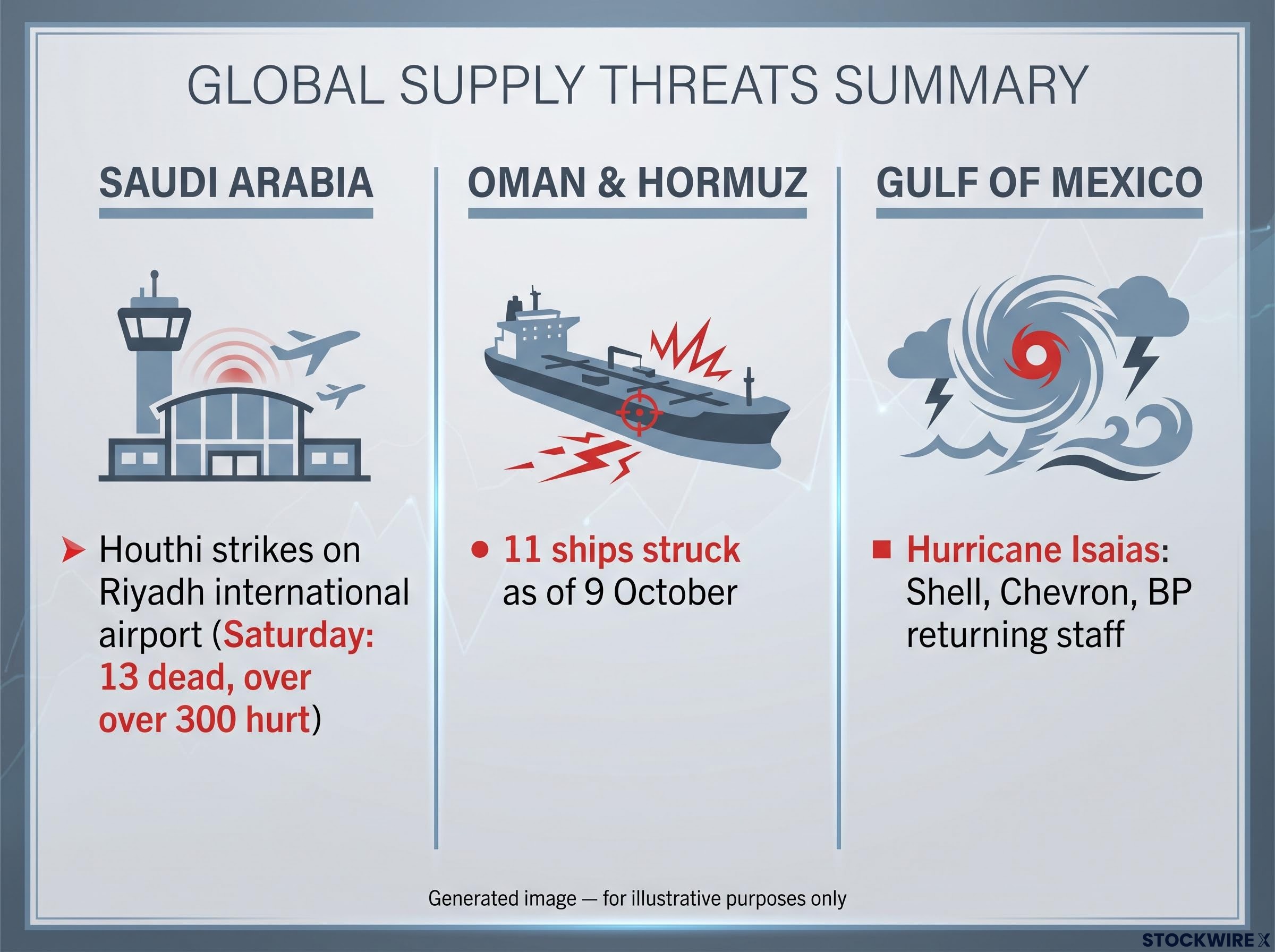
The weekend added several new risks. The Houthis struck Saudi Arabia, two tankers were hit near Oman and the Strait of Hormuz, and Hurricane Isaias forced production shutdowns in the Gulf of Mexico.
This matters if you buy fuel, hold energy stocks or worry about inflation. The split between fear and fundamentals decides how quickly oil prices could fall, or how much further they could climb. Below is what the market has priced in, what could unwind it and what could push it higher.
What is baked into oil prices right now?
As of 2304 GMT, Brent stood at $105.48, up 0.73%. West Texas Intermediate (WTI), the main US crude benchmark, was at $92.44, up 59 cents or 0.64%. Both benchmarks have climbed steadily over the past week.
| Date | Brent (US$/bbl) | WTI (US$/bbl) |
|---|---|---|
| 7 October 2026 | $101.33 | $89.83 |
| 10 October 2026 | ~$103.53 | ~$90.97 |
| 12 October 2026 | $105.48 | $92.44 |
The prices on screen do not tell you how much oil is actually missing. Goldman’s note of 11 October raised its December 2026 Brent forecast to $90 from $85 and isolated the portion of the price that reflects risk.
Goldman’s risk premium estimate Just over $20 per barrel of Brent’s price reflects geopolitical risk premium tied to the Middle East conflict, tanker attacks and Houthi strikes.
A risk premium is the extra amount buyers pay above what current supply and demand would justify. Goldman says this premium hedges against possible shortages and demand disruption, not just outages that are happening now. The bank expects it to stay in the price until markets are confident a long disruption is unlikely.
Analysts note that a geopolitical risk premium tends to decompress slowly even after de-escalation, because insurance withdrawal and supply chain repair take far longer than a ceasefire announcement.
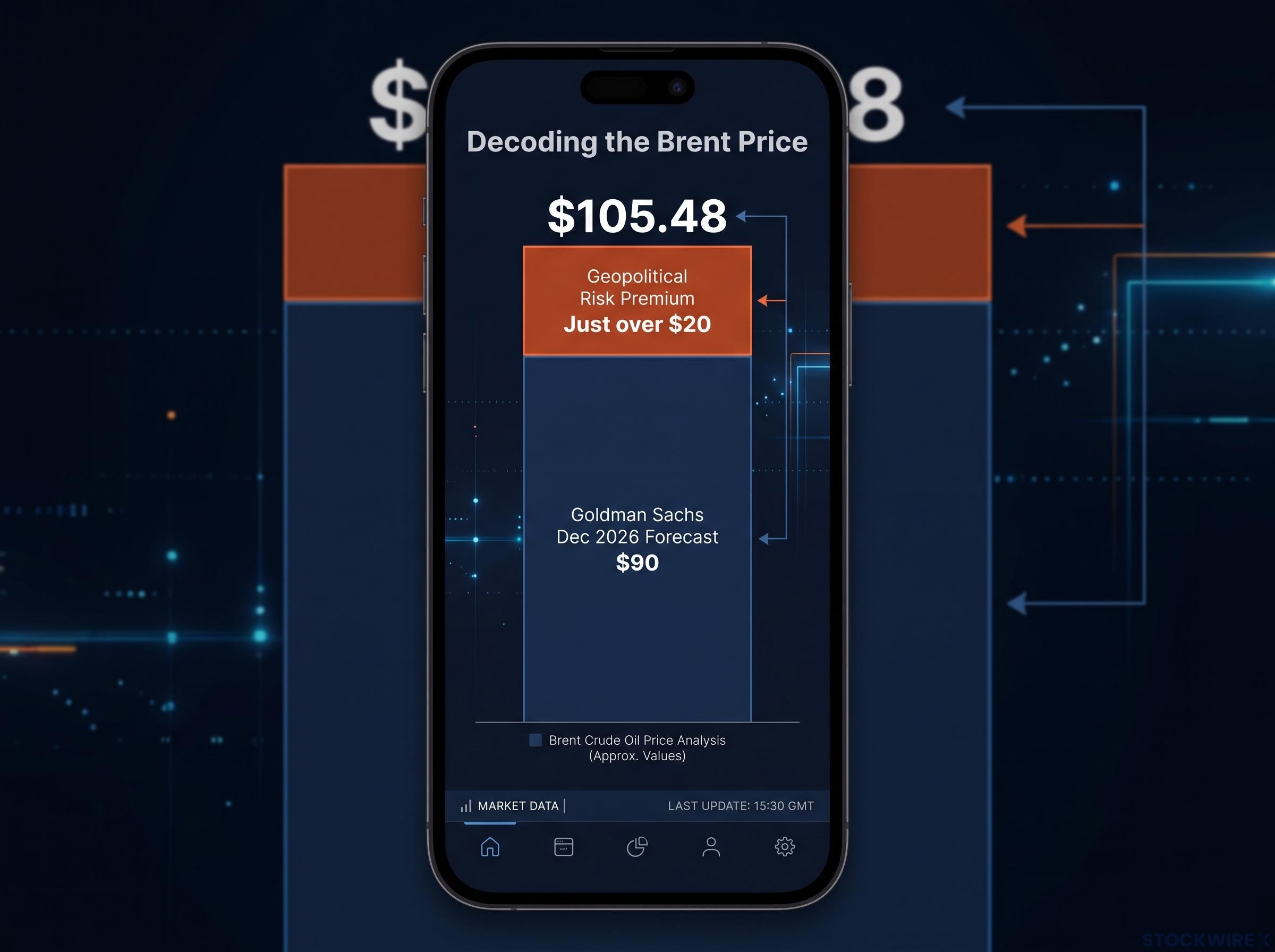
The premium has also grown. In March, Goldman estimated traders were paying about $14 more per barrel than before the conflict. Later that month, it forecast Brent to average about $110 across March and April.
If Goldman is right, roughly a fifth of what you pay for crude-linked fuel or exposure is a fear charge that could disappear quickly. You should treat today’s price as conditional, not as a floor.
When big ASX news breaks, our subscribers know first
Where the supply threat is coming from: Saudi airports, Hormuz tankers and a Gulf storm
That fear charge rests on three separate threats, each with a different link to actual barrels:
- Saudi Arabia and the Houthis: strikes on civilian infrastructure, with the risk of US involvement
- Tankers near Oman and Hormuz: repeated hits on vessels in the world’s most important oil shipping lane
- Gulf of Mexico: storm-related production shut-ins that are already reversing
Houthi strikes on Saudi Arabia
The Houthis took credit for Saturday’s attack on Riyadh’s international airport, which left 13 dead and over 300 hurt. Saudi officials said a further attack on the same airport on Sunday also caused injuries.
President Donald Trump said on Saturday that Washington was weighing whether to join Saudi military action against the Houthis. He framed the escalation as a knock-on effect of the broader conflict with Iran, which the US and Israel started in February. US military involvement would raise the stakes considerably.
Tanker attacks near Oman and Hormuz
Two tankers were attacked over the weekend. One was hit by a drone close to the Sohar anchorage in Oman, while the other was damaged by an unidentified projectile during its passage through the Strait of Hormuz.
The UK Maritime Trade Operations (UKMTO) first logged Sohar as an “incident”, then reclassified it as an “attack”. It has advised vessels in Hormuz to exercise caution. Fox News, citing the International Maritime Organization and UKMTO, reported that 11 ships had been struck in Hormuz or off Oman as of 9 October. That figure has not been independently confirmed.
The Hormuz shipping crisis has left transits at a small fraction of pre-war levels, with war-risk insurance far above normal rates, which is why tanker hits matter beyond the vessels involved.
Hurricane disruption in the Gulf of Mexico
Hurricane Isaias made landfall early on Saturday. Shell, Chevron and BP are now returning staff to their platforms and restarting output. Operator-level shut-in volumes were not available.
Running the other way, Russia and Ukraine agreed an energy ceasefire, Trump said on Sunday, days after Friday’s announcement of a diesel supply arrangement with Russia.
Attacks on airports and tankers are not the same as lost barrels. The signal to watch is whether strikes shift from civilian and shipping targets to oil export infrastructure.
Why is WTI so far below Brent?
Look again at the price table and you will see a gap. On Monday, Brent traded about $13 above WTI. Most of the explanation comes down to freight costs and geography.
Goldman Sachs on the spread WTI is “unusually low vs Brent” because of high shipping costs between the US and Europe.
Four factors keep the gap wide:
- Freight: expensive transatlantic shipping makes it less profitable to buy US crude and sell it in Europe, so the two prices stay apart
- Insurance and rerouting: detours around the Red Sea, Hormuz and the Gulf of Aden raise delivered costs for Brent-linked cargoes
- Export capacity: pipeline and port limits on the US Gulf Coast cap how far WTI can rise
- Benchmark role: Brent prices seaborne oil and takes shipping shocks directly, while US inventories cushion WTI
Goldman forecasts WTI to average $81 in December 2026 and $73 in 2027. The spread could narrow if freight costs come down. If you hedge or trade with WTI contracts, your exposure may not track the Brent headline, and that relationship can change quickly.
Premium fades or premium grows: what could move oil prices next
Goldman’s $90 target sits roughly $15 below Monday’s Brent price. The bank’s base case is that Middle East supply keeps adapting and prices ease. It also warns that renewed escalation poses significant net upside risk.
| Scenario | Drivers | Signals | Price implication |
|---|---|---|---|
| Adaptation case | Rerouting, spare OPEC+ capacity, strategic reserves, more US shale | Contained damage, ceasefires hold | Premium erodes towards Goldman’s $90 |
| Escalation case | Strikes on Saudi infrastructure, partial Hormuz disruption | US action against the Houthis, more tanker hits | Another leg higher |
History favours the adaptation camp. After the 2019 Abqaiq attacks, the tanker wars of the 1980s and the 1990-91 Gulf War, risk premiums spiked and then faded once escorts, insurance adjustments and diplomacy restored confidence.
The current situation differs in one way: the number of attacks. Analysts warn that with double-digit tanker hits, markets may be underpricing the risk of a partial Hormuz disruption. Others argue that tight fundamentals explain part of today’s price, which would make the true premium smaller than Goldman’s estimate.
Sustained high oil also feeds into inflation and interest rates. Higher prices can reduce demand, which changes when any unwind might happen.
Fuel buyers face a separate pressure from diesel crack spreads, which have run several times their historical norm and mean pump prices can stay high even if crude retreats.
Four triggers to watch:
- Further successful strikes on Saudi oil infrastructure
- A US decision to join action against the Houthis
- OPEC+ or strategic reserve intervention
- Whether the Russia-Ukraine energy ceasefire holds
Treat the outlook as having two likely paths: a rapid unwind if damage stays contained, or a move higher if infrastructure is hit. Planning positions or budgets around a single forecast is the main mistake to avoid.
Past performance does not guarantee future results. Financial projections are subject to market conditions and various risk factors. These statements are speculative and subject to change based on market developments.
Reading the $90 forecast against a $105 market
Goldman’s forecast and the market price disagree by roughly the size of the risk premium, and that gap is the real story. Neither number is wrong. Each reflects a different view of whether the Middle East conflict stays contained.
Two developments are likely to decide which way the gap closes: whether strikes reach Saudi export infrastructure, and whether Washington joins action against the Houthis. If neither happens, the premium has room to fade. If either does, the forecast may need revising instead.
Whatever your exposure, the useful question is not where oil settles. It is how much of a fast reversal, in either direction, you can absorb.
Investors comparing forecasts will find our detailed coverage of institutional crude oil forecasts sets Goldman, J.P. Morgan and the Reuters consensus side by side against spot prices.
This article is for informational purposes only and should not be considered financial advice. Investors should conduct their own research and consult with financial professionals before making investment decisions.