Elon Musk said over the weekend that Starlink will have to price its service affordably in India, and he turned the remark into a public clash with Mukesh Ambani. The timing is pointed: Reliance‘s telecom arm, Jio Platforms, is days away from opening the largest IPO in Indian history.
The offer carries a price band of ₹1,065-₹1,119 per share and a reported valuation of roughly US$106-107 billion. Subscription opens on 21 October 2026, so the feud has landed in the final stretch before investors commit capital.
Musk’s posts, published around 9-10 October, offered rhetoric but no Starlink India pricing. The key question is whether satellite competition actually threatens Jio’s growth story, or whether the threat is louder than it is large.
Here is how to separate the noise of the feud from the structural factors that decide that question, and what to track before listing day.
Does satellite competition actually threaten Jio’s growth story?
The instinctive worry is simple. A deep-pocketed disruptor promises cheap service just as Jio asks the market to price its future.
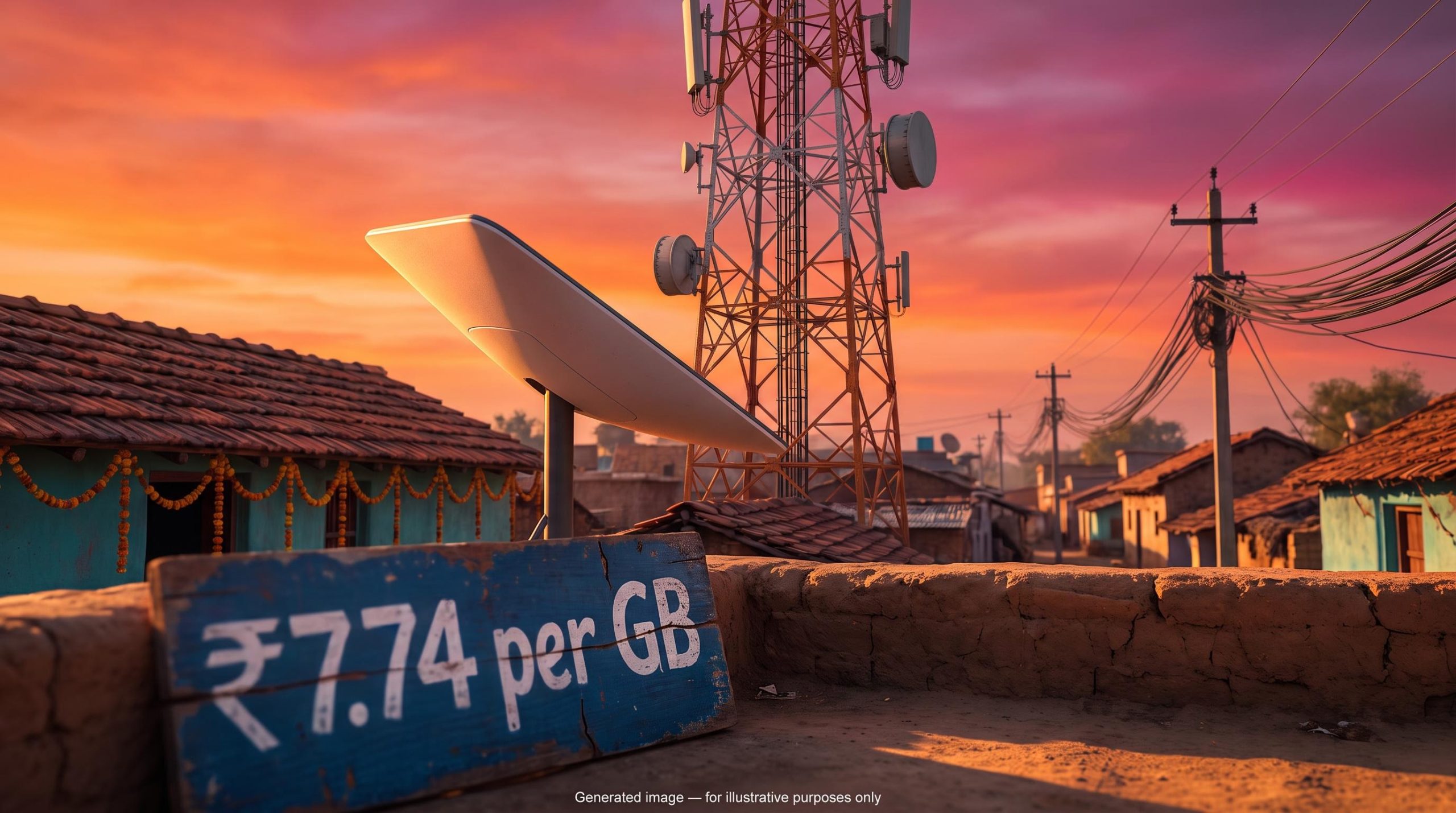
Then comes the benchmark Musk himself raised. Indian mobile data costs roughly ₹7.74 (about US$0.08) per GB, among the cheapest anywhere in the world.
Elon Musk on X: “if Starlink is too expensive in India, no one will buy it, so SpaceX will need to make pricing affordable.”
That price floor is a very high bar. Satellite constellations generally carry higher capital and operating costs per GB than dense terrestrial networks, which limits how far they can chase heavy urban users on price. Even Musk conceded Ambani’s profits would shrink but that he “is not going out of business.”
The scale Starlink would be competing against, as of the April-June 2026 quarter:
- 533.3 million customers
- 285 million 5G users
- 28.6 million fixed broadband connections
- Access to 360,382 towers and over 1 million route-km of fibre
- Wireless broadband coverage above 99% of India’s population
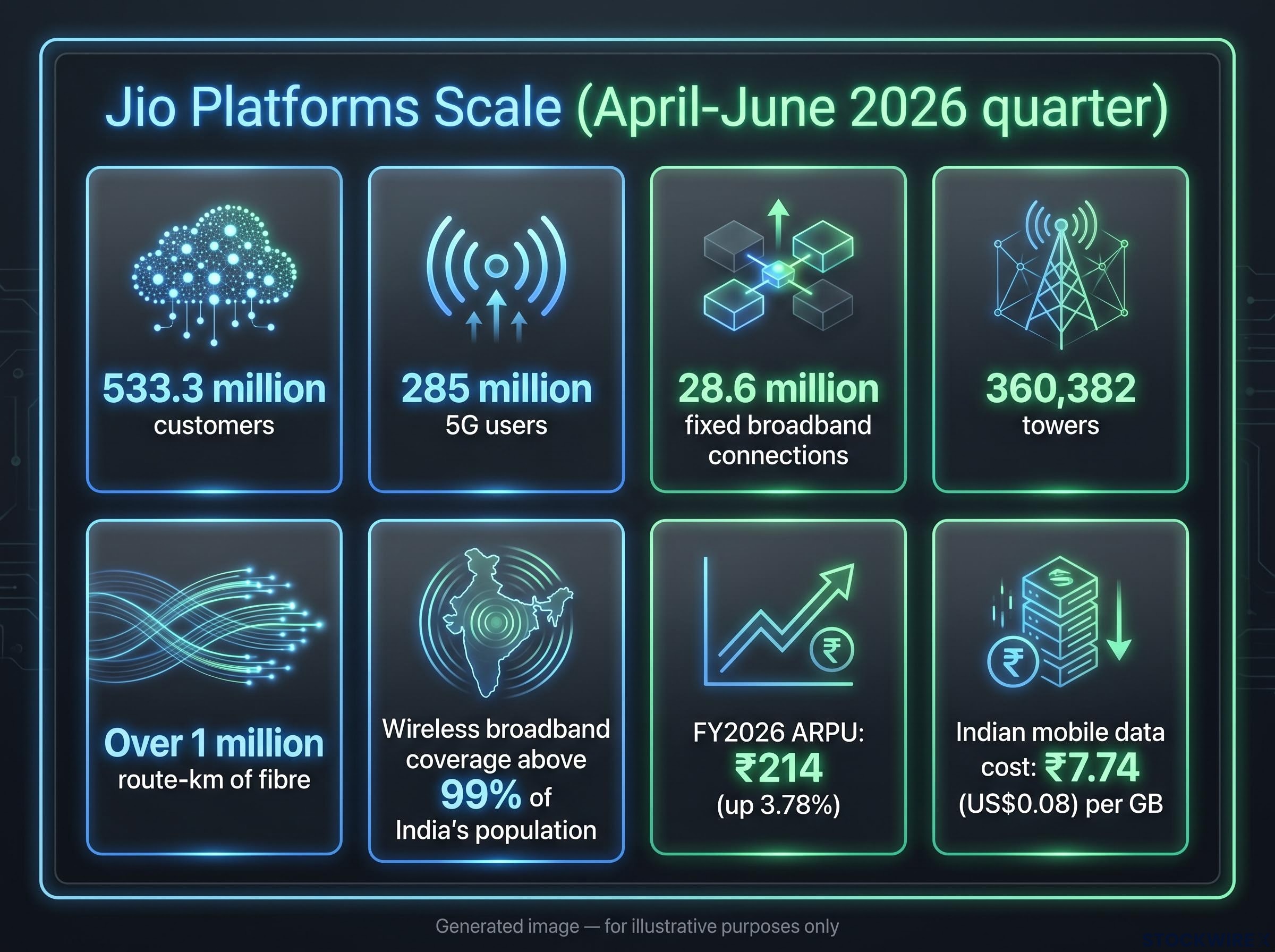
Jio’s FY2026 average revenue per user (ARPU), the monthly revenue earned from each subscriber, was ₹214, up about 3.78% year on year. Satellite typically targets rural, remote, maritime and enterprise customers, so its pressure on urban mass-market ARPU is structurally limited.
Satellite targets rural, remote and enterprise customers because the Starlink business model rests on a rural broadband franchise with high retention and limited terrestrial competition, alongside a wholesale direct-to-cell layer sold through carrier partners.
No official Starlink India price plans, hardware costs or plan structures have been published. Reuters noted Musk has used cheap-data tactics in Kenya, but no sourced Kenyan pricing exists for comparison, and no named analyst has quantified satellite’s impact on Jio. For you, that makes the pledge a statement of intent, not a measurable threat to Jio’s earnings today.
Where satellite could help rather than hurt Jio
Jio has its own satellite venture with SES, queued for the same clearance as Starlink. Satellite could close rural and corporate coverage gaps and lift blended ARPU at the margin if Jio captures premium segments. Treat this as a scenario rather than a forecast.
Why is Starlink still waiting, and who else is in the queue?
Musk’s sharper charge was about delay. Late on Friday he mocked Ambani as “Prime Minister Ambani,” asked whether he would “consider allowing Starlink to compete,” and suggested Ambani’s influence was slowing approval, a sharp turn from his previously friendly public stance toward Prime Minister Narendra Modi.
Officials have called claims of targeted delay “blatantly false.” Reliance did not reply to requests for comment.
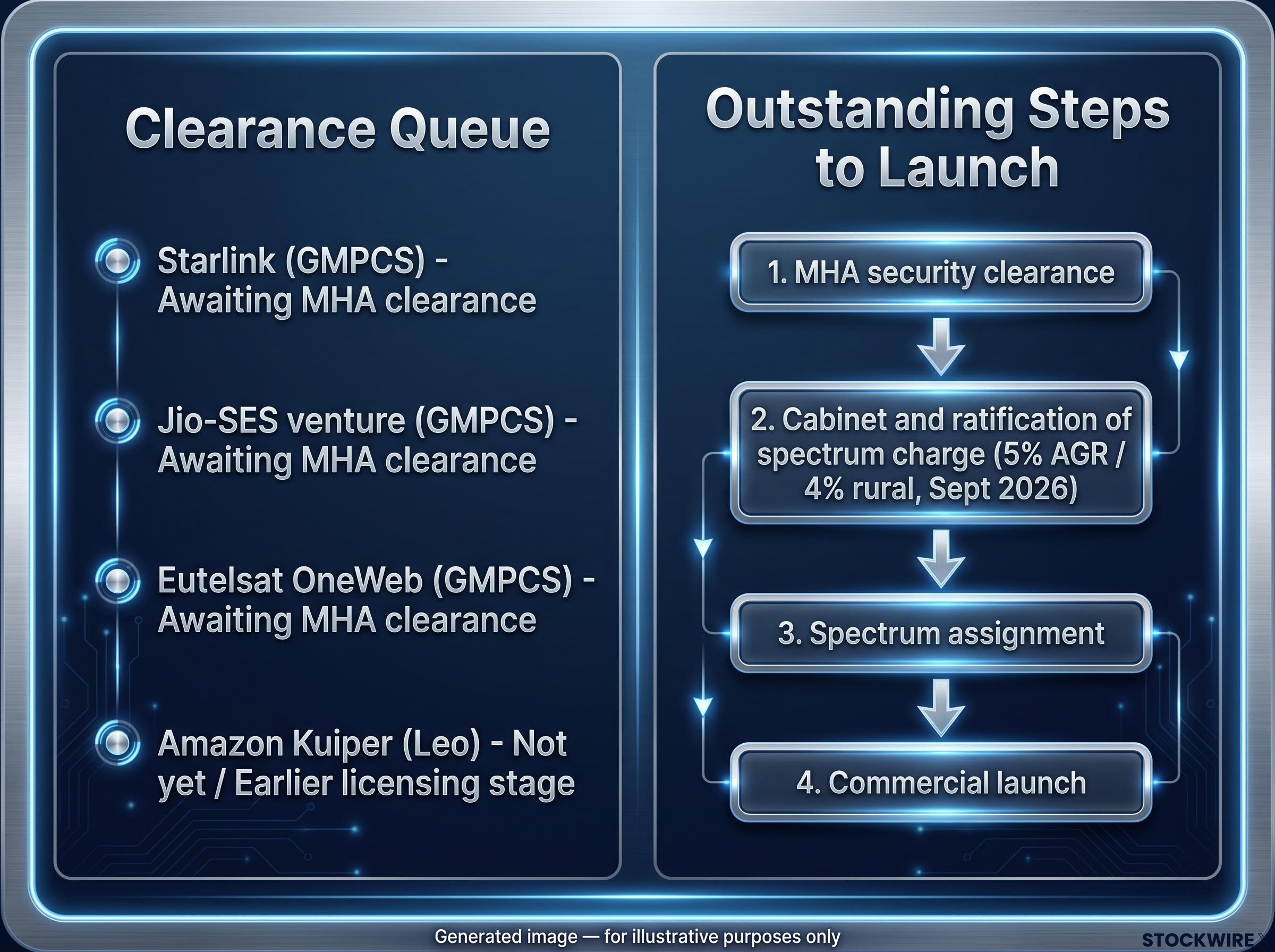
The documented process points elsewhere. Three ventures hold Global Mobile Personal Communications by Satellite (GMPCS) licences, yet none can launch commercially without final Ministry of Home Affairs (MHA) security clearance and a completed spectrum pricing framework.
| Operator | Licence held | Clearance status | Notes |
|---|---|---|---|
| Starlink | GMPCS | Awaiting MHA clearance | Third licensee |
| Jio-SES venture | GMPCS | Awaiting MHA clearance | Reliance’s own satellite play |
| Eutelsat OneWeb | GMPCS | Awaiting MHA clearance | Same conditions apply |
| Amazon Kuiper (Leo) | Not yet | Earlier licensing stage | Behind the other three |
The MHA review covers lawful interception, Indian gateways and data localisation. In September 2026, the Digital Communications Commission approved a spectrum charge of 5% of adjusted gross revenue (AGR), cut to 4% in notified rural and remote areas. Spectrum is assigned administratively, not by auction.
Steps still outstanding:
- MHA security clearance
- Cabinet and ratification of the spectrum charge
- Spectrum assignment
- Commercial launch
SpaceX also plans to become a mobile carrier, starting in the US. Any Indian direct-to-cell service, meaning satellite connectivity to standard phones without a dish, would face the same framework. Because the bottleneck is shared, read timing as a sector-wide policy variable rather than favouritism, while recognising that every month of delay buys incumbents time.
Investors exploring whether satellite pricing can work at mass-market scale should read our deep-dive into Starlink phone service economics, which tests whether it can stand without a terrestrial partner subsidising costs.
What should Jio IPO investors weigh beyond the headlines?
The fundraising tops out at about ₹30,200 crore (one report gives ₹28,755-₹30,213 crore) through a fresh issue of roughly 27 crore shares.
- Anchor book: 19 October 2026
- Subscription opens: 21 October 2026
- Potential listing: around 28 October 2026
Valuation discrepancy: Reuters cites US$106 billion. Fortune India and Moneycontrol report about ₹10.3 lakh crore (about US$107 billion) as of 9 October, while Economic Times, citing Bloomberg, reports around ₹11 lakh crore as of 11 October. Earlier speculative estimates reached US$170 billion.
| Risks | Counter-arguments |
|---|---|
| ₹10.3-11 lakh crore valuation against ₹214 ARPU embeds strong growth expectations | 533.3 million customers and a nationwide network support earnings power |
| ARPU growth may be capped by low tariffs or new competitors | ARPU rose about 3.78% and fixed broadband reached 28.6 million |
| Prolonged satellite policy uncertainty | Jio’s SES venture offers satellite optionality |
| Reputational risk from a foreign entrant alleging partiality | Authorities may clear multiple operators to show neutrality |
Musk is invoking Jio’s own 2016 launch, when free and entry-level offers drove price erosion and industry consolidation, though that account has not been independently confirmed. Your IPO decision likely hinges more on ARPU growth and tariff policy than on Starlink, yet the feud adds a policy-sentiment risk worth tracking.
Record size does not guarantee returns either, since historical IPO cohorts have trailed comparable established peers by an average of 3.3% per year across the first five years of trading.
What to watch between now and listing day
The feud generates headlines, but ARPU trajectory, tariff policy and clearance timing decide the outcome for Jio. Three markers will tell you whether satellite competition is moving from rhetoric to reality: the MHA security clearance decision, Cabinet ratification of the spectrum charge, and any published Starlink India price plans.
None of those has arrived. With no pricing on the table and subscription opening on 21 October, treat claims from either camp as unproven until real figures appear.
This article is for informational purposes only and should not be considered financial advice. Investors should conduct their own research and consult with financial professionals before making investment decisions. Past performance does not guarantee future results, and forward-looking statements are speculative and subject to change.