Oil markets got what looked like good news this week, and prices rose anyway. Brent slipped after President Trump called talks with Iran “productive” and ruled out a strike before the November midterms. Yet crude still finished the day and the week higher, near $103.3 a barrel, while diesel and gasoil climbed about 12% from Tuesday’s dip.
That gap is the signal many readers miss when they think about the oil price forecast. Softer rhetoric from Washington is not the same thing as safer tankers in the Strait of Hormuz.
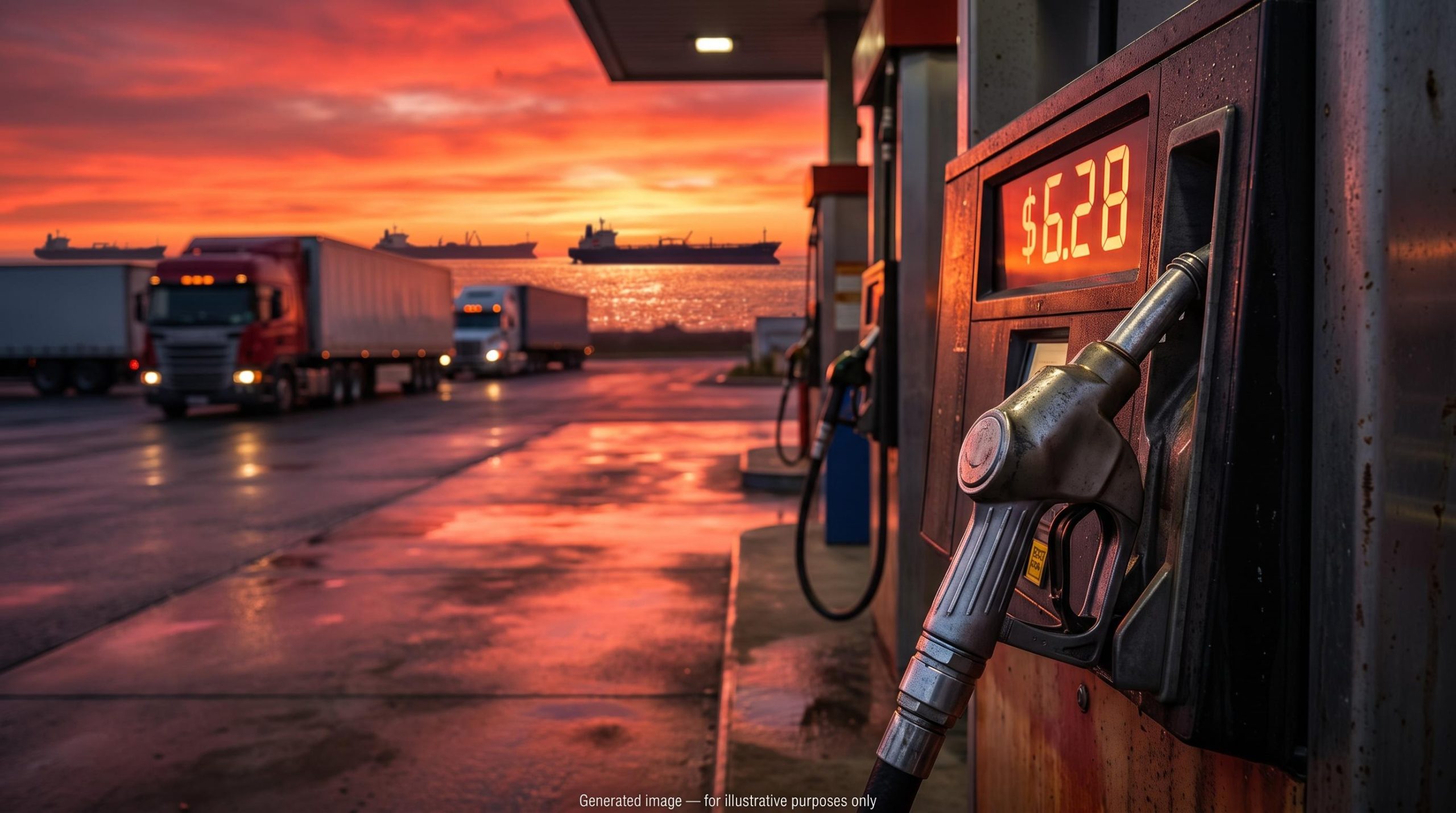
The pressure shows up first at the pump. According to AAA, the US national average for diesel sits around $6.28-$6.30 per gallon, only about $0.23-$0.25 below the record of $6.5276 set on 22 September. That feeds into freight costs, inflation readings and any energy-exposed holdings you own.
Here is how to read the near-term oil outlook from this episode: which moves are noise, which are physical supply risk, and which signals deserve a place on your watchlist.
Why crude stayed above $100 even as Brent eased on Trump’s Iran comments
The day started with escalation. Reports that the US might strike Iran before the midterms pushed Brent toward $105. Then Trump described the Iran talks as “productive” and said no attack would come before November, and Brent slid into the low $103s.
On a chart, that looks like relief. It wasn’t enough to finish the job.
Brent settled at $104.28 on 8 October, and oil closed higher on both the day and the week. Note that earlier reported figures of $100.20 and $88.28 referred to specific contract months (December Brent and November WTI), not the front-month settlements used as headline prices below.
| Benchmark | 8 Oct settlement | Recent reference point | What drives it |
|---|---|---|---|
| Brent | $104.28 | Peaked near $105 before Trump’s comments | Seaborne supply, Hormuz shipping risk |
| WTI | $90.25-$91.66 | Pressured by reserve release news | US supply, landlocked delivery |
| Brent-WTI spread | $12-$13 | Framed by Investing.com as the cost of Hormuz risk | Geopolitical premium on seaborne crude |
That spread is the market’s price tag on danger. Brent is the benchmark for oil that moves by sea, so it carries the risk of tankers being hit; West Texas Intermediate (WTI), priced at a US inland hub, does not.
That spread reflects a geopolitical risk premium that tends to decompress slowly, and the IEA has projected a two-year supply chain recovery even under a best-case resolution.
The danger is physical. On or around 6 October, a projectile struck the tanker MT On Peace in the Strait of Hormuz, injuring 12 crew members, and CNBC reported nearly 20 commercial ships came under fire in the area over the prior month.
Rabobank’s read Senior Economist Maartje Wijffelaars said diplomacy reduced the risk premium but did not remove it. While Hormuz shipping stays under threat, Rabobank expects prices to tend to hold in the low $100s.
The US Energy Information Administration (EIA) points the same way, projecting Brent to average $105 in Q4 2026 in its latest Short-Term Energy Outlook. When Brent holds above $100 after a diplomatic headline, it tells you the market still prices a real chance of further escalation, so headline-driven dips are weaker signals than they look.
When big ASX news breaks, our subscribers know first
Why is diesel rising faster than crude?
Crude is well off its highs. Diesel is not. The pump price sits within about 25 cents of its record, and Rabobank notes gasoil (the European benchmark for diesel-type fuel) has jumped 12% since Tuesday.
To see why, start with what diesel is. Diesel is a refined product, meaning it is made from crude oil at a refinery. Its price depends on crude plus three other things: how much refining capacity is available, how much fuel sits in storage, and whether shipping routes are open.
Right now, all four drivers point in the same direction:
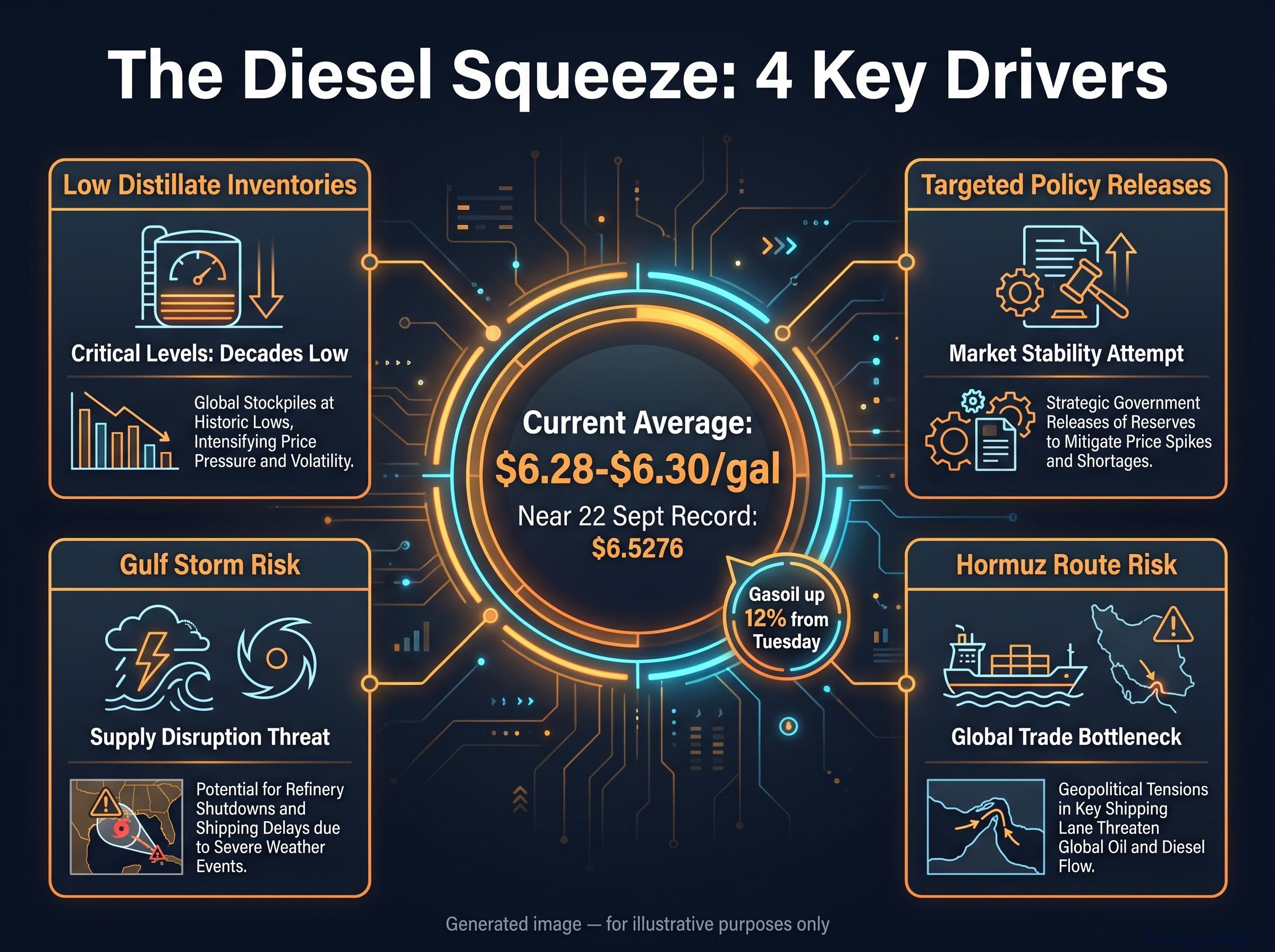
- Low distillate inventories. Distillates are the heavier refined fuels such as diesel, heating oil and jet fuel, and tight stocks meet strong transport and heating demand.
- Storm risk. Gulf storms hit refinery output and local fuel logistics more directly than they hit overall crude balances.
- Targeted policy releases. When governments aim stockpile releases specifically at diesel, they are telling you diesel, not crude, is the stress point.
- Hormuz route risk. Attacks raise insurance and disruption costs for product tankers as well as crude carriers, and traders price that into diesel.
You have seen this before. In 2022, diesel surged ahead of crude on post-pandemic demand, limited refining capacity and rerouted European fuel flows after Russia’s invasion of Ukraine.
How stockpile releases fit in
According to Energy News Beat, the G7 agreed on 2 October to a coordinated release through the International Energy Agency (IEA) of 100 million barrels over four months, with diesel front-loaded in the first 20 days and a pledge of no energy export restrictions. Those exact terms still need confirmation from primary G7 and IEA statements.
Releases like this can squeeze diesel prices briefly, and gasoil did dip. Then the dip reversed, which tells you the underlying tightness never went away.
Releases like this can squeeze prices briefly, but diesel market analysis of past drawdowns shows that faster barrels are not more barrels, which is why you often see the relief fade within days.
If you hold or are considering energy positions, the takeaway is that stress sits in refined products. Refiners, and any business sensitive to distillate costs, can move quite differently from crude itself.
What could push prices higher or lower from here?
No single number captures where oil goes next. You get a clearer view by weighing the strongest evidence on each side.
Upside risks
More tanker attacks top the list, and a wider Hormuz disruption would hit seaborne supply directly. Strike speculation could also return before the November midterms, as it did earlier this week.
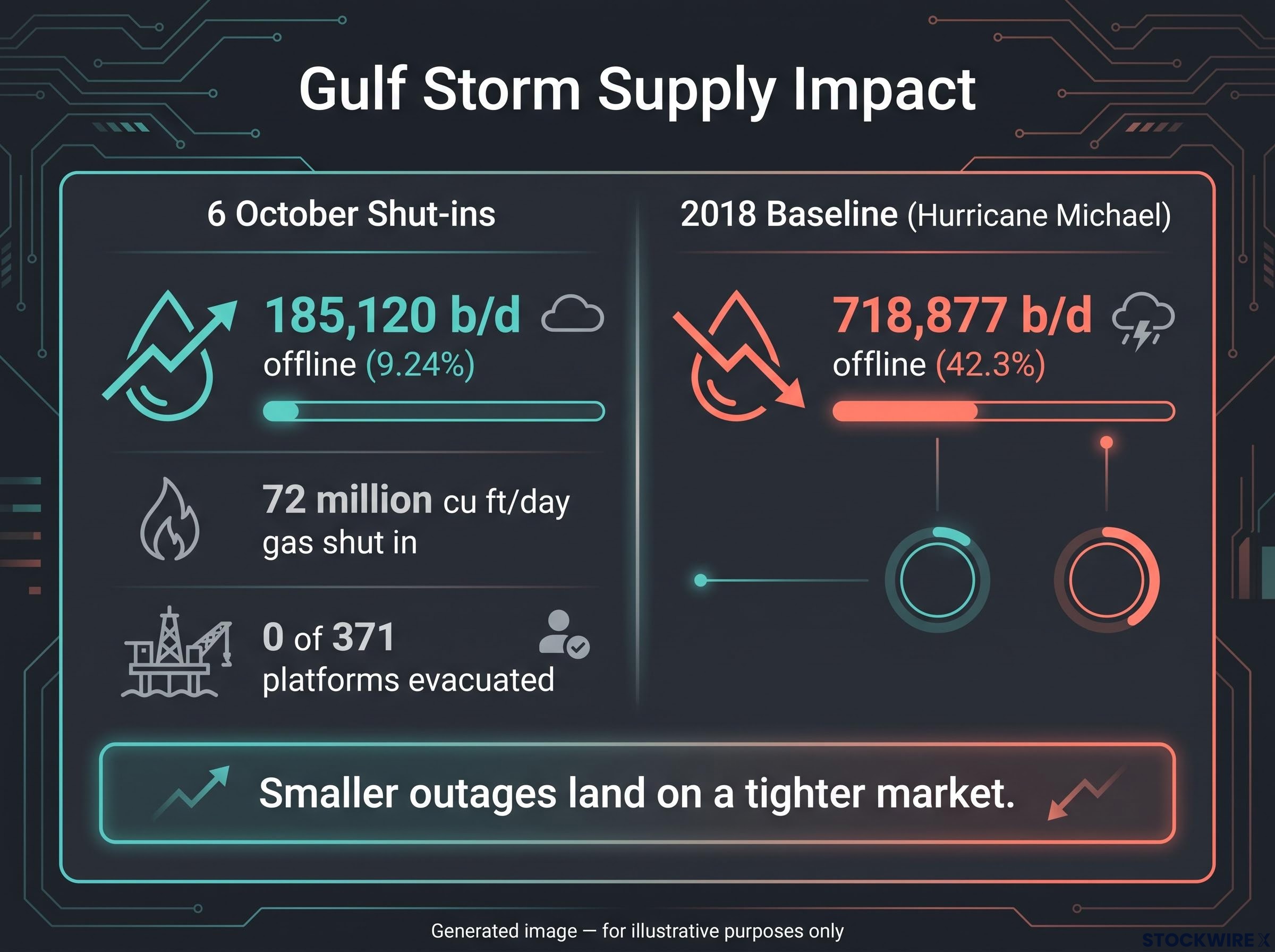
Weather adds another layer. As of 6 October, the Bureau of Safety and Environmental Enforcement reported Gulf of Mexico oil shut-ins of 185,120 barrels per day (9.24% of production) and gas shut-ins of 72 million cubic feet per day, with 0 of 371 platforms evacuated.
That sounds small next to Hurricane Michael in 2018, which shut in 718,877 barrels per day (42.3%) with little national price effect. The difference is the starting point. Today’s smaller outage lands on a much tighter market, so prices are more sensitive to minor supply shocks than the raw volumes suggest.
Downside offsets
De-escalation talk has already shown it can knock a couple of dollars off Brent within a session. Midterm politics may also lean Washington toward calming tensions and adding supply, though nothing guarantees that.
Reserve releases have weighed on WTI and could pressure diesel once barrels reach the market. Rising Middle East exports add supply too. Then there is demand destruction: when diesel nears records, truckers and industrial users may cut use or pass on costs, which can cool prices over time.
| Factor | Direction | Evidence | Time horizon |
|---|---|---|---|
| Hormuz tanker attacks | Higher | MT On Peace strike; nearly 20 ships reportedly fired on | Immediate |
| Pre-midterm strike talk | Higher | Lifted Brent toward $105 | Until November |
| Gulf storm shut-ins | Higher | 185,120 b/d offline on 6 October | Days to weeks |
| Diplomacy | Lower | Brent fell to low $103s after Trump’s comments | Headline-driven |
| Reserve releases and exports | Lower | Reported G7 release; rising Middle East exports | Over four months |
| Demand destruction | Lower | Diesel near record pump prices | Months |
Major banks such as Goldman Sachs and JPMorgan have not published quantified early-October forecasts in the available research. Forecasts and projections are subject to market conditions and various risk factors, and past performance does not guarantee future results.
Investors tracking scenarios will find our detailed coverage of the oil price outlook, which explains how the WTI-Brent spread reflects diverging domestic and global conditions.
What near-record diesel means for investors and energy-exposed portfolios
A $6.30 gallon of diesel does not stay at the pump. It moves through company accounts, and it lands differently depending on which side of the trade a business sits.
| Sector | Likely effect | Why | Key sensitivity |
|---|---|---|---|
| Integrated oil companies | Typically favoured | Brent in low $100s plus refining margins | De-escalation |
| Exploration and production (E&P) | Typically favoured | Higher realised crude prices | Reserve releases |
| Refiners | Typically favoured | Strong diesel margins | Diesel stockpile flows |
| Airlines | Pressured | Jet fuel is a distillate | Distillate inventories |
| Trucking and logistics | Pressured | Diesel is a core operating cost | Ability to pass on costs |
| Broader equities | Pressured | Margin squeeze and inflation pass-through | Duration of high prices |
The supports for producers look durable for now. The EIA’s $105 Q4 Brent projection and Rabobank’s view that risk premiums persist while Hormuz is threatened both suggest elevated prices could linger, though neither is a guarantee.
Diesel, not crude, is where the strain shows because a loose crude balance can coexist with a tighter products market, which widens refining margins and favours refiners.
That creates a trade-off inside a diversified portfolio. Energy holdings can act as a hedge against inflation and geopolitical shocks, while fuel-hungry sectors absorb the cost.
If your portfolio is light on energy, you are effectively short oil-driven cost inflation. Three checks can show you how exposed you are:
- Fuel as a cost line: How many of your holdings list fuel, freight or transport among their largest expenses?
- Pricing power: Can those companies pass higher costs to customers, or will margins absorb them?
- Energy weighting: What share of your portfolio actually benefits when oil and diesel rise?
Reading the oil outlook without chasing the headlines
This is a product-led squeeze. Hormuz risk, diesel stockpile policy, Gulf storm shut-ins and midterm politics are interacting, and diplomatic headlines trim the premium without erasing it. Diesel, not crude, is where the strain shows most clearly.
Three variables will tell you more than any single statement from Washington:
- Hormuz shipping incidents: further attacks keep Brent’s premium intact.
- Diesel inventories and gasoil spreads: a sustained easing would signal real relief.
- Reserve release timing: watch whether the reported G7 barrels actually reach the market.
This article is for informational purposes only and should not be considered financial advice. Investors should conduct their own research and consult with financial professionals before making investment decisions. Forward-looking statements are speculative and subject to change based on market developments.