
Citigroup now argues that mounting strain on French public finances may push the European Central Bank (ECB) to stop raising rates once it has delivered a December hike, or sooner should financial stress spread through the euro area. The bank sees room for 50-75 basis points of repricing in ECB rates relative to the US Federal Reserve. A basis point is one hundredth of a percentage point.
The call lands at an awkward moment for the consensus. The ECB deposit rate sits at 2.50%, a December hike to 2.75% is widely expected, and markets still price further tightening into 2027.
Citi is challenging that last assumption directly.
Here is what the argument rests on, what it could mean for the euro against the dollar, and where other forecasters see things differently.
Why Citi thinks the euro and rates are mispriced
Something odd has happened in European bond markets. Citi rates strategists found that the relationship between ECB rate expectations and the French-German yield spread has flipped: wider spreads now line up with lower hike expectations, not higher ones.
That spread is the extra yield investors demand to hold 10-year French government bonds (OATs) instead of German Bunds. It is the market’s price for French risk.
Citi does not spell out why the link reversed, but one plausible reading is this. When French borrowing costs jump, investors conclude that more ECB hikes could destabilise a vulnerable sovereign, so the bank is more likely to slow down and lean on tools such as the Transmission Protection Instrument (TPI), a 2022 facility that lets the ECB buy bonds of countries facing disorderly spread widening.
The French numbers explain the nerves:
- Public debt projected at 119.3% of GDP in 2026 and 121.7% in 2027 (finance ministry, via Reuters)
- 2026 deficit projected at 5.4% of GDP
- Debt-service costs of about €65 billion in 2026, roughly €4.5 billion above plan
- 10-year risk premium over Germany at its highest since 2012 (Reuters, 11 September 2026)
Citi’s core estimate Room for 50-75 bp of repricing in ECB rates relative to the Fed.
Citi says markets have almost fully priced a December hike plus close to two more in 2027, a path it regards as overstated. A Reuters poll describes pricing of nearly three further hikes by end-2027; the counts differ, but both point to more tightening than Citi expects.
For you, the shift matters. When spreads and rate expectations move in opposite directions, the market is questioning whether the ECB can keep tightening at all, so the next French bond selloff is a policy signal, not just a credit story.
Investors exploring the budget politics behind these numbers can read our deep-dive into France’s fiscal crisis, which covers the minority government and the likelihood of a 2027 budget rollover.
What a 50-75 bp repricing could mean for EUR/USD and Citi’s preferred trade
The euro closed Friday at 1.1202 against the dollar, down 0.09%. Citi’s foreign exchange strategists use a two-year valuation model that links the currency to the gap between short-term euro and US interest rates.
On that model, a 50-75 bp narrowing in the euro-US rate spread maps to roughly 1.1075-1.1000. If the pair overshoots the fair value implied by two-year differentials, which a French fiscal risk premium could encourage, it may slip below 1.10.
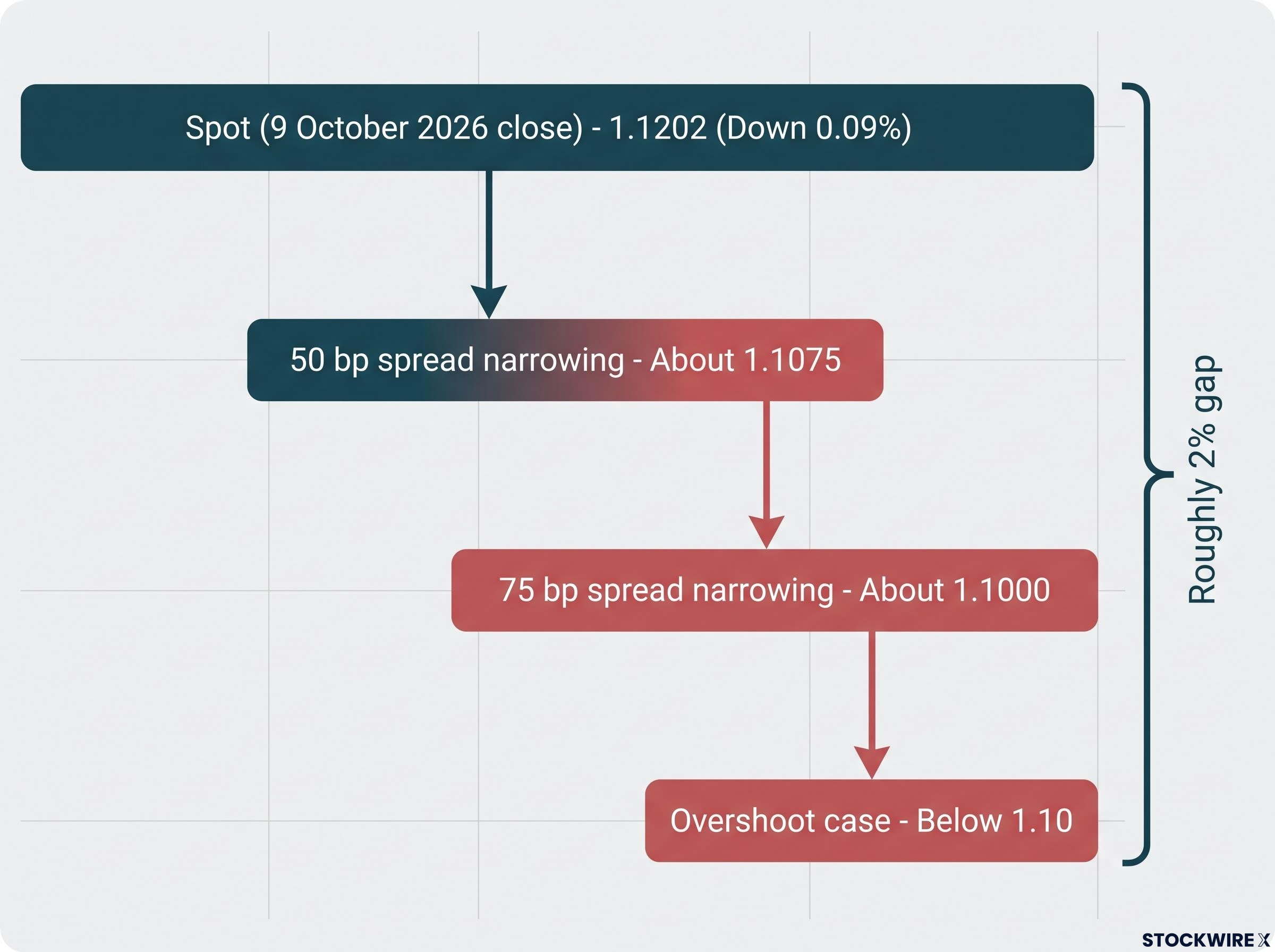
| Scenario | Implied EUR/USD | Note |
|---|---|---|
| Spot (9 October 2026 close) | 1.1202 | Down 0.09% on the day |
| 50 bp spread narrowing | About 1.1075 | Upper end of Citi’s model range |
| 75 bp spread narrowing | About 1.1000 | Lower end of Citi’s model range |
| Overshoot case | Below 1.10 | Fair value overshoot plus French risk premium |
The gap between 1.1202 and 1.10 is roughly 2%. That makes this a specific, testable currency call tied to rate differentials, not a loose bearish mood on the euro.
Separating euro-specific stress from broad dollar strength is possible by cross-checking EUR/GBP, EUR/JPY and EUR/AUD, which is how analysts confirm that a French fiscal risk premium is driving a move rather than the dollar.
Citi’s preferred expression is to receive ECB rates versus Fed rates. Receiving rates means taking the side of a swap that profits if interest rate expectations fall, so the position gains if euro rates drop relative to US rates.
On general macro reasoning, three developments could break that trade:
- Euro-area inflation stays sticky, pushing the ECB to hike more
- Energy shocks return, reviving the inflation case
- The Fed cuts faster than expected, changing the relative repricing
Where other forecasters disagree, and how Iran could change the picture
Citi sits outside the consensus on timing. In a Reuters poll of 73 economists published on 8 October 2026, all but three expected a hold at the late-October meeting, 64 expected a December hike, and 40 of 70 saw the deposit rate peaking at 2.75%.
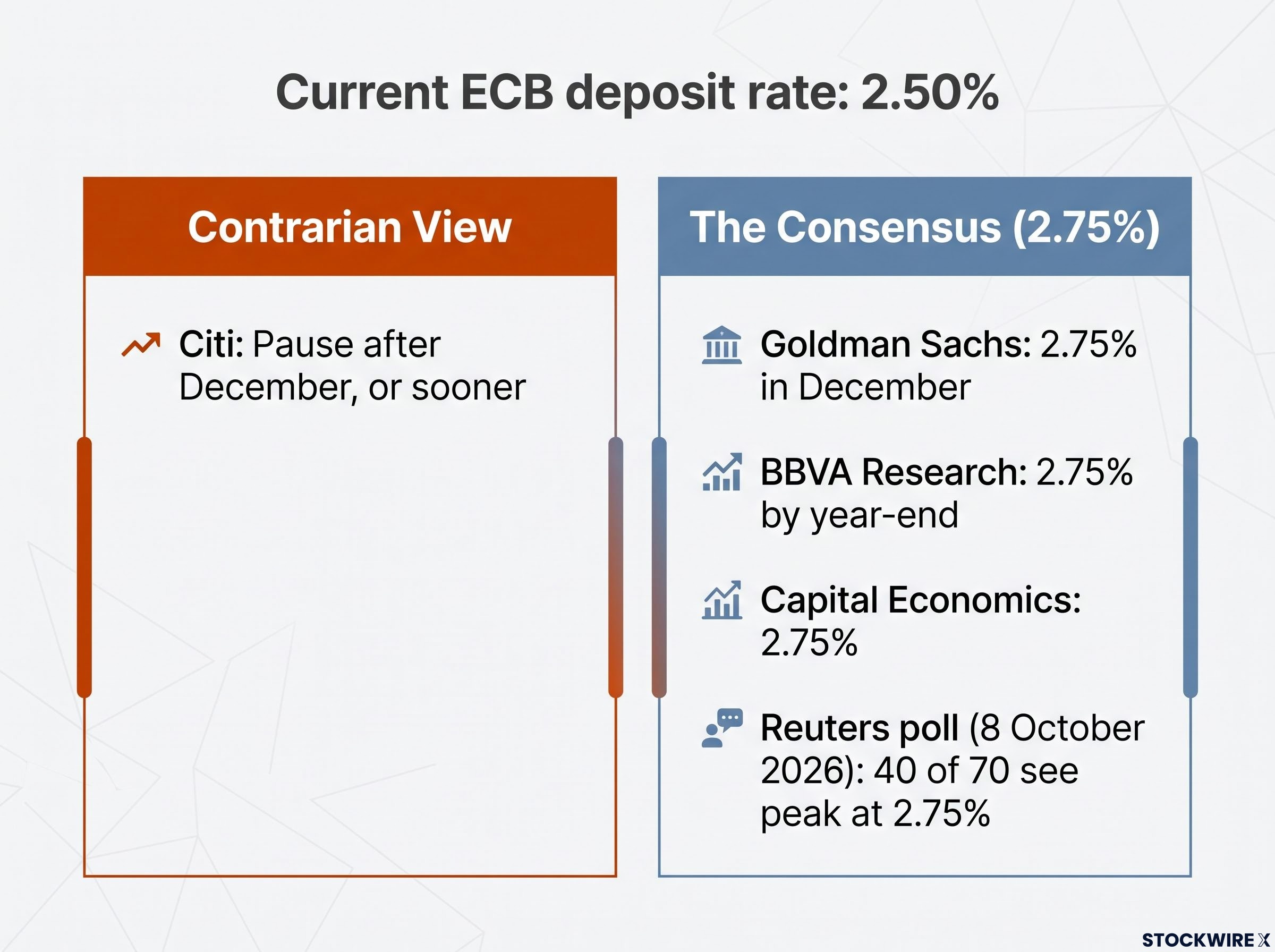
| Institution | Expected peak or path | Main driver | Treatment of French risk |
|---|---|---|---|
| Citi | Pause after December, or sooner | Financial conditions, fragmentation | Central constraint |
| Goldman Sachs | 2.75% in December; unlikely much above 3% | Manageable inflation, slowing growth | Not singled out |
| BBVA Research | 2.75% by year-end, upside risk | Inflation, energy shock | Background risk |
| Capital Economics | 2.75%, little need for more | Inflation and growth data | Not the driver |
The striking point is that Goldman and Capital Economics reach a similarly low ceiling without leaning on France. That suggests Citi may be over-attributing a pause to French stress.
History does back the idea that spreads can tie the ECB’s hands. The 2010-2012 sovereign debt crisis pushed the bank into bond-buying programmes, and the 2022 TPI was built for exactly this kind of strain.
For you, an ECB rate pause is a contested scenario, not a base case. The evidence for a peak near 2.75% is broad, but whether the reason is French stress or soft inflation shapes how you should position.
How Iran de-escalation could shift French asset positioning
Citi flags that a de-escalation involving Iran could keep its rates trade attractive while weakening the case for outright bearish bets on French assets. Cheaper commodities could lend support to French stocks, sovereign debt and the euro.
The broader chain is general macro reasoning: cheaper oil and gas would ease inflation, improve France’s growth and fiscal position, and potentially narrow the OAT-Bund spread. No recent rating agency actions on France were located as of today.
What would confirm or break the Citi call before December
Citi’s case rests on French spreads and fragmentation risk; the consensus still points to a December hike to 2.75% driven by inflation and growth. The signposts to track:
- The late-October ECB meeting and any change in tone
- French budget and election developments
- Direction of the OAT-Bund spread
- Energy prices tied to Iran
- The December decision itself
If spreads widen while hike pricing falls, Citi’s thesis strengthens. If spreads calm and energy stays firm, the consensus path regains the upper hand.
Past performance does not guarantee future results. Financial projections are subject to market conditions and various risk factors. These statements are speculative and subject to change based on market developments.
This article is for informational purposes only and should not be considered financial advice. Investors should conduct their own research and consult with financial professionals before making investment decisions.
—