
Donald Trump said on 9 October 2026 that Russia will send more than 300,000 tons of diesel to American and global buyers, following a phone call with Vladimir Putin. Within hours, the US Treasury’s Office of Foreign Assets Control (OFAC) posted General License 135, which makes trading in Russian diesel shipments legal on a temporary basis.
The timing matters because US diesel supplies are thin. Distillate inventories sit well below seasonal norms. Distillates are the group of fuels that includes diesel and heating oil.
Retail diesel averages about $6.28/gal, according to AAA. For truckers, farmers, refiners and oil traders, any sign of new supply carries weight.
This piece sets out three things: what the licence permits, how far the promised volumes go against US demand, and what the announcement means for diesel margins and the price of West Texas Intermediate (WTI) crude.
How far do the Russian diesel volumes actually go?
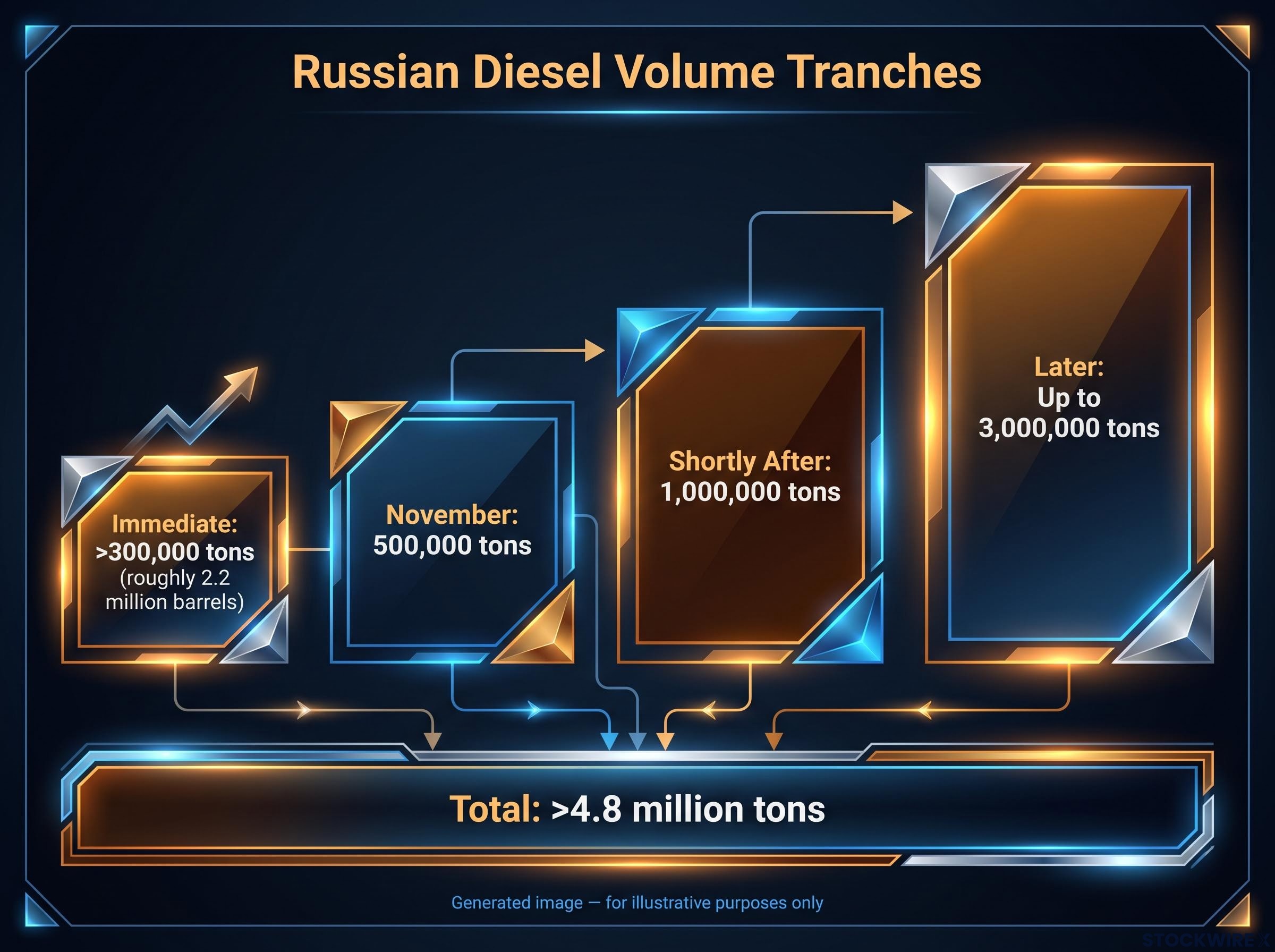
The headline numbers are large. Trump’s Truth Social post, carried by Interfax, Bloomberg and Investing.com, set out a staged schedule:
- More than 300,000 tons immediately
- 500,000 tons during November
- 1,000,000 tons shortly after that
- Up to three million tonnes more later, depending on the condition of Russian refineries
Added together, the tranches come to more than 4.8 million tons.
Trump on Truth Social: Russia would “immediately supply over 300,000 tons of diesel fuel to the American and global marketplace.”
The first tranche shrinks once it is measured in barrels. 300,000 tons works out to roughly 2.2 million barrels, which covers slightly more than half a day of US distillate demand.
The larger volumes are conditional. The biggest tranche depends on how Russian refineries are performing, which leaves the timing uncertain.
This is also Trump’s second diesel move in a week. On 2 October, European Union states accepted a French proposal, made at his request, to release diesel reserves. Kirill Dmitriev, Putin’s envoy, called the call “successful” and wrote on X that Russia-US cooperation on diesel and energy “will benefit the world.”
For you, the scale suggests treating this announcement as a signal about sentiment and margins rather than a fix for supply.
Refinery capacity limits compound the squeeze, since US plants running near 97% utilisation have almost no room to add output, so new demand feeds directly into pump prices rather than extra supply.
What General License 135 permits and what it does not
The licence is titled “Russia-related General License No. 135.” It authorises transactions that would otherwise be barred under 31 CFR parts 587 and 589, as long as they relate to the sale, delivery, offloading or importation of Russian-origin diesel. That includes importing the fuel into the United States.
The licence runs until 12:01 a.m. EDT on 7 April 2027.
It has one firm exclusion. It does not allow any debit to accounts held at US financial institutions by the Central Bank of the Russian Federation, the National Wealth Fund or the Ministry of Finance.
The underlying sanctions remain in force. The licence is a temporary carve-out, and it can be revoked.
When big ASX news breaks, our subscribers know first
How did diesel futures and WTI react on the day?
Traders moved quickly. New York diesel futures fell after the post and gave back most of Thursday’s gains, trading near $4.67/gal, or about $196/bbl.
WTI crude dropped in the two five-minute trading bars that followed the post. It recovered only a quarter or so of that slide’s starting ground, having earlier stalled twice below $91.50. Spot WTI slipped from around $91.00 to just under $90.00. Other reports describe a dip from highs near $91.40 to a settle above $90.
Then the selling ran out of energy.
| Market | Level | Move | Context |
|---|---|---|---|
| NY diesel futures | $4.67/gal (about $196/bbl) | Fell after the post | Erased most of Thursday’s gains |
| WTI crude | Near $90.50 | Retraced about three-quarters of its rise from the low | Session range about $89.50-$91.50 |
| Spot WTI | Just under $90.00 | Down from about $91.00 | Later recovered toward the middle of the range |
WTI later climbed back toward the middle of its range. Intraday momentum swung from overbought to nearly oversold and was still easing.
FXStreet interpreted the plan as easing tightness in fuel products and pressure on refining margins. Bloomberg and other outlets focused on the politics and the volumes rather than on price levels.
A move that fades within hours tells you traders saw this as a modest supply headline, not a lasting change in the direction of fuel prices.
Why the diesel margin over WTI matters for US refiners
Even after the drop, diesel’s margin over WTI stayed above $100/bbl. Refiners earn that gap between the price of the crude they buy and the price of the diesel they sell.
The figure ties directly back to crude. A thinner margin gives refiners less incentive to bid higher for WTI.
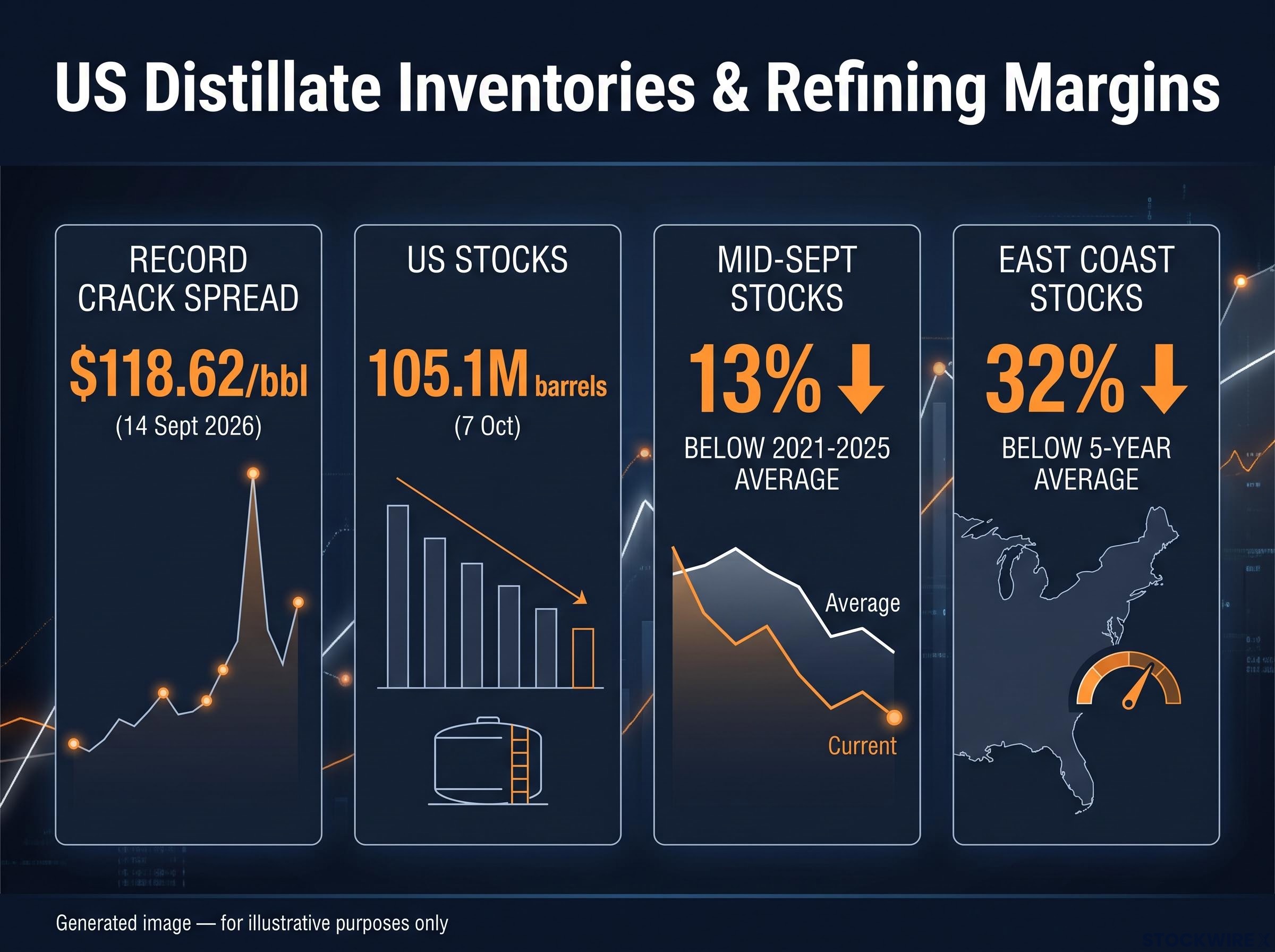
That margin is close to all-time highs. The US diesel crack spread is the difference between NYMEX diesel futures and US crude futures, and it measures refiners’ profit on each barrel. According to Reuters, it set a record on 14 September. The inventory picture shows why:
- Record crack spread: $118.62/bbl on 14 September 2026
- US distillate stocks: 105.1 million barrels on 7 October
- Mid-September stocks: 13% below the 2021-2025 seasonal average
- East Coast stocks: 32% below the five-year seasonal average in September
Russian cargoes would compete directly with diesel refined in the US, which threatens those exceptional margins. Even so, the Energy Information Administration (EIA) forecasts that retail diesel will stay above $6/gal in October, then ease gradually.
EIA, October Short-Term Energy Outlook: Below-average inventories are expected to keep “diesel crack spreads elevated and retail prices above $4/gal through 2027.”
If you buy, haul or burn diesel, this tight market means relief from the licence is likely to arrive slowly. Refiners, meanwhile, face a limit on how much higher their margins can climb.
Past performance does not guarantee future results. Forecasts are subject to market conditions and various risk factors.
Structural tightness or a temporary spike?
The EIA expects inventories to stay below average through late 2026 and most of 2027. Reuters reported on 21 September that the global shortage is likely to last into 2027.
Analysts attribute the tightness to two structural supply shocks, the collapse of Russian diesel exports and the loss of Middle Eastern barrels, which is why a single licence is unlikely to reset the market.
GL 135, by contrast, is a single permission with an expiry date. Dmitriev argues that more Russian supply helps consumers. The US framing stresses that this is a controlled, revocable exception to sanctions that otherwise remain in place.
What is driving WTI beyond the diesel headline?
The diesel post explains only part of Friday’s trading. WTI is a light, sweet crude, meaning it is low in density and sulphur and easy to refine. It is priced through the storage hub at Cushing, Oklahoma, and serves as one of three major benchmarks alongside Brent and Dubai.
Several forces drive its price:
- OPEC+ quotas: The Organization of the Petroleum Exporting Countries (OPEC) has 12 member nations. OPEC+ adds ten non-OPEC producers, including Russia. Quota cuts lift prices, and output increases push them down.
- Inventory reports: The American Petroleum Institute (API) publishes data on Tuesdays and the EIA on Wednesdays. Their figures land within 1% of each other about 75% of the time.
- The dollar: A weaker dollar generally makes oil cheaper for foreign buyers.
- Growth and geopolitics: Economic growth, wars and sanctions all shift expectations for supply and demand.
Beyond supply headlines, a dollar-driven ceiling tied to Fed rate expectations has capped most WTI rallies, which helps explain why Friday’s dip faded so quickly.
The inventory data does offer a concrete clue. The EIA’s 7 October report showed distillates little changed, while traders had expected a 2.1 million barrel draw. That surprise eased some pressure before Trump posted.
It makes sense to read Friday’s dip as one data point among many, and to watch the weekly inventory reports rather than react to a single post.
What to watch as the November tranche approaches
The licence is real but limited. The first volumes amount to roughly half a day of US demand, and the underlying shortage of inventories has not changed.
Four checkpoints will show whether the announcement turns into physical supply:
- Whether the 500,000-ton November tranche actually arrives
- Weekly EIA distillate inventory figures
- Any change by OFAC to the licence terms
- The 7 April 2027 expiry date
If you buy fuel, budget for prices that stay high rather than counting on quick relief. If you follow refiners, compare margins against inventory data, not against headlines.
This article is for informational purposes only and should not be considered financial advice. Investors should conduct their own research and consult with financial professionals before making investment decisions. Forward-looking statements are speculative and subject to change based on market developments.
—