The Bank of Japan’s (BoJ) latest regional economic report, known as the Sakura Report, left its assessment unchanged for seven of Japan’s nine regions on 8 October 2026. Beneath the steady ratings, firms across the country are passing higher costs on to customers and still paying high wages, while USD/JPY holds at 158.18.
The report shows whether the wage and price cycle is spreading beyond a few sectors. The BoJ needs that broad, lasting cycle before it lifts its policy rate beyond 1.25%. The policy rate is the short-term interest rate the central bank sets to steer borrowing costs across the economy.
The three questions that matter are what the regional findings signal for the timing of the next hike, why the yen has barely moved, and where the risks sit for anyone running a carry trade. A carry trade means borrowing in a low-yielding currency such as the yen to invest in higher-yielding assets elsewhere.
What the regional report actually showed, and where firms are raising prices
The scorecard barely moved. According to the BoJ report, as summarised by Yomiuri Shimbun and FXStreet, only two regions were upgraded from the July assessment.
| Region | July 2026 assessment | October 2026 assessment |
|---|---|---|
| Tohoku | Good turn | Moderate recovery |
| Shikoku | Moderate good turn | Good turn |
Hokkaido, Hokuriku, Kanto-Koshinetsu, Tokai, Kinki, Chugoku and Kyushu-Okinawa were all unchanged.
The ratings were never the real story. The commentary was.
Numerous regions reported firms passing on higher expenses to customers. This is called price pass-through, where a business raises its selling prices to cover rising costs. The drivers cited were:
- The Middle East conflict
- The weak yen
- Distribution costs
- Labour costs
Some regions said firms were raising prices more often than before. Many reported that businesses continue to pay high wages, although some suggested firms unable to pass on costs may hold back wage growth.
The wider picture was steady rather than surging. Output is strong on global AI-related demand, investment appetite is firm, and consumer spending held up despite poor weather, while housing investment stayed soft.
For you, the combination is the signal. Stable ratings alongside wider pass-through suggest inflation is becoming more entrenched even though growth is not accelerating, and that is the input the BoJ weighs most heavily.
Why this keeps the yen near 158 and the BoJ on a gradual path
Currency markets shrugged. USD/JPY was up 0.06% at 158.18 at the time of FXStreet’s report, inside an early-October range of roughly 157.5-158.5.
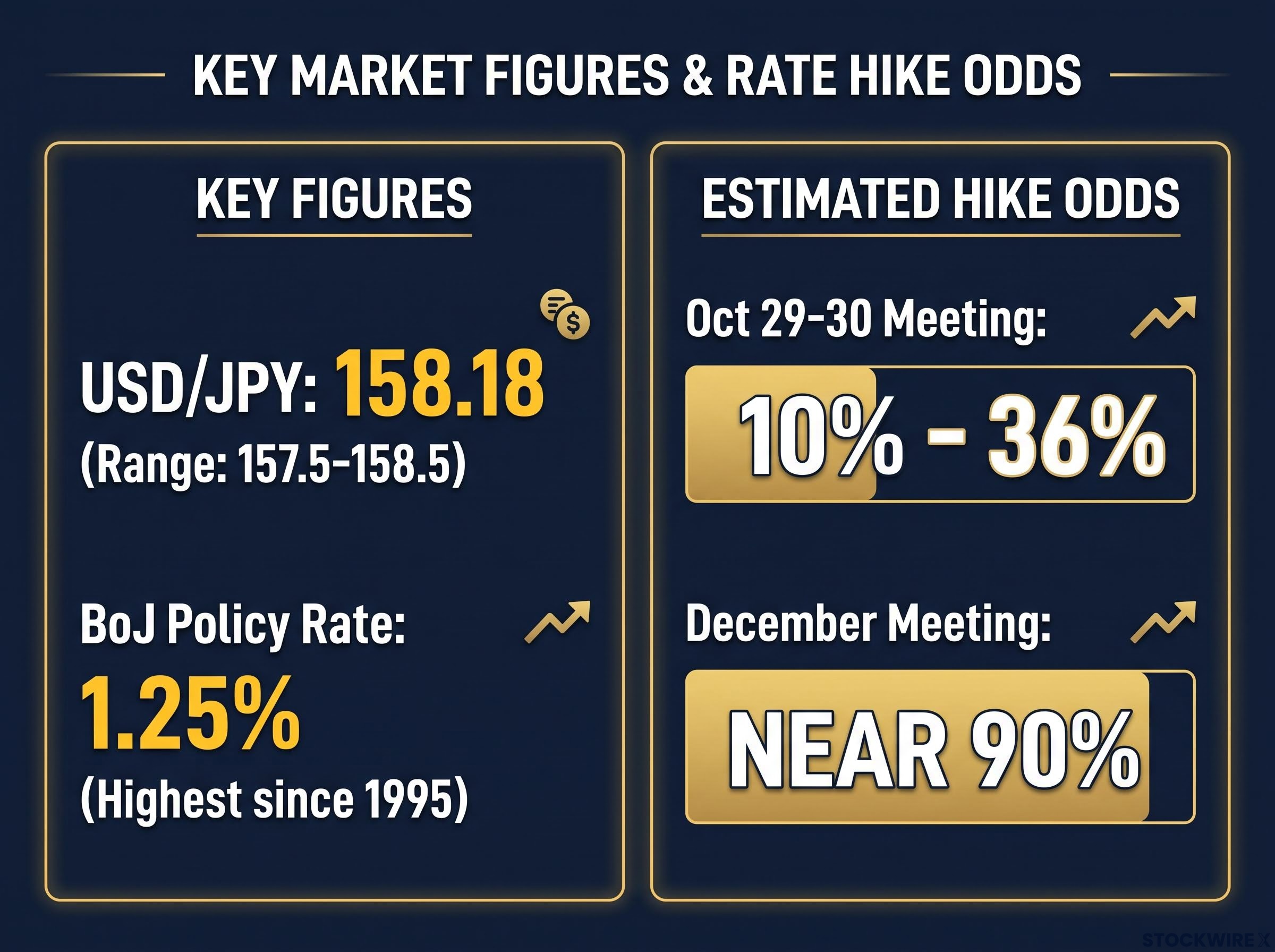
Key figures USD/JPY: 158.18 on 8 October 2026 BoJ policy rate: 1.25%, the highest since 1995
The flat reaction makes sense once you follow the policy logic. The BoJ lifted rates by 25 basis points to 1.25% on 18 September 2026 in a 7-2 vote. Officials have said they want evidence that conditions are expanding strongly or sustainably before tightening again. Three factors keep the bank cautious:
- Inflation confirmation: policymakers want proof that price gains will last.
- Domestic demand: some officials question whether it is strong enough, and consumer confidence fell to 35.4 according to Admiral Markets on 5 October.
- Communication: a cautious tone keeps the path data-dependent and gradual.
The latest consumer price index (CPI) and shunto (annual spring wage negotiation) figures were not available in the research and are not cited here.
Reading the October versus December odds
The next meeting runs 29-30 October. Estimates for a hike there conflict. TMGM reported swaps pricing about a 36% chance on 1 October; swaps are contracts traders use to bet on future interest rates. Perplexity Finance put the odds below 20% on 3 October, though that figure has not been independently confirmed.
Taken together, October odds sit somewhere around 10-36%, which suggests expectations faded through the week. The same unverified Perplexity source puts December near 90%, and analysts cited by Mitrade infer a roughly once-every-three-months hiking pattern.
Hot Tokyo core inflation of 2.7% in September and the strongest July wage gain since 1997 have made the BoJ October rate decision a genuinely live call, even as swaps pricing remains muted.
If you hold currency or rate-sensitive positions, the report supports a slow tightening path rather than a sudden one. That helps explain why the yen has not strengthened.
From 2013 easing to 1.25%: the policy history behind today’s yen risk
Today’s 158 level is the product of a long cycle that is only now reversing:
- 2013: the BoJ launched quantitative and qualitative easing, buying government and corporate bonds to push down borrowing costs.
- 2016: it added negative interest rates and capped 10-year government bond yields.
- March 2024: the first hike in 17 years ended negative rates.
- 18 September 2026: the rate rose to 1.25% in a 7-2 vote.
The yen weakened across this stretch, and the slide deepened in 2022-2023 as other central banks raised rates sharply, widening the gap between their rates and Japan’s. A weaker yen and a global surge in energy prices pushed inflation above 2%, and expected wage rises helped justify the policy shift.
Governor Kazuo Ueda’s cautious tone in September left markets unconvinced that rapid follow-up hikes are coming, according to Perplexity Finance (not independently confirmed). AI-related demand supports output, but that support may not be spread evenly across the economy.
The risks now run in both directions:
- Further hikes could support the yen.
- Depreciation toward 160 raises the chance of government intervention, with 158-160 seen as a possible zone (unverified).
If you hold yen-funded carry positions, the direction has turned, but the pace is slow and intervention risk near 160 can cut either way.
For readers weighing yen-funded positions, our deep-dive into yen carry trade panic offers a three-question framework separating real systemic risk from headline noise.
What to watch before the 29-30 October meeting
The Sakura Report confirmed wider price pass-through and continued high wages without changing the regional picture. That leaves the December hike expectation intact. Three markers will tell you whether the timing is shifting:
Consensus places the BoJ rate hike path at 1.75% by April 2027, though a planned food consumption tax cut could pull headline CPI down by up to 1.5 percentage points and complicate the reading.
- The BoJ’s communication at the October meeting
- USD/JPY moving toward 160
- Whether the pass-through signal keeps outweighing signs of wage restraint
Check the latest CPI and shunto figures separately, because they were not available for this report.
This article is for informational purposes only and should not be considered financial advice. Investors should conduct their own research and consult with financial professionals before making investment decisions. Past performance does not guarantee future results. Financial projections are subject to market conditions and various risk factors. These statements are speculative and subject to change based on market developments.