
Market Index ranked Helia Group (ASX: HLI) #3 on its Stock Scores list today, 8 October 2026. That is a striking result for an insurer that has just lost a client which supplied about 44% of its FY24 gross written premium. On paper, a dividend yield of roughly 20% looks like a sign of strength. For Helia, it may point to something else.
The timing makes the question harder to set aside. National dwelling values sit about 5.2% below their March 2026 peak, and the cash rate is 4.60%. Meanwhile, the Commonwealth Bank (CBA) book is running off. All of this is happening while the ASX 200 drifts flat and the 30-year bond yield sits at a record high.
The stock analysis below separates how much of Helia’s income keeps coming back each year from how much is a one-off release of spare capital. That distinction decides what the yield is really worth to you. This is general information, not personal advice.
What is actually holding Helia up after losing CBA?
A top-three ranking suggests momentum. The numbers show something quieter: a balance sheet doing the heavy lifting while the business shrinks.
The loss
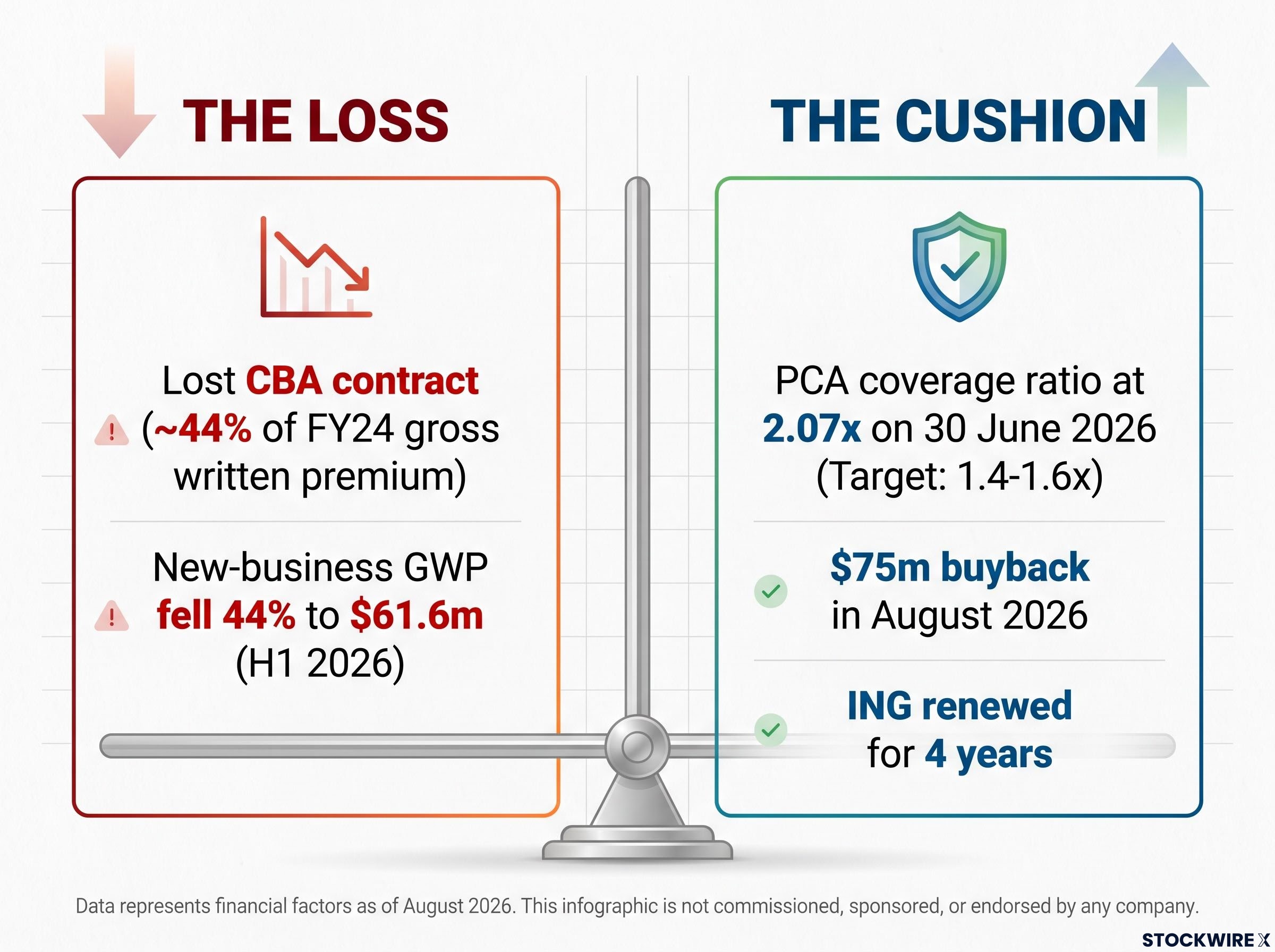
Helia told the ASX on 24 March 2025 that CBA would not renew its lenders mortgage insurance contract beyond 31 December 2025. Lenders mortgage insurance (LMI) is cover a bank takes out, usually paid for by the borrower, that protects the bank if a low-deposit borrower defaults. New CBA business stopped on 31 January 2026. Revenue from policies already written will still be recognised over about 15 years under the AASB 17 accounting standard, so the damage arrives slowly rather than all at once.
Slowly is not the same as invisibly. New-business gross written premium (GWP), the value of new policies sold, fell 44% to $61.6m in H1 2026. Speaking at the annual meeting, Helia’s chair put the first-quarter GWP decline at 32%.
Helia’s chair on the CBA loss The chair described losing CBA as “significant” (Insurance News, May 2026).
| Metric | FY25 | H1 2026 | Direction |
|---|---|---|---|
| Underlying NPAT | $247.0M (up 12%) | $106.3M (down 16%) | Falling |
| Statutory NPAT | $244.9M (up 6%) | $100.0M (down 25%) | Falling |
| New-business GWP | Includes CBA | $61.6M (down 44%) | Falling |
The cushion
So why does the share price hold near $5.10-$5.13, giving a market value of about $1.40bn? The support rests on three things: surplus capital, low claims and renewals with smaller lenders such as ING, which signed on for four years. Helia still held about 30% of the LMI market in the first quarter, with CBA contributing roughly 4% of that before it ceased.
Capital is the strongest of the three. The prescribed capital amount (PCA) coverage ratio measures how much capital Helia holds against the minimum the regulator requires, and it stood at 2.07x on 30 June 2026, well above the board’s 1.4-1.6x target. That surplus funded a new on-market buyback of up to $75m in August 2026.
APRA GPS 110 sets the capital adequacy framework for general insurers, which is why a PCA coverage ratio of 2.07x against a 1.4-1.6x board target translates into surplus capital that can be returned to shareholders.
What this tells you is that you are buying capital already sitting on the balance sheet, not a growing stream of earnings.
When big ASX news breaks, our subscribers know first
Why does a roughly 20% yield deserve scrutiny?
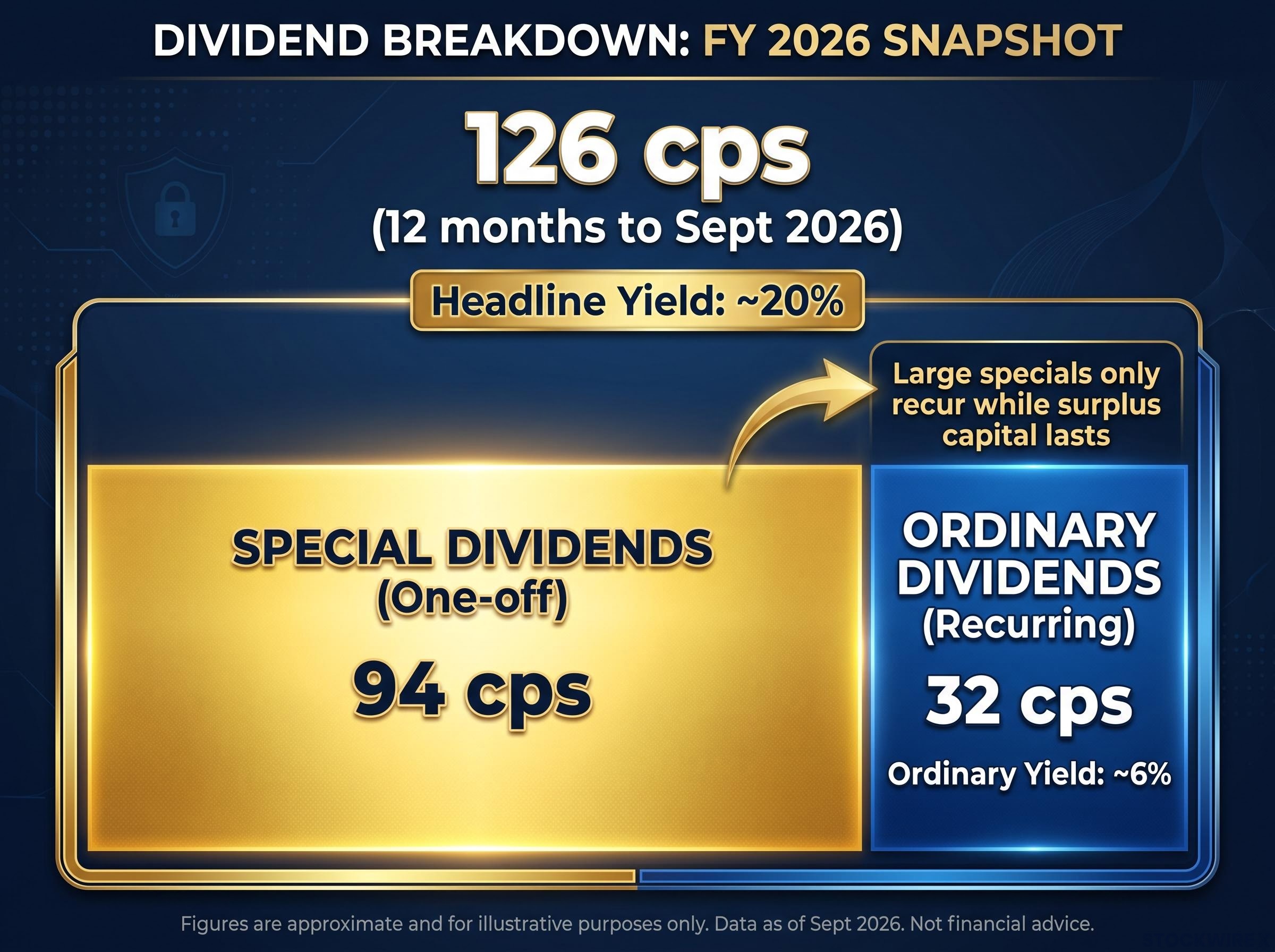
The headline yield is built from parts, and they are not equal. Of the 126 cps paid over the 12 months to September 2026, about 94 cps was special dividends. A special dividend is a one-off payment, outside the regular schedule, usually funded from surplus capital rather than that year’s profit.
Ex-dividend price drops average close to the full size of the payout, which means a large special dividend transfers value out of the company rather than creating new wealth for you.
| Period | Type | Cents per share | Paid |
|---|---|---|---|
| FY24 | Ordinary (interim + final) | 31.0 | Sept 2024 / April 2025 |
| FY24 | Special | 53.0 | 3 April 2025 |
| FY25 | Special | 67.0 | March 2026 |
| H1 2026 | Ordinary | 16.0 | September 2026 |
| H1 2026 | Special | 27.0 | September 2026 |
Strip the specials out and the picture changes sharply. Ordinary dividends run at about 32 cps a year, which implies a yield of around 6%.
Key figure Ordinary yield: about 6%. Headline yield: roughly 20-25%, depending on the source.
Even the headline figure is not settled. The reasons sources disagree include:
- Market Index cites roughly 20% in its 8 October 2026 Stock Scores piece
- Data-provider calculations put the trailing yield at about 23-25%
- Intelligent Investor showed the yield as “n/a” on the same day
- Each method uses a different dividend window, share price and treatment of specials
The figure has also moved fast. Market Index framed Helia as a roughly 12% yielder in February 2025, and it warned earlier that the high payout partly compensated for expected earnings pressure. Capital returns in FY24 alone reached $344.5m, split between $231.1m in dividends and $113.4m in buybacks. The dividends were fully franked, so their grossed-up value depends on your own tax position.
Large specials only recur while surplus capital lasts, and revenue is now falling. Treat the roughly 6% ordinary yield as your baseline income expectation, and anything above it as a shrinking bonus rather than a salary.
How could falling house prices hit a lenders mortgage insurer?
LMI pays out when a borrower defaults, the home is sold, and the sale price does not cover the loan. Falling prices make that gap more likely. The loan-to-value ratio (LVR), the loan size as a share of the property’s value, rises as values drop, and some borrowers slide into negative equity, owing more than the home is worth.
How claims rise
The chain runs in a predictable order:
- House prices fall, lifting LVRs across the insured book.
- More borrowers fall into negative equity.
- Forced sales happen at discounts, so each claim costs more.
- Helia must hold larger loss reserves and more capital under APRA rules.
- Less surplus remains for specials and buybacks.
Prices are already moving. Cotality/CoreLogic data shows national values 5.2% below the March peak by September, including a 1.1% fall that month, with Sydney down 8.6% and Melbourne down 7.5% from their peaks.
Forecasts such as Morgan Stanley’s 10% housing call, which flags the largest potential fall in four decades, show how quickly consensus has shifted and why claims risk for mortgage insurers is back in focus.
Why new business also shrinks
Only loans above 80% LVR typically need LMI. When prices fall, that slice of lending tends to slow, cutting new GWP just as the CBA book runs off. Broker News reports record low-deposit lending today, which is exactly the exposure LMI carries into any downturn.
What cushions the blow
The counterview deserves weight. The RBA’s October 2026 Financial Stability Review found borrowers resilient, with negative equity below 1% of loans. Its modelling suggests a 20% price fall could push about 5% of borrowers into negative equity. 90+ day arrears sit at about 1.01%, above the 0.93% average since 2019 but still low, while unemployment is about 4.65-4.7%.
| Scenario | Claims | New GWP | Capital and dividends |
|---|---|---|---|
| Moderate price fall, low unemployment | Contained | Lower | Surplus shrinks gradually |
| Price fall plus rising unemployment | Rising, larger reserves | Lower | Surplus and returns under pressure |
History shows both outcomes. Helia, then Genworth, absorbed claims in the early 2010s and in 2020, rebuilt capital and resumed dividends. US mortgage insurers in the GFC suffered losses that wiped out years of profit when prices and jobs collapsed together.
Low arrears tell you the risk has not arrived yet. Watch unemployment: falling prices alone mostly cost Helia volume, while falling prices plus job losses cost it claims.
How should investors weigh Helia’s yield against its risks?
With the mechanics laid out, the question becomes what kind of income you are prepared to accept.
Bull case
- PCA of 2.07x remains well above target
- Claims are low and the RBA sees borrowers as resilient
- A $75m buyback is in progress
- Market share near 30% in Q1 alongside lender renewals such as ING
Bear case
- New-business GWP down 44% in H1 2026
- Underlying NPAT down 16%
- One pro-forma illustration puts PCA at about 1.79x after the latest returns
- House prices are falling while low-deposit lending sits at record highs
The surplus has already been drawn down heavily. Market Index once counted about $390m above target at 1H24 and $460m at Q3 FY24, against a market value near $1.5bn at the time. AlphaInsights pointed to a strong capital position enabling large returns in July 2025, before the CBA loss made that profile far less certain.
The trade-off in one line Helia is capital-rich but earnings-challenged.
Five signals would change the picture:
- PCA drifting toward 1.6x
- A rise in 30-89 day arrears
- Unemployment trending above about 5%
- Further house price declines
- New-business GWP stabilising
The real question for you is not whether Helia looks cheap on its headline yield. It is whether you are comfortable being paid mainly from capital release while recurring earnings shrink and housing risk builds.
For readers weighing dividend investing versus total return, Helia is a live case: income paid from released capital can look generous while the underlying business contracts.
What the ranking tells you, and what the yield does not
Helia’s support is real, but it comes from capital, not growth. The headline yield overstates recurring income, and housing combined with unemployment is the swing factor for claims and future returns.
The ordinary yield of about 6% is the baseline worth anchoring to. PCA, arrears, unemployment and new-business GWP will show whether the cushion is holding. Helia’s next results and the monthly Cotality/CoreLogic and labour force releases will be the next tests. Past performance does not guarantee future results, and these outcomes depend on market and housing conditions.
This article is for informational purposes only and should not be considered financial advice. Investors should conduct their own research and consult with financial professionals before making investment decisions.