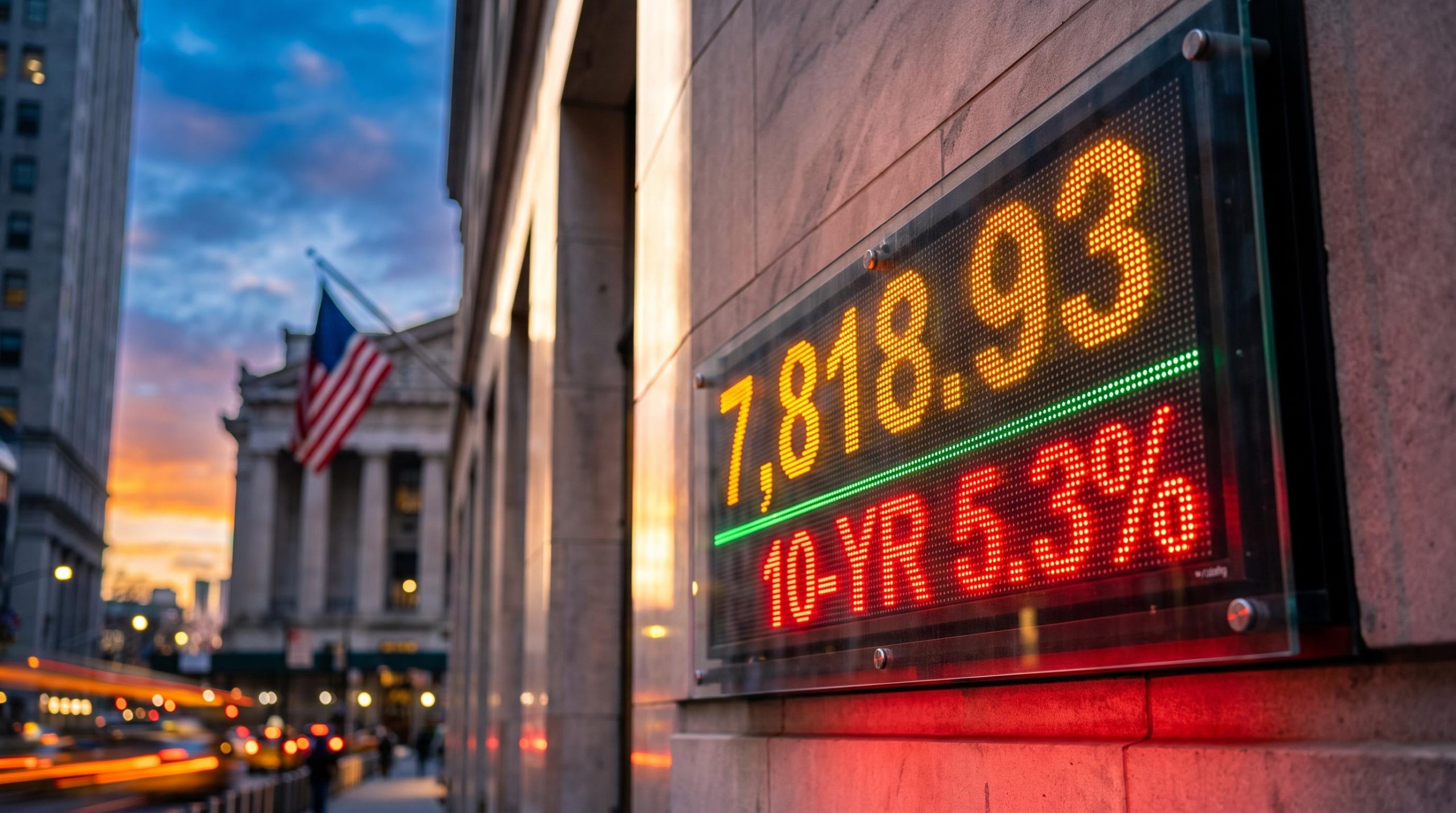
The S&P 500 closed at a record 7,818.93 on Tuesday and the Nasdaq Composite finished at a record 27,599.79. By Wednesday morning, futures were slipping, and the 10-year Treasury yield was sitting near 5.3%. Records usually read as good news, but the Wall Street market outlook today looks less certain than those numbers suggest.
As of 06:58 ET, Dow futures were down 0.5%, S&P 500 futures were down 0.2% and Nasdaq 100 futures were down 0.6%. That is a modest pullback. It still matters because four forces are converging at once: a Federal Reserve that has just hiked for the first time since 2023, long-dated yields at their highest in more than two decades, Brent crude near $100 amid the Iran war, and an earnings season about to begin.
The next test arrives quickly. The minutes of the September Federal Open Market Committee (FOMC) meeting land at 2:00 p.m. ET today, 7 October 2026.
Here is how these four pressures connect, and which one deserves most of your attention.
Why did futures slip after record closes?
The dip itself is small. Losing 19 points on S&P 500 futures after a record session barely registers as a move, and it is the kind of drift that often follows a strong run.
The pattern inside the dip is more revealing.
| Index | 6 Oct close | Daily move (6 Oct) | Wednesday futures move |
|---|---|---|---|
| S&P 500 | 7,818.93 | +0.58% | -19 points (-0.2%) |
| Dow Jones Industrial Average | 51,521.28 | +0.49% | -255 points (-0.5%) |
| Nasdaq Composite (futures: Nasdaq 100) | 27,599.79 | About +0.45% | -181 points (-0.6%) |
Reports differ slightly on Tuesday’s Nasdaq gain, with outlets citing anywhere from roughly 0.4% to 0.5%. The record came a day after Monday’s close of 27,477.31, also a record, while the S&P 500 finished Monday at 7,773.95.
Nvidia’s gains helped lift the Nasdaq to Monday’s high even with long-dated yields elevated. That detail points to the real issue: the rally leans heavily on a narrow group of mega-cap AI and semiconductor stocks. When the tech-heavy Nasdaq 100 falls three times as far as the S&P 500 in premarket trade, it suggests traders are trimming the crowded AI winners that carry the most rate sensitivity.
What this tells you is that the futures dip looks more like positioning than panic. A calm index level can still mask concentration risk inside your own holdings, particularly if your portfolio tracks the same handful of names driving the records.
When big ASX news breaks, our subscribers know first
How do 5.3% yields and heavy AI borrowing pressure stock valuations?
The 10-year yield was shown at about 5.34% on Wednesday, after earlier readings between 5.27% and 5.33%. That is the highest level in more than two decades, and it sits alongside record stock prices. Those two facts usually pull against each other.
The discount-rate mechanism
A discount rate is the return investors use to convert future earnings into a value today. The 10-year Treasury yield sets the starting point for that rate, so when it rises, every future dollar of profit is worth less in today’s money.
The effect grows with distance. A dollar of earnings expected next year loses a little value when yields climb, while a dollar expected in 2036 loses far more because the higher rate compounds over a decade. High-growth AI companies, whose biggest profits are expected years from now, are therefore known as “long-duration” stocks and tend to feel rising yields first.
AI spending adds a second layer through borrowing.
Debt supply warning Vital Knowledge’s analysts argued that investors are still unconvinced bonds can power a sizeable advance, and noted that soaring AI outlays probably arrive together with an enormous surge in new debt sales.
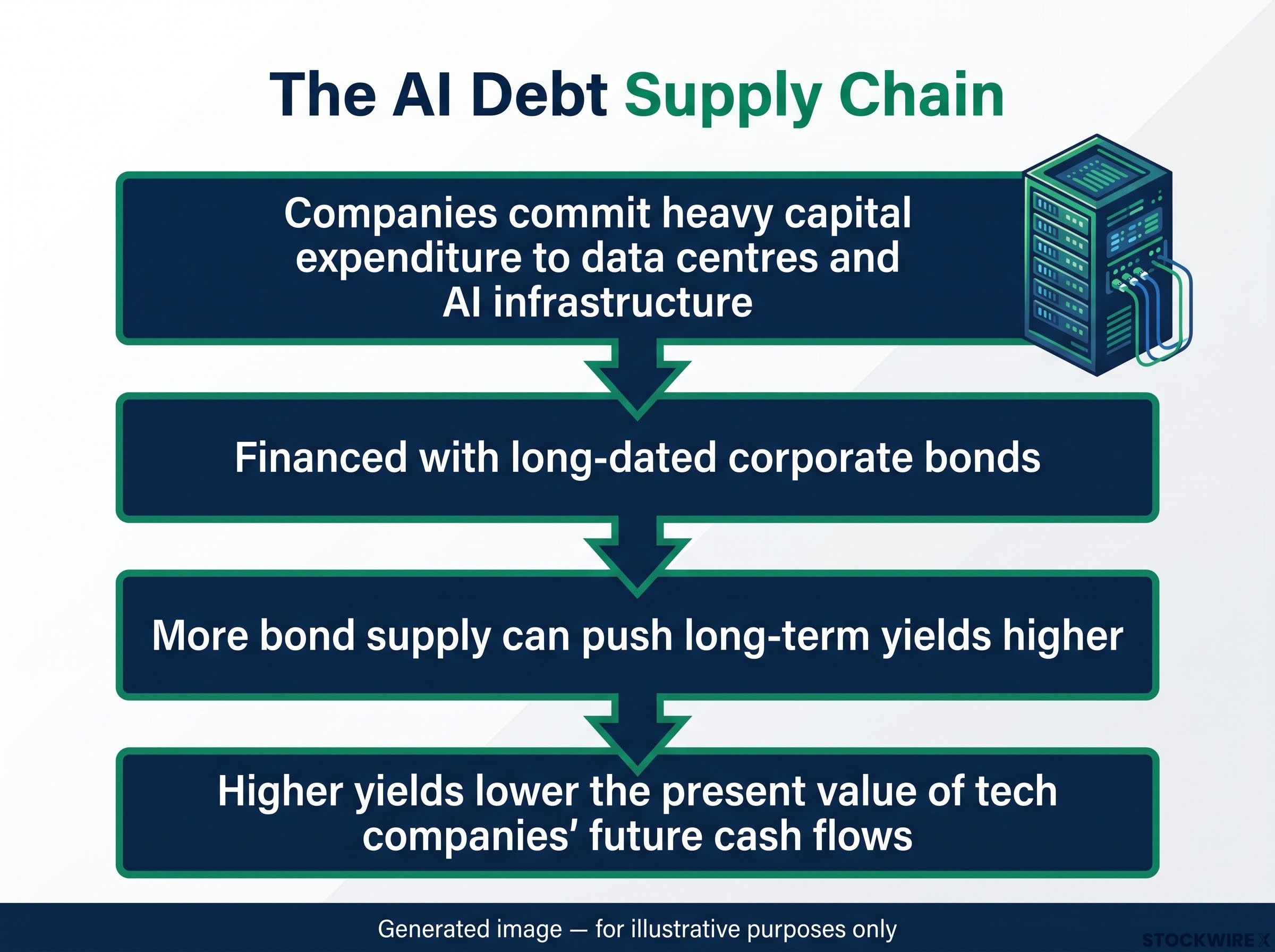
The chain runs like this:
- Companies commit heavy capital expenditure to data centres and AI infrastructure.
- Much of that spending is financed with long-dated corporate bonds.
- More bond supply, for a given level of demand, can push long-term yields higher.
- Higher yields lower the present value of tech companies’ future cash flows.
The bear case builds on that loop. Narrow leadership leaves indexes exposed, and a 5%+ yield on government bonds gives investors a serious income alternative to equities. History offers a warning: the yield spikes of parts of 2022 and 2023 brought valuation compression in high-growth sectors and rotation toward value and defensive names.
The bull case against the yield worry
The counterargument has substance. Many AI-exposed firms generate strong earnings and cash flow, and sustained AI demand could let them grow into their valuations, especially if real yields stabilise and energy prices ease.
Some AI-linked megacaps are defying the rate-hike playbook because earnings growth is outrunning share prices, which compresses multiples even as real yields climb, and that dynamic underpins the bull case here.
Funding mix matters too. If AI build-outs draw on internal cash, equity issuance and debt locked in at earlier, lower rates, the direct effect on long-term yields may be limited, and broader factors such as Fed policy, inflation expectations and fiscal deficits may remain the bigger drivers.
The read for you: a risk-free yield above 5% raises the bar equities must clear. Holding high-multiple tech now depends on earnings delivering, not on momentum carrying prices higher.
Can a hawkish Fed and $100 oil coexist with a soft jobs market?
Yields do not move in isolation. Behind them sits a central bank that changed direction only three weeks ago.
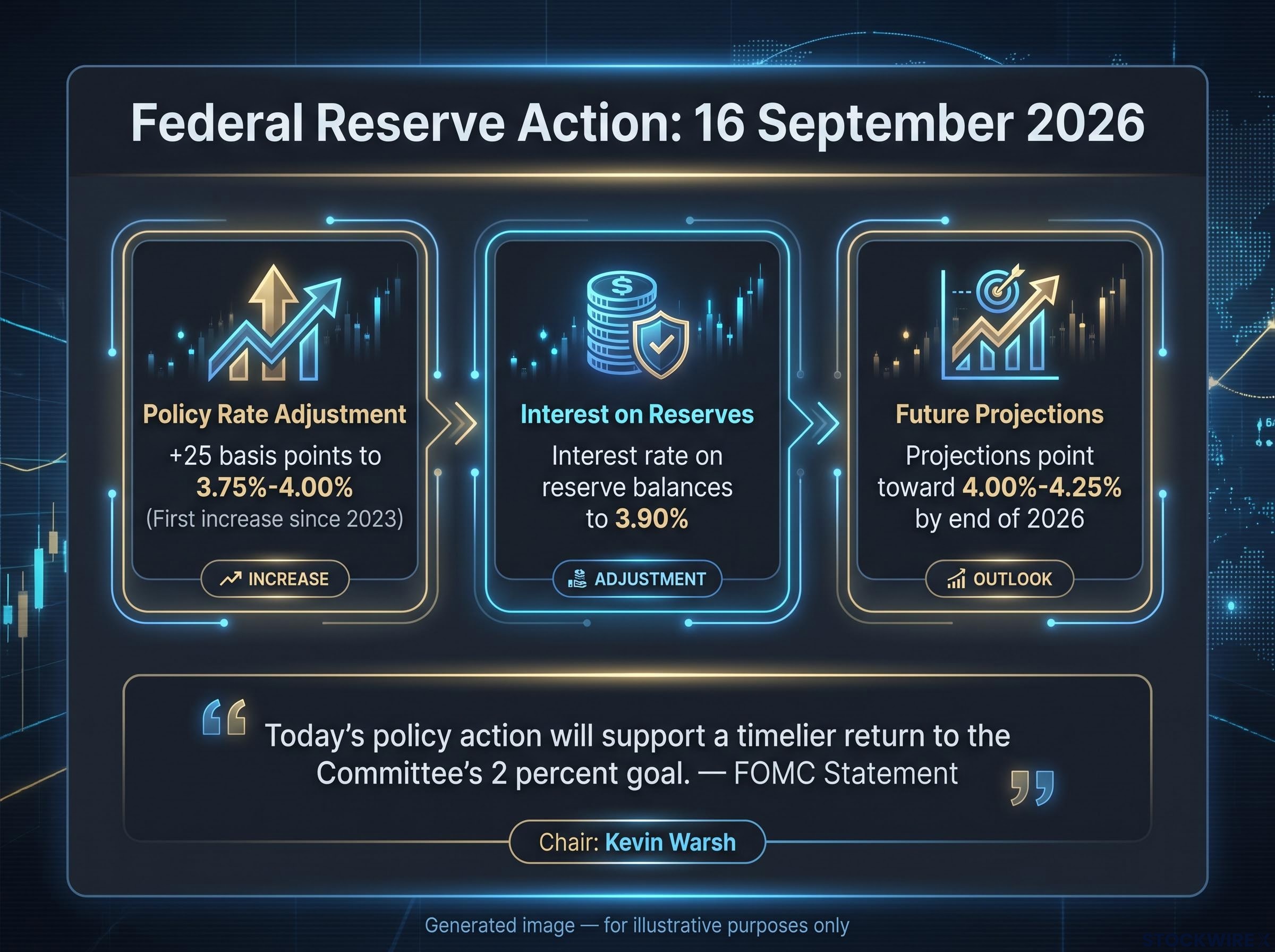
On 16 September 2026, the Fed raised the federal funds target range by 25 basis points to 3.75%-4.00%, its first increase since 2023. The Board voted unanimously to lift the interest rate on reserve balances to 3.90%, and the statement said inflation “remains elevated” while uncertainty stayed high partly because of geopolitical developments.
FOMC statement, 16 September 2026 “Today’s policy action will support a timelier return to the Committee’s 2 percent goal.”
The Fed under Chair Kevin Warsh framed the hike as a renewed fight against inflation, which had picked up partly because of the Iran war’s effect on energy prices. Projections released alongside the decision pointed toward 4.00%-4.25% by the end of 2026, implying more tightening this year.
Oil as the second inflation channel
Brent closed around $100.58 on 6 October, and Wednesday readings ranged from roughly $101.62 to $101.99, depending on the source. Oil recovered on Tuesday after an early dip, as coverage of how expensive it is to move crude out through the Gulf, plus a persistent worldwide squeeze on refined fuels, outweighed optimism about Middle East supply resuming.
Oil at this level spreads well beyond energy companies. It raises input and transport costs, squeezes margins for businesses that cannot pass them on, and keeps headline inflation sticky, which in turn keeps the Fed leaning hawkish.
Analyst estimates suggest 40-60% of an oil price rise feeds into core CPI over three to six months, which is why $100 Brent keeps rate pressure elevated well after the initial energy spike.
The squeeze tightens on the other side. Recent jobs data came in weaker than forecast, and several Fed officials have downplayed the urgency of an October hike. Hawks argue that failing to act decisively could entrench inflation and force harsher hikes later, while others warn that tightening against a supply-driven shock may do little for headline inflation and raise recession risk.
History leans toward caution. The oil shocks of the 1970s proved negative for equities once energy costs and tight policy fed through to profits and employment.
That makes today’s minutes more than routine paperwork. Watch for:
- Any signal that officials view October as a live meeting for another hike
- How strongly inflation is described, especially energy-driven pressure
- Concern about labour-market softening or growth risks
Oil keeps inflation, and therefore rate pressure, higher for longer. A calm tone in the minutes would ease the pressure on rate-sensitive holdings, while a hawkish one would land hardest on the same AI names leading the rally.
What does earnings season need to prove for the rally to hold?
Macro worries set the backdrop, but earnings decide whether record prices are justified. Investors are optimistic about AI and technology profits, though detailed brokerage previews of third-quarter guidance and margins were not available.
The first reports already hint at what the market rewards. Constellation Brands shares dropped before the open because a wary annual guide outweighed stronger-than-expected second-quarter sales and earnings.
Constellation Brands fits the classic expectations gap: a quarterly beat was already priced in, so a cautious annual forecast drove the shares lower before the open.
The message is blunt: guidance is outweighing beats.
| Bank or company | Report timing | What to watch |
|---|---|---|
| Constellation Brands | Reported; shares fell premarket 7 October | Cautious full-year forecast despite a quarterly beat |
| Levi Strauss | After the close, 7 October | Strength of premium denim demand from wealthier shoppers |
| JPMorgan Chase, Citigroup, Wells Fargo | Next week | Net interest margins, credit quality, trading and investment-banking revenue, AI and energy financing commentary |
The big banks matter because they sit at the junction of every force covered here. Net interest margin, the gap between what a bank earns on loans and pays on deposits, shows how higher rates are flowing through, while credit quality reveals whether borrowers are straining. Their commentary on financing AI and energy projects also speaks directly to the debt-supply question.
Four variables will shape the outlook from here:
- The 10-year yield and whether it stabilises near 5.3% or keeps climbing
- Brent crude around $100 and its pass-through to inflation
- The Fed’s tone, starting with today’s minutes
- Corporate guidance on absorbing higher financing and energy costs
For you, guidance is the line to read first. Headline beats describe the past quarter; forward forecasts reveal whether companies can carry heavier costs into next year, and concentration in AI leaders means a few disappointing outlooks could move the whole index.
Weighing the AI rally against rates, oil and the next earnings test
Record highs and a 5.3% yield can coexist only while earnings grow faster than the discount rate rises. Oil and the Fed decide how long that balance holds, because energy-driven inflation keeps rate pressure in place.
Your decision points are close together: today’s minutes, the October Fed meeting, upcoming inflation and jobs data, and bank earnings next week. None of them settles the question alone, but together they will show whether AI profits can outrun higher borrowing costs.
The evidence supports neither alarm nor complacency. A practical step is to check how much of your portfolio rides on the same small group of AI and semiconductor names powering the indexes.
This article is for informational purposes only and should not be considered financial advice. Investors should conduct their own research and consult with financial professionals before making investment decisions. Past performance does not guarantee future results. Financial projections are subject to market conditions and various risk factors.
—