
The Reserve Bank of India (RBI) raised its repo rate by 25 basis points to 5.50% on 7 October 2026. It is the RBI’s first rate hike since February 2023, yet the rupee barely moved, with USD/INR sitting near 96.37 after the announcement and no spike reported.
The headline rate is only part of the story. The RBI also moved its policy stance from neutral to “calibrated tightening”. The decision arrives as the US Federal Reserve’s September hike, a firmer dollar and today’s pending Federal Open Market Committee (FOMC) minutes push policy in the same direction across much of the world.
This piece explains why a historic shift left the currency so calm. It also covers what the move signals for the euro, yen, Australian dollar and gold, and which event could change the picture before markets close.
Why did the rupee barely move after the RBI rate hike?
The screen told a quiet story. USD/INR traded around 96.37 after the decision, inside the 96.29-96.43 range it held in the sessions just before it.
That calm was the logical outcome of three separate forces:
- Expectations: almost every economist polled saw the move coming, so the market had already priced it in.
- Intervention: the RBI has been actively smoothing the currency. The Economic Times linked this activity to a decline in India’s foreign exchange reserves, although no precise reserve figure was found.
- Oil: softer Brent crude eased pressure on India’s import bill. On one recent day the rupee firmed 0.16% to 95.83 as Brent slipped below US$103 a barrel.
The rupee’s oil sensitivity is structural: research estimates each $1 rise in Brent depreciates the currency by roughly 0.28 rupee, which explains why softer crude did so much to steady USD/INR.
The consensus call 9 of 10 economists in one Mint poll, and 20 of 21 in another, expected a 25 bp hike.
Intervention has also shown up directly in closing prices. On another recent session, RBI action helped the rupee close at 95.98.
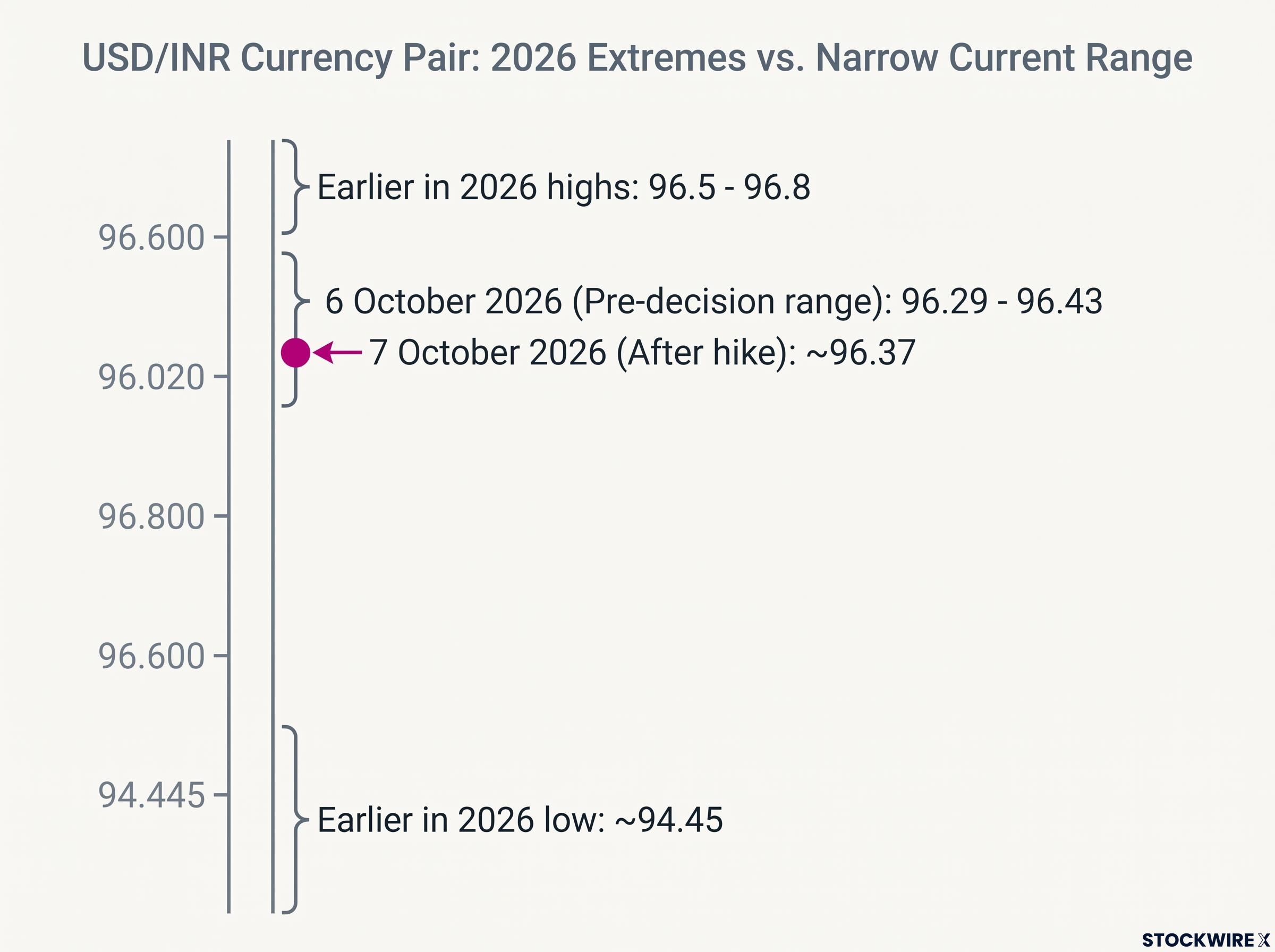
| USD/INR level | Context | Date or condition |
|---|---|---|
| ~96.37 | After the hike | 7 October 2026 |
| 96.29-96.43 | Pre-decision range | 6 October 2026 |
| 95.8-96.5 | Recent trading range | Recent weeks |
| 95.83 | Rupee firmed 0.16% | Brent below US$103 |
| ~94.45 | 2026 low | Earlier in 2026 |
| 96.5-96.8 | 2026 highs | Earlier in 2026 |
Strategists at Brown Brothers Harriman expect the hike to support the rupee. Because the market had already absorbed the 25 bp move, the same-day price told you very little. The new information sits in the stance language and the guidance about what comes next.
When big ASX news breaks, our subscribers know first
What the MPC actually changed: rates, corridor and a tightening bias
The number itself held no surprise. The Monetary Policy Committee (MPC), chaired by Governor Sanjay Malhotra, voted unanimously to lift the repo rate from 5.25% to 5.50%. The repo rate is the interest rate at which the RBI lends short-term money to commercial banks.
The rest of the rate corridor moved with it. The Standing Deposit Facility (SDF) is the rate banks earn on surplus cash parked with the RBI. The Marginal Standing Facility (MSF) is the emergency overnight borrowing rate.
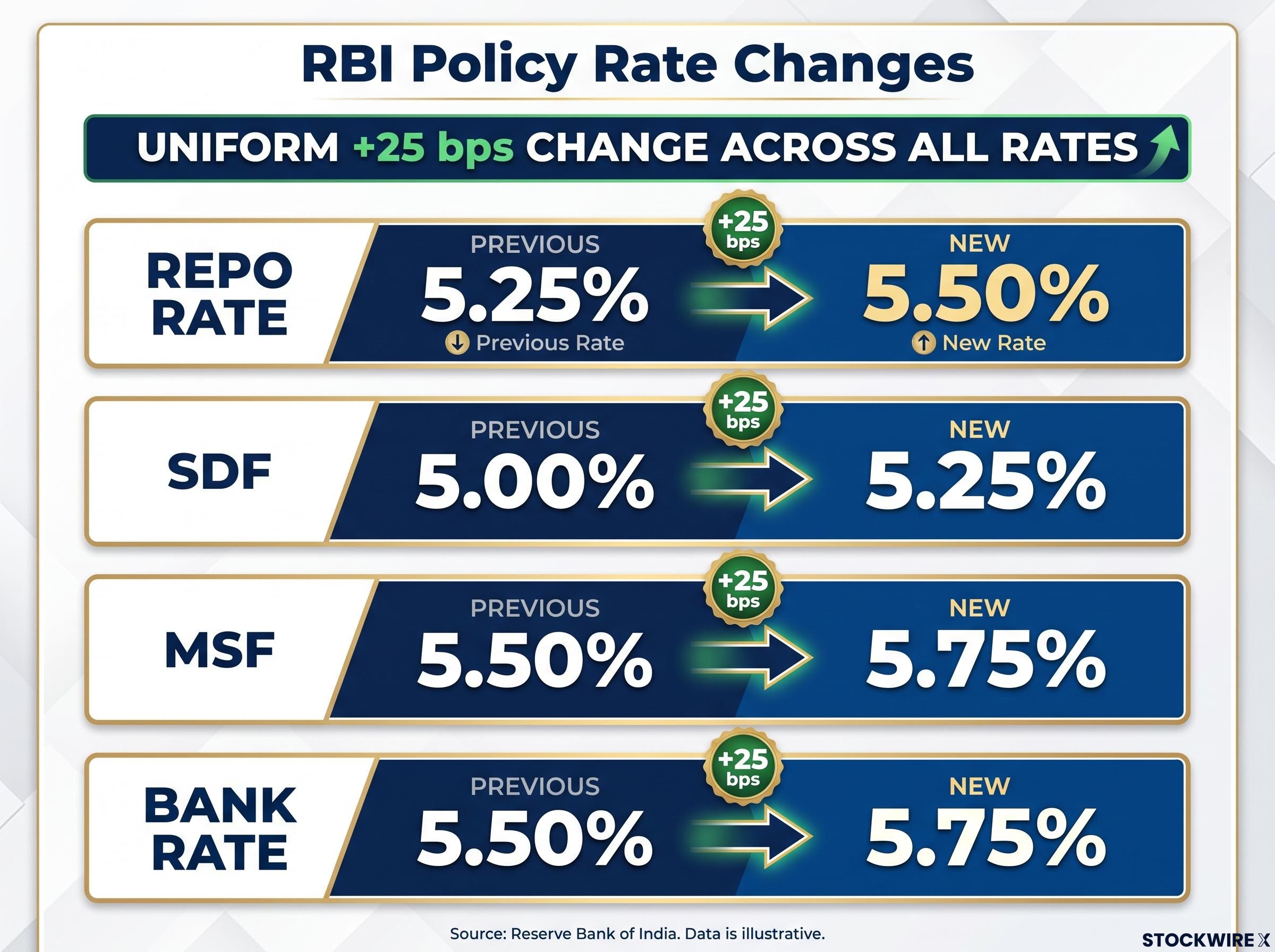
| Rate | Previous | New | Change |
|---|---|---|---|
| Repo rate | 5.25% | 5.50% | +25 bps |
| SDF | 5.00% | 5.25% | +25 bps |
| MSF | 5.50% | 5.75% | +25 bps |
| Bank Rate | 5.50% | 5.75% | +25 bps |
How the vote split
The real shift came in the stance vote. The committee had held a neutral stance at its March, June and August meetings, and the 5 August decision was its fourth consecutive pause. This time, the move to calibrated tightening passed 4:2.
Malhotra then closed the door on easing. He pointed to a stronger dollar, Middle East tensions and trade uncertainty as pressures on global sentiment.
Governor Sanjay Malhotra on the outlook Rate cuts are off the table in the near term. Future moves will be either a hike or a pause, depending on how growth and inflation develop.
Growth gives the RBI room to act. Brown Brothers Harriman cited GDP growth of 7.8% year on year against an RBI forecast of 6.4%, although sources differ on whether that figure covers Q1 or Q2 of FY27. Some reports put the new FY27 forecasts at about 5.2% for consumer price inflation and 7.1% for growth. The latest CPI print was not available.
Inflation still sits inside the RBI’s 2%-6% tolerance band, so the central bank is acting on where it expects prices to go rather than where they are today. For borrowers and rupee holders, the likely result is a firmer floor under rates rather than a rapid run of hikes.
The RBI’s August minutes had already hinted at this shift, showing four of six members leaning cautious to hawkish and projected inflation peaking near 5.9%, just below the upper tolerance band.
A firmer dollar and a hiking Fed: the backdrop the RBI is reading
Viewed from further out, India’s move is one response among several to the same external pressure. The Fed raised rates by 25 bps in September and signalled at least one more hike this year.
The Fed’s dual mandate leaves it missing both targets at once, with inflation above 2% and unemployment at 4.1%, which is why price stability now dominates its September decision and the signal markets expect from the minutes.
The dollar recovered slightly in Asian trade today after a correction the previous session. The US Dollar Index (DXY), which tracks the dollar against a basket of major currencies, rose 0.18% to about 102.00.
That strength reaches India through three channels:
- Oil and the import bill: India imports most of its crude, so higher prices widen its import costs and weaken the rupee. The Economic Times has tied volatile crude and the West Asia conflict to inflation and currency pressure.
- Intervention: RBI dollar sales cushion currency swings but draw down reserves, which limits how long the central bank can lean against the tide.
- Capital flows: when US rates rise faster than rates elsewhere, money tends to flow towards dollar assets. That gap, along with rising global yields, puts pressure on emerging-market currencies.
What to watch in the FOMC minutes
The minutes of the Fed’s September meeting land at 18:00 GMT today. They will show how committed policymakers are to another hike.
If the minutes confirm a further US increase, renewed dollar strength could test the rupee’s calm. Seen that way, the RBI’s tightening bias works as a defensive buffer as much as a domestic inflation call.
Euro, yen, Australian dollar and gold: how policy divergence is playing out elsewhere
Across other markets, the pressure on non-dollar assets is easy to see.
| Market | Level | Driver | Short-term read |
|---|---|---|---|
| EUR/USD | Lowest since May 2025 | French budget risk, 3.8% inflation | Nearly 7% below January peak |
| USD/JPY | ~158.50 | Firmer dollar | Testing 200-day SMA |
| AUD/USD | Below 0.7000 | Geopolitics, higher US yields | Under pressure |
| Gold | ~US$4,150 | Dollar strength | Sell-on-bounce bias |
The euro faces a double bind. France’s 2027 budget could bring down the government before the end of November, while eurozone inflation has hit 3.8%, a three-year high and almost double the target.
The yen sits near a one-and-a-half-week high around 158.50, where it meets the 200-day simple moving average (SMA), the average closing price over the past 200 trading days. Gold is struggling, and traders see rallies as selling opportunities in the short term.
Set against these moves, the rupee’s stability stands out. The risks that could change that include:
- Upside inflation surprises that force further tightening
- Volatile oil prices and Middle East tensions
- Rising global yields or risk-off episodes
- The European Central Bank’s dilemma over political risk and high inflation
The common thread is the dollar. Any exposure you hold to the euro, yen, Australian dollar or gold faces the same US rate path the RBI is responding to.
What the hike settles, and what the FOMC minutes could reopen
The 25 bp move was expected. The shift to calibrated tightening, and Malhotra’s rejection of near-term cuts, is the genuine news. It confirms that India’s easing cycle is over for now.
The main open question sits outside India. Three things to watch:
- Tonight’s FOMC minutes and any firmer signal on a further US hike
- Oil prices and developments in the Middle East
- India’s next inflation prints
India’s next inflation prints carry added weight because a 15% monsoon deficit threatens a sharp food price surge, while frozen fuel prices have queued an energy shock rather than cancelled it.
If you hold rupee or other dollar-sensitive assets, the decision comes down to how much further US rate pressure you are prepared to absorb.
This article is for informational purposes only and should not be considered financial advice. Investors should conduct their own research and consult with financial professionals before making investment decisions. Forecasts and forward-looking statements are speculative and subject to change based on market developments.