
At around $151, Commonwealth Bank of Australia (ASX: CBA) looks cheaper than it did at its highs. It still trades on roughly 22.6x FY27 consensus earnings, though, and that changes what “cheaper” means. A softer share price and a low multiple are two different things.
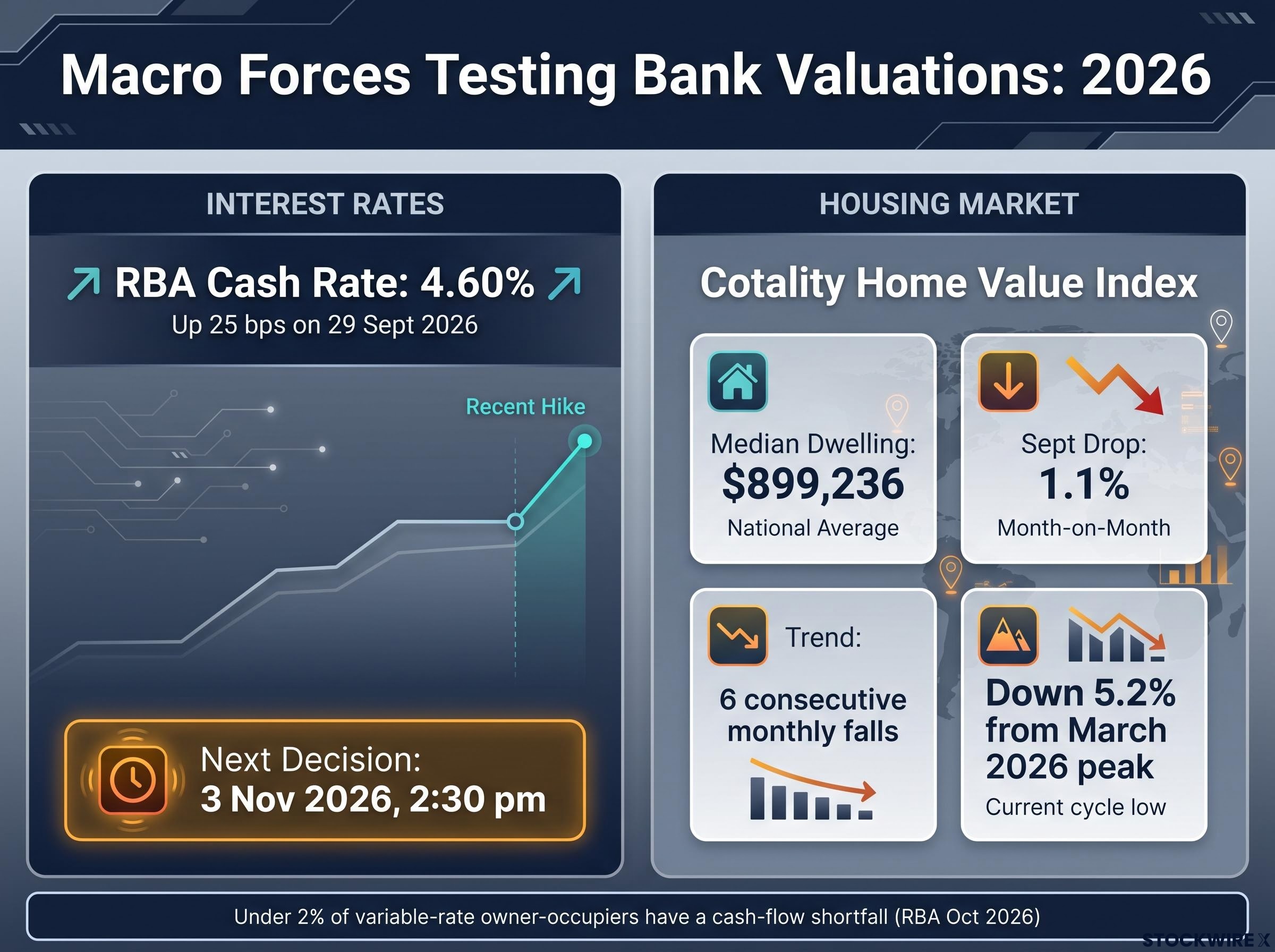
Two forces are testing that premium right now. The Reserve Bank of Australia (RBA) lifted the cash rate 25 basis points to 4.60% on 29 September 2026. National home values have now fallen for six consecutive months.
This CBA stock analysis gives you a way to weigh franchise quality against the price you pay, and it shows which numbers would change the verdict. It is general analysis, not personal advice. One input is a Motley Fool Australia opinion piece, which is treated as one author’s view rather than independent evidence.
What do rising rates and falling home prices actually do to a bank like CBA?
The common assumption is that higher rates are good for banks. They charge more on loans, so profits rise. That holds early in a hiking cycle, but the benefit has a shelf life.
Margins and deposit competition
Net interest margin (NIM) is the gap between what a bank earns on loans and what it pays for funding, expressed as a percentage of its lending assets. When the RBA lifts the cash rate, yields on variable-rate mortgages reset higher almost immediately. If deposit rates lag behind, the margin widens.
Net interest margin is one of three core metrics, alongside return on equity and CET1 capital, that show whether a bank’s profitability gap is cyclical or structural, which is why CBA’s scale and cheaper deposit funding matter so much to the premium.
That lag does not last. As rates stay high, savers stop tolerating near-zero returns and move money out of transaction accounts into savings and term deposits. Banks then compete harder for those funds, funding costs climb, and the early margin gain starts to erode.
The RBA has signalled it could tighten further if inflation stays elevated. Its next decision lands on 3 November 2026 at 2:30 pm.
Credit quality and loan growth
Falling home prices hit banks more slowly. Cotality’s Home Value Index shows national values fell 1.1% in September, with the median dwelling now at $899,236. Values dropped 3.7% across the September quarter and are flat (0.0%) over the year. August was also revised down, from -0.9% to -1.2%.
Six months and counting National home values are now 5.2% below their March 2026 peak after six straight monthly falls, according to Cotality.
Lower collateral values raise loss-given-default, which is the share of a loan a bank loses if a borrower defaults and the property is sold. Reduced borrowing capacity also cuts demand for new mortgages and refinancing.
The starting point is still benign. The RBA’s October 2026 Financial Stability Review estimates that under 2% of variable-rate owner-occupiers have a cash-flow shortfall. That tells you the credit problem is about duration rather than the present. The number to watch is how long prices keep falling, not today’s stress data.
| Pressure | How it can help CBA | How it can hurt CBA |
|---|---|---|
| Margins | Variable loan yields reset faster than deposit costs | Deposit competition lifts funding costs over time |
| Credit quality | Low starting stress among owner-occupiers | Falling collateral values raise potential losses |
| Loan growth | Repricing lifts income on the existing book | Lower borrowing capacity dampens new lending |
When big ASX news breaks, our subscribers know first
Is a 22.6x multiple fair for a bank forecast to grow earnings by 1.4%?
That cause-and-effect map matters because the valuation leaves little room for the less flattering side of the table.
What the forecasts imply
CBA closed at $151.22 on 5 October and $152.38 on 6 October. Motley Fool Australia put it at about $151.07 on 7 October.
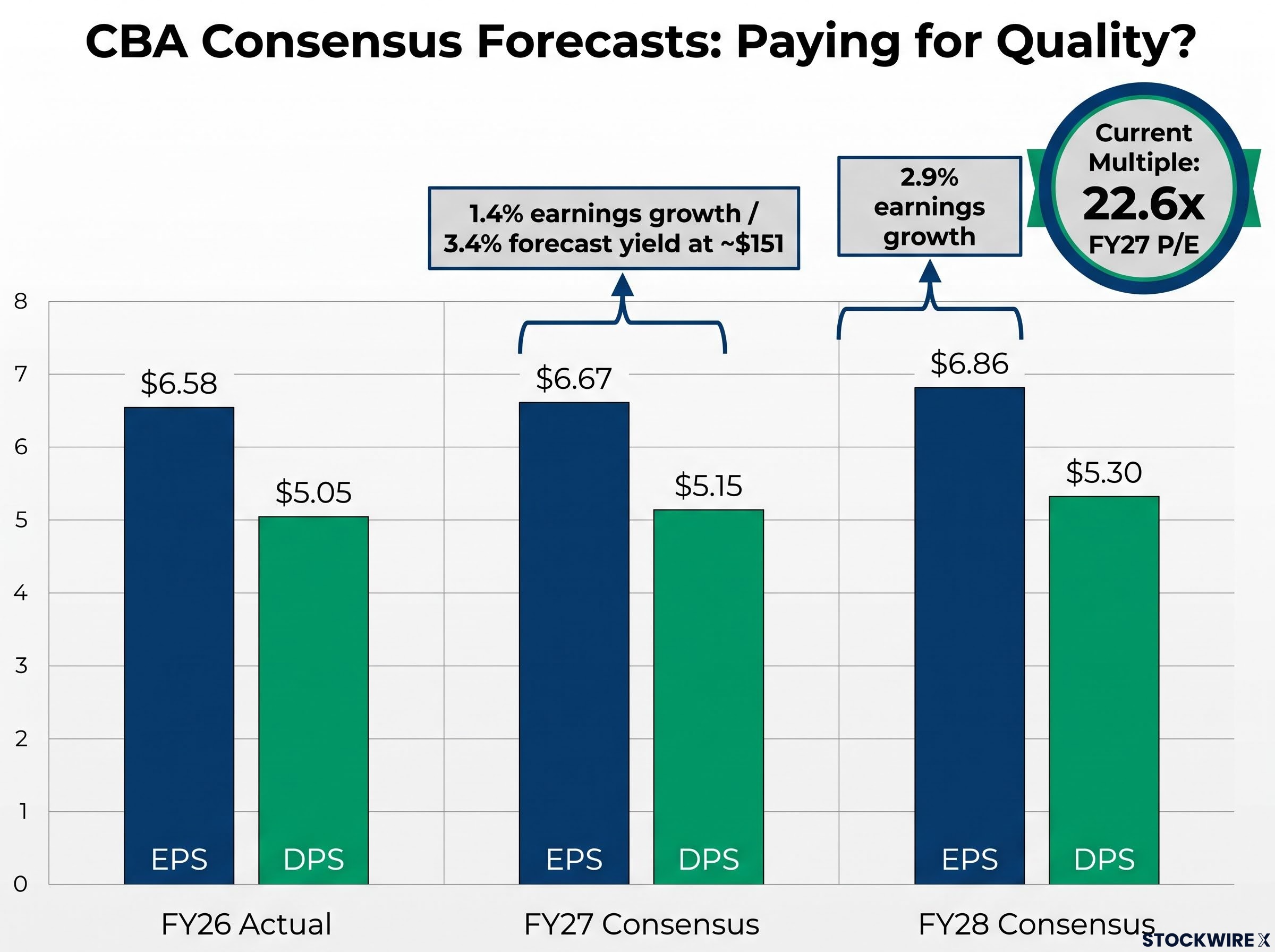
| Metric | FY26 actual | FY27 consensus | FY28 consensus |
|---|---|---|---|
| Earnings per share | $6.58 | $6.67 | $6.86 |
| Dividend per share | $5.05 | $5.15 | $5.30 |
Those figures imply earnings growth of about 1.4% in FY27 and about 2.9% in FY28. The FY27 dividend of $5.15 gives a forecast yield of roughly 3.4% at $151.
A price-to-earnings (P/E) ratio of 22.6x means you are paying $22.60 for every dollar of expected annual profit. Multiples like that usually come with faster growth than this.
The quality case for paying up
Investors have paid up anyway, for reasons commonly cited across the market:
- Higher and more stable return on equity (ROE, profit as a share of shareholder capital) than peers
- A leading retail deposit and payments franchise that supplies low-cost funding
- Strong capital and provisioning
- Technology advantages, built through years of digital investment, that support customer retention and efficiency
Morningstar’s data provides the counterweight. Its quote page showed CBA trading at a premium to Morningstar’s assessed fair value at $151.22 on 5 October 2026. The Motley Fool author argues, as opinion, that investors are “still paying a hefty price for quality”, yet still names CBA as the major bank they would most want to own.
How CBA’s multiple compares with Westpac, NAB and ANZ cannot be verified from the available research. At this price you are buying stability rather than growth. The question is whether a roughly 3.4% yield plus low single-digit earnings growth is an acceptable return on that quality for you.
The premium is not unique to CBA; Australian banks as a group screen as the most expensive in the developed world on forward earnings, and UBS has named CBA its least preferred major on relative value.
Where could the premium crack, and what does history suggest?
CBA’s record of resilience is reassuring. It is also the reason the stock has more to lose if conditions turn.
The risks, ranked
- Valuation compression: the multiple could drift toward peers even if operations stay solid, and Morningstar’s fair-value reading adds weight to this risk.
- A prolonged housing and rate cycle: a 4.60% cash rate and persistent price falls raise the odds of higher arrears and provisioning, particularly if unemployment rises.
- Regulatory and capital changes: shifts in capital rules or mortgage risk weights could compress returns, and premium-priced banks tend to feel that hardest.
- Competitive pricing: aggressive deposit and mortgage offers from other majors, regionals and non-banks could erode CBA’s margin edge.
- Performance rotation: if peers lift their ROE or tighten costs, market leadership can shift away from CBA.
The optimistic reading holds that a well-capitalised bank with a predominantly prime mortgage book can absorb a moderate rise in arrears, provided it prices deposits with discipline. The cautious reading holds that prolonged high rates and falling prices eventually show up in credit charges and pressure on the multiple.
The author’s caveat (opinion) The Motley Fool author calls the housing downturn and higher rates “legitimate reasons for caution” and expects both to stay influential over the coming year.
What past cycles suggest
The following are general historical patterns that have not been independently verified, and they are not 2026 data. During the GFC, CBA’s balance sheet helped it outperform on resilience, but it still suffered sharp drawdowns. Through 2011-12 and 2014-16, the gap between CBA’s valuation and its peers’ widened and narrowed with risk sentiment.
In the 2022-23 hiking cycle, margins improved first and then came under deposit pressure, while CBA broadly kept its premium.
History tells you a quality premium can hold for years. It is most exposed when macro risks are rising and the valuation is already demanding, and that describes today. Treat the premium as conditional, not guaranteed.
Does CBA still earn its premium at about $150? A framework for deciding
The decision comes down to three inputs: the quality you are buying, the price you are paying, and the path of rates and housing. The quality is largely settled. The price and the macro path are what move from here.
| Signal to watch | Supports the premium | Challenges the premium |
|---|---|---|
| RBA decision, 3 November 2026 | Rates on hold | Further tightening |
| Next Cotality reading | Declines slow or stop | A seventh monthly fall |
| Arrears data | Stress stays contained | Rising cash-flow shortfalls |
| Deposit pricing | Disciplined competition | Aggressive rate offers |
How you weigh these signals depends on what you want from the holding:
- Income-focused: a roughly 3.4% forecast yield with rising dividends offers steadiness, but it may trail what other majors offer.
- Long-term quality holder: the franchise case is intact, so the question is whether you can tolerate multiple compression along the way.
- Valuation-sensitive: with growth of 1.4% and 2.9% forecast, the margin of safety is thin, and waiting for clearer macro data may suit you better.
Several numbers that matter were not available here: peer P/Es, CBA’s NIM and its FY26 cash profit. Check them before you decide. Then set out in advance which data points would make you add, hold or wait.
For investors wanting a repeatable screen before acting, our dedicated guide to the five-factor bank checklist covers income structure, property exposure, unemployment trajectory, management discipline and arrears trends.
What the pullback changes, and what it does not
The softer price makes an entry point easier to accept. It does not change the 22.6x multiple, the thin forecast earnings growth or the stock’s dependence on the housing and rate path.
CBA’s quality is real. Much of that quality is already reflected in the price, which is why the next data points carry so much weight.
The 3 November RBA meeting and the next Cotality home value reading are the thesis’s next two tests. Holding steady on both would support the premium. Further tightening or a seventh monthly fall would put it under strain.
This article is for informational purposes only and should not be considered financial advice. Investors should conduct their own research and consult with financial professionals before making investment decisions. Past performance does not guarantee future results. Financial projections are subject to market conditions and various risk factors.