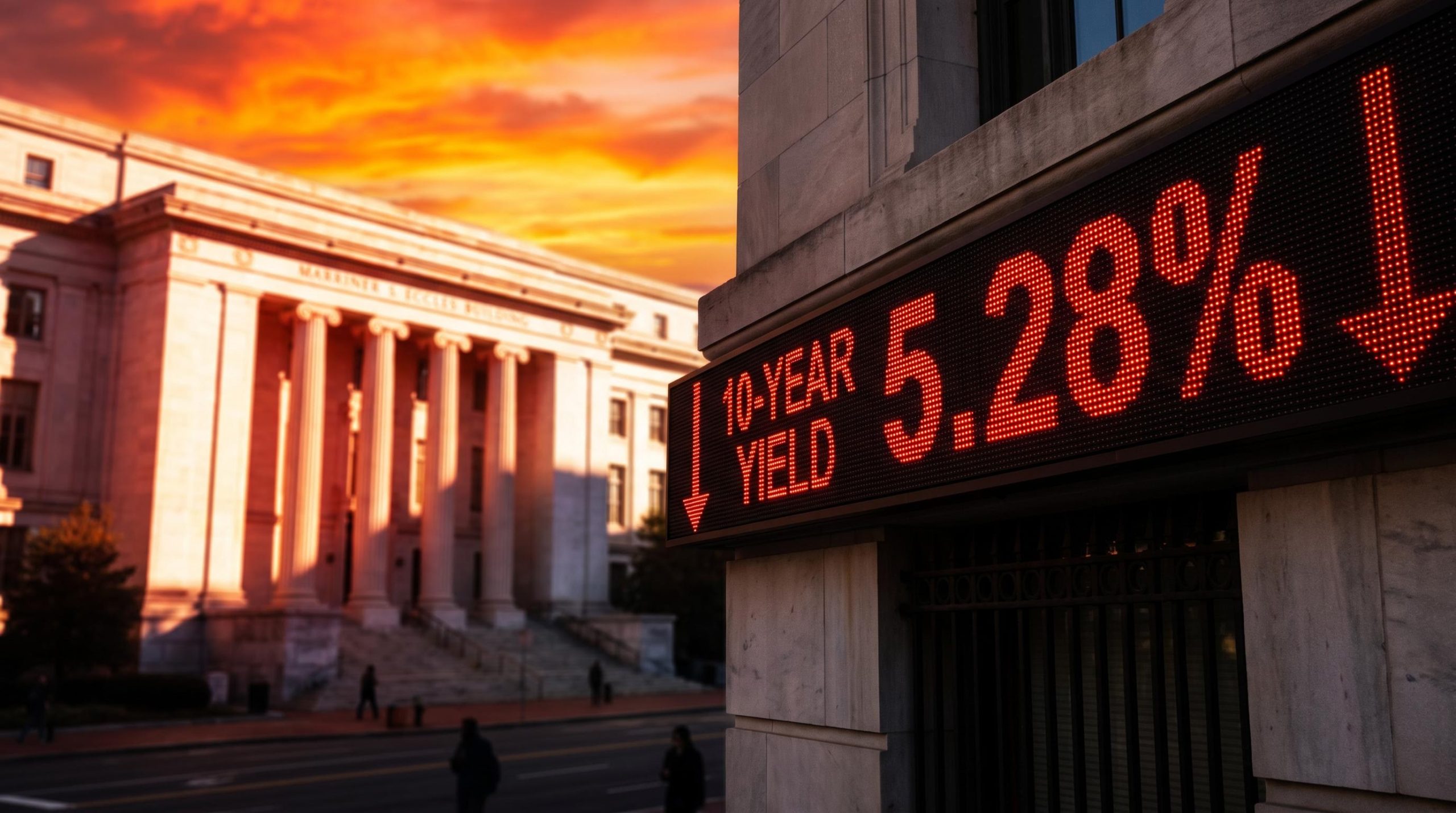
A falling US Dollar is supposed to be good news for almost everything priced against it. On Tuesday, the US Dollar Index (DXY) slipped back under 102.00, only a day after printing its highest level since April 2025. Any US Dollar market analysis of the move has to start somewhere unexpected: a bond market in Paris.
That single session moved the Dollar, the euro, sterling, the yen, the Australian Dollar, gold and West Texas Intermediate (WTI) crude, the US oil benchmark. Not all of them moved for the same reason.
Wednesday brings the minutes of the Federal Open Market Committee (FOMC), the Federal Reserve’s rate-setting body. They could confirm Tuesday’s pattern or undo it within hours.
Here is what drove the moves, how currencies, yields and commodities connect, and which of Wednesday’s events could break the pattern.
Why did the Dollar slip below 102.00 when French fears eased?
The number on the screen was the DXY under 102.00, roughly a two-day low. On 5 October, the ICE Dollar Index had reached 102.53, its strongest level since April 2025. Another report from the same day put the high at 102.14, a gap that most likely reflects different timestamps.
The cause of the reversal sits in Europe, not Washington.
The French pressure points behind the swing
France’s public debt is approaching 120% of GDP, and its 2026 deficit is projected at around 5.4% of GDP. The government’s budget bill targets a 5% deficit in 2027, backed by €54 billion of proposed spending cuts. Political gridlock ahead of the 2027 election leaves investors doubting those cuts will pass.
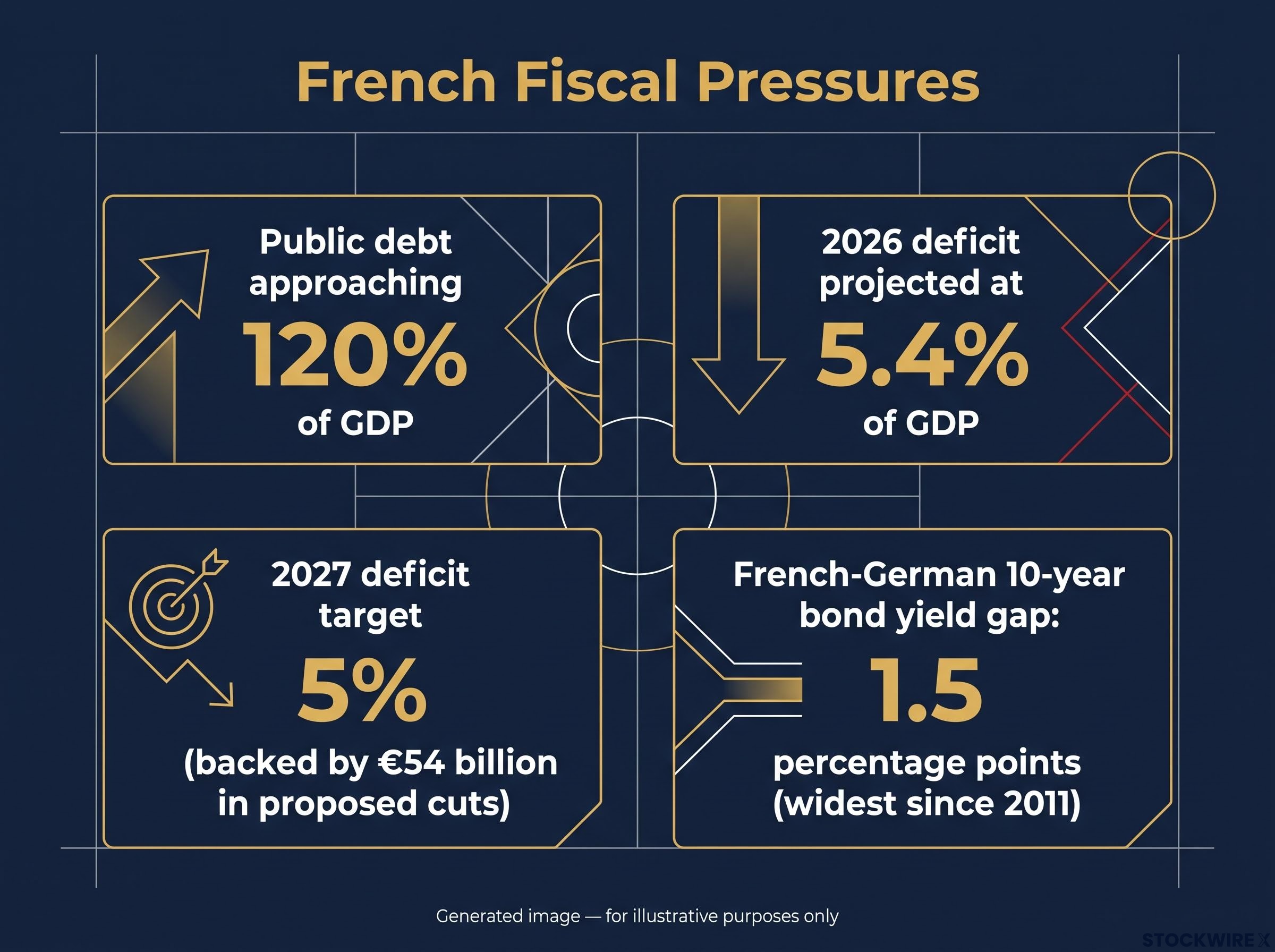
Markets responded by pushing the gap between French and German 10-year bond yields to about 1.5 percentage points, the widest since 2011. That spread is the extra return investors demand to hold French debt instead of German debt. Reuters and others have drawn comparisons with the eurozone debt crisis, and that fear travels to the Dollar through three steps:
- Debt, deficits and gridlock trigger selling in French bonds, widening the spread against Germany.
- Investors demand a higher risk premium on euro assets, dragging the euro lower.
- The DXY is heavily weighted toward the euro, so a weaker euro lifts the index. When French worries ease, the chain runs in reverse.
Tuesday’s relief came from modest spread compression and fewer immediate signs of gridlock. That is an easing, not a resolution.
French fiscal strain matters for the Dollar because every widening of the OAT-Bund spread pushes the euro lower and the DXY higher, which is why Tuesday’s easing proved so market-moving.
How the four major pairs responded
| Pair | Tuesday level or move | Key level in focus | Conviction or note |
|---|---|---|---|
| EUR/USD | Weekly highs near 1.1280 | Initial resistance at the weekly high | Up from about 1.1246 on 4 October, near a 17-month low (Reuters) |
| GBP/USD | Advanced on the softer Dollar | 1.3300 resistance | Retesting the level again |
| USD/JPY | Back above 158.00 | 158.00 | Weak buyer conviction |
| AUD/USD | Third straight daily gain | Just under 0.7000 | Lifted by risk appetite |
Three pairs moved against the Dollar together, which fits a euro-led story. The yen was the outlier, climbing against a weaker Dollar on thin conviction, and that will matter later.
What this tells you is that the Dollar’s retreat reflects euro relief more than any change in US fundamentals. The move is only as durable as the calm in French bond markets, so check European credit spreads before assuming a Dollar move is about the Fed.
When big ASX news breaks, our subscribers know first
What did falling yields and cheaper oil do to gold and WTI?
Gold and oil both reacted to Tuesday’s session. They did so for entirely different reasons.
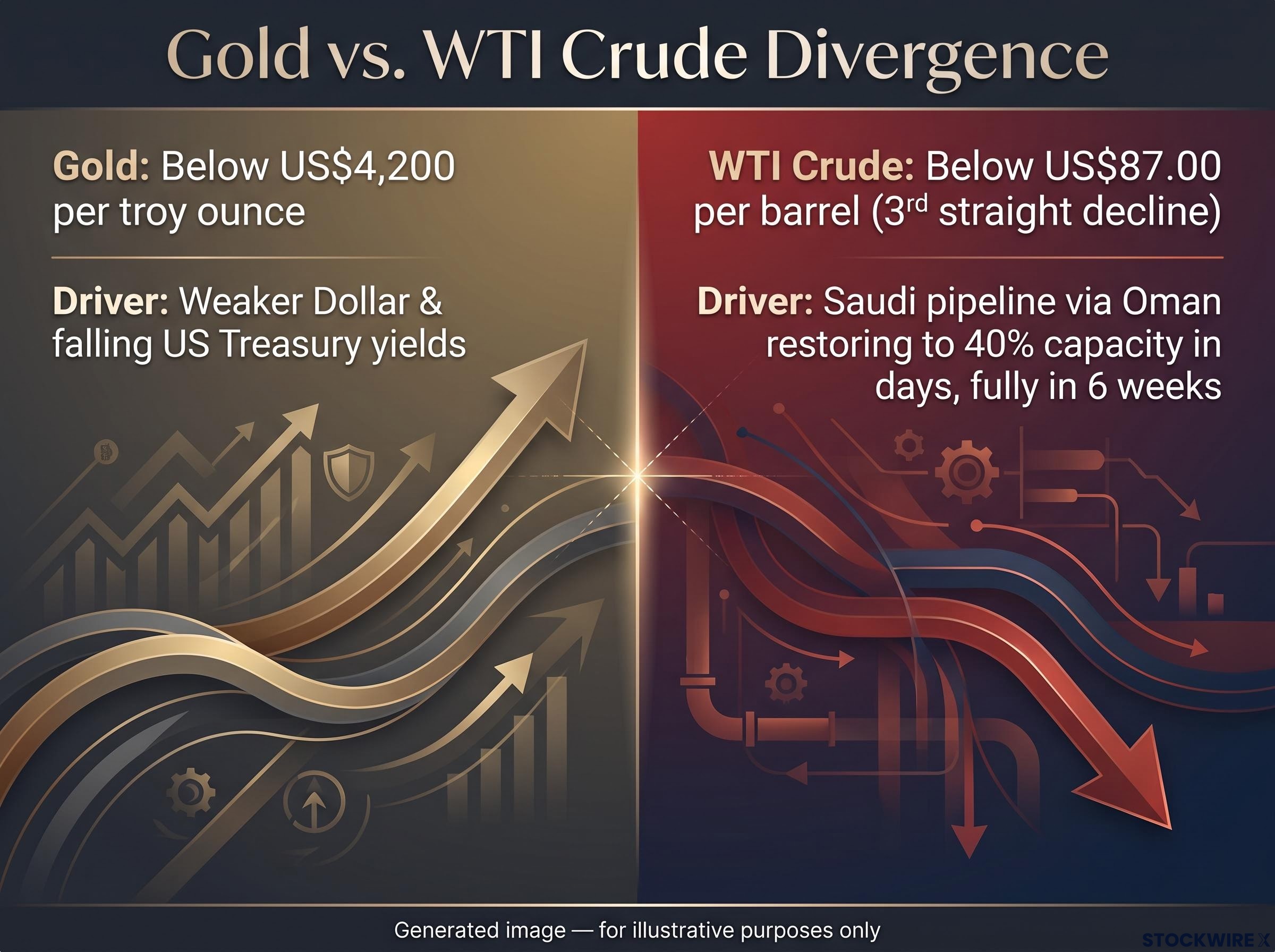
Gold edged higher in consolidation, a phase of sideways trading, while staying below US$4,200 per troy ounce. Its support came from the weaker Dollar and from US Treasury yields falling across maturities. Exact yield levels were not available, but the direction matters given that an earlier global bond rout had pushed borrowing costs to multi-decade highs.
Bond yields fall when prices rise, so the drop in Treasury yields across maturities reflects buying demand, and that lowers the opportunity cost of holding gold, which pays no income.
WTI went the other way.
Oil’s third straight decline Front-month WTI fell for a third consecutive session, dropping below US$87.00 per barrel as Middle East supply fears eased.
An earlier report placed WTI below US$89, but the session wrap’s sub-US$87 level is the more precise figure. The driver was physical: signs that Middle East crude exports are recovering toward pre-war levels. Saudi Arabia found an alternative route through Oman to ship crude to Asia after attacks on a key pipeline, and authorities plan to restore that pipeline to 40% capacity within days and fully within six weeks.
- Gold’s driver: a rates and Dollar story, as lower yields cut the cost of holding a metal that pays no income.
- WTI’s driver: a supply story, tied to export routes and pipeline repairs rather than currency moves.
Cheaper oil also eases inflation worries that would otherwise support bets on tighter Fed policy. If you treat gold and oil as one “Dollar trade”, you risk misreading the next shift when their drivers pull apart.
How do currencies, yields, gold and oil actually interact?
Tuesday looked like the standard pattern working as expected. That is exactly why the exceptions deserve attention.
The default pattern
When the Fed sounds hawkish, meaning it leans toward higher rates or slower cuts, the Dollar and Treasury yields tend to rise. A FinanceCalendar.com explainer from 25 August 2026 notes that hawkish language typically supports the Dollar against the euro, sterling and yen. Dovish signals tend to push both lower, which usually helps non-yielding assets such as gold.
| Scenario | Dollar | Yields | Gold | Typical driver |
|---|---|---|---|---|
| Dovish minutes | Lower | Lower | Tends to rise | Expectations of easier policy |
| Hawkish minutes | Higher | Higher | Tends to fall | Higher rates or slower cuts |
| Safe-haven bid | Higher | Can be reinforced | Does not move in lockstep | Political or financial stress |
When the pattern breaks
The third row is where the relationship bends. ADM Investor Services observed that when the Dollar is bought as a safe haven, as it was amid French and Japanese political uncertainty, minutes and yields can reinforce that bid without commodities following the usual inverse path. Around the FOMC Minutes on 8 October 2025, the USD index rose for a third straight day on exactly that kind of demand.
Oil is the second exception, because supply routes can overpower any currency effect, as Tuesday showed.
Commentators split on how much weight to give each force. One camp sees gold and oil as largely rates-driven, lifted by lower real yields and a softer Dollar. The other stresses structure and geopolitics: oil follows physical export volumes, while gold answers to safe-haven demand and long-term inflation hedging.
Treat the Dollar-yields-gold link as a default rather than a law. Before predicting what commodities will do, ask what is driving the Dollar.
What could reverse the move on Wednesday?
Tuesday’s calm rests on several conditions holding at once. Ranked by likely market impact, these are the ways it could unwind.
Headline risks
- FOMC Minutes and Fed’s Logan: The reaction hinges on how the minutes shift expectations for the policy path and real yields. A hawkish surprise could reverse the Dollar’s softness and weigh on gold. No preview of Logan’s stance was found, so his remarks are an open variable.
- Yen intervention: USD/JPY above 158.00 on weak conviction makes official action a live caveat. Minutes from the 28 January 2026 meeting recorded that the Dollar “depreciated markedly” after New York Fed “rate checks” on dollar-yen, proof that FX-specific moves can hit around an FOMC date.
- Oil supply reversal: Repair delays on the Saudi pipeline or regional escalation could push WTI back toward prior highs, reviving inflation worries.
- French risk: Spreads remain near crisis-era levels, so any euro relief stays fragile.
The rest of the calendar
| Region | Event | Why it matters |
|---|---|---|
| US | MBA Mortgage Applications, NY Fed Consumer Inflation Expectations | Inflation expectations feed the rate outlook |
| Europe | Germany Industrial Production, ECB’s Cipollone and Vujčić | Euro direction beyond France |
| UK | BBA Mortgage Rate, Lloyds House Price Index | Housing signals for sterling |
| Japan | Reuters Tankan, Average Cash Earnings | Context for a fragile yen |
| Australia | Building Permits, Ai Group Manufacturing Index | Support for AUD/USD near 0.7000 |
If you are positioned for further Dollar weakness, a hawkish minutes surprise, yen intervention and an oil supply setback are the three triggers most likely to challenge that view.
For readers wanting to weigh Wednesday’s release properly, our full explainer on reading FOMC minutes shows how to audit the data released since the meeting before trusting the minutes.
What Tuesday’s Dollar slide changes, and what it leaves unresolved
Tuesday’s move was a French-driven euro relief rally, reinforced by lower Treasury yields, that eased the Dollar and lifted gold. Oil followed its own supply story.
None of the underlying risks has been settled. French fiscal strain, the Saudi pipeline timeline and the minutes outcome all remain open, so the Dollar’s softness is conditional rather than confirmed.
On Wednesday, two indicators are worth checking first. Watch how EUR/USD reacts to the minutes, then the direction of Treasury yields. If both hold, the pattern holds; if either turns sharply, Tuesday’s read needs revisiting.
This article is for informational purposes only and should not be considered financial advice. Investors should conduct their own research and consult with financial professionals before making investment decisions. These statements are speculative and subject to change based on market developments.