
The usual explanation for rising long-term borrowing costs is a strong economy. That story is harder to tell when Japan’s 30-year government bond yield sits at a reported record near 4.2% and France pays a premium over Germany not seen since the euro-area debt crisis.
Neither country is booming. Something else is pushing long-dated yields higher, and the global bond market stress now visible across several regions deserves a closer look.
Long-end yields are climbing in Japan, the euro area and, according to one commentator, the US. This matters because heavily indebted governments must refinance at these higher rates. Economist Felix Prins, founder of the Prins Institute, describes the moves as falling “dominoes” signalling eroding trust in big borrowers. That is one informed opinion, not a market consensus.
Here is a framework for separating what the data confirms from what remains disputed, as of early October 2026. It will also help you read the next alarming bond headline with more care.
Japan and France: where the repricing is most visible
Japan: record yields, contested debt figures
On Monday, 5 October 2026, the 30-year Japanese Government Bond (JGB) yield reached about 4.235%, which Investing.com called a record high. It linked the move to worries about heavier debt issuance and inflation risk from Middle East tensions. Prins cites a figure near 4.24% and a 52-week high of roughly 4.279%, which would sit above the “record” level. Under either reading, the yield is at or near its highest in decades.
The speed is as striking as the level. In January 2026, DWS reported the 30-year yield jumping roughly 0.25 percentage point in a single session, with the 40-year above 4%. Under yield-curve control, the Bank of Japan’s (BoJ) policy of capping yields by buying bonds, that kind of move was close to impossible.
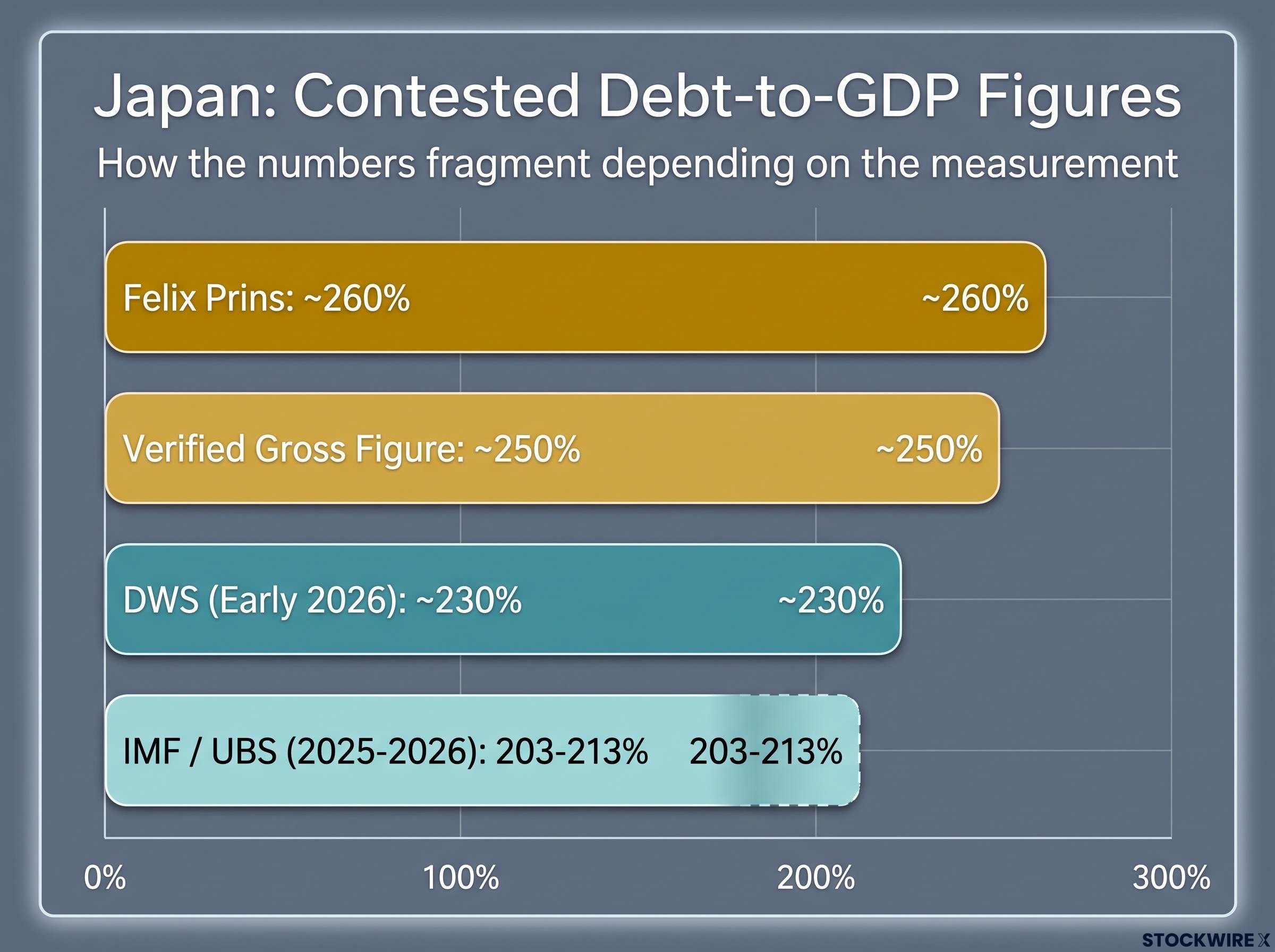
Japan’s debt load is where the numbers fragment. Prins cites about 260% of GDP. Other estimates depend on whether you measure gross debt or net public debt.
France and the periphery
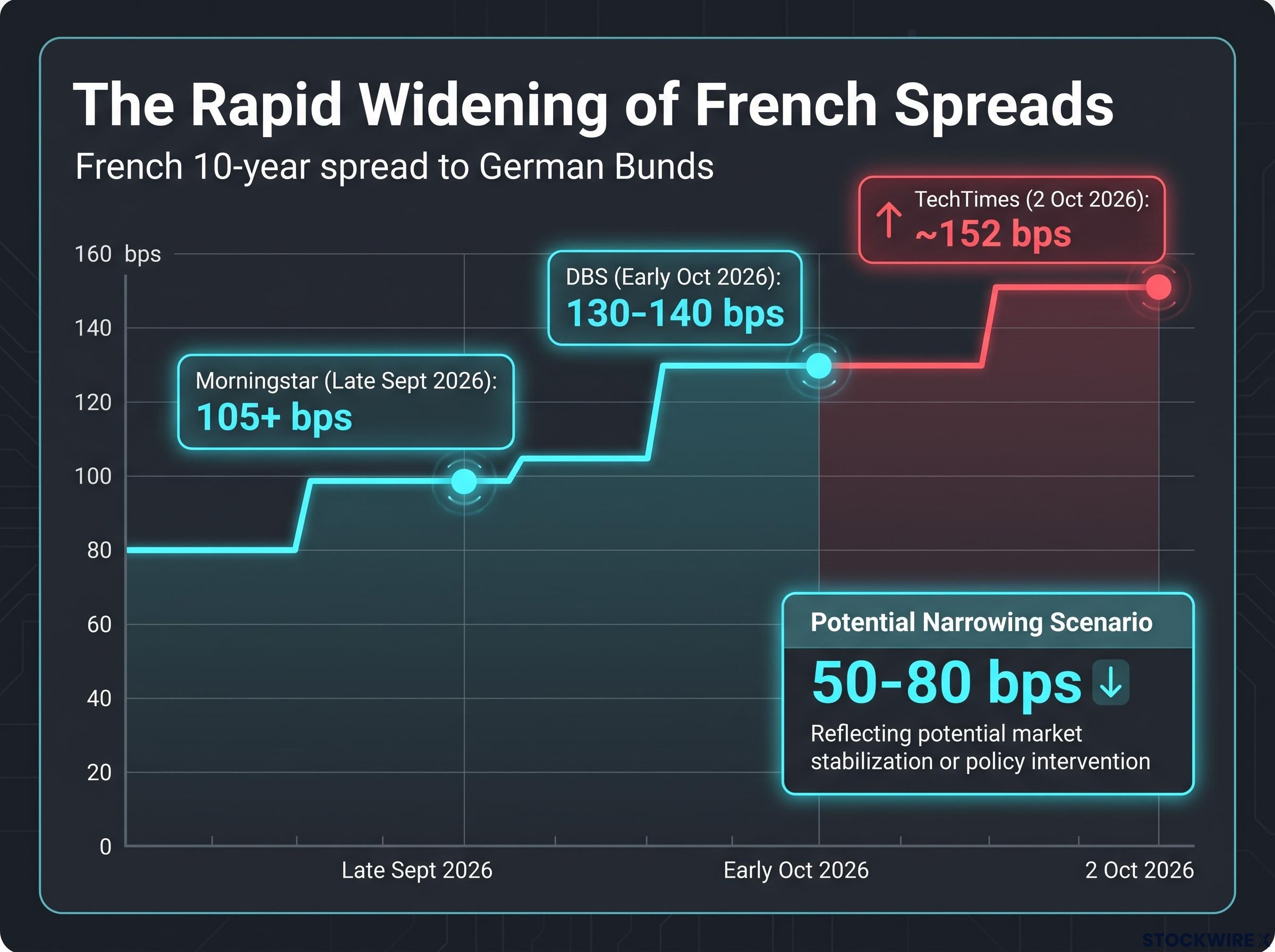
France tells a similar story through spreads. A spread is the extra yield a government pays over a benchmark borrower, here Germany’s Bunds. Morningstar put the French 10-year spread above 105 basis points (bps) in late September, ahead of Italy at about 90 bps and Greece at about 76 bps. A basis point is one hundredth of a percentage point.
A spread only makes sense once you grasp how bond yields move: prices fall when demand weakens, and the fixed coupon then translates into a higher yield for new buyers.
Within days, the figures leapt. DBS reported 130-140 bps in early October, while TechTimes cited about 152 bps on 2 October. Yahoo Finance reported Italy’s premium nearing 110 bps, and Belgium and Greece also widened. Precise yield levels for France, Italy, Belgium and Greece were not available.
| Metric | Source | Figure | Date |
|---|---|---|---|
| French 10-year spread to Bunds | Morningstar | 105+ bps | Late September 2026 |
| French 10-year spread to Bunds | DBS | 130-140 bps | Early October 2026 |
| French 10-year spread to Bunds | TechTimes | ~152 bps | 2 October 2026 |
| Japan debt-to-GDP (speaker) | Felix Prins | ~260% | October 2026 |
| Japan gross debt-to-GDP | Verified gross figure cited by speaker | ~250% | 2024-2026 data |
| Japan gross debt-to-GDP | DWS | ~230% | Early 2026 |
| Japan net/public debt-to-GDP | IMF / UBS | 203-213% | 2025-2026 |
The direction of travel is clear in both countries. The exact magnitudes are not, so treat any single headline figure as one reading of a fast-moving market rather than the final word.
When big ASX news breaks, our subscribers know first
Is Germany still a safe haven, and what about the US?
If France is the stress point, Germany should be the refuge. Prins disputes that. He argues that, unlike the euro crisis, German yields are rising too, so Bunds no longer offer shelter.
Market reporting reads differently. Nai500 said Bunds held up as the safe haven when French bonds fell on 1 October, and the Irish Examiner described investors moving into German debt. Bloomberg tracked flows into both Bunds and US Treasuries.
The disagreement is largely one of definition. Commentators cite three reasons Bunds keep attracting relative demand:
- Germany’s lower debt and stronger perceived fiscal discipline than France, Italy or Belgium
- Bunds’ role as benchmark collateral in repo and derivatives markets
- A higher floor for euro yields as global real rates rise and the European Central Bank (ECB) buys fewer bonds
That third point resolves the puzzle. A haven can absorb inflows and widen less than its neighbours while its nominal yield still drifts up from the quantitative easing era. In 2010-12, by contrast, Bunds rallied hard on euro break-up fears. Precise current Bund yields were not available.
What this tells you is that “safe haven” means relative protection, not falling yields. A rising Bund yield does not, on its own, prove Prins right.
The US claims need firmer handling. Prins says the 30-year Treasury is near 5.6%, the highest since 2004, that annual interest costs run about $1.25 trillion, and that mortgage applications are the lowest since 1995.
Single-source caution None of the speaker’s US figures could be independently confirmed. The only verified data point available is the 10-year Treasury yield of 4.24% on 30 January 2026.
Until those numbers are corroborated, weigh them as one commentator’s claims.
Why are long-term yields rising together?
Prins makes a sharp point: a strong economy cannot explain rising yields in economies that are weakening. The research supports him on that narrow claim, but points to a layered cause rather than a single collapse of trust.
What the term premium is
The term premium is the extra return investors demand for lending money for a long period instead of rolling over short-term loans. It compensates for the risk that inflation, interest rates or government finances change over decades.
If a 30-year bond pays more than a series of short bonds is expected to pay over the same span, that gap is the term premium. When central banks bought long bonds in bulk, they squeezed it towards zero. As they step back, it widens again, and supply plus fiscal doubts push it further.
Investors weighing the cause should note that term premium rebuilding is being driven by heavier sovereign supply, quantitative tightening and a fading convenience premium, a pattern visible across several regions at once.
The drivers behind the repricing
- Term premium normalisation: DWS says markets react nervously when the term premium moves into focus; DBS links the euro surge to widening risk premia as QE fades.
- Fiscal supply and sustainability: TechTimes argues France paying more than Italy and Greece reflects genuine fiscal concern.
- Reduced central-bank buying: The BoJ is loosening yield control and the ECB is shrinking its balance sheet.
- Weaker foreign demand: International investors are selling French paper and demanding more from lower-rated issuers.
- Inflation and geopolitics: Middle East tensions added inflation risk to the JGB move.
Local triggers sharpened these forces. Morningstar flags French budget gridlock and a looming election, and fiscal fears pushed the euro to a 17-month low. TechTimes adds that the ECB’s Transmission Protection Instrument (TPI), its backstop against disorderly selloffs, cannot legally be used when markets respond to real fiscal problems.
Japan has buffers. UBS notes only about 11.4% of planned FY2026 issuance falls in the 20-40-year sector, the existing debt stock averages a yield of about 1.13%, and nominal growth averaged roughly 3.7% over 2021-2025.
DWS and the IMF stress that high debt turns small yield shifts into large budget costs. The cause matters to you because it decides how long the pressure lasts: cyclical triggers fade, structural ones compound.
Domino or localised stress? Testing the framing
The domino label is Prins’s. Contagion language also appears in Bloomberg and in KBC commentary quoted by Yahoo Finance, which cited clear contagion towards Belgium and Italy. That does not settle the question.
| View | Key proponents | Supporting evidence | What would change it |
|---|---|---|---|
| Benign normalisation | UBS, IMF | Japan’s public debt projected from ~203% in 2026 to 193% by 2031 if growth beats the effective rate | Nominal growth falling below borrowing costs |
| Debt and trust | DWS, TechTimes, DBS, Felix Prins | France pricing above Italy and Greece; term premium sensitivity | A credible French fiscal plan |
| Contagion vs localised | Bloomberg, KBC vs Irish Examiner | Periphery spreads widening, then partly stabilising | Sustained widening in Italy and Belgium |
| Structural vs cyclical | Market commentators | Ageing, debt and reduced central-bank buying vs election and geopolitical risk | Pressure persisting after the French election |
The mitigating evidence is real. Morningstar sketches a scenario where French spreads narrow to 50-80 bps if a credible fiscal path emerges.
A note of restraint The Irish Examiner observed that spreads “for the most part still remain relatively low” and that the rout “largely stabilised on Friday.”
The risks are also real: France’s unprecedented core-periphery inversion, heavier refinancing burdens for Italy and Belgium, and a Japanese yield above 4.2% against debt above 200% of GDP. History shows how long-end stress can travel:
- UK gilts, 2022: Rapid yield rises forced margin calls on liability-driven investment funds and Bank of England intervention.
- Euro area, 2010-12: Spreads blew out on redenomination fears until the ECB’s Outright Monetary Transactions programme calmed markets.
- Earlier Japanese spikes: BoJ buying contained them, a tool now far less available.
The read you should take is that the domino view is a risk scenario to monitor, not a settled conclusion. Sustained periphery widening would strengthen it; narrowing French spreads would weaken it.
For readers wanting the budget politics behind the spread, our deep-dive into France’s fiscal crisis explains why analysts see a 2027 budget rollover as the likeliest outcome.
What the evidence supports, and what it does not
Long-dated yields are clearly higher and fiscal risk is clearly being priced. The cause, the extent of contagion and whether Bunds still function as a haven remain argued.
Keep three attribution lines straight. The domino framing is Prins’s opinion. His US figures are unconfirmed. Japan’s debt ratio depends entirely on the measure quoted.
Three signals will show which way this breaks:
- The French spread’s trajectory and the election outcome
- Whether Italian and Belgian spreads keep widening or settle
- How the BoJ responds to the 30-year yield level
Past performance does not guarantee future results. Projections and forward-looking statements are speculative and subject to change with market conditions.
This article is for informational purposes only and should not be considered financial advice. Investors should conduct their own research and consult with financial professionals before making investment decisions.