


ATH434 slows functional decline by 52% in new Phase 2 MSA analyses
New analyses from Alterity Therapeutics‘ completed Phase 2 trial in Multiple System Atrophy (MSA) were presented at the 2026 International Congress of Parkinson’s Disease and Movement Disorders (MDS Congress) in Seoul, Korea on 5 October 2026. The headline finding: ATH434 50 mg significantly slowed functional decline in MSA by approximately 52% versus placebo on the 11-item Unified Multiple System Atrophy Rating Scale (UMSARS) Part I at Week 52, after adjusting for baseline cerebrospinal fluid neurofilament light chain (CSF NfL).
The −4.64-point difference versus placebo (p=0.032) is approximately three times the 1.5-point minimal clinically important difference (MCID) for the scale. These results are consistent with the previously reported analysis in which ATH434 50 mg slowed decline by 46% versus placebo (p=0.037). The difference between the two figures reflects distinct analysis populations and statistical models, not a contradiction.
Phase 2 results across multiple scales show consistent directional alignment: the 50 mg dose achieved a 41% relative treatment effect on the MuSyCA composite and a 53% relative treatment effect on modified UMSARS Part I in separate MMRM analyses, reinforcing that the efficacy signal is not an artefact of any single outcome measure.
David Stamler, M.D., CEO
“These additional analyses strengthen our confidence in ATH434 as a potential disease-modifying therapy for MSA. When we account for differences in baseline disease severity using CSF NfL, ATH434 50 mg significantly slowed functional decline by more than 50% compared with placebo over one year, a treatment effect well above the threshold considered clinically meaningful.”
When big ASX news breaks, our subscribers know first
What these analyses add to the Phase 2 picture
CSF NfL as a disease severity covariate
Baseline CSF NfL is an established prognostic biomarker in MSA and was a prespecified covariate in the Phase 2 trial. The analysis demonstrated that higher baseline CSF NfL predicted greater functional decline: each 1,000 pg/mL increase in baseline CSF NfL was associated with approximately 0.9 additional points of worsening on UMSARS Part I (p=0.033).
For investors, the significance of this finding extends beyond Phase 2. Adjusting for a known predictor of decline produces a more precise measurement of treatment effect, and validating CSF NfL as a covariate supports its incorporation into Phase 3 trial design. This represents a meaningful de-risking step for the programme.
Brain iron MRI imaging consistent with mechanism of action
ATH434 is designed as an iron chaperone, intended to redistribute reactive (labile) iron driving MSA pathology. The poster reported brain iron measured by quantitative susceptibility mapping (QSM) MRI, analysed using the same CSF NfL-adjusted model.
Although the trial’s primary endpoint — change in substantia nigra iron at Week 52 — was not met (a result previously disclosed), the imaging data showed directional findings across multiple brain regions consistent with ATH434’s proposed mechanism:
- Substantia nigra: Primary endpoint; change not statistically significant at Week 52
- Dentate nucleus: Iron signal increased relative to placebo at Week 52 (50 mg: +0.016 ppm, p=0.021), hypothesised to reflect redistribution of mobilised iron through the brain’s glymphatic system
- Putamen and globus pallidus: Iron was numerically lower with ATH434 versus placebo
The poster noted that MRI captures iron efflux but cannot measure iron that has been stored or buffered within cells. Regional differences may therefore reflect region-specific iron handling rather than an absence of drug effect.
Understanding MSA and why a 52% slowing matters
MSA is a rare, rapidly progressive neurodegenerative disease characterised by failure of the autonomic nervous system and impaired movement. The disease causes profound disability through the progressive loss of function and death of nerve cells in the brain and spinal cord. MSA affects up to 50,000 individuals in the U.S., and while some symptoms can be managed with medications, there are currently no drugs approved to slow disease progression and no cure.
The UMSARS Part I is a functional rating scale that assesses disability across activities of daily living affected by MSA. Higher scores indicate greater disability, making it a direct measure of patient function in everyday life.
In this context, a statistically significant 52% slowing of functional decline in a controlled trial carries considerable clinical weight. The finding exceeds the MCID by approximately three times, in an indication where no approved disease-modifying therapy currently exists.
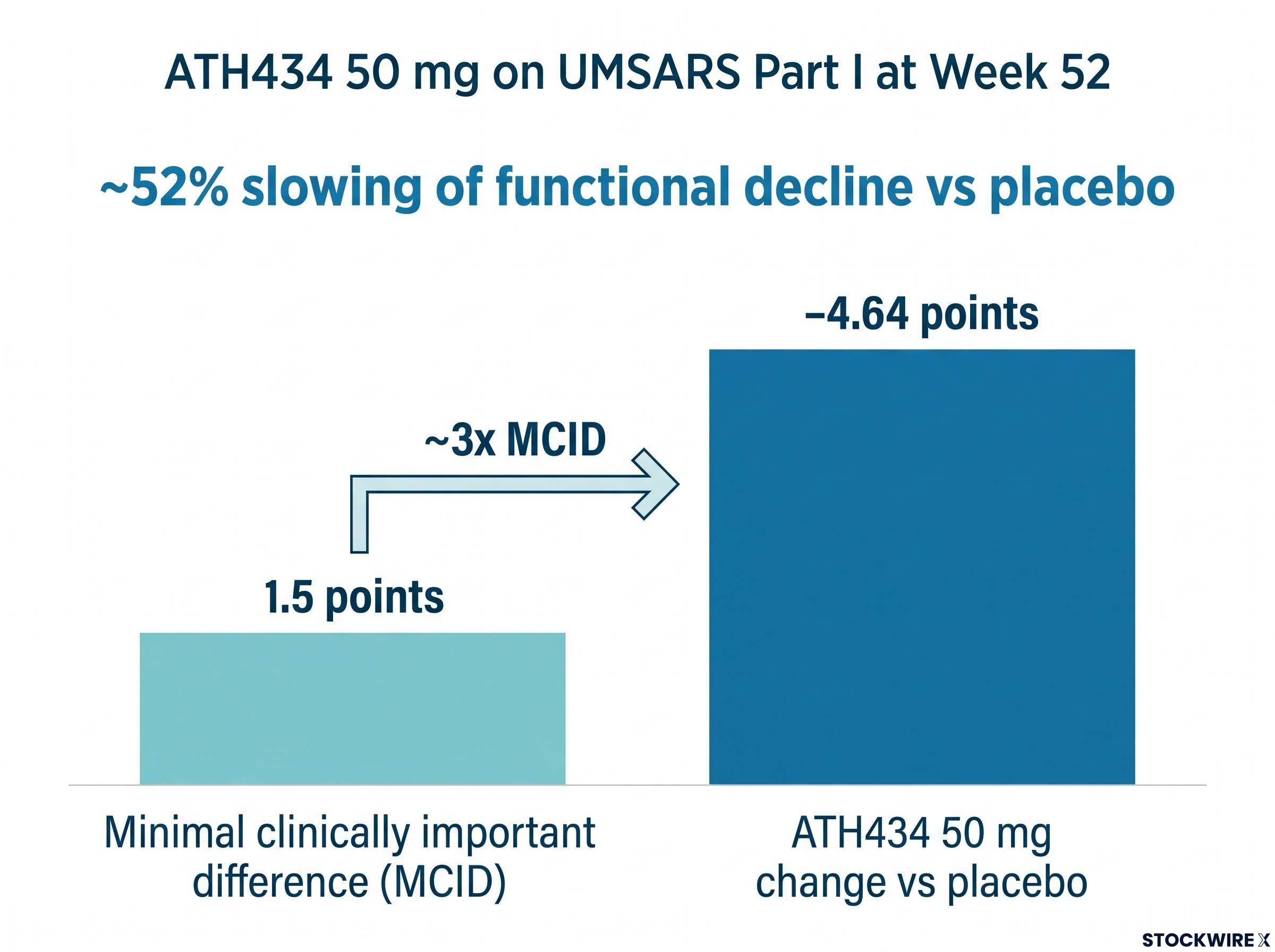
| Metric | ATH434 50 mg | ATH434 75 mg | Placebo | Significance |
|---|---|---|---|---|
| UMSARS Part I change vs placebo at Week 52 | −4.64 points | Not significant at Week 52 | Reference | p=0.032 (50 mg); p=0.179 (75 mg at Week 52) |
| Approximate slowing of functional decline vs placebo | ~52% | — | — | — |
| 75 mg change vs placebo at Week 26 | — | −2.81 points | Reference | p=0.072 |
| Minimal clinically important difference (MCID) | 1.5 points | 50 mg result ~3x MCID | ||
Phase 3 implications and what comes next
The new analyses presented at the MDS Congress are framed by management as reinforcing the de-risking strategy underpinning the company’s Phase 3 programme. Alterity is preparing to initiate a Phase 3 pivotal trial in MSA, with CSF NfL learnings from Phase 2 intended to inform the confirmatory trial design.
David Stamler, M.D., CEO
“I continue to be impressed by the strength of the efficacy signal in our Phase 2 study in the context of other treatments that are in development for MSA. By incorporating the learnings regarding NfL into our Phase 3 confirmatory trial, we continue to build on our de-risking strategy that has been so successful in Phase 2.”
The Phase 2 trial that generated these data was a randomised, double-blind, placebo-controlled study enrolling 77 adults, who were assigned to receive ATH434 50 mg or 75 mg twice daily, or matching placebo, over 12 months. The new analyses were conducted on the modified intent-to-treat (mITT) population (N=61), applying a mixed model for repeated measures (MMRM) methodology to align with the imaging analyses.
The FDA-agreed Phase 3 design locks in the 50 mg twice-daily dose, the 11-item UMSARS Part I as primary endpoint, and approximately 200-patient enrolment over 12 months, creating direct continuity between the Phase 2 MMRM methodology and the confirmatory trial structure.
ATH434 was well tolerated across the trial, with similar adverse event rates compared to placebo and no serious adverse events attributed to the drug. Phase 3 has not yet commenced; Alterity has indicated it is preparing to initiate the trial.
Don’t Miss the Next Healthcare Breakthrough
Big News Blast delivers FREE breaking ASX healthcare news directly to your inbox within minutes of release, complete with in-depth analysis. Join 20,000+ subscribers already ahead of the market. Click the “Free Alerts” button at StockWire X to start receiving alerts the moment market-moving news breaks.