You found the trade. A bearish thesis on AST SpaceMobile that held together from every angle: a 47.5% price decline over three months, a securities-fraud class-action lawsuit, a capital-intensive business model burning cash, and an analyst cutting the price target over pricing concerns. You picked the structure, a bearish call spread. Then a professional looked at the exact same setup and declined to enter.
Here is the uncomfortable part. The thesis was not the problem. The direction was defensible. The trade still got passed on, and the reason has nothing to do with whether the stock falls.
This is a real, documented rejection, not a hypothetical. The bearish argument on ASTS was intact, and the trade was walked away from anyway. What follows this paragraph is the reason why, and why it applies to any short premium trade you will ever evaluate, not just this one stock.
By the time you finish, you will know the three conditions that must line up before you enter a short premium trade, and you will recognise the moment when walking away is the professionally correct call rather than a missed opportunity.
Why your directional thesis is only half the trade
The instinct is natural. You know where the stock is going, so the trade works. If you are right about ASTS falling, selling a call spread above the current price should pay off, because the stock finishes below your strikes and you keep the credit.
That logic quietly assumes the directional call is the whole decision. It is not. Every options trade carries two independent components, and both have to be favourable before a short premium structure makes sense.
- The directional view tells you which way you think the stock moves. It says nothing about how you get paid for the position.
- The volatility view tells you whether the market is paying you enough to take on the risk of being wrong. It says nothing about direction.
A bearish call spread is a short premium structure. That means you are the seller, paid upfront to absorb the risk that the stock rises instead of falls. The size of that payment, the credit, is set by market-implied volatility, not by how convincing your bearish argument happens to be.
The directional view tells you which way you think the stock moves, but implied volatility is the independent input that sets how much the market pays you to take the other side, and the two can point in completely opposite directions.
This is where ASTS tripped the wire. The bearish thesis was sound. The credit the market offered to take the other side was not.
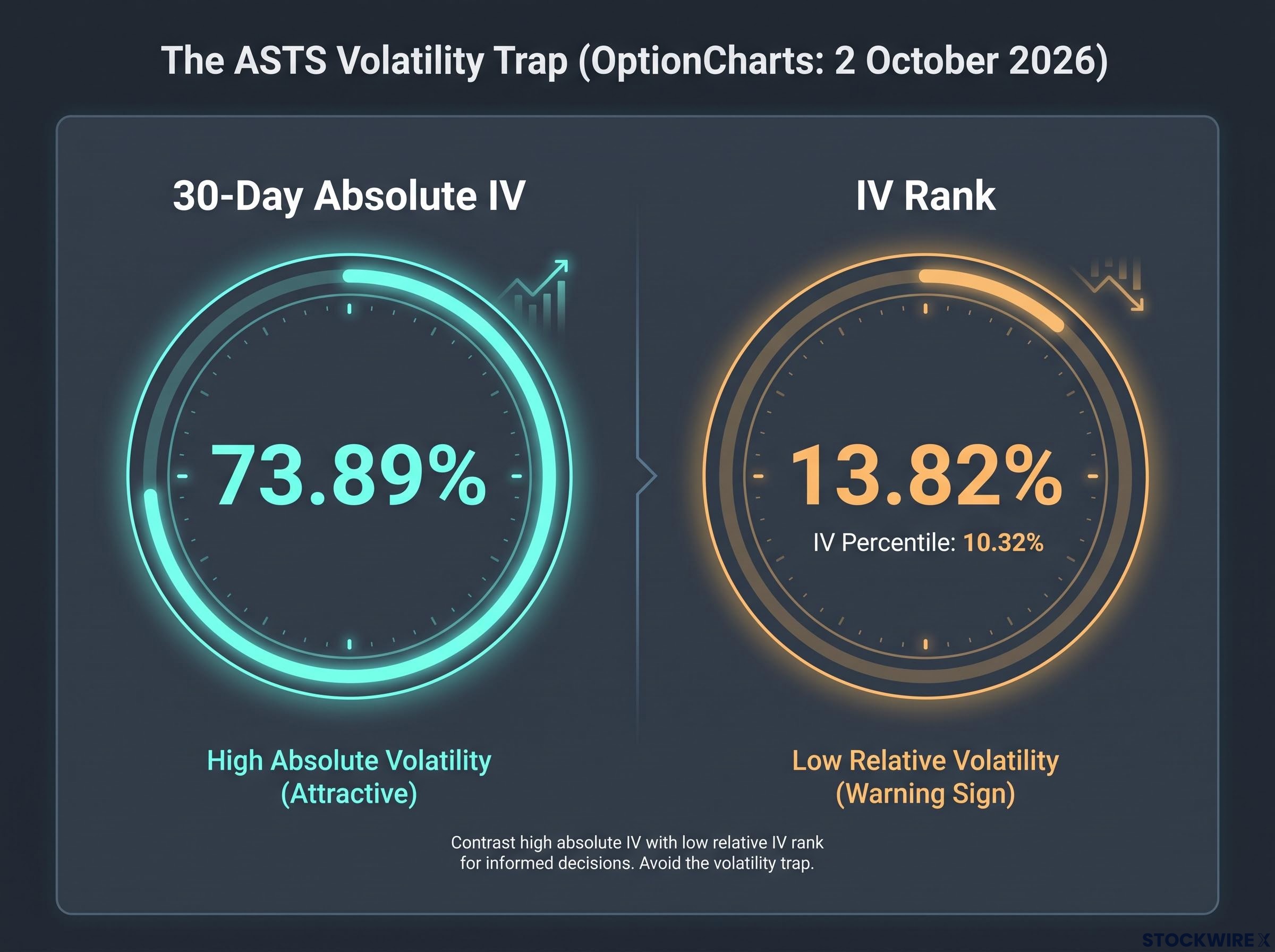
Look at the numbers and the trap becomes visible. ASTS carried a 30-day implied volatility of 73.89% (OptionCharts, 2 October 2026), a figure that looks high in absolute terms. On that number alone, you would assume options were expensive and a seller was being paid well.
IV rank at the time of evaluation: approximately 9%.
That is the figure that matters, and it tells the opposite story. Absolute IV says options look pricey; IV rank says the market is pricing volatility cheaply relative to this stock’s own recent history. The gap between a 74% absolute reading and a sub-14% rank is exactly what catches traders who screen only for the number they can see on the screen. The rank, not the absolute level, determines whether the seller is actually getting a good deal.
When big ASX news breaks, our subscribers know first
What IV rank actually measures, and why it functions as a veto
On your screen, IV rank shows up as a single number between 0 and 100. That number is doing more work than almost any other input in a short premium decision, so it pays to understand exactly what it captures.
The formula, as defined in tastytrade’s volatility-metrics guidance, is straightforward:
(current IV minus 52-week IV low) divided by (52-week IV high minus 52-week IV low), expressed as a percentage.
In plain terms, IV rank tells you where today’s implied volatility sits inside its own range over the past year. A reading of 9 means current IV is near the floor of where it has traded all year. The market is not pricing large future moves relative to what it has priced before, even when the absolute number looks elevated.
That low position creates two mechanical consequences for a short call spread, and neither can be offset by a correct directional view.
First, you collect a smaller premium for the same spread width. Cheap volatility across the surface means less money changing hands, so the credit you receive shrinks while the maximum loss stays fixed.
Second, you lose the mean-reversion tailwind. When IV is elevated, it tends to drift back toward its average, pulling option prices down even if the stock goes nowhere. That drift is free profit for the seller. At the bottom of the range, there is almost no room left to fall and plenty of room to spike against you.
The ASTS data confirms the problem. Historical volatility sat at 72.24% (OptionCharts, 2 October 2026), nearly identical to current implied volatility. Options were not pricing any meaningful premium over the moves the stock had already been making. You would be selling cheap insurance on a stock that regularly swings violently.
| Platform | 30-day IV | IV rank | IV percentile | Date |
|---|---|---|---|---|
| OptionCharts | 73.89% | 13.82% | 10.32% | 2 October 2026 |
| MarketChameleon | 71.9% | 6% (“subdued”) | Not reported | Late September 2026 |
| Original evaluation | ~74% | ~9% | Not specified | At time of trade |
Why does this filter exist at all? History gives a blunt answer.
The Volmageddon precedent (February 2018): Through 2017, equity volatility sat at unusually depressed IV rank levels for months. When volatility reverted sharply in early 2018, short-volatility strategies suffered outsized drawdowns within a matter of days.
The lesson applied to single names is direct. When IV rank sits in the single digits, you are collecting a small, fixed premium against a distribution of outcomes that has historically included 45%-plus swings in one direction. That asymmetry is the structural problem. In ASTS, no two-point wide call spread combination generated enough credit to meet minimum acceptable parameters.
If you remember one idea from this piece, make it this: an IV rank below your preferred threshold is a near-automatic veto on short premium, and your correct directional view does not change the maths.
How to read IV rank in practice
Make the 9 concrete. If ASTS’s implied volatility ranged from a yearly low to a yearly high, a reading of 9 means current IV sits roughly 9% of the way up that range. You are close to the cheapest options have been all year, selling them at a discount to their own history.
Now picture a reading above 50. The same spread width would hand you a materially larger credit, because volatility is richer across the surface, and you would have the mean-reversion tailwind working in your favour. Practitioners commonly reference a preferred band of roughly 30 to 50-plus before entering short premium, though this varies by trader and strategy. At 9, ASTS was not close.
How upside skew compounds the problem
If low IV rank were the only issue, the story would be simpler. It was not. A second, independent force was working against the same trade, and the two reinforce each other in a way that makes the rejection feel less like a judgement call and more like arithmetic.
That second force is volatility skew. Skew describes how implied volatility varies across different strike prices rather than sitting at one flat level. In an upside-skewed name, far out-of-the-money calls carry higher implied volatility than comparable puts, reflecting market demand for upside optionality, short-squeeze hedging, or speculative call buying.
Volatility skew is not a static property of the market; it shifts in response to institutional hedging demand, short-squeeze positioning, and macro risk repricing, which is why reading skew orientation before entering any directional spread is a separate check from reading IV rank.
ASTS is pronouncedly upside-skewed. The MarketBeat options chain for 2 October 2026 shows far out-of-the-money calls at strikes around 47 to 49 carrying implied volatilities in the 120% to 140% range. The original trade evaluation independently reached the same conclusion: skew in ASTS leans toward the upside.
Far out-of-the-money call IV in ASTS: 120% to 140% at strikes around 47 to 49.
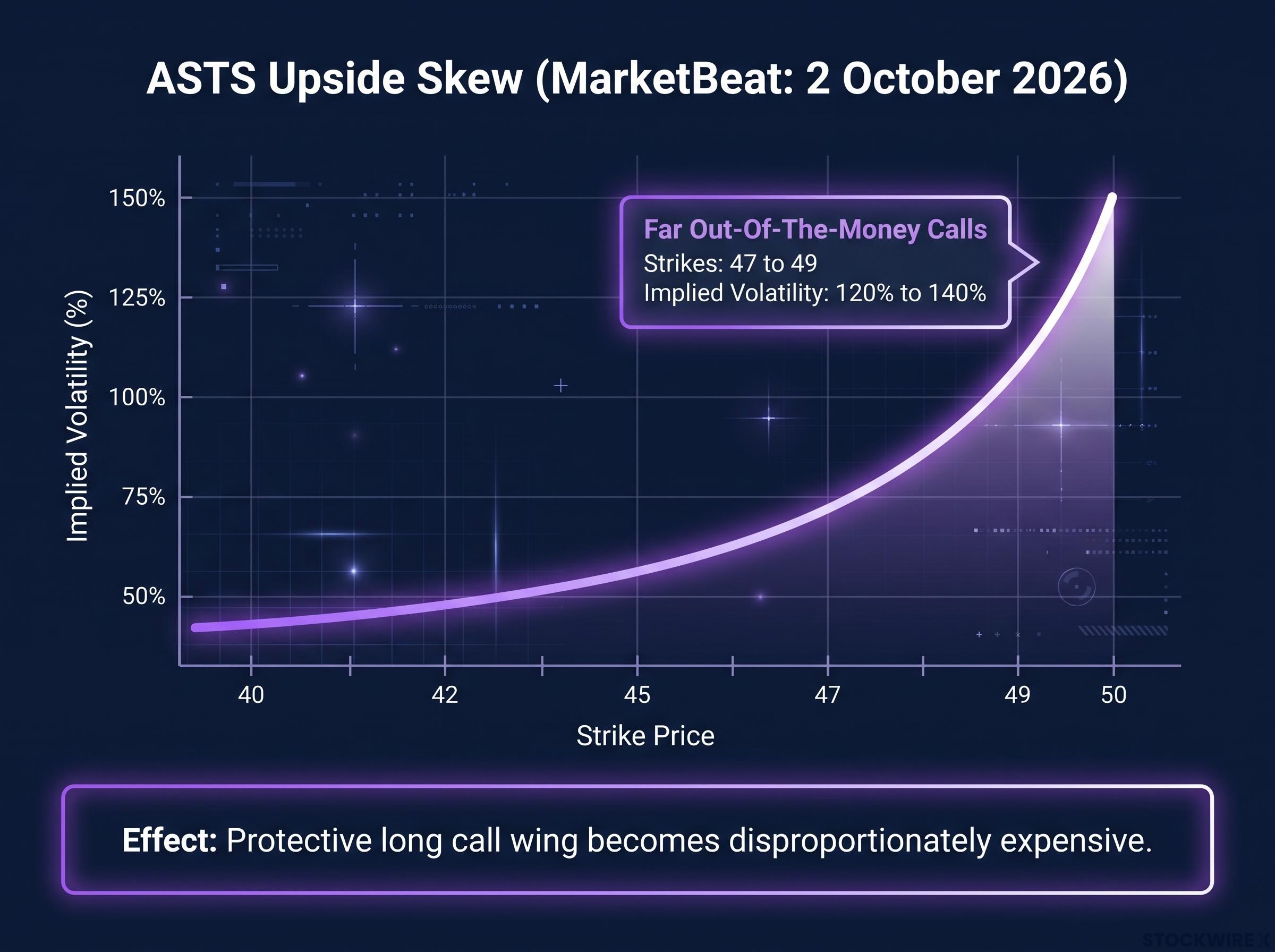
Here is why that wrecks a bearish short call spread specifically. To define your risk, you must buy the higher-strike call as protection. In an upside-skewed name, that long call sits in the most expensive part of the volatility surface. You are forced to pay a premium for the one leg you need, which compresses your net credit from both ends at once.
The two forces then stack, and the sequence is what makes the damage inevitable:
- Low IV rank depresses the entire surface. Volatility is cheap relative to history, so the premium available across all strikes is already small.
- Upside skew inflates the specific wing you must buy. Within that already-cheap surface, the protective long call is disproportionately expensive, shrinking your credit further.
The result is a credit-to-width ratio that deteriorates until the worst-case loss is never adequately compensated by the best-case gain. To claw back meaningful credit, you would have to move the short strike closer to the money, which dramatically increases directional and assignment risk. That is not a fix. It is trading one problem for a larger one.
This is why checking skew orientation before you enter matters as much as checking IV rank. Upside skew on a bearish trade is not a minor inconvenience. It is a structural cost you pay on every single entry, and when it compounds with low IV rank, the trade stops making sense regardless of where you think the stock is headed.
What professional traders do when conditions oppose the trade
Walking away is not a failure. In ASTS, the professional conclusion was to stand aside, and that decision was the product of applying the filters correctly, not a breakdown in analysis. The thesis worked. The structure did not get paid enough to justify its risk. Those are two separate findings, and recognising the difference is the skill.
The stock itself made the no-trade conclusion easier to defend. ASTS carries a beta of approximately 2.70 (MarketBeat, June 2026), meaning it moves roughly 2.7 times as violently as the broad market. Selling a small-credit call spread on a stock that swings that hard, while a volatility expansion event could gap the position against you overnight, is the exact asymmetry the filters are designed to catch.
The tail risk asymmetry on an underpaid short spread is not theoretical; when a high-beta name gaps against a small-credit position overnight, the loss-to-credit ratio can exceed any predefined stop threshold before a trader can act, which is the structural problem the filters are designed to intercept before entry.
When skew and IV rank both oppose a short call spread, professionals reach for different tools rather than forcing the trade:
- Debit put spreads or long puts: In upside-skewed names, downside puts are relatively cheap, so buying volatility on the put side sidesteps the need for rich credits and benefits if volatility expands.
- Put calendars or diagonals: These buy longer-dated volatility and sell shorter-dated options, aiming to profit from term-structure behaviour without relying on a high IV rank at any single maturity.
- No trade: When an underlying combines extreme realised volatility, low IV rank, and unfavourable skew, standing aside is a legitimate, capital-preserving outcome.
Practitioners do disagree on how rigidly these thresholds should bind. Option Alpha’s Kirk Du Plessis and other retail-focused educators argue IV rank is a guidepost, not a mechanical rule, and that a lower reading can be tolerated when skew makes the short options structurally rich in the seller’s favour. More rule-driven communities counter that selling premium in low IV rank is never worth it.
ASTS does not reward either camp. Even the flexible view requires skew to make the short options rich for the seller, and upside skew does the opposite for a short call. Add the live catalysts, the class-action lawsuit, capital-raise risk, dilution, and insider selling, and the setup fails on every axis at once.
That gives you a concrete filtration checklist you can apply to any proposed short premium trade:
- IV rank. Is it inside your preferred band, roughly 30 to 50-plus? Below your threshold, the credit and the mean-reversion edge are both too thin.
- Skew orientation. Does skew work for or against your trade direction? Upside skew on a short call spread actively compresses your credit.
- Credit-to-width ratio. Does the structure collect enough relative to its maximum loss to meet your minimum? If not, the tail risk is uncompensated.
If any one of the three fails, step back and either restructure the trade or pass. Trade filtration is the discipline that separates traders who survive full volatility cycles from those who do not.
Three filters, one discipline: applying the framework beyond ASTS
Strip away the ticker and what remains is a portable decision sequence. The ASTS case is useful precisely because it fails cleanly, letting you see each filter do its job. The same three checks apply to every short premium structure you will evaluate: iron condors, short strangles, short call or put spreads alike.
Run them in order:
- IV rank first. Check it against your preferred band, roughly 30 to 50-plus as a starting benchmark rather than a rigid rule. A reading in the single digits signals you are selling volatility near its cheapest, with no contraction tailwind to help you.
- Skew orientation second. Confirm the skew works with your trade direction. If the wing you must buy sits in the expensive part of the surface, your credit is compressed before you even place the order.
- Credit-to-width ratio third. Confirm the structure collects enough relative to its maximum loss. If the payoff does not compensate the tail risk, the trade is underpriced no matter how strong the thesis.
All three must pass before you enter. The discipline is not about being right on direction. It is about being paid adequately for the tail risk you absorb as the seller.
ASTS is the closing illustration. A 73.89% absolute IV that looked impressive on first inspection concealed a sub-14% IV rank, pronounced upside skew, and credit that never cleared the minimum. Applied consistently, this sequence helps you avoid the category of loss that comes not from misreading direction but from being structurally underpaid for the risk you take on.
This article is for informational purposes only and should not be considered financial advice. Investors should conduct their own research and consult with financial professionals before making investment decisions.
Past performance does not guarantee future results. Options trading carries substantial risk and these observations are specific to the conditions described. Volatility conditions change, and any trade assessment is subject to market developments.
When the filters fail, the correct answer is no trade
The ASTS outcome resolves to a clean synthesis. A valid bearish thesis, an IV rank in the single digits, skew oriented against the trade, and a credit that never met minimum parameters combined to produce a professional no-trade conclusion. The analysis was not wasted. It simply ran into filters the directional view could not override.
Seen that way, walking away is capital-preserving and buying-power-preserving behaviour, not a missed opportunity. The money you do not risk on an underpaid trade stays available for setups where all three filters align, which is where short premium actually earns its keep.
The forward-looking point matters as much as the diagnosis. The same ASTS setup could become a valid short premium trade if IV rank rises into the preferred zone and skew normalises. Knowing precisely what would need to change, a richer surface, a friendlier skew, and a credit that clears your threshold, is as valuable as knowing why the current setup fails. You are not ruling the name out forever. You are waiting for the conditions to pay you properly.
Investors exploring when conditions do align for short premium entry will find our full explainer on entry timing for short premium, which examines how selling after significant down days affects average returns, win rates, and tail risk across a 13-year backtest of 16-delta strangles.