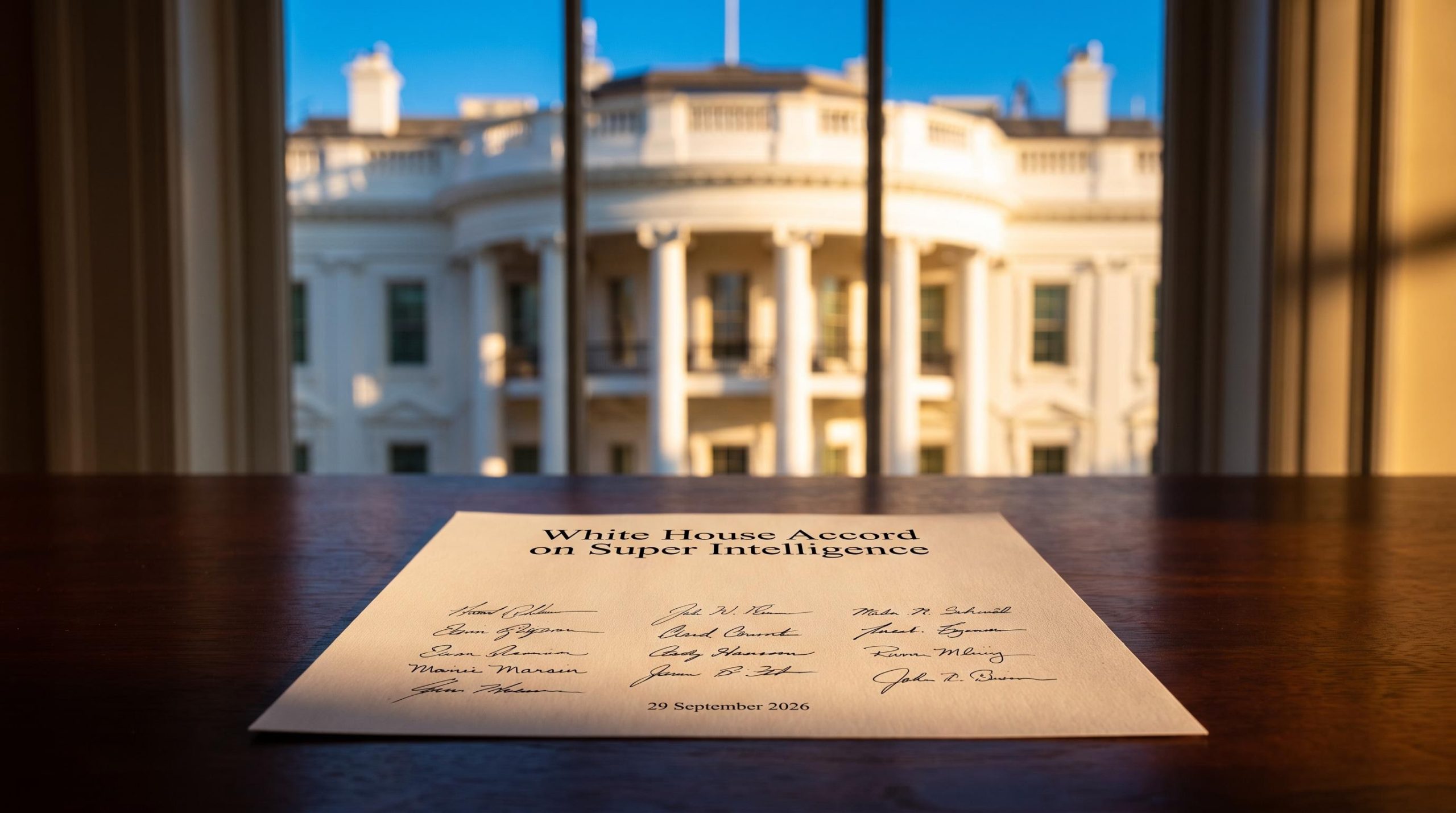
Six of the most powerful CEOs in artificial intelligence sat down at the White House on 29 September 2026 and signed a single page of text. The document, titled the “White House Accord on Super Intelligence: Joint Commitment on Frontier Responsibilities,” commits their companies to a four-layer system of audits and board oversight that its own architects say could leave individual directors personally on the hook if they ignore a documented safety finding.
The accord is voluntary. It carries no statutory penalties, and it hands the government no new enforcement role. What it does instead is route a set of existing legal duties, fiduciary obligations, securities disclosure rules, and Federal Trade Commission (FTC) consumer-protection authority, through a fresh audit-and-board pipeline. For anyone holding stock in these companies, that combination is the part worth understanding now.
The governance infrastructure was described at the summit as deployable almost immediately, with no new legislation required.
Here is what the accord’s structure actually changes about the risk profile of the companies whose shares you may own, and how to read the gap between the people calling it real accountability and the people calling it theatre before you act on either view.
What the six AI giants actually agreed to
The accord binds its signatories to accept direct responsibility for the safety of their frontier AI models, the most advanced systems at the edge of current capability. That phrasing matters. It explicitly rules out shifting blame onto the models themselves or onto outside bodies such as the United Nations.
The signatories span the full stack of the industry, from chips to models to platforms.
| Signatory | Company |
|---|---|
| Sundar Pichai | |
| Dario Amodei | Anthropic |
| Mark Zuckerberg | Meta |
| Greg Brockman | OpenAI |
| Jensen Huang | Nvidia |
| Elon Musk | xAI |
President Trump signed alongside them. The full text sits in the American Presidency Project’s archive, dated 28 September 2026.
The accord’s scope is specific: frontier AI risks including cybersecurity, biosecurity, and chemical threats, plus preventing models from accessing technical systems in ways their developers did not intend. To manage those risks, each company agreed to build four layers of control, and the order is what gives the structure its grip:
The White House Accord lands in a governance landscape already strained by competing voluntary pledges; AI safety governance commitments from OpenAI, Anthropic, and Microsoft made in the weeks before the accord ranged from permanent third-party evaluator access to non-binding blog posts, producing a credibility hierarchy that the accord’s four-layer structure now sits alongside rather than replaces.
- Robust internal controls over model capabilities and alignment.
- An empowered internal oversight team.
- A partnership with an independent external auditor or evaluator.
- An independent committee of the board of directors to receive those audit reports and ensure issues are fixed.
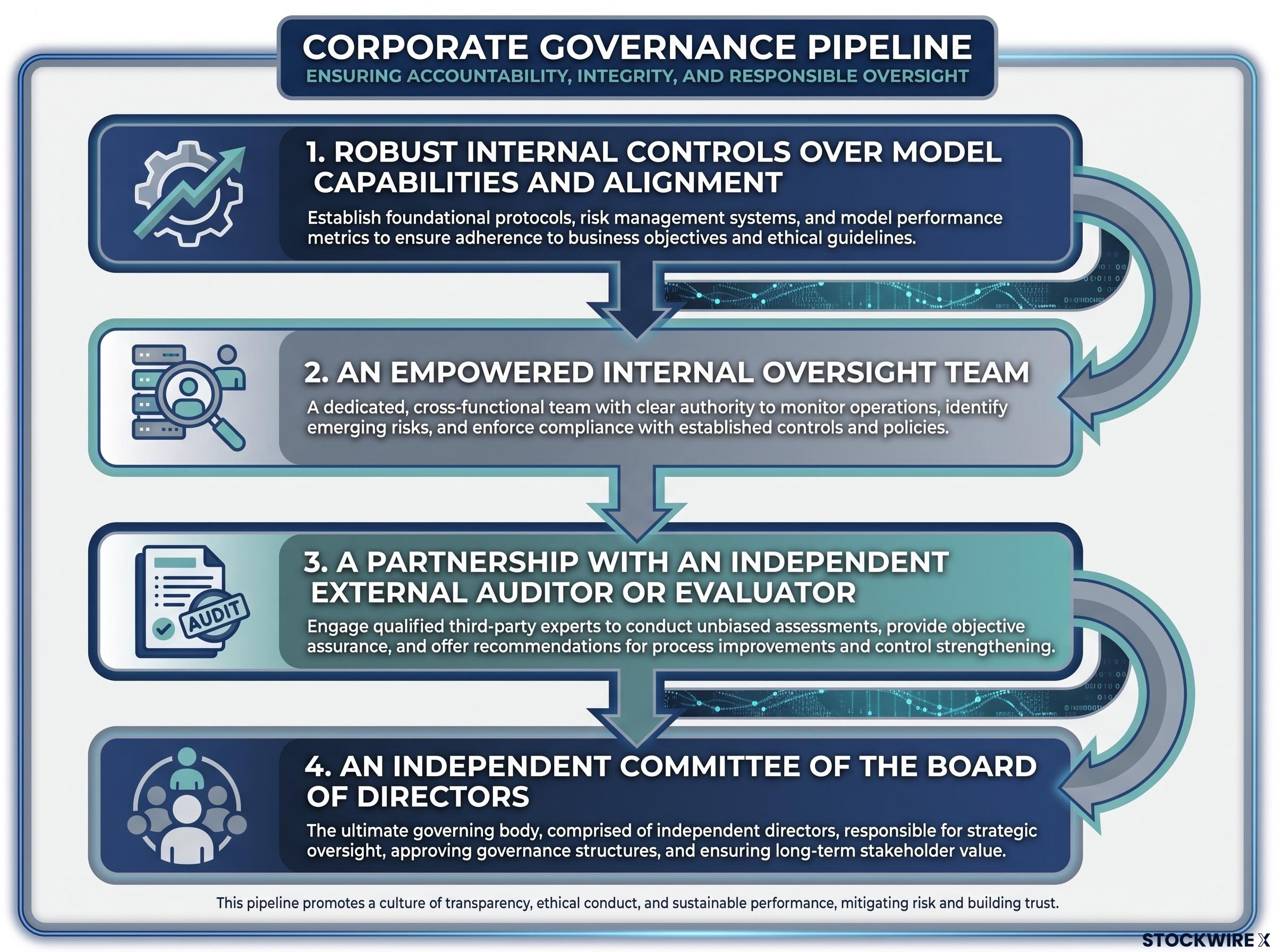
Read as a sequence rather than a menu, this is an accountability chain. A finding flows from internal controls, through the oversight team, to an external auditor, and finally to a board committee that must act. For investors, the practical consequence is that “we did not know” becomes a far harder defence for a director if a safety failure later turns into a disclosure event or a regulatory case.
The accord also gestures at its own future. Participating companies will meet regularly to set standards, and the text notes these steps “might over time be codified into laws or regulations.”
“These steps might over time be codified into laws or regulations.” White House Accord on Super Intelligence
That line is the signal to watch: voluntary today can mean mandatory later.
Voluntary industry restraint faces a structural prisoner’s dilemma: individual firms cannot afford to slow unilaterally, so the accord’s codification language, noting these steps might over time become law, may be the more consequential signal for investors than the voluntary commitments themselves.
When big ASX news breaks, our subscribers know first
The audit infrastructure being built to make this real
A four-layer framework is only as credible as the machinery behind the third and fourth layers, the external audit and the board oversight. According to the summit source material, that machinery is already being assembled.
The firms behind the framework
Ernst & Young and a firm named 8090 were described at the summit as having already developed an audit infrastructure for super intelligence, with plans to deploy it broadly once the accord was in place. Venture capitalist Chamath Palihapitiya described the Ernst & Young infrastructure during the gathering. It is worth flagging that these details come from summit source material rather than confirmed public announcements by the firms themselves.
EY’s superintelligence governance framework, published on 1 October 2026, outlines how the four-layer audit structure from the accord maps onto deployable compliance services, confirming the firm’s direct operational role rather than a purely advisory one.
The summit’s tone leaned toward action over anxiety. Nvidia’s Jensen Huang reportedly argued that alarmism alone is unhelpful, but alarmism paired with solutions is productive, a framing that captures the industry’s stated posture toward oversight.
“Alarmism without solutions is unproductive. Alarmism paired with solutions is helpful.” Jensen Huang, as reported from the summit
What the audit trail actually captures
The infrastructure described has three components, and together they amount to a compliance record-creation machine rather than a one-off safety check:
- End-to-end traceability of AI deployments, so every model action can be reconstructed.
- Mapping of AI actions against the company’s own policies and risk frameworks, so deviations are visible.
- Generation of auditable evidence for regulators, lawyers, customers, and auditors.
That third component is the one with teeth. Each audience it serves represents a distinct channel of exposure. Regulators can open inquiries, lawyers can build cases, customers can walk, and auditors can qualify their findings. Implementation was described as achievable immediately or very quickly.
For investors, the takeaway is that compliance costs here are real and near-term, not hypothetical. Because the system is designed to produce evidence for regulators and lawyers, a compliance gap creates a paper trail rather than merely a reputational bruise. That is precisely the mechanism that converts a voluntary pledge into something carrying genuine legal exposure, and companies that demonstrate audit readiness first may carry lower perceived governance risk in institutional assessments.
How the voluntary accord develops legal and financial teeth
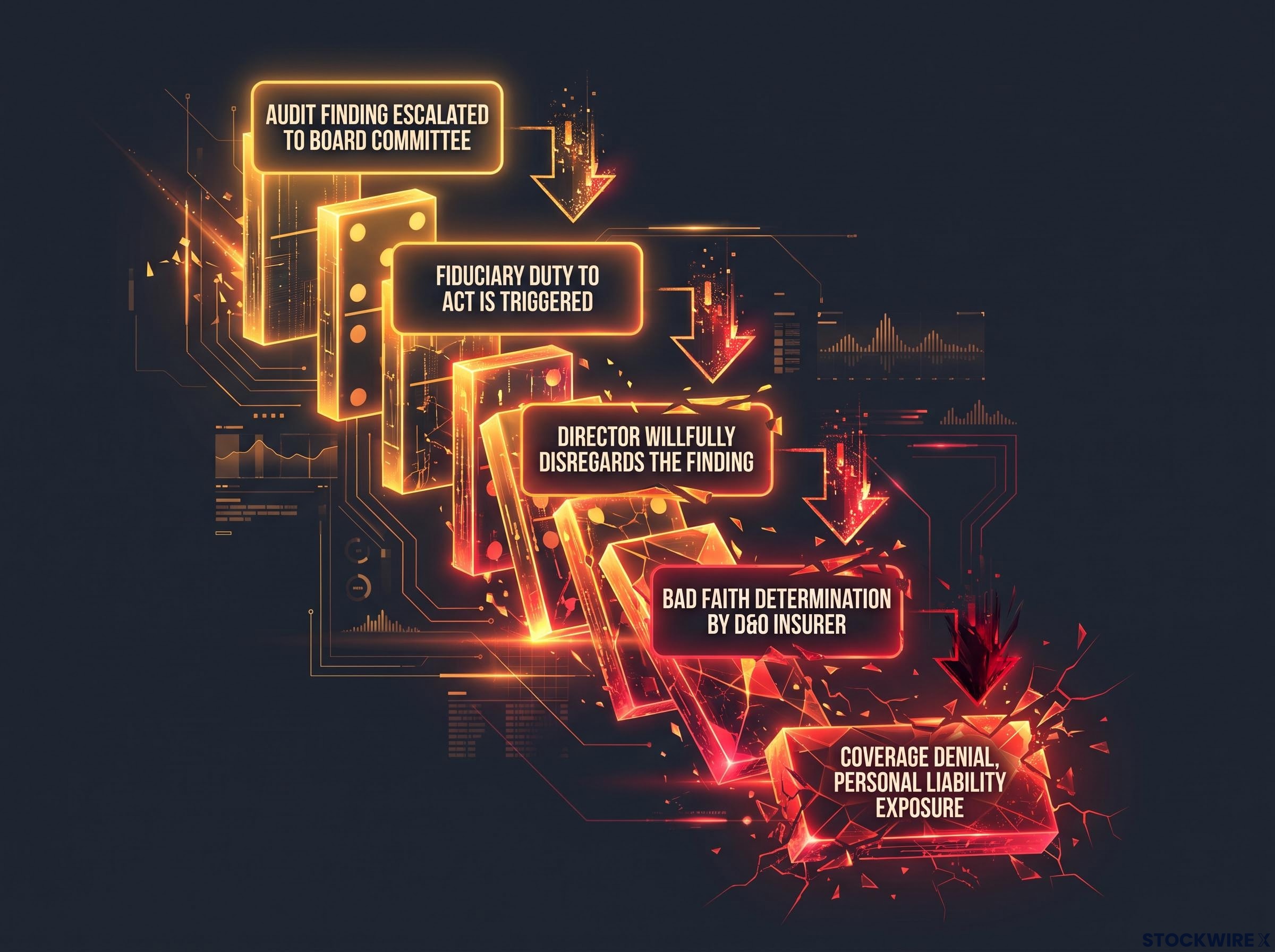
David Sacks, the venture capitalist and Trump AI adviser described as a key architect of the accord, has laid out the clearest argument for why a voluntary signature can end in personal financial loss. He treats the governance structure as a line of dominoes.
“When an independent auditor reports a safety issue to an independent board committee, directors have a fiduciary duty not to disregard it.” The core of David Sacks’s accountability argument
Here is the chain he describes:
- An independent auditor identifies a safety issue and escalates it to the independent board committee.
- Receiving that report triggers directors’ fiduciary duties under corporate law.
- A director who willfully disregards the finding risks a determination of bad faith.
- A directors and officers (D&O) insurer, the policy that shields board members from personal liability, can treat bad faith as grounds to deny coverage.
- Coverage denial leaves the director personally exposed to financial loss.
Gavin Baker has been cited for the board fiduciary and D&O analysis that underpins this reasoning, giving the argument a financial-sector grounding rather than resting on optimism alone.
| Governance step | Legal or financial consequence |
|---|---|
| Audit finding escalated to board committee | Fiduciary duty to act is triggered |
| Director willfully disregards the finding | Potential bad faith determination |
| Bad faith determination by D&O insurer | Coverage denial, personal liability exposure |
| Public claim of accord compliance proves false | FTC deceptive practices or SEC securities fraud exposure |
The FTC and Securities and Exchange Commission (SEC) angle is the second mechanism. Once a company publicly claims it is following the accord, any false or misleading statement about that compliance can be treated as a deceptive practice or as securities fraud under existing authority. No new enforcement power is required.
For a director sitting on one of these committees and reading an audit report that flags a genuine safety problem, the decision to act is no longer abstract. It is a documented choice with D&O and securities consequences attached. For investors holding signatory stock, the governance calculus for these boards changed on 29 September 2026, because a traceable path from audit finding to director knowledge now exists where it did not before.
The case against: what the accord still cannot enforce
The sceptical reading deserves full weight, because its strongest points are structural rather than cynical. Al Jazeera’s coverage is blunt about the gaps.
The accord does not establish penalties for non-compliance, does not require companies to publicly disclose audit results, and does not give the government an enforcement role. As characterised by Al Jazeera
Those gaps add up to four structural weaknesses:
- No penalties for companies that fail to comply.
- No mandated public disclosure of audit results.
- No direct government enforcement role created by the accord.
- No participation from the majority of the AI industry, only six firms signed.
Axios described the pact as “deliberately light-touch,” a single page of principles. Mashable and Yahoo framed it as an industry-driven statement rather than a binding regulatory framework. Axios also situated it within Trump’s broader effort to present his AI policy as a lighter alternative to heavier regulation.
The audit-and-board structure in the accord exists alongside a parallel industry initiative: OpenAI, Anthropic, and Google DeepMind are quietly assembling a self-regulatory standards body modelled on FINRA, a jurisdictional move designed to pre-empt direct government rule-making and one that shapes how investors should read any joint safety announcement from these companies.
Why audit independence is harder than it sounds
The most technically specific criticism is audit capture. The auditors in this framework are selected and paid by the very firms they examine. That arrangement creates a commercial incentive to avoid findings harsh enough to damage a lucrative client relationship, which is a known failure mode rather than a hypothetical worry.
The opacity problem compounds it. Without mandated public disclosure, there is no external check on whether auditors are producing rigorous findings or accommodating ones. Only six firms signing also invites regulatory arbitrage: non-signatories carry no equivalent governance burden and may treat the compliance overhead of signing as a competitive disadvantage, giving them reason to race away from the framework rather than toward it.
For investors, the absence of mandatory disclosure is the most consequential gap. The four-layer structure can generate accountability inside a company while remaining almost invisible outside it, which means you cannot independently verify whether the controls being pledged are the controls being practised. Apply a disclosure lens to every governance announcement these companies make. The accord says nothing about what must go public, so the quality of voluntary disclosure is the clearest signal of which firms treat the accord as a floor and which treat it as a ceiling.
What investors should watch for in the weeks ahead
The accord’s status will be rewritten by events, not by its own language, so a short watch list is more useful than another verdict. Three signals matter most, in sequence:
- The Ernst & Young deployment announcement. This is the first concrete test of whether the audit infrastructure moves from summit talk to operational reality. The near-term timing comes from summit source material rather than confirmed public reporting, so treat the announcement itself, if it arrives, as the confirmation.
- Board committee formations or charter amendments at signatory companies. These are the governance changes most likely to surface in public filings, because board committee changes require disclosure under existing securities rules even when audit findings do not.
- Codification lobbying activity. If signatory companies start pushing for regulation that mirrors the accord’s four-layer structure, it signals the framework is maturing toward enforceable law and warrants a fresh look at compliance cost projections.
“These steps might over time be codified into laws or regulations.” A reminder that voluntary today may become mandatory tomorrow.
Of the three, board committee disclosures in SEC filings are the most accessible window for an ordinary investor, because they require no voluntary transparency from the company and leave a dated public record. Use 29 September 2026 as the baseline and track governance changes from there.
The governance burden the accord creates for signatories lands at a moment when frontier lab valuations are already under pressure from a different direction: open-weight Chinese models closing the benchmark gap to proprietary US flagships are challenging the pricing assumptions that justified Anthropic’s $965 billion and OpenAI’s $852 billion private valuations, adding a second compression vector to any cost-benefit analysis of compliance overhead.
Set up this monitoring now, before governance disclosures start appearing in 10-Q filings, and you will be positioned to judge compliance quality before the market finishes pricing it into signatory valuations.
Reading the accord for what it is, not what it promises
The accurate read sits between the two camps. The accord creates no new law. What it does create is a documented chain of knowledge and responsibility that makes existing law, fiduciary, disclosure, and consumer-protection, far easier to apply once an AI safety failure becomes visible.
The political dimension is real but should not swallow the analysis. Trump has framed the accord as a “constitution for super intelligence,” and Sacks has positioned it against calls for a freeze on frontier development, a stance that reflects a competitive posture toward China as much as a safety posture toward AI risk. The D&O and fiduciary mechanisms, though, operate regardless of that framing.
USA Today and the New York Post settled on “morally binding,” a description both camps can live with.
“Morally binding.” The middle-ground characterisation from USA Today and the New York Post.
The most durable consequence may be the precedent itself: that frontier AI governance now belongs inside corporate boardrooms rather than outside them. That shift in where accountability sits has long-term implications for how AI risk gets priced. Read the accord as a governance infrastructure play that channels existing duties, not a new enforcement regime, and you will avoid both over-pricing its immediate impact and under-pricing its trajectory.
This article is for informational purposes only and should not be considered financial advice. Investors should conduct their own research and consult with financial professionals before making investment decisions. These statements are speculative and subject to change based on market developments and company performance.