Harvest ETFs listed the Harvest All-In-One High Income Shares ETF (HONE) on the Toronto Stock Exchange yesterday, on 1 October 2026, with a proposition that has rarely been delivered cleanly in the Canadian market: multi-geography high-income equity exposure in a single ticker, with no management fee stacked on top of the underlying funds.
For income-focused investors who have been manually juggling US, Canadian, and international covered-call positions across separate holdings, that is a structure worth examining closely rather than taking at face value.
HONE bundles three existing Harvest funds into one holding, giving you exposure to roughly 50 large-cap companies across North America and international markets, with a targeted monthly distribution of $0.20 per unit. But the architecture, the fee pass-through mechanics, the leverage sitting inside the product, and the tax character of those distributions all carry implications the headline yield figure never shows you.
This is a forensic look at how HONE is actually built, what it genuinely costs to own, what those monthly distributions represent once you account for tax, and whether a single ticker justifies the trade-offs against holding the underlying funds yourself. By the time you finish, you will have a clear framework for deciding whether this product fits your situation, or simply looks like it does.
How HONE is built: three funds, one ticker, roughly 50 companies
Before you assess whether HONE is worth owning, you need to understand that you are not buying a new portfolio of hand-picked stocks. You are buying a pre-assembled allocation to three strategies that already exist.
HONE is a fund-of-funds. That means it holds other funds rather than individual shares directly. Its three building blocks are HHIS (the US-focused fund, 20 holdings), HHIC (the Canadian fund, 15 holdings), and HHII (the international fund, 15 holdings).
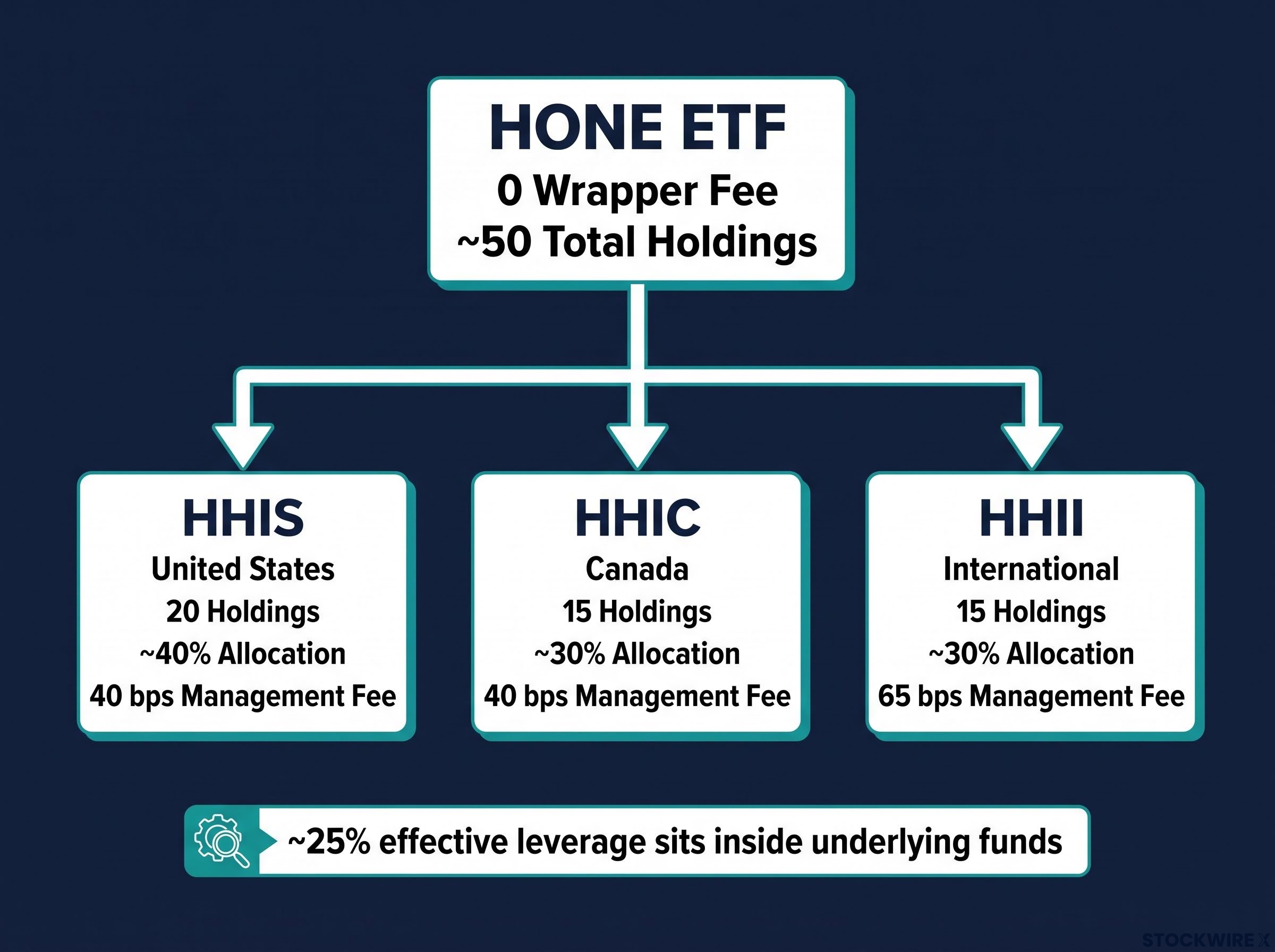
The split between them is roughly 40% HHIS, 30% HHIC, and 30% HHII. Crucially, the rebalancing across those three sleeves happens automatically inside the HONE wrapper, so you never have to adjust the regional weights yourself.
| Fund Ticker | Geographic Focus | Holdings Count | HONE Allocation |
|---|---|---|---|
| HHIS | United States | 20 | ~40% |
| HHIC | Canada | 15 | ~30% |
| HHII | International | 15 | ~30% |
HONE opened at an initial unit price of $12.00, with a market price of $11.97 recorded on 1 October 2026. Harvest has also signalled that the fund may add other High Income Shares ETFs over time, so the portfolio you buy today could evolve.
One structural detail matters for how you read HONE’s risk: the fund carries approximately 25% effective leverage, meaning it uses borrowing to amplify its exposure. That leverage sits inside HHIS, HHIC, and HHII. HONE does not pile a second layer of leverage on top.
The practical takeaway is simple. The diversification HONE gives you is geographic and structural, not the result of Harvest selecting unique securities you could not access elsewhere. Every name HONE holds is already held by one of its three constituent funds.
The HHIC expansion: why Harvest added five new Canadian names on launch day
Harvest timed a change to HHIC for the same day HONE listed, expanding the Canadian fund from 10 to 15 holdings. According to Paul MacDonald, President and Co-CIO of Harvest ETFs, the five additions were chosen partly because the market volatility during September 2026 had created attractive entry prices.
The new positions were expected to include exposure to materials such as copper, along with increased technology representation. The stated aim was broader diversification without undermining the income the fund distributes.
Here is the full 15-stock HHIC portfolio following the expansion, as at 30 September 2026:
- Royal Bank of Canada
- The Toronto-Dominion Bank
- Shopify Inc.
- Lundin Mining Corporation
- Agnico Eagle Mines Limited
- Cameco Corporation
- Brookfield Corporation
- Suncor Energy Inc.
- Canadian Natural Resources Limited
- Enbridge Inc.
- Nutrien Ltd.
- Celestica Inc.
- Alimentation Couche-Tard Inc.
- TELUS Corporation
- BCE Inc.
The specific five names newly added were not officially confirmed in the sources available at the time of writing. If that detail matters to your decision, check Harvest’s website for the current disclosed list rather than relying on inference.
When big ASX news breaks, our subscribers know first
What HONE actually costs, and what the $0.20 monthly distribution really means
Fund-of-funds products have long attracted one consistent criticism: they charge a fee at the wrapper level and then charge you again through the underlying funds. HONE avoids that, and that is the first thing you should understand about its cost.
There is no management fee at the HONE level. You pay only the management fees of the underlying funds, which Harvest discloses as 40 basis points for HHIS, 40 basis points for HHIC, and 65 basis points for HHII.
| Fund | Management Fee | Notes |
|---|---|---|
| HHIS | 40 bps | US large-cap exposure |
| HHIC | 40 bps | Canadian large-cap exposure |
| HHII | 65 bps | Higher fee reflects added complexity of international tax reclaims |
| HONE | None | Flow-through; no wrapper-level management fee |
That HHII premium is not arbitrary. International holdings involve reclaiming foreign withholding taxes, which is operationally more demanding, and that extra work is what the 25-basis-point difference pays for.
One caveat worth flagging: full management expense ratios (MERs), which include operating costs beyond the base management fee, were not available at the time of writing. The figures above are the management fees, not the complete cost of ownership.
Now the distribution. HONE targets $0.20 per unit each month, based on an estimated initial unit price of roughly $12. That payout is variable, not guaranteed, and it flows through from the distributions the underlying funds generate.
Here is where the headline number gets more nuanced. Harvest expects more than 90% of distributions to consist of capital gains and return of capital under Canadian tax rules.
Key tax point: More than 90% of HONE’s distributions are expected to be classified as capital gains and return of capital, not ordinary income.
Two mechanics drive that. Under Canada Revenue Agency (CRA) technical interpretations, option premiums for investors not in the business of trading are generally treated on account of capital rather than income, so covered-call cash tends to arrive as capital gains. Separately, when an ETF pays out more than its net taxable income, the excess is classified as return of capital.
Return of capital is not free money: what ACB reduction means in practice
Return of capital (ROC) is the part of a distribution that is not taxable when you receive it. That sounds appealing, but it is not income in any real sense.
Each ROC distribution reduces your adjusted cost base (ACB), which is the figure used to calculate your capital gain when you eventually sell. Lower your cost base today, and you crystallise a larger capital gain at disposition.
Jamie Golombek of CIBC has repeatedly made the point that ROC is not a gift; it is effectively a deferred tax event, not an avoided one. You are receiving your own capital back, and the tax bill shows up later.
There is a further wrinkle. Once your ACB reaches zero, any further ROC distributions become immediately taxable as capital gains, so the deferral eventually runs out.
None of this makes HONE problematic. ROC is common across covered-call ETFs and perfectly manageable once you understand it. The practical requirement is simple: track your ACB carefully, because treating the monthly cash as pure income without doing so can hand you an unexpected tax bill the day you sell. HONE’s tax composition estimates are expected to be published around November 2026, which will be your first look at the real breakdown.
The risks built into the structure: leverage, capped upside, and distribution volatility
HONE’s risks are not random. They follow logically from three deliberate design choices: leverage, covered calls, and a high distribution target. Understand those choices and you understand exactly what can go wrong.
Start with the engine behind the income. HONE’s underlying funds write covered calls, meaning they sell other investors the right to buy their shares at a set price, collect a premium for doing so, and pass that cash through to you alongside dividends.
That premium is the distribution’s fuel, and it comes with a cost. When markets rally hard, those written calls cap how much of the gain the fund keeps, so you participate only partially in strong upswings. Meanwhile the roughly 25% leverage amplifies losses when markets fall.
ETF strategists at PWL Capital and Morningstar Canada have described this combination as a short-volatility profile.
The structural trade-off: With covered calls and leverage together, strong trends in either direction can hurt. Upside is truncated by the written calls, while downside is magnified by the leverage.
There is also a distribution-stability risk you cannot ignore. Option premiums shrink when volatility is low. In quiet or sideways markets, there is simply less premium to collect, which means the distribution can fall, exactly what Harvest acknowledges when it describes the payout as variable.
The four core risks worth holding in mind:
- Concentration and correlation risk: leveraged large-cap exposure tends to move with the broader market, and leverage magnifies drawdowns.
- Distribution volatility: payouts depend on option premiums that fluctuate with market conditions.
- Upside cap versus amplified downside: written calls limit gains while leverage amplifies losses.
- Long-run total return risk: covered-call plus leveraged strategies have shown attractive cash yields alongside subpar total returns across some extended bull markets, because the upside cap keeps limiting participation in rising equity values.
Then there is the behavioural risk, which is arguably the most dangerous because it is the least visible. A reliable-looking monthly cheque can lull you into underestimating the equity and leverage risk underneath it. Canadian publications including Wealth Professional and Globe and Mail personal finance coverage have repeatedly cautioned that products like this are risk assets, not bond substitutes, and are a poor fit as the core of a conservative or retirement-focused portfolio.
The read you should take is this: HONE’s attractive income is a direct product of structural choices that cut both ways. Knowing where the cash comes from tells you precisely what conditions will make it shrink, which is the one question that matters most if you are relying on those distributions to live on.
HONE versus owning HHIS, HHIC, and HHII directly: what you gain and what you give up
If you already understand HONE’s building blocks, an obvious question follows: why not just buy HHIS, HHIC, and HHII yourself? The honest answer is that it depends entirely on what you value.
The clearest advantage HONE offers is operational. You get automatic geographic rebalancing across three strategies in a single trade, with no management fee at the wrapper level, which removes the ongoing chore of maintaining and rebalancing three separate positions.
The trade-off is allocation control. Buy the three funds directly and you can overweight the US or lean into Canada based on your own view. HONE fixes you to roughly 40% US, 30% Canadian, and 30% international, and you cannot tilt without exiting the wrapper entirely.
There is also an embedded tax consideration. When Harvest rebalances inside HONE, that activity can generate taxable distributions you did not personally trigger, a point Canadian ETF commentators regularly raise about asset-allocation wrappers.
| Dimension | HONE | Direct HHIS/HHIC/HHII | HDIV |
|---|---|---|---|
| Geographic scope | US, Canada, international | US, Canada, international | Sector-concentrated (Canada/US) |
| Fee structure | Pass-through, no wrapper fee | Same underlying fees, no wrapper | Wrapper fee plus underlying fees |
| Allocation control | Fixed ~40/30/30 | Full control | Fixed by provider |
| Leverage location | Within underlying funds | Within each fund | Applied at wrapper level |
Now the point that matters most if cost is your motivation: there is no fee saving in choosing HONE. Because the wrapper passes through the same underlying MERs with nothing added, owning HONE costs approximately the same as owning the three funds directly in the same proportions. No penalty for the convenience, but no discount either.
Against competitors, HONE’s positioning is reasonably distinct. Relative to the Hamilton Enhanced Multi-Sector Covered Call ETF (HDIV), HONE offers broader geographic diversification and avoids the wrapper-level fee layering that analysts have criticised in HDIV, whose leverage sits at the wrapper rather than inside its constituents. Against BMO’s income-focused all-in-one ETFs, HONE offers higher potential income but with meaningfully more complexity and risk, since those BMO products are typically unleveraged and lower-yielding.
So the decision is not a fee question. It is a preference question: how much do you value automatic rebalancing and single-ticket simplicity, and are you willing to give up the ability to tilt your regional exposure to get them?
Who HONE is actually built for, and what to confirm before buying
HONE is a good fit for a specific investor, and a poor fit for others. The product’s design is sound; whether it belongs in your portfolio depends almost entirely on how clearly you understand what you are buying.
HONE suits you if you recognise yourself in this profile:
- You want high monthly cash distributions from a globally diversified equity portfolio.
- You are comfortable with leverage and covered-call mechanics and accept their trade-offs.
- You prefer single-ticket simplicity over granular control of your regional weights.
HONE is likely a poor fit if any of these apply:
- You are a conservative investor treating it as a bond substitute or safe income source.
- You are a retiree who cannot tolerate significant drawdowns, which leverage can amplify.
- You have not accounted for the ACB implications of regular return of capital distributions.
One mandate detail is worth knowing. By prospectus, HONE is limited to large-cap individual equities. Income-style ETFs, Bitcoin-linked funds, and similar products cannot be added, so the portfolio will stay within those boundaries regardless of how Harvest evolves it.
Before you buy, confirm these three things:
- Your tax treatment of the distributions and how you will track ACB. With more than 90% of payouts expected as capital gains and return of capital, record-keeping is not optional.
- Whether the roughly 40/30/30 geographic split fits your existing regional exposures. If you already hold US-heavy positions, HONE’s US tilt may concentrate you further.
- Whether you accept that the $0.20 monthly distribution will fluctuate with option premium conditions rather than holding steady like a bond coupon.
Full MERs were not available at the time of writing, so verify those on Harvest’s website once disclosed. And remember that a product’s launch date, with limited trading history and tax data not yet published until around November 2026, is rarely the ideal moment to commit a large allocation.
This article is for informational purposes only and should not be considered financial advice. Investors should conduct their own research and consult with financial professionals before making investment decisions. Past performance does not guarantee future results. Financial projections are subject to market conditions and various risk factors.
Making an informed call on HONE in a market hungry for income
HONE is a structurally coherent, fee-efficient, globally diversified income product, and it delivers what it describes. The honest qualifier is that its high distributions come from leverage and covered calls, not from superior underlying fundamentals.
The genuine innovation sits in the fee pass-through model, which answers the most persistent criticism of fund-of-funds products, and in packaging US, Canadian, and international covered-call income into a single ticker, something that remains differentiated in the Canadian high-income market as of October 2026.
The next real test arrives with the tax composition disclosure expected around November 2026. That will show whether distributions actually line up with the expected greater-than-90% capital gains and return of capital profile, and it is a data point worth waiting for before committing serious capital.
What HONE makes possible is a simpler high-income portfolio. Simplicity and safety are not the same thing, though, and you now have the framework to tell the difference before you decide.