In January 2015, a single sentence from the Swiss National Bank wiped out hedge funds and bankrupted retail currency brokers within minutes. The bank scrapped the ceiling it had placed on the Swiss franc, and the currency immediately surged more than 20% against the euro.
Most people had never traded the franc. Yet its sudden appreciation detonated losses across the global financial system in a matter of minutes.
So what kind of currency does that? And why should it matter to anyone who holds assets priced in euros, dollars, or any other major currency?
Here is the paradox. Switzerland has a small economy, yet it runs the world’s sixth most-traded currency and sits on foreign-exchange reserves approaching CHF 770 billion as of August 2026. That financial footprint is not an accident. It reflects deep structural features that make the Swiss franc a systemically important currency for global investors, central banks, and traders who may never set foot in Zurich.
This explainer breaks down why the franc earns its safe-haven reputation, why that status comes with specific trade-offs, and why its behaviour is inseparable from what happens in Frankfurt, Brussels, and the European Central Bank boardroom.
The currency that punches far above its weight
Start with the mismatch. Switzerland’s economy is a fraction of the size of the Eurozone, the United States, or even the United Kingdom. On economic weight alone, its currency should barely register in global markets.
It does the opposite. According to the 2025 BIS Triennial Central Bank Survey (final results released in June 2026), the Swiss franc is involved in 6.4% of global daily foreign-exchange turnover, ranking it sixth worldwide.
The 2025 BIS Triennial Central Bank Survey, with final results published in June 2026, provides the definitive global benchmark for measuring currency turnover, confirming the franc’s sixth-place ranking and its expanded share of daily FX activity relative to the 2022 survey cycle.
The Swiss franc accounts for 6.4% of all daily global foreign-exchange turnover, the sixth-largest share of any currency on Earth.
That figure is striking when you hold it against the size of the Swiss economy. For context, the 2022 BIS survey put the franc at roughly 3% of daily turnover and around eighth place. Its global footprint has grown, not because Switzerland’s output doubled, but because institutional demand for the franc keeps rising. This is turnover driven by hedging, reserve management, and crisis positioning, not by domestic trade.
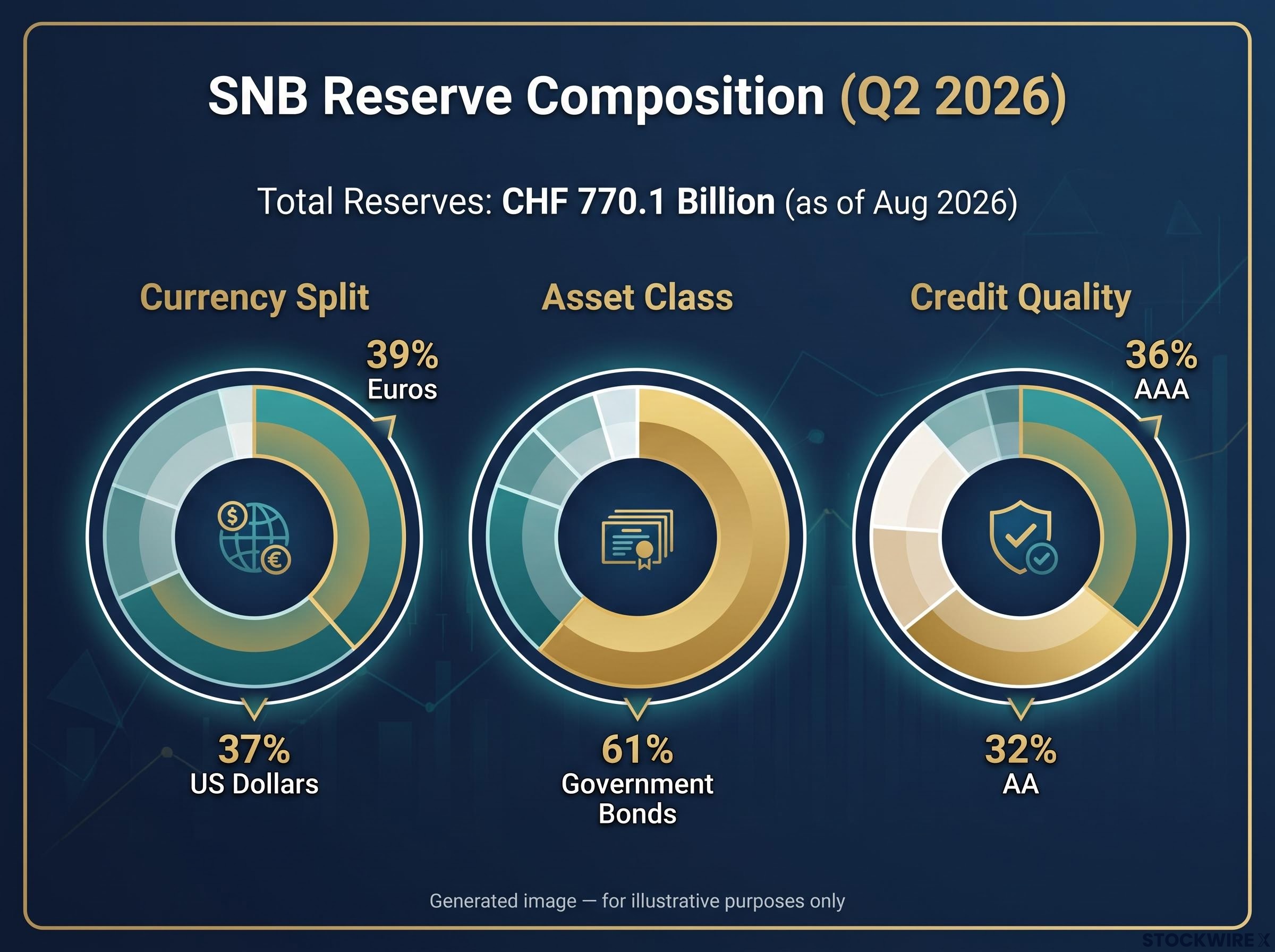
The clearest downstream signal of that demand is the SNB’s own balance sheet. As of August 2026, the Swiss National Bank held approximately CHF 770.1 billion in foreign-exchange reserves, spread across government bonds, equities, and deposits at major central banks and the Bank for International Settlements.
How the SNB builds its balance sheet is itself an unusual story: rather than conducting domestic quantitative easing, the bank creates francs to purchase foreign assets directly, which is why reserves now exceed Switzerland’s entire annual economic output.
How the reserves are built
The composition of those reserves tells you how conservatively the SNB manages them, based on the Q2 2026 breakdown:
- Currency split: roughly 39% in euros and 37% in US dollars, with the remainder in yen, sterling, Canadian dollars, and others
- Asset class: 61% held in government bonds, with the rest in equities and central-bank deposits
- Credit quality: 36% of fixed-income holdings rated AAA and 32% rated AA
Here is what the sheer scale of those reserves means for you as an investor. A reserve pile that large relative to the economy behind it signals a central bank that does not merely react to currency moves; it actively shapes them. That capacity to intervene decisively is itself part of what makes the franc trustworthy when markets panic.
When big ASX news breaks, our subscribers know first
What actually makes a currency a safe haven?
When the world turns uncertain, where does money run to? That instinct, capital fleeing risk, is the entire mechanism behind safe-haven status. A safe haven is simply a currency that attracts inflows during global stress because it combines three things: deep liquidity, institutional credibility, and low correlation to whatever risk investors are escaping.
The franc checks each box for specific, identifiable reasons. Here are the five structural pillars, in order of how much explanatory work each one does.
- Large, conservatively managed reserves. The SNB holds around CHF 770.1 billion in foreign assets, 61% in government bonds and heavily skewed toward AAA and AA credit. That war chest lets the bank intervene decisively in a crisis, which is precisely when confidence matters most.
- Persistent current-account surpluses. Switzerland is a structural net creditor to the rest of the world. IMF Article IV reports and SNB balance-of-payments data repeatedly highlight this. The franc is backed by claims on foreign economies rather than dependence on borrowing from them.
- Political neutrality and rule of law. Long-standing neutrality in international conflicts, stable coalition politics, low corruption, and strong property rights draw offshore wealth during geopolitical stress elsewhere.
- A credible inflation track record. The SNB’s mandate centres on price stability, and its long record of low inflation keeps the franc attractive as a store of value.
- Willingness to use unconventional tools. From negative interest rates to large-scale currency interventions, the SNB has shown it will act aggressively to manage the franc.
What makes this combination durable is that the pillars feed one another. Creditor status backs the reserve position. The reserves fund the SNB’s intervention firepower. That firepower protects the inflation record, which in turn keeps creditor inflows arriving.
Safe-haven hierarchies across currencies are not fixed: research indicates the primary haven role shifted from the US dollar before the global financial crisis, to the franc post-crisis, to the yen during trade friction and COVID-19, so the franc’s current position reflects a specific historical window rather than a permanent structural crown.
For a globally diversified portfolio, the practical takeaway is this: the franc tends to appreciate at exactly the moment your other positions come under stress. That makes it a hedge, not a return-seeking asset. You hold it for protection, not yield.
There is a bonus here. These same five pillars form the checklist for evaluating any candidate safe-haven currency anywhere in the world. Learn them once, and you can read the quality of a refuge currency the next time markets wobble.
Why CHF and the euro move together, and what that means for investors
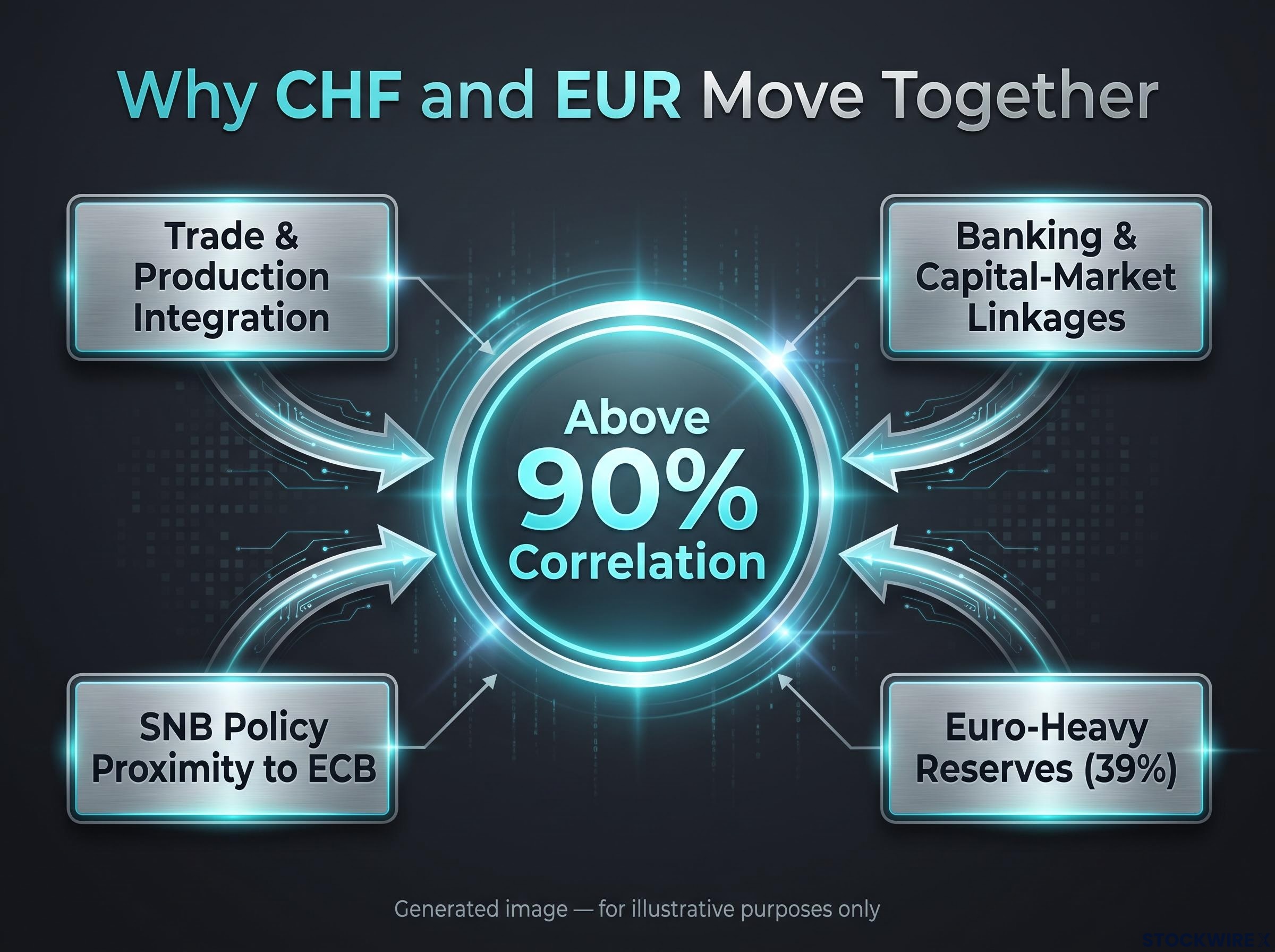
Some financial models estimate the correlation between the euro and the franc at above 90%, approaching a near-perfect relationship. That sounds extreme until you trace where it comes from. The link is not a coincidence of the charts; it emerges logically from how Switzerland’s economy is wired into the Eurozone at every level.
Four reinforcing drivers produce the co-movement.
| Driver | Mechanism | Effect on EUR/CHF |
|---|---|---|
| Trade and production integration | The EU is Switzerland’s primary trading partner, with much cross-border trade priced in euros | Shared business-cycle shocks move both currencies together |
| Banking and capital-market linkages | Swiss banks and firms borrow, lend, and invest heavily in euros | Persistent hedging flows anchor the pair |
| SNB policy proximity to the ECB | SNB rates historically kept close to or below ECB rates | Aligned rate expectations keep the pair range-bound |
| Euro-heavy reserve composition | Around 39% of SNB reserves are held in euros | Interventions often operate through EUR assets, moving both at once |
If you assumed holding the franc gave you clean diversification away from euro-area exposure, this figure is a correction. The franc is a hedge against idiosyncratic European stress, the kind specific to one country or institution, not a hedge against European risk in general. When the euro itself rallies in a global panic, the franc often moves with it.
That distinction matters for how you size and time a franc position. Treating it as broad crisis insurance is a common error. It is more precisely a tool for shocks that are not systemic to the euro bloc.
The 2015 peg removal: when the correlation broke
Between 2011 and 2015, the SNB formalised this structural link into a hard floor, capping the franc at EUR/CHF 1.20. Traders came to treat that line as permanent.
In January 2015, the SNB abandoned it without warning. The franc jumped more than 20% in minutes.
The franc surged more than 20% almost instantaneously when the SNB removed the 1.20 floor in January 2015.
The move shredded retail forex brokers and leveraged traders who had built positions assuming the floor would hold. The episode taught markets two lessons at once. SNB policy can shift abruptly and override the structural correlation for a moment, with violent consequences. But the sheer size of the move also revealed how much genuine demand for the franc had been bottled up beneath the managed lid. The scarcity was real; the policy was simply holding it back.
When CHF safe-haven status gets complicated
Here is the tension at the heart of the franc. The same SNB intervention capacity that makes it credible in a crisis is also what limits how much of a crisis-driven gain you can actually capture. The central bank that protects the currency is the same one that will lean against it the moment appreciation runs too far.
Three complications follow from that.
- SNB intervention risk: A sharp crisis appreciation can be reversed in part by subsequent rate cuts or currency sales aimed at weakening the franc.
- Negative carry: The franc has long carried very low or negative interest rates, offering poor income relative to higher-yielding alternatives.
- Correlation limit: Its tight link to the euro means it does not diversify well against euro-area systemic risk.
What the case studies show
Recent episodes make each complication concrete.
During the 2020 COVID-19 shock, the franc drew classic safe-haven inflows, but the SNB intensified its currency interventions to counter excessive appreciation. The refuge worked, but the central bank capped how far it could run.
In 2022, as the Russia-Ukraine war erupted and rates rose globally, the franc strengthened notably. Its gains reflected both safe-haven demand and a reassessment of relative policy following surprise SNB rate hikes, a reminder that the franc’s path depends as much on monetary decisions as on fear.
The March 2023 Credit Suisse collapse tested the narrative directly. Some observers questioned whether domestic banking stress would strip the franc of its refuge status. It did not. EUR/CHF stayed relatively contained as authorities arranged the UBS takeover and the SNB provided large liquidity backstops.
When Credit Suisse faced acute stress in March 2023, decisive institutional action helped preserve confidence in the currency, and EUR/CHF remained relatively contained.
Geopolitical currency shocks do not follow a single template: the US dollar can rally while gold sells off during the same event, and the credibility of each escalation stage, not its rhetorical tone, determines how capital repositions across the safe-haven spectrum.
The SNB’s interim 2026 results, showing large swings in profit and loss on foreign-currency positions, underline how actively the bank manages its reserves. For you, the implication is that the franc works best as a tactical hedge timed around specific stress events, not as a permanent anchor. The SNB’s active hand creates asymmetric outcomes that passive holders can get caught by.
The honest picture is this: the franc’s safe-haven status is real and structural, but its expression is policy-mediated, low-yielding, and geographically bounded.
What CHF’s safe-haven mechanics mean for how you hold it
Pull the threads together. The franc is a genuine safe haven, built on large reserves, creditor status, political neutrality, and monetary credibility. Its usefulness as a hedge is shaped by three constraints: SNB intervention, low carry, and its bounded diversification against euro-area risk.
That combination changes how you should treat it. A reader who grasps the mechanics times a franc position, sizes it, and exits it deliberately, rather than parking money in it as passive crisis protection and hoping for the best.
Three variables are worth tracking to do that well.
- SNB policy and reserve data. Published monthly on the SNB data portal under the IMF Special Data Dissemination Standard template. Rising intervention activity signals the bank is leaning against franc strength.
- The ECB-SNB rate differential. This acts as a leading indicator of pressure on EUR/CHF. A widening gap tends to drive the pair.
- Stress events outside the euro area. This is where the franc’s diversification benefit is strongest, since its roughly 90%-plus correlation with the euro blunts its usefulness against euro-systemic shocks.
The ECB-SNB rate differential works as a directional signal for EUR/CHF because aligned rate expectations have historically kept the pair range-bound, while divergences, particularly when the SNB moved earlier or deeper than the ECB, have preceded the pair’s sharpest single-session moves.
| Variable | What to watch | Source | What a shift signals |
|---|---|---|---|
| SNB reserves and policy | Monthly reserve levels and intervention activity | SNB data portal (IMF SDDS) | Rising reserves suggest the SNB is capping franc strength |
| ECB-SNB rate differential | The gap between Swiss and Eurozone policy rates | SNB and ECB rate announcements | A widening gap points to directional pressure on EUR/CHF |
| Non-euro stress events | Geopolitical or financial shocks outside the euro bloc | Global market news | These are where franc diversification works best |
The franc, ranked sixth globally in FX turnover, is not a universal store of value like gold or US Treasuries. It is a precision tool with a defined set of conditions under which it delivers the protection investors expect of it.
This article is for informational purposes only and should not be considered financial advice. Investors should conduct their own research and consult with financial professionals before making investment decisions. Past performance does not guarantee future results, and currency movements are subject to market conditions and various risk factors.