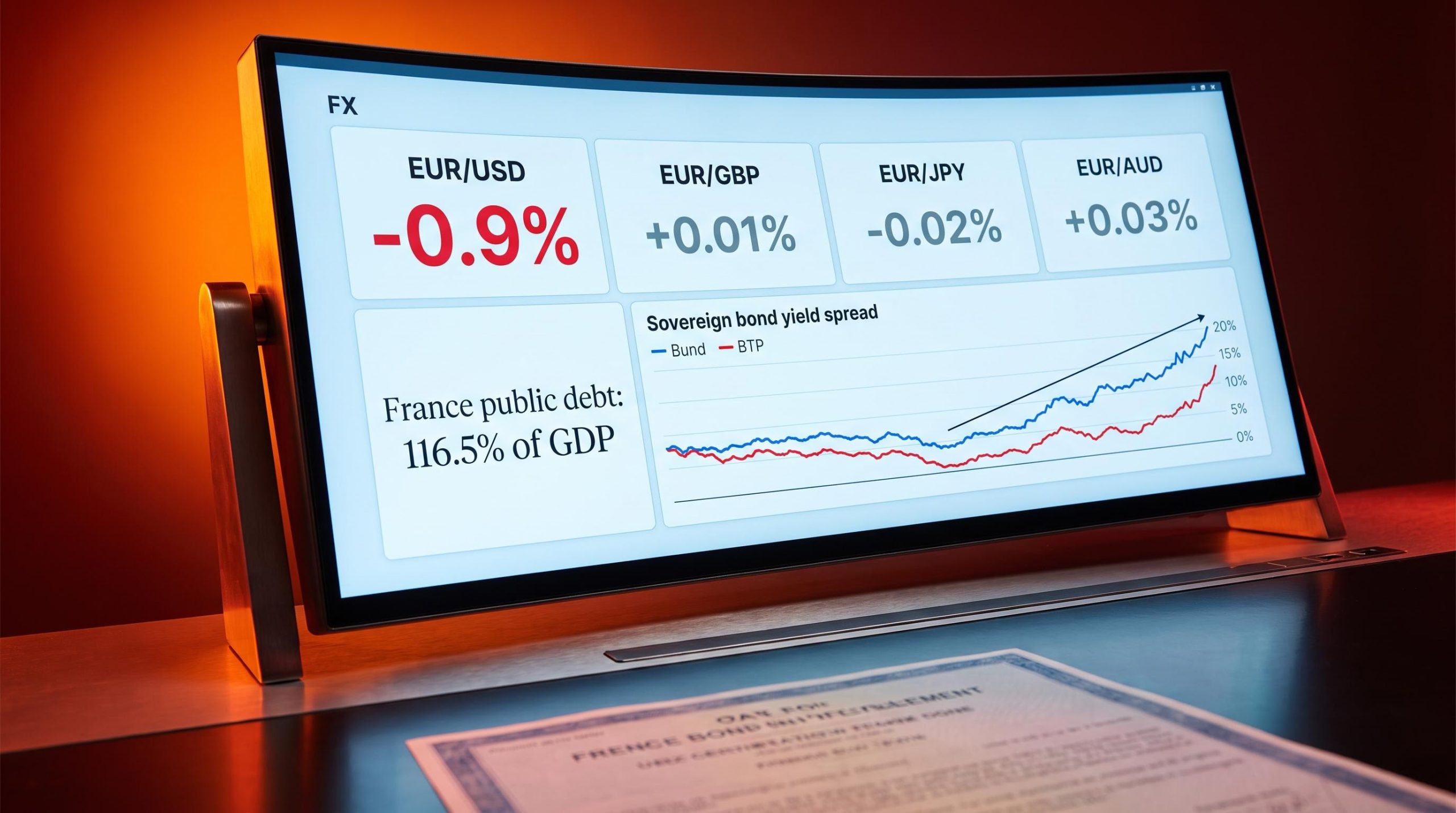
Picture this: the euro drops nearly a full percentage point in a single session, briefly breaching a 1% intraday decline, and yet the British pound barely moves. The Australian dollar holds. The Japanese yen does not flinch.
If every major currency pair simply danced to the tune of the US dollar, that would be impossible. When the dollar flexes, everything moves against it together. What you just saw was something different.
This is where Euro currency risk becomes its own distinct category, separate from broad dollar strength. Internal Eurozone politics and sovereign debt trajectories, particularly the widening yield gaps between Germany and higher-debt members like France and Italy, can trigger aggressive, isolated selloffs in the single currency while every other major pair sits still.
Ignore the regional bond market behind this, and you are trading blind. You will mistake a structural fracture for a routine technical pullback, and you will buy the dip right into a wall.
This guide gives you a definitive framework for diagnosing isolated currency weakness. After this, you will be able to instantly separate a broad dollar rally from genuine Eurozone stress, and adjust your positions before the damage compounds.
How sovereign bond spreads dictate single currency pricing
Start with the screen you look at every day. EUR/USD moves, and you reach for the usual explanations: Federal Reserve expectations, risk sentiment, a data surprise. But sometimes the real driver is sitting in a market you may never have opened: the government bond market of a single European country.
German federal government bonds, known as Bunds, are treated as the benchmark “risk-free” asset inside the Eurozone. Everything else is measured against them.
The yield spread, meaning the difference in interest rate between a Bund and, say, a French government bond (an OAT) or an Italian one (a BTP), is the single clearest barometer of internal Eurozone stress. When investors demand a higher yield to hold French or Italian debt relative to German debt, that gap widens. A widening gap is the market pricing in fear.
Here is the part that catches traders out. France, Italy, Spain and the rest do not have their own floating currencies anymore. They share the euro.
So when sovereign credit risk rises in one large member, there is no French franc or Italian lira to sell off. The pressure has nowhere to go except onto the shared currency itself. Country-specific fiscal stress transmits straight through to the euro via the bond market and cross-border capital flows.
That is why fiscal divergence shows up as “euro risk” rather than “French currency risk.” Global investors reduce exposure to euro-denominated assets broadly, and the euro weakens in FX markets even when the dollar itself is doing very little.
The BTP-Bund spread functions as a fragmentation risk gauge that professionals track alongside the VIX, and the euro valuation fundamentals that underpin these relationships, from the ECB’s symmetric 2% mandate to rate differential mechanics, are often misread even by attentive market participants.
Embedded inside those spreads are two distinct fears: the probability of a default or debt restructuring, and something more existential.
Redenomination risk The low-probability but market-moving risk that a member state might leave the euro and reissue its debt in a new national currency, crystallising losses for anyone holding euro-denominated bonds. When this fear rises, global capital exits euro assets broadly, dragging the currency down across multiple pairs at once.
The reference point for all of this is the 2010-2012 sovereign debt crisis. Back then, widening spreads between Bunds and peripheral bonds, Greek, Italian, Spanish, Portuguese, moved in tight correlation with euro weakness and spikes in volatility. Markets were not pricing one country’s default. They were pricing the risk to the integrity of the currency union itself.
Understanding this transmission mechanism lets you anticipate structural FX moves before they fully show up on a standard price chart. The bond market often flinches first.
Core indicators to watch
FX desks keep a permanent eye on long-dated government bond spreads, typically the 10-year Bund against the 10-year OAT and BTP.
The specific signal to watch for is acceleration. When Bund-OAT or Bund-BTP spreads widen sharply without any parallel move in US Treasury yields, that is localised Eurozone stress, not a global rates shock. That divergence is your first clue that the next euro selloff is homegrown.
When big ASX news breaks, our subscribers know first
Reading the 2026 structural fractures inside the Eurozone
Theory is one thing. The numbers currently sitting on France’s balance sheet are another, and they tell you this pressure is not about to resolve itself with a tidy chart bounce.
The most authoritative recent read comes from the International Monetary Fund’s 2026 Article IV Consultation for France, with the staff report and press release dated 21-22 July 2026. The picture it paints is of a core Eurozone economy wrestling with entrenched, structural fiscal challenges.
Here are the figures that matter:
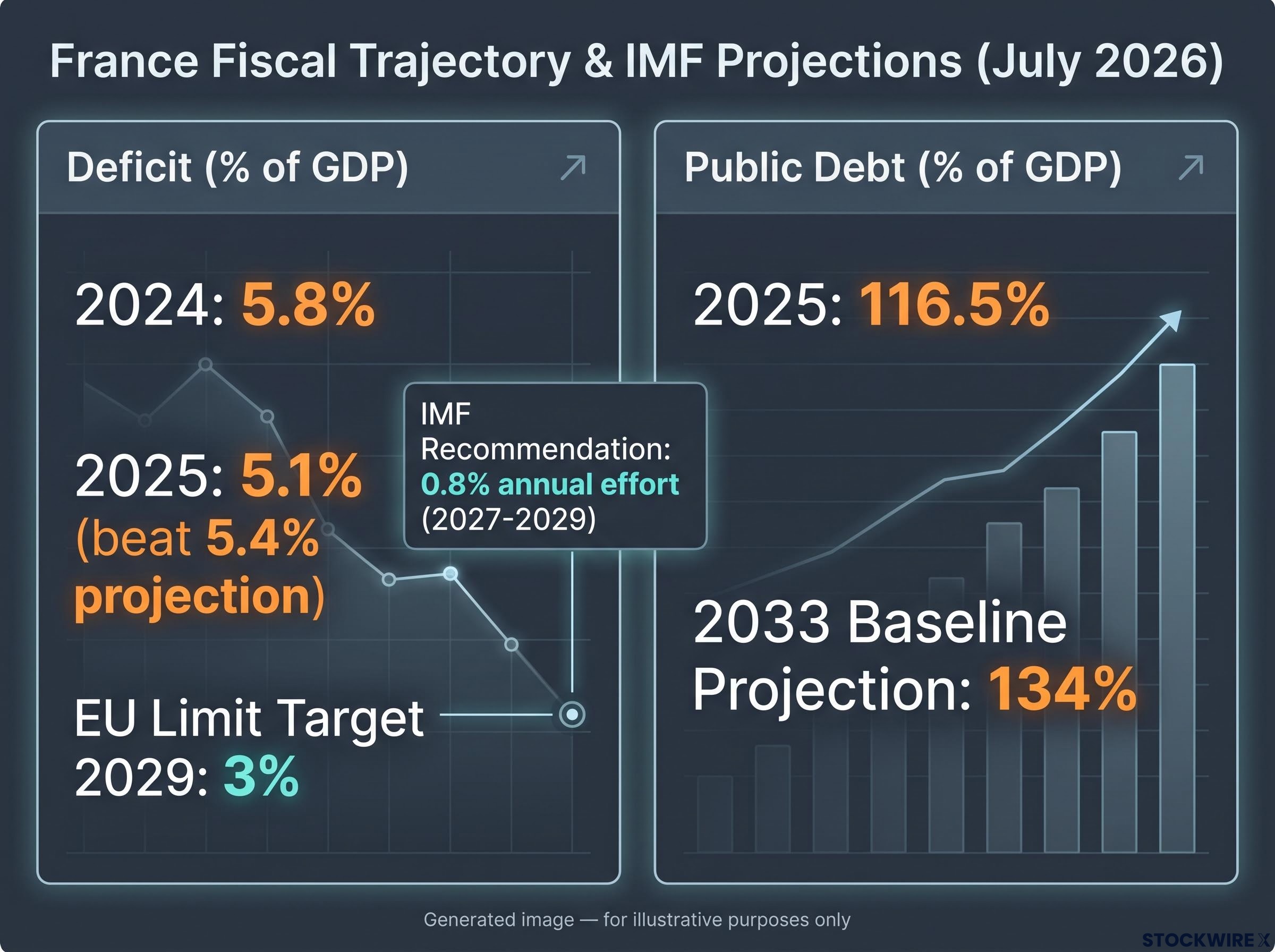
- France’s headline fiscal deficit came in at 5.1% of GDP in 2025, down from 5.8% in 2024, which the IMF attributed to proactive spending management and modestly beat its own earlier 5.4% projection.
- Public debt stood at approximately 116.5% of GDP in 2025.
- Under the baseline scenario, without stronger consolidation, debt is projected to climb toward roughly 134% of GDP by 2033.
- IMF staff recommend a front-loaded structural fiscal effort of about 0.8% of GDP per year over 2027-2029 to bring the deficit below the EU’s 3% limit by 2029.
The France-Germany spread has now widened to levels not seen since 2012, with France’s 10-year yield overtaking Italy’s for the first time since approximately 2005, a hierarchy inversion that illustrates exactly how the structural divergence the IMF data describes is already being priced into sovereign markets.
What makes this so difficult is the tension baked into it. The IMF is explicit that consolidation must be expenditure-led and growth-friendly, because France’s tax burden is already high and purely revenue-based fixes would choke growth. Yet spending is being pushed upward by structural forces: defence, an ageing population, and the green transition. Cutting into that while protecting growth is a genuine bind.
This is where two interpretations split the market, and knowing which one you believe shapes how you trade.
The structural divergence camp reads the IMF data as evidence of a deep, slow-moving fracture. High debt, sensitivity to interest rates, and spending pressures that will not fade point to a persistent risk premium on the euro that no single budget can fix.
The political shock camp treats spread widening as event-driven noise. Budget negotiations, disputes over EU fiscal rules, and political uncertainty cause flare-ups, but the assumption is that EU governance and ECB tools eventually reassert discipline. This view leans on the IMF’s own language, which classifies medium-term sovereign risks as “moderate” provided credible consolidation is actually delivered.
Both are live right now. They differ mainly on one question: how likely is France to hit its targets on schedule?
For you, the numbers settle the near-term posture. This is a structural governance problem, which means you should not expect a quick, clean technical reversal without a genuine policy shift. When you know the exact fiscal thresholds authorities are struggling to meet, you can gauge in advance whether an upcoming budget announcement is likely to light the fuse on fresh currency volatility.
Diagnostic tools for isolating local weakness from global dollar trends
So the euro is falling on your screen. The question that determines your next move is simple to ask and easy to get wrong: is this the dollar, or is this the Eurozone?
Get this diagnosis right and you avoid the single most expensive mistake available to a EUR/USD trader, which is buying a false dip into a structural break. Here is the systematic method institutional desks use.
The core technique is cross-referencing. Do not just stare at EUR/USD. Pull up EUR/GBP, EUR/JPY, and EUR/AUD alongside it.
The logic is clean. If the euro is falling against multiple non-dollar currencies while those currencies hold steady against the dollar, the weakness is euro-specific. If the euro is roughly flat against those crosses and only weak against the dollar, then you are looking at broad dollar strength, most likely a shift in Fed expectations, and the story has nothing to do with the Eurozone.
This is exactly what played out in the session described in recent macro commentary. The euro fell approximately 0.9% on the day, with intraday declines pushing past 1%. Meanwhile the British pound showed only limited weakness, and the Australian dollar, Canadian dollar, and Japanese yen barely moved. That contained behaviour across the crosses was the proof: this was euro stress, not a dollar rally.
The US bond market sealed the diagnosis. On the same day, 30-year Treasury futures (ZB) posted a relief bounce after six straight sessions of selling, with the front end of the curve recovering more sharply than the long end.
That detail matters more than it looks. A recovering Treasury market should, in theory, suppress dollar strength. So if the dollar was not surging and the euro was still falling hard, the weakness could only be coming from inside Europe. The absence of a dollar driver is itself evidence.
By cross-referencing these pairs and the bond context, you can prove whether your trade is fighting the Fed or fighting French politics. That single distinction dictates your exact next move.
The euro under pressure from sovereign spread widening is compounded by a 125-150 basis point policy gap favouring the dollar, meaning that even when the Fed is not actively moving, the structural rate differential acts as a persistent headwind on any euro recovery attempt.
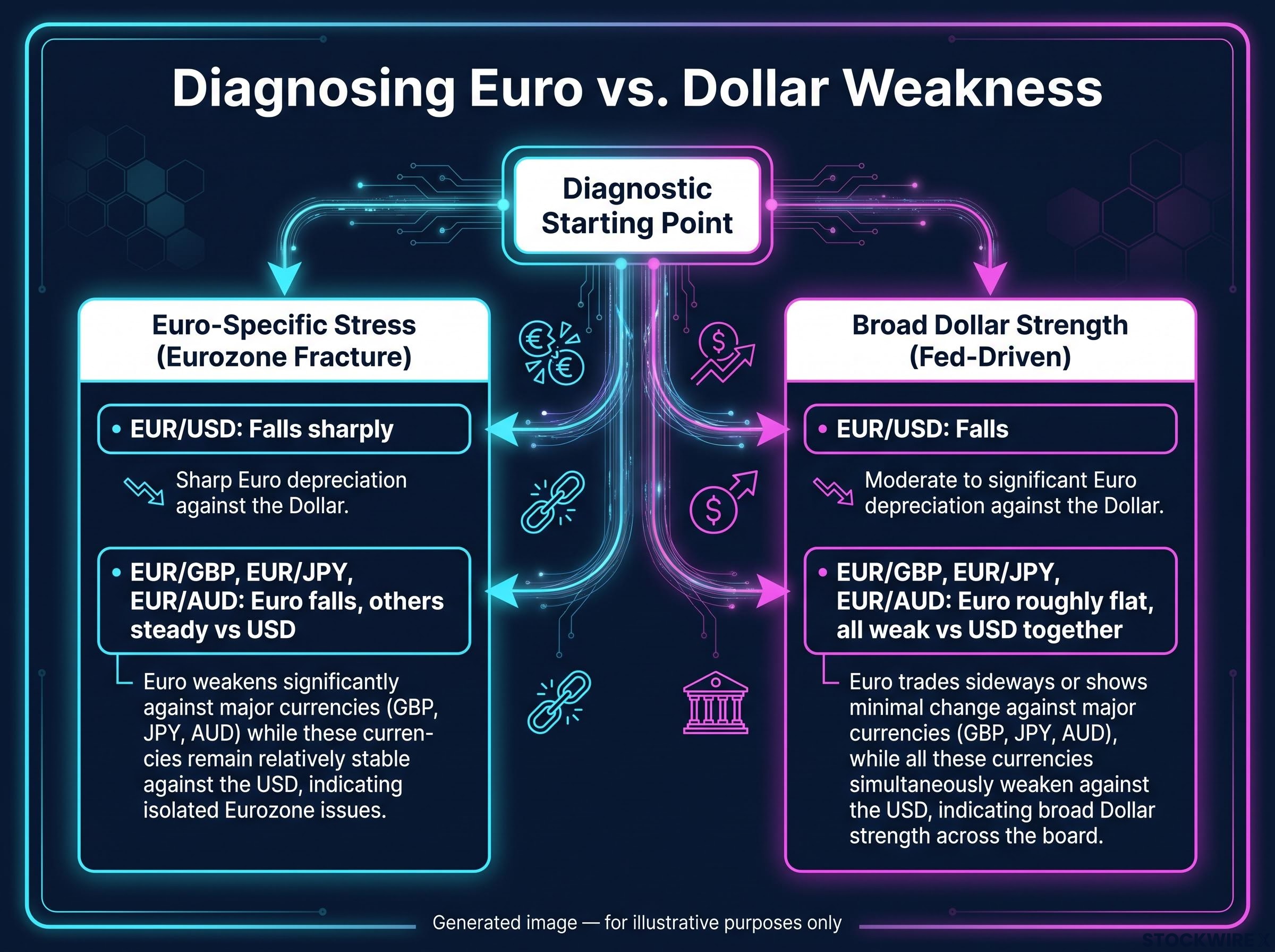
| Market condition | EUR/USD price action | Non-USD crosses (EUR/GBP, EUR/JPY, EUR/AUD) |
|---|---|---|
| Euro-specific stress (Eurozone fracture) | Falls sharply | Euro also falls; non-USD currencies steady vs USD |
| Broad dollar strength (Fed-driven) | Falls | Euro roughly flat; all currencies weak vs USD together |
Mapping event risk to price action
Technicals give you the level; events give you the timing. On a weekly chart, EUR/USD was testing a major former resistance zone that had capped the pair from mid-July 2023, before it broke higher in April 2025 and then converted to support around May 2025. When macro stress forces a chart down to a level like that, you watch it closely, because a break below a converted support zone confirms the fundamental story in price.
Overlay spread movements with the calendar. Budget announcements, EU Commission assessments, and scheduled IMF Article IV releases are exactly the events that catalyse spread widening and euro-specific repricing. When spreads blow out around one of these dates and the euro underperforms its crosses at the same time, treat the move as fundamentally euro-driven rather than generic risk-off noise.
Adapting your FX portfolio when the macro thesis breaks
Here is the mindset that separates disciplined traders from gamblers. Your original reason for a trade matters more than the profit or loss on the screen. When the catalyst changes, the trade has to change with it, regardless of whether you are up or down.
Consider the live example disclosed in recent Tasty Live Macro Money commentary, where a presenter managed a multi-currency book straight through one of these isolated euro selloffs. The handling of it is a working blueprint.
Walk through the logic step by step:
- Identify what is actually driving the move. The euro position was being hit by factors inconsistent with the original portfolio thesis. The price action and the rationale had diverged.
- Close the position when the catalyst no longer matches your thesis. The euro trade was exited at a small loss. Not because the loss was large, but because the reason for holding it had evaporated.
- Protect secondary exposures that are only moving by association. Long positions in gold, the Australian dollar, and the British pound were retained. The pound and the Aussie had weakened, but only as a side effect of euro selling, not as independent bearish signals, so there was no reason to abandon them.
- Manage your overall dollar concentration. A short Canadian dollar position was kept specifically to dilute the portfolio’s overall exposure to a strengthening dollar.
Notice what the discipline is really about. The small loss on the euro was accepted without hesitation because the underlying driver had contradicted the thesis. Holding on in that situation would have converted a calculated position into a bet on hope.
That is the line you have to respect. The moment the fundamental catalyst contradicts your original reason for being in a trade, continuing to hold stops being speculation and becomes gambling. Knowing exactly when to walk away is what protects your capital through a shock you did not see coming.
This article is for informational purposes only and should not be considered financial advice. Investors should conduct their own research and consult with financial professionals before making investment decisions.
Navigating structural divergence in the quarters ahead
The relationship at the heart of all this is simple to state and hard to escape: as long as core Eurozone members struggle with structural deficits, the single currency carries a persistent risk premium that no technical bounce can fully erase.
The IMF figures make clear this is a multi-year governance challenge, not a passing budget dispute. With France’s debt projected toward 134% of GDP by 2033 absent stronger consolidation, expect the euro to remain structurally sensitive to every budget announcement and EU assessment in the quarters ahead.
That means one habit is no longer optional. Keep a sovereign bond spread tracker, Bund against OAT and BTP, permanently visible on your dashboard, sitting right alongside your FX charts. The bond market will often tell you what the euro is about to do before the currency does.
Reading bond yield signals correctly requires tracking corporate credit spreads alongside sovereign yields, because investment-grade and high-yield spreads can stay compressed even as Treasury or Bund yields rise sharply, and that divergence changes how you interpret the severity of any risk-off move.
Before you take your next major EUR/USD position, run the diagnostic. Check the non-dollar crosses, check the US bond context, and check the spreads. Prove whether you are trading the Fed or trading Europe before you commit a single unit of capital.
Past performance does not guarantee future results, and these forward-looking statements are speculative and subject to change based on policy developments and market conditions.