Most people who start trading options buy calls. They pick a direction, pay a premium, and then watch the position lose value every single day the stock does not move enough.
What they did not know going in is that the moment they bought that option, roughly two-thirds of the probability was already working against them. Not because their market view was wrong, but because of how options are structurally priced.
The difference between buying vs selling options is not just a matter of direction or risk appetite. It is a structural difference in how probability, time, and option pricing interact, and every option has a built-in headwind for one side of the trade and a built-in tailwind for the other.
Understanding which side you are on, and why, is the foundation of any options approach that lasts beyond a few lucky trades.
This piece walks through the mechanics clearly, using a real McDonald’s options chain to illustrate the numbers. By the time you finish, you will be able to see exactly how probability of profit and time decay shift depending on which side of the trade you take, and what trade-offs come with each.
The structural starting point: what you are actually buying or selling
Start with something familiar. When you buy or short a stock outright, you are making roughly a 50/50 bet in the short term.
Short-term price movement is close to random. No amount of chart-gazing or fundamental analysis reliably tells you which way a stock moves over the next few days. According to Tasty Research, the split is not perfectly even: daily stock price movement runs approximately 53% upward versus 47% downward over time, reflecting a slight long-term upward bias in equity markets.
Dimensional Fund Advisors’ historical analysis of the long-term upward bias in equity markets documents the consistent but variable nature of annual stock returns since 1926, providing the broader context that explains why even a 53% daily up-move frequency translates into meaningful compounding over time while remaining unreliable over short windows.
Hold onto that figure. It tells you that even the simplest trade, just owning stock, has a small edge baked in. That makes the structural disadvantage of buying at-the-money options stand out all the more sharply once the comparison arrives.
Here is where options change the game. They are the mechanism that lets you step off the coin-flip and deliberately choose which side of a probability distribution to stand on.
You can position yourself on the high-probability side or the low-probability side. That choice, not just your directional view, is what determines your odds before the stock moves a single cent.
The three starting positions look like this:
- Stock ownership (~50/50): A near-even bet on direction, with a slight structural lean toward up over the long run.
- Buying options (low probability): You start below even odds. An at-the-money option purchase begins at roughly 33% probability of profit before time decay is even factored in.
- Selling options (high probability): You start above even odds, collecting premium and letting the structure work in your favour.
There is a principle underneath all of this that you need to carry through the rest of this article: every structural advantage on one side of an options trade carries a corresponding disadvantage on the other. This is not a market inefficiency waiting to be exploited. It is a deliberate feature of how options are designed.
Most beginners start by buying options. It feels intuitive: pick a direction, pay a known amount, cap your downside. The problem is that the most intuitive side is also the low-probability side, and almost nobody explains that going in.
The mechanics here build on a foundation that trips up most beginners: call and put options each carry asymmetric payoff profiles that interact differently with time and volatility, and the gap between their theoretical appeal and real-world outcomes is where most retail losses originate.
When big ASX news breaks, our subscribers know first
Why buying options puts probability against you before the trade begins
Picture a long call on your screen. McDonald’s (MCD) is trading near $232 per share, and you buy the 230-strike call expiring in roughly 50 days.
It looks clean. Your maximum loss is the premium you pay, your upside is theoretically unlimited, and you have a clear directional bet. The numbers underneath tell a less comfortable story.
Here is the trade profile.
| Strike | Premium Paid | Break-even | Probability of Profit | Extrinsic Value |
|---|---|---|---|---|
| 230 call | ~$9.85-$10.00 | ~$240 | ~33% | ~$8.00 |
Maximum loss is capped at the premium, roughly $800-$900 per contract. Maximum profit is theoretically unlimited. That part of the sales pitch is true.
Now look at the break-even. At ~$240, the stock has to climb about 3.5% from where it sits just for you to get your money back, before you make a single dollar of profit. The ~33% probability of profit confirms the odds: you need a meaningful directional move just to break even, not to win.
The reason sits in the premium itself. Of the roughly $9.85 you pay, about $8.00 is extrinsic value.
Extrinsic value is the portion of an option’s price beyond its intrinsic (in-the-money) value. It includes time value and the premium for expected volatility, and it is guaranteed to reach zero by expiration. That is not a probability; it is a certainty of how options are priced.
Implied volatility is the variable that determines how much extrinsic value is embedded in a premium at any given moment, and a seller entering at identical strikes on the same underlying can collect 40 times more or less depending solely on where volatility sits in its historical range.
So you are holding roughly $8.00 of value that is contractually destined to disappear. Every day the stock fails to move enough, a slice of it evaporates. This is the structural headwind every buyer carries.
The Greek that measures this daily erosion is theta.
Theta: your daily cost of waiting Theta is the rate at which an option’s price falls purely because time is passing, expressed in cents per day. A theta of 0.05 means the option loses $0.05 per day, or $5 per day on a standard 100-share contract. Importantly, theta only erodes the extrinsic portion of the premium. Intrinsic value does not decay this way.
Put the pieces together and the picture is stark. You bought a position that starts with the odds against you, carries a break-even above the current price, and loses value to time every single day you wait for your move to arrive.
That does not make buying wrong. It makes it a tool for a specific job, which the final section returns to. But if you have ever bought a call, watched the stock drift sideways, and seen your position bleed out, now you know exactly what was happening under the hood.
How selling options flips the probability and reverses the decay
Now run the mirror image. Same McDonald’s chain, same roughly 50 days to expiration, but this time you sell the 230-strike put instead of buying the 230-strike call.
Everything that worked against the buyer now works for you.
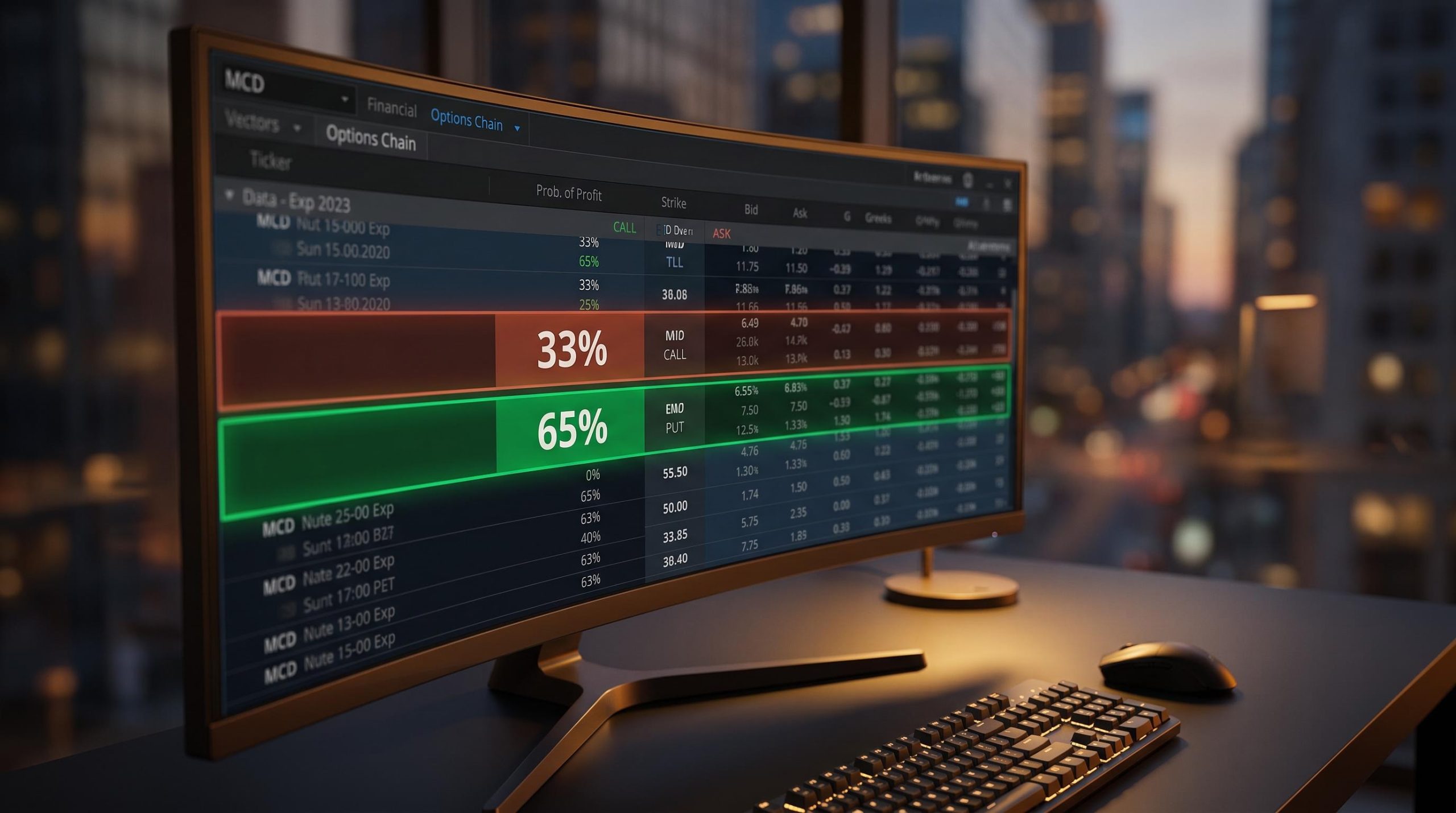
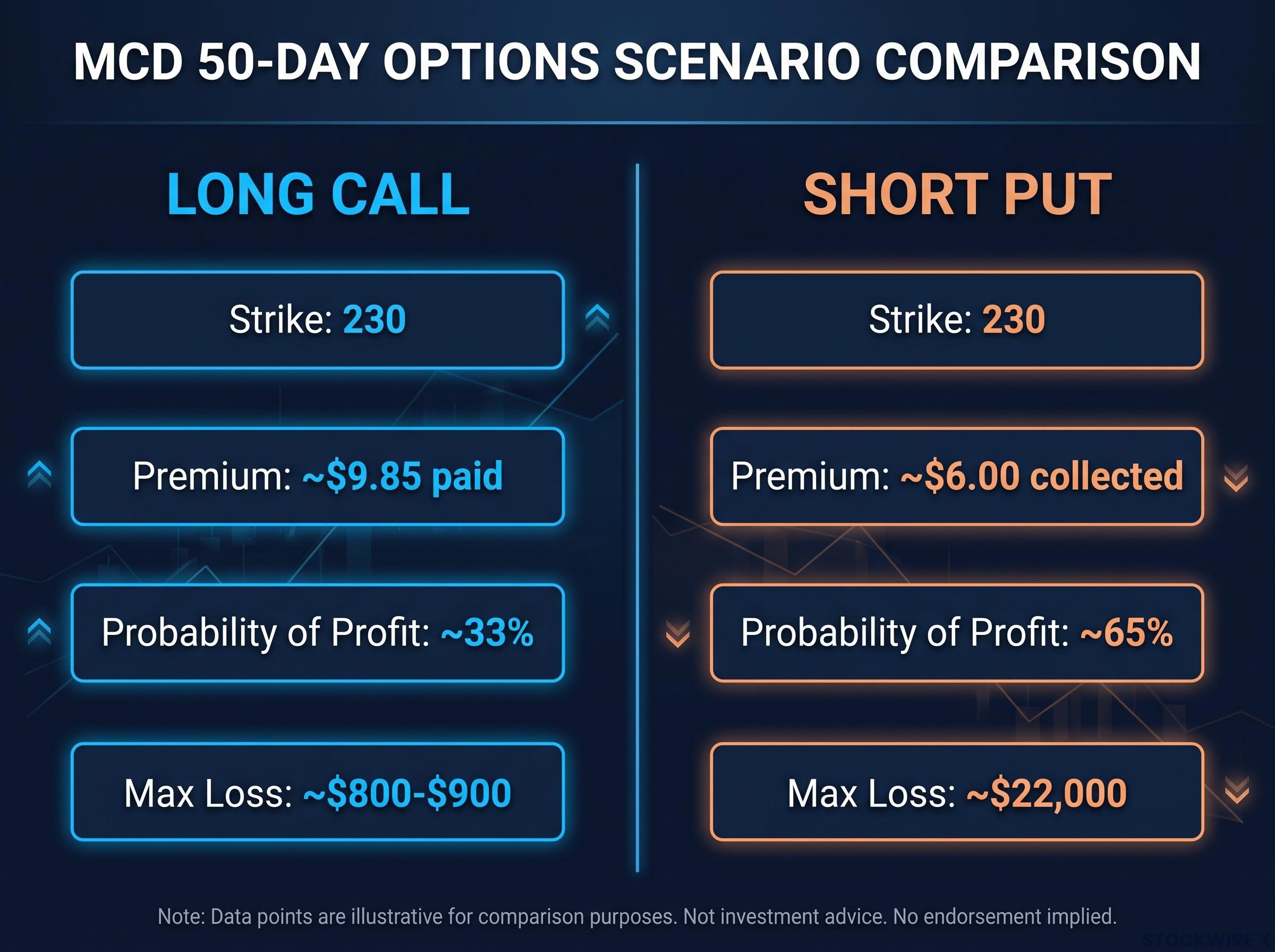
You collect a premium of approximately $6.00 up front. Your probability of profit jumps to approximately 65%, and there is roughly an 80% probability of capturing at least half of your maximum profit. The same underlying, the same expiration, and a completely different set of odds.
Here is the two positions side by side.
| Position | Strike | Premium | Probability of Profit | Max Loss |
|---|---|---|---|---|
| Long call | 230 | ~$9.85 paid | ~33% | ~$800-$900 |
| Short put | 230 | ~$6.00 collected | ~65% | ~$22,000 |
The jump from 33% to 65% on the same stock and the same expiration is the entire point. The structural difference between buying and selling is not small or marginal. It is the difference between starting each trade with the odds against you versus starting with the odds in your favour.
Theta is the reason. As a seller, you hold positive theta, which means the daily decay of extrinsic value mechanically produces profit for you, as long as the underlying does not move deep into the money. The headwind from the previous section becomes your tailwind.
There is a directional point worth clearing up. Selling an at-the-money put on MCD is a bullish-leaning position, similar in directional exposure to buying the call. You profit if the stock stays flat or rises.
So the directional bet is roughly the same. The gap in probability is entirely a function of which side collects extrinsic value and which side pays it. That is the whole mechanic, visible in a single comparison.
Reading delta as a probability shortcut
There is a practical screening tool that makes all of this easier to apply: delta.
Delta is most often described as how much an option’s price moves relative to the stock. But it doubles as an approximate probability that the option will expire in the money.
A 30-delta option implies roughly a 30% chance of finishing in the money. For the seller of that option, that translates to roughly a 70% probability of profit before any active management.
This is why sellers often work in the 20-30 delta range. Selling at that distance puts theoretical probability of profit in the 70-80% range, far higher than the probability attached to an at-the-money long call or put.
Using delta as a probability shortcut is well-established among professional traders, but the approximation becomes less reliable as expiration approaches because delta polarises toward 0 or 1 in the final days, compressing the range of outcomes that the number appeared to describe earlier in the cycle.
When you choose how far out of the money to sell, delta gives you a quick read on your odds. It is not exact, but it is close enough to be genuinely useful as a first filter.
What premium sellers give up, and why the trade-off is not automatic
Everything so far builds a clean case for the seller. Higher probability, positive theta, a wider profit zone. It is easy to walk away thinking selling options is simply the better side.
It is not that simple, and the reason is sitting in that ~$22,000 figure in the table above.
As a seller, your maximum profit is capped at the credit you collect, around $6.00 in the MCD example. Your maximum loss, in the extreme scenario where the stock falls to zero, is roughly $22,000. That is considered an extreme outcome for an established company like McDonald’s, but it is the theoretical risk you are carrying.
This is the defining asymmetry of premium selling: many small, high-probability wins, occasionally interrupted by a single large loss that can erase a long string of them. A high win rate does not guarantee you come out ahead.
The data on retail traders drives this home. A peer-reviewed 2024 study in Management Science titled “Who Profits from Trading Options?” found that retail investors as a group lost money relative to other market participants, with both buyers and sellers underperforming. Broader industry summaries suggest roughly 80-90% of retail options traders lose money overall, regardless of which side they take.
What that tells you is blunt: the structural edge from positive theta and higher probability is real, but it does not execute itself. Without discipline, it does not reliably translate into lasting gains.
It also helps to clear up a myth you have almost certainly heard.
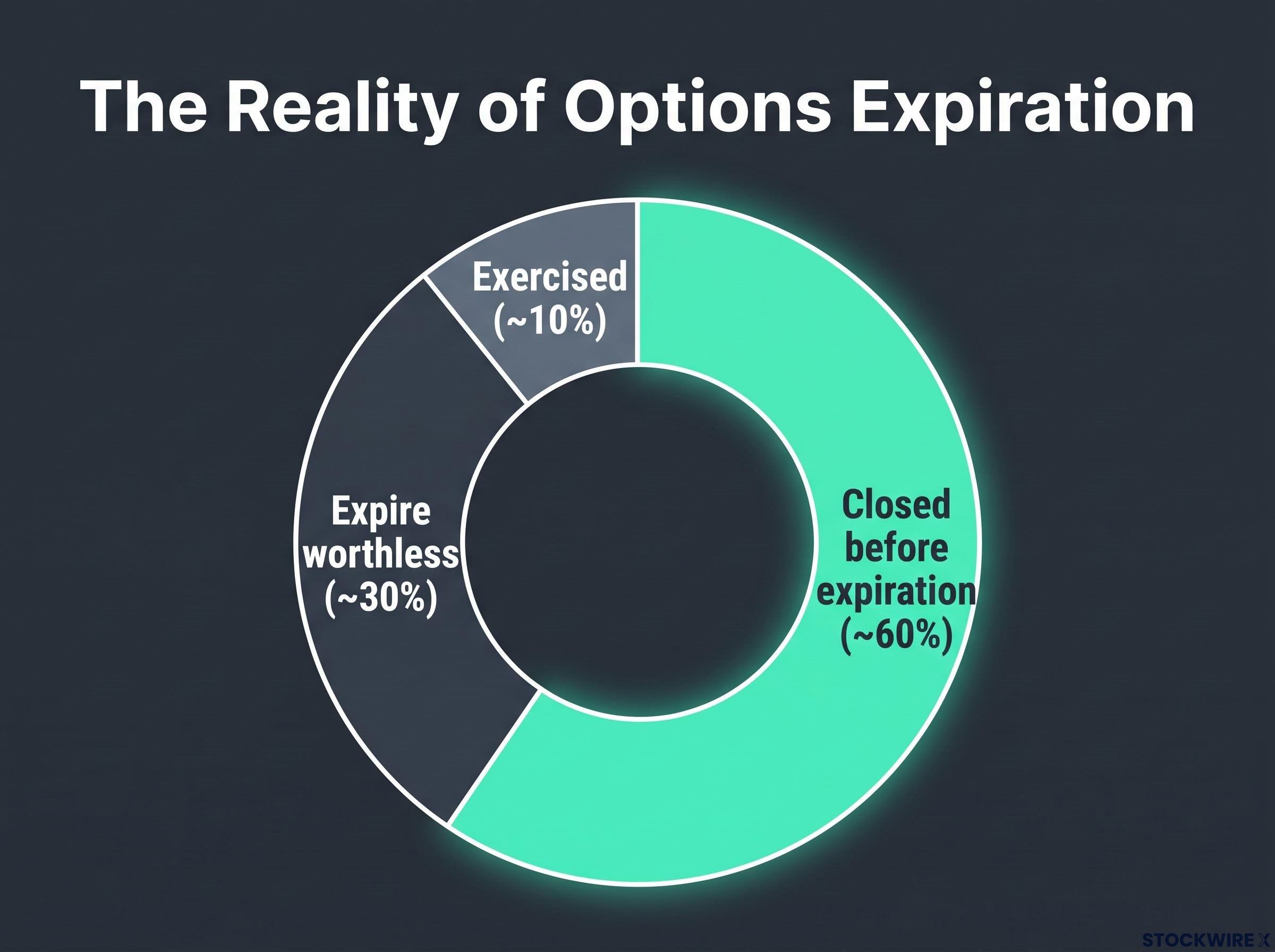
The “80-90% of options expire worthless” claim is wrong According to OCC-based data, approximately 60% of options are closed before expiration, around 30% expire worthless, and about 10% are exercised. The confusion comes from the roughly 80% of options that go unassigned, which is not the same as expiring worthless. Never in the history of listed options has 90% expired worthless.
That correction matters because the inflated figure is often used to justify aggressive selling. The real numbers are more modest, and realised profitability depends far more on how you manage positions than on the raw expiration statistics.
The practical requirements for making premium-selling work
The structural advantage becomes sustainable only when you build the right scaffolding around it. For most retail accounts, that means four things.
- Defined-risk structures: Pair a short put with a long put (a put spread), define a short strangle with long options (an iron condor), or sell calls against stock you own (a covered call). Each caps your maximum loss and keeps a single bad move from wiping out months of gains.
- Modest position sizing: Keep each position small relative to your account so a drawdown is survivable rather than catastrophic.
- Diversification: Spread exposure across different underlyings and expiration cycles rather than concentrating on one name or one date.
- Active management: Take profits at around 50% of maximum gain, and roll or close losing positions rather than holding passively to expiration.
Credit spreads are the structure that makes the probability edge discussed here sustainable for most retail accounts: they preserve positive theta while capping the maximum loss at the width of the spread minus the credit received, replacing the open-ended risk profile of a naked short put with a defined worst-case outcome.
That last point ties back to theta. Decay is slow around 45-30 days to expiration, picks up through the 14-7 day window, and turns rapid in the final 7-0 days.
That curve is why many sellers enter at 30-45 days to expiration and close or roll before the final week. You capture the steepening decay while avoiding the binary, gap-prone risk of holding right up to the wire for the last small slice of premium.
The takeaway from this section is the one that protects your account: a 70-80% win rate is not the same as positive expectancy. Structure, sizing, and management are what decide whether the seller’s paper edge ever reaches your bottom line.
Choosing your side of the trade with both eyes open
You now have the mechanics, the numbers, and the risks. The question is no longer which side is “better,” because there is no single right answer. The right side depends entirely on what you are trying to achieve.
Three questions settle it.
- How large and fast do I expect the move to be? Buying options rewards big, quick directional moves that overwhelm extrinsic value decay before theta grinds the position down. If you expect a sharp move, especially around a binary event or when implied volatility is historically low, buying can be the right tool.
- Can my account and risk tolerance absorb the asymmetric loss profile on the selling side? Selling gives you the higher probability and positive theta, but it hands you a capped gain against a much larger potential loss. You need to be able to survive the bad trade, not just enjoy the good ones.
- Am I using a defined-risk structure? For most retail accounts, credit spreads, iron condors, and covered calls are what make the high-probability edge sustainable, with entries around the 30-45 day window and profits typically taken near 50% of maximum gain.
Keep the anchor in view: on the same McDonald’s underlying and expiration, buying the call starts you at roughly 33% probability of profit, while selling the put starts you at roughly 65%. Same stock, same directional lean, opposite odds.
This matters more every year. U.S. average daily options volume grew from 29.04 million contracts in 2020 to 47.6 million as of August 2024. Options are no longer niche, which makes structural literacy more relevant whether you trade them yourself or simply need to understand what other market participants are doing.
Here is the single most useful mental model to carry forward: every options position has extrinsic value either working for you or against you. Knowing which side of that mechanic you are standing on before you enter is worth more than any directional hunch.
This article is for informational purposes only and should not be considered financial advice. Investors should conduct their own research and consult with financial professionals before making investment decisions. Past performance does not guarantee future results, and the probabilities and figures discussed are illustrative and subject to market conditions and various risk factors.