
At $71 per share, Howard Hughes Holdings trades at somewhere between a third and a half of the intrinsic value range management says the business is worth. That gap is either one of the more interesting mispricings in small-cap real estate, or a warning sign wrapped in Berkshire Hathaway language.
The company is mid-pivot. In June 2026 it closed a $2.1 billion acquisition of specialty insurer Vantage, Bill Ackman’s Pershing Square owns close to half the float, and insiders have been buying near current prices. Management is projecting per-share values approaching $200 by 2030. The stock has not followed.
The question is what the market is actually pricing in, and whether that skepticism is warranted. This analysis gives you a structured way to stress-test management’s bull case against the independent risk-adjusted range, so you can decide for yourself whether the current price reflects genuine opportunity or complexity risk you are not being paid to take.
From land developer to insurance holding company: what Howard Hughes is actually becoming
The company you see at $71 and the company management is describing are not quite the same business, and the distance between them is the whole story.
The legacy model HHH is leaving behind
Howard Hughes built its name on a capital-heavy real estate model with three revenue pillars. It acquired large land positions and sold parcels to homebuilders, it retained and developed commercial properties for rental income, and it built and sold condominiums.
The structural problem with that model is timing. Cash arrives years after capital goes out, and the return on any given land parcel stays uncertain until it sells.
That lag between investment and realisation is exactly what management is trying to engineer out of the business.
The holding company structure it is building toward
The new plan is to gradually sell hard real estate assets and shift toward a lighter role as a real estate investment manager, potentially holding only minority stakes in properties. Proceeds from those sales get redirected into a second operating platform: specialty insurance and reinsurance.
The mechanism for that pivot is Vantage, acquired for approximately $2.1 billion in a deal that closed on 4 June 2026. Insurance here is not just a financial investment; it is the engine management wants the entire company to run on. Alongside it, management projects over $1 billion in near-term capital unlocking through master planned community land sales, income-property disposals, and condo transactions.
The long-term structural goal Management is targeting a composition of roughly 80% insurance and 20% real estate.
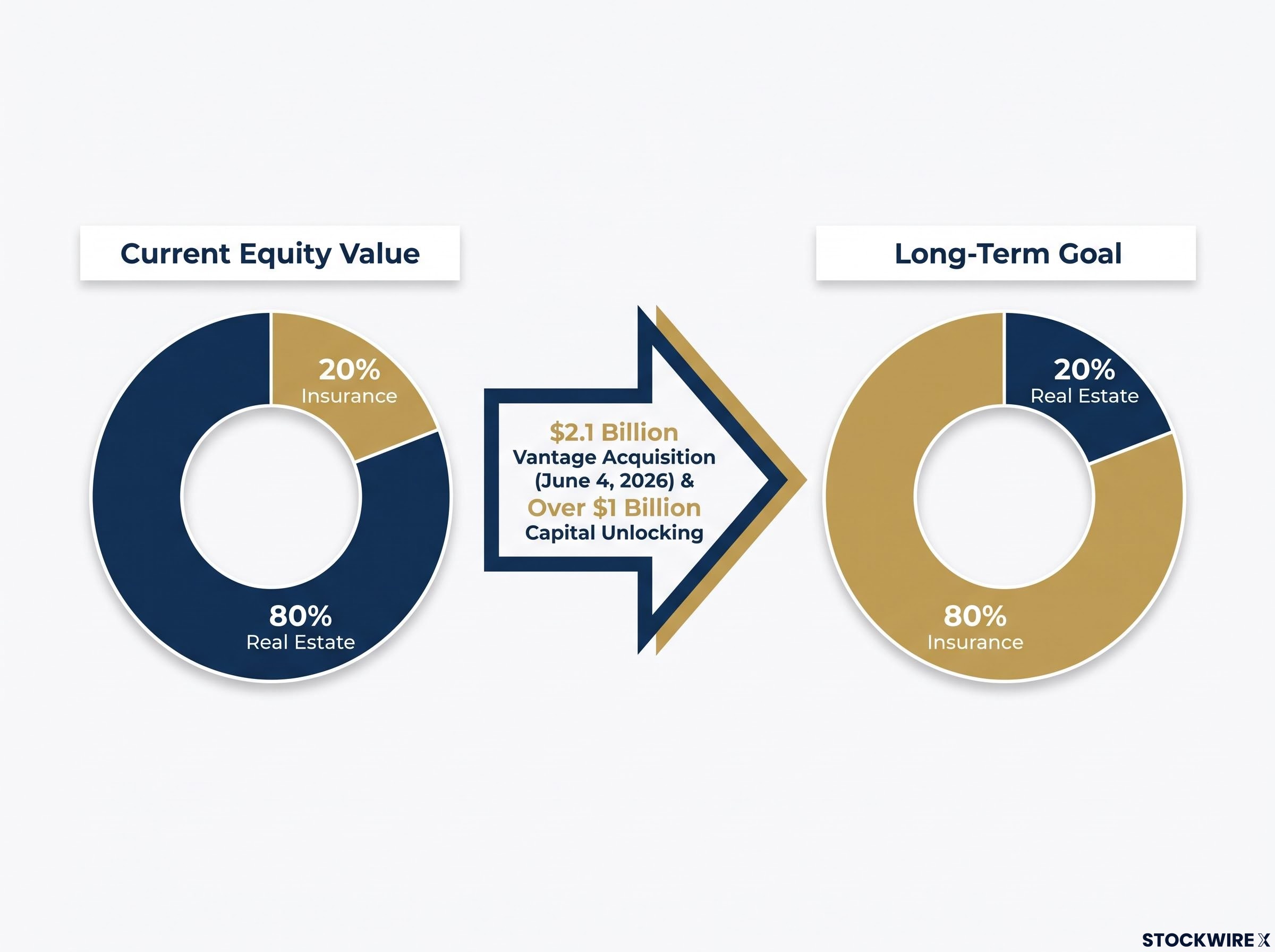
Here is the detail that should anchor everything that follows. Management estimates the equity value split today is roughly 20% insurance and 80% real estate. So at $71, you are primarily buying a legacy real estate book, not the insurance platform the pitch is built around. That distinction matters enormously for how you think about downside protection.
When big ASX news breaks, our subscribers know first
What Vantage’s first numbers actually show
The first consolidated figures for Vantage arrived in the second-quarter 2026 earnings release and Form 10-Q, covering the stub period from the 4 June closing through 30 June 2026. That is 27 days of data, so read the numbers as a starting condition, not a track record.
| Metric | Figure | Interpretation |
|---|---|---|
| Total revenues | $113.141M | Covers 27 days only |
| Net earned insurance premiums | $97.2M | Core underwriting top line |
| Net insurance investment income | $11.0M | Return on float, early stage |
| Combined ratio | 95% | Positive underwriting, one month |
| Net loss to common stockholders | $15.730M | Integration and operating costs |
Now the tension. The combined ratio of 95% produced positive underwriting income of $4.7 million, which looks encouraging. Yet the segment still posted a $20.8 million pre-tax loss, driven by operating and integration costs that swamped the underwriting result.
Combined ratio of 95% Composed of a 57% loss ratio and a 38% expense ratio. The two components matter separately: the loss ratio tells you about claims experience, the expense ratio about cost discipline, and future performance depends on both holding.
Premium volume has grown at roughly 20%, which sounds like momentum. The catch is that growth tells you nothing about quality. An insurer can expand premiums quickly while writing worse and worse risks, and the bill for that arrives later as claims. Public filings as of September 2026 do not provide granular year-over-year premium comparisons for Vantage under HHH ownership, so even the growth figure sits without much context.
What should you take from one month of a 95% combined ratio? Almost nothing about whether Vantage is a disciplined underwriter or a growth-at-any-price insurer. It is a single data point, and the transformation thesis rests entirely on what the next several quarters look like.
Understanding the insurance-float model and why execution is so hard
To judge whether that single data point can become a durable advantage, you need to understand the model management is trying to replicate. Insurers collect premiums before they pay claims. That gap creates a pool of money called float, which can be invested while it waits to be paid out.
The institutional reference points management cites, Berkshire Hathaway, Fairfax Financial, and Loews, share a structural advantage rooted in insurance float mechanics that took decades of underwriting discipline and accumulated financial strength to build, and which no competitor has successfully replicated from a standing start.
If underwriting is profitable, meaning the insurer takes in more in premiums than it pays in claims and expenses, the float costs nothing. It becomes free leverage for the investment portfolio. That is the mechanic behind Berkshire Hathaway, Fairfax Financial, and Loews, the institutional reference points everyone cites.
When the model works
Over decades, the successful versions of this model have shared three conditions:
- Underwriting discipline: combined ratios sustained below 100 across multiple cycles, with conservative reserving and tight expense control.
- Conservative leverage: careful capital allocation that avoids excessive leverage or concentrated bets, so book value survives downturns.
- Aligned governance: the capital allocator’s economic interests tied closely to common shareholders, traditionally through heavy insider ownership and modest external fees.
When it fails
The failure modes are just as well established:
- Persistent underwriting losses: combined ratios above 100 erode book value and make float expensive rather than free, no matter how good the investment returns.
- Aggressive investment assumptions: models leaning on double-digit equity returns tend to backfire in volatile markets, causing permanent capital loss.
- Complexity discount: markets apply a conglomerate discount to holding companies that mix unrelated businesses, such as raw land and specialty reinsurance, especially before a multi-cycle record exists.
Here is the honest read for HHH. Comparable established insurers with multi-decade return-on-equity records often trade near 1.0 times book value, which puts management’s 1.5 to 2.0 times target in perspective. You are not buying a proven compounder at a discount. You are buying a bet that a freshly assembled insurance platform joins the very short list of businesses that have run this model well over decades.
The valuation gap: what management is claiming versus what the numbers support
With the model in view, the valuation disagreement becomes legible. It is not noise. It is a structured argument about assumptions.
Management’s bull case
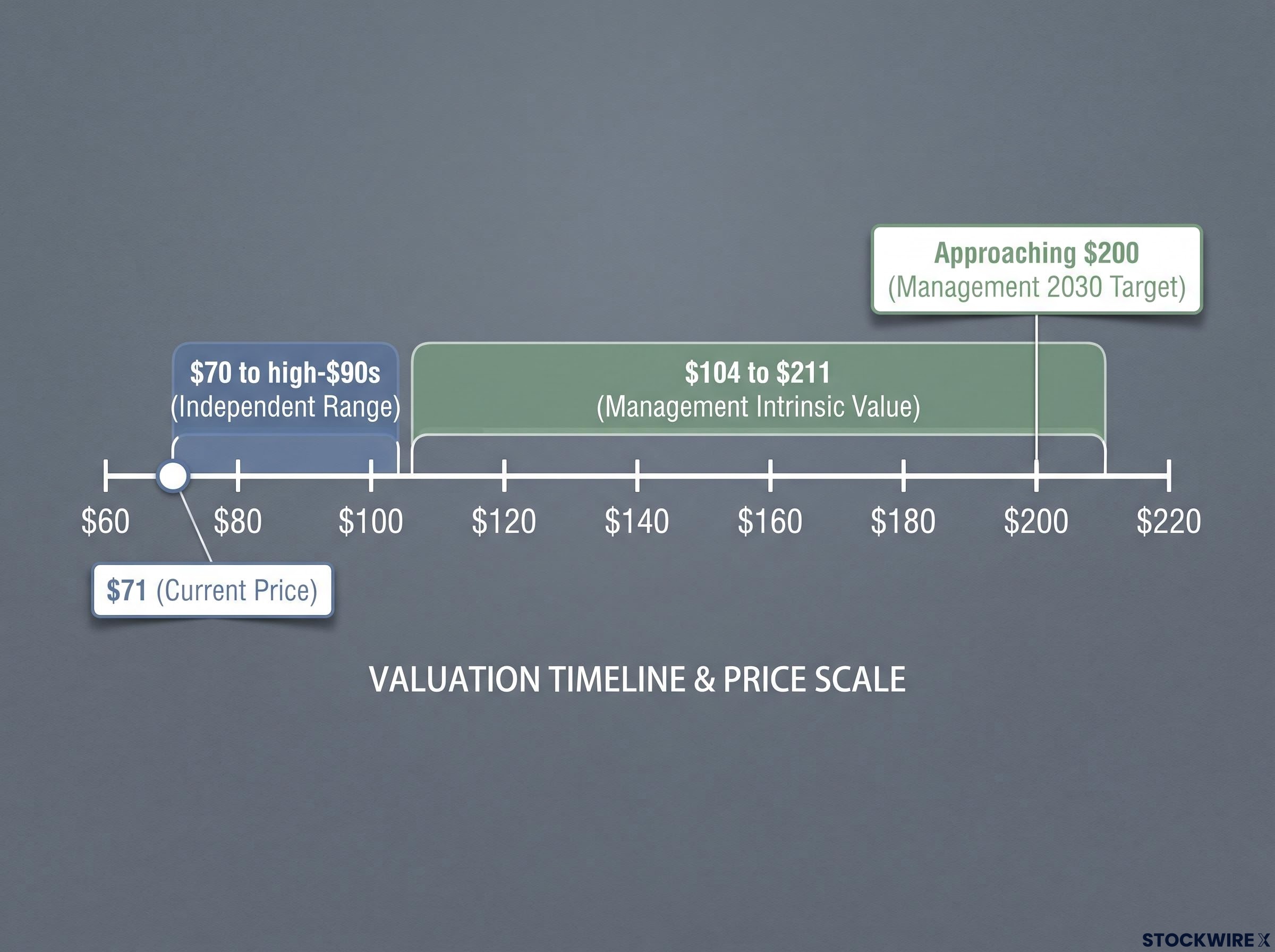
Management has put intrinsic value at a range of $104 to $211 per share, with a 2030 target approaching $200. From current levels, the low end alone implies more than 50% upside. Three assumptions power that range: valuing insurance at 1.5 times tangible book value (with an assertion true worth may be closer to 2.0 times), projected return on equity in the high-teens to low-20s percent, and equity portfolio returns of 15% to 20% annually.
Where independent analysis diverges
Each of those assumptions sits at the aggressive end, and independent analysis lands lower on all three.
| Assumption | Management projection | Independent estimate |
|---|---|---|
| Insurance valuation multiple | 1.5x to 2.0x book | 1.1x to 1.5x book |
| Projected ROE | High-teens to low-20s % | More conservative |
| Equity portfolio return | 15% to 20% annually | High single-digit long-run |
| Land haircut applied | None in bull case | 10% base, 25% pessimistic |
The land picture compounds the gap. The legacy land assets were valued at roughly $5 billion in equity terms at the end of March 2026. After that assessment, interest rates moved from around 4% to above 5%, which compresses the present value of long-duration land, slows lot absorption in master planned communities, and raises refinancing risk on debt secured by illiquid land banks.
Apply a conservative haircut of about 10% (or 25% in a pessimistic case) to the land, pair it with a more restrained insurance valuation, and the independent net asset value range lands well below management’s floor.
The independent risk-adjusted range Roughly $70 to the high-$90s per share.
The single assumption most worth scrutinising is the 15% to 20% equity return. Broad markets have historically delivered high single-digit real returns, so those figures are outliers that generally require leverage, concentration, or exceptional timing. If Vantage’s portfolio instead delivers broad-market returns, the insurance segment’s contribution to per-share value collapses, and the entire gap between $71 and $104 to $211 largely explains itself.
The investment return assumption embedded in management’s $200 target is not purely an equity portfolio bet; float reinvestment income from the fixed-income portion of Vantage’s book is also rate-sensitive, and the current rate environment above 5% creates a tailwind that compresses if central banks pivot.
Insider buying and governance: reading the conviction signals correctly
Conviction signals here point in two directions at once, and the trick is holding both without letting one cancel the other.
What the insider purchases signal
The cleanest signal is Marc Grandisson, executive chair of the insurance division, buying approximately $1.6 million of stock on the open market at roughly $64 per share. That is a senior executive paying below the current price with his own money. Other executives have also made open-market purchases recently.
Grandisson’s background carries weight. He previously ran Arch Capital Group’s insurance division, where total shareholder return reached nearly 300% under his tenure. He also holds warrants on roughly 1.13 million shares at $100 per share, exercisable over five years from 2026, which only pay off if the stock more than doubles.
What the fee structure complicates
Then there is Pershing Square. Bill Ackman holds close to half the outstanding shares and, in 2025, invested roughly $900 million at $100 per share in preferred stock to fund the insurance entry. HHH retains the right to repurchase that preferred at 1.5 times the original value.
The management fee arrangement is where the governance tension lives:
- Fixed base fee: $15 million annually.
- Variable performance fee: roughly 1.5% multiplied by approximately 60 million shares, scaled to the stock price relative to a reference price of about $68.
The variable fee at higher prices If the stock reaches $100 to $150 per share, the performance fee could approach $100 million or more annually.
This structure is unusual for a corporate entity, and critics argue it can incentivise short-to-medium-term share price outcomes over patient capital allocation. That is a legitimate concern. But Grandisson buying at $64 is a different kind of signal from Ackman’s advocacy, because Grandisson has no performance fee that benefits directly from appreciation at these levels. When you weight the conviction here, separate who is buying from personal conviction from who has a structural incentive tied to the price.
Opportunity or value trap: making a risk-adjusted call at $71
The core tension resolves to this. At $71, the stock sits at the low end of the independent NAV range of $70 to the high-$90s and well below management’s $104 floor. On current information, it is neither obviously cheap nor obviously expensive. You are paying roughly fair value, on independent estimates, for a complex holding company that needs several things to go right at once.
The bull case becomes more defensible under specific conditions: Vantage sustaining sub-100 combined ratios over two to three quarters, real estate disposals closing at or above carrying value, and equity portfolio returns that begin to validate the 15% to 20% assumption. Note the compounding here. Management’s $200 by 2030 target layers best-in-class underwriting on top of double-digit equity returns, and both have to land together.
The more defensible framework Mid-to-low $60s, or after meaningful real estate dispositions have simplified the business and reduced the complexity discount.
Three variables are worth watching as they resolve over time:
- Vantage’s quarterly combined ratio trajectory.
- The pace and pricing of real estate asset sales relative to carrying values.
- Any revision to the management fee structure as the business evolves.
The framework is not a buy or sell call. It is a set of conditions and a price level that would shift the risk-reward materially in either direction. At $71, you are paying fair value for complexity, which is a very different proposition from paying a discount to a proven compounder.
This article is for informational purposes only and should not be considered financial advice. Investors should conduct their own research and consult with financial professionals before making investment decisions. Past performance does not guarantee future results. Financial projections are subject to market conditions and various risk factors, and forward-looking statements are speculative and subject to change based on market developments and company performance.