Semiconductor demand is holding up, most chipmakers are set to meet their earnings targets, and DRAM prices are still climbing. So why have European chip stocks been quietly losing value since July 2025?
That contradiction sits at the heart of a thesis published on 30 September 2026 by Jefferies analyst Janardan Menon. In his Q3 2026 semiconductor earnings preview, Menon projects Q4 2026 as the peak of the current upcycle, and the valuation compression across European chip equities is already well underway. This is not a temporary wobble ahead of a strong print. It is structural, and it started more than a year before the projected peak.
For an investor holding or evaluating a semiconductor cycle peak European stocks position right now, that gap between strong fundamentals and falling valuations is the most important thing to understand. This explains the mechanics behind the Jefferies thesis and gives you a framework for reading the signals yourself, rather than waiting for one bank to tell you what has already happened.
What the semiconductor upcycle actually is, and where we stand now
Before you can interpret any earnings result this season, you need to know exactly where the cycle sits. The semiconductor industry moves in a repeating rhythm, and each phase produces a different set of signals.
That rhythm has four recognisable stages:
- Inventory drawdown: customers run down stockpiles built during the last downturn, and orders stay weak.
- Restocking-led demand surge: depleted inventories force a wave of new orders, pushing prices and utilisation higher.
- Capex expansion: manufacturers, seeing strong pricing, commit heavily to new capacity.
- Oversupply: that new capacity arrives just as demand growth slows, and prices reverse.
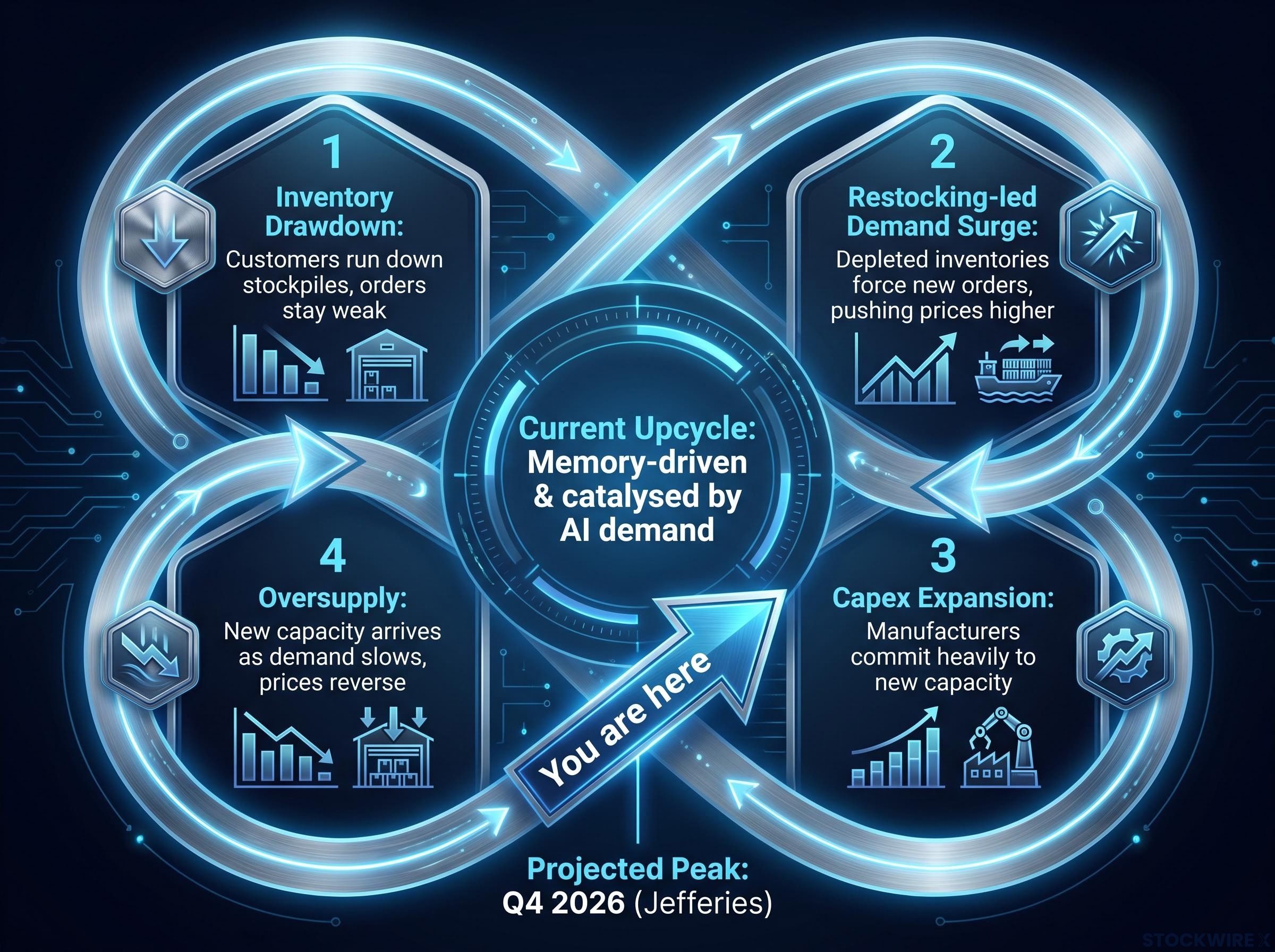
The current upcycle is memory-driven and catalysed by artificial intelligence (AI) demand. DRAM prices, the pricing benchmark for the memory chips that sit at the centre of this episode, rose sharply through 2025 and into 2026 as AI and server demand collided with tight supply. That supply tightness is still present. What has changed is the momentum: the rate of price increases is now moderating.
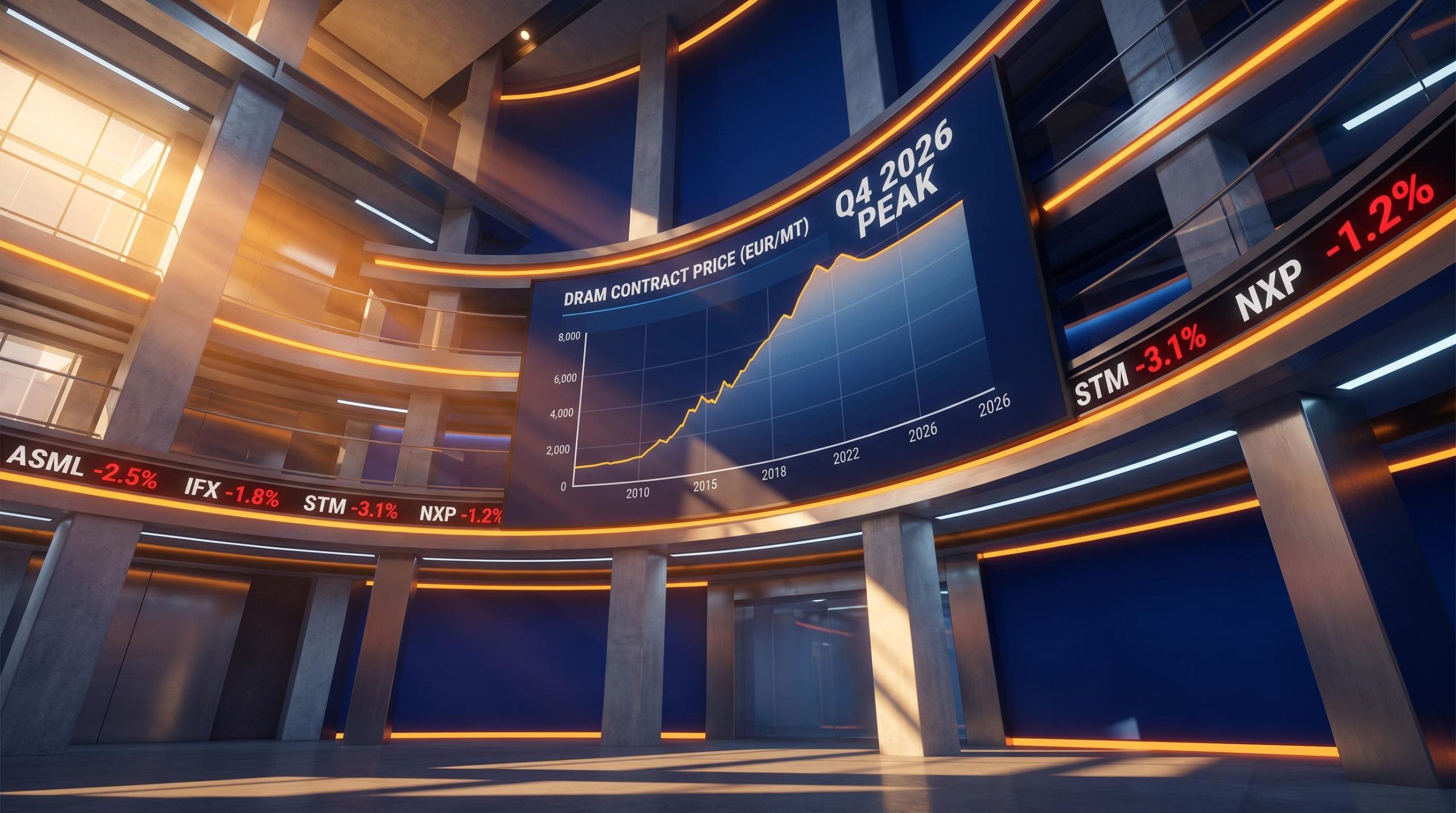
TrendForce data (updated 24 September 2026) confirm that PC DRAM contract prices are still rising, but the pace has narrowed to the point where buyers and sellers have reached a stalemate.
DRAM contract prices surged 90-95% in Q1 2026 and a further 58-63% in Q2 2026, setting the unusually high comparison bar that makes Q4 2026 a mathematically difficult quarter for memory-exposed names to grow against.
TrendForce Q4 2026 projection Conventional DRAM contract prices are projected to rise 10-15% quarter-on-quarter in Q4 2026, a marked slowdown from the acceleration seen earlier in the cycle.
Here is why that narrowing rate matters more than the headline that prices are still climbing. “Prices rising, but more slowly” is itself a late-cycle indicator. It signals the cycle’s fuel is running low.
The base effect sharpens the point. A steep DRAM price spike in Q4 2025 set an unusually high comparison bar, which makes Q4 2026 a mathematically difficult quarter to grow against. That single dynamic is a core reason Jefferies has pinpointed Q4 2026 as the peak. Menon’s preview expects most companies to at least meet Q3 2026 revenue and margin consensus, but with earnings upgrades likely to be limited given how mature the cycle now is. AI-related demand remains the genuine positive; a deceleration in AI spending is flagged as the primary risk. That tension is the cycle in a single sentence.
When big ASX news breaks, our subscribers know first
Why valuation multiples fall before earnings do
The confusing part, for many investors, is watching a stock de-rate while the company keeps beating estimates. To understand why that happens, follow the sequence rather than jumping to the conclusion.
Equity markets do not price what a company earned last quarter. They price what it is expected to earn next. When leading indicators start to turn, orders, pricing momentum, inventory levels, capex guidance, multiples begin to compress even while reported revenues and profits still look healthy.
Four specific mechanisms are active in this episode:
- Forward-looking discounting: the market prices slower future earnings growth before it appears in results.
- Expectations management: after a sharp 2025 re-rating, positioning is stretched and analysts start flagging risk, which caps further multiple expansion.
- Pricing plateau signals: narrowing DRAM price gains act as an early trigger for compression, exactly the signal TrendForce’s data now shows.
- Risk repricing: as the cycle matures, investors grow more sensitive to tail risks, chiefly the AI capex slowdown, and reprice risk even while fundamentals hold.
Jefferies cites a historical pattern in which sector multiples lead cycle peaks and troughs by roughly three to six months. The firm says that pattern has been active since mid-2025.
A Morningstar-identified capex-to-revenue lag of 18-24 months sits beneath the AI demand story, meaning the spending commitments that drove 2025 re-ratings may not fully convert into revenue growth during the window Jefferies has now marked as cycle peak.
How this pattern is playing out in the current cycle
Apply those four mechanisms to the window running from July 2025 to September 2026 and each one maps to something observable.
Forward discounting shows up in Jefferies’ January 2026 outlook, which described a “sharp re-rating in 2025” that left “little room for further multiple expansion,” with any further gains needing to come from earnings upgrades rather than re-rating. That is expectations management in the same breath.
The pricing plateau signal is TrendForce’s narrowing contract-price data. Risk repricing is the market’s growing focus on the AI capex tail risk.
The clearest illustration of the paradox: Menon described himself as “quite optimistic” about industry momentum after meeting European chip firms in June 2026, yet Jefferies held a cautious sector stance throughout. Strong underlying demand and compressing multiples coexist in late-cycle conditions. That is normal.
If you are waiting for earnings to weaken before you act on cycle-peak positioning, you are likely already late. The market has been pricing this transition since July 2025.
What Jefferies’ thesis means for specific European chip names
Treating “European chip stocks” as one block is the mistake that this section exists to correct. The cycle-peak thesis does not fall evenly across every name, and the differences are where portfolio outcomes are actually decided.
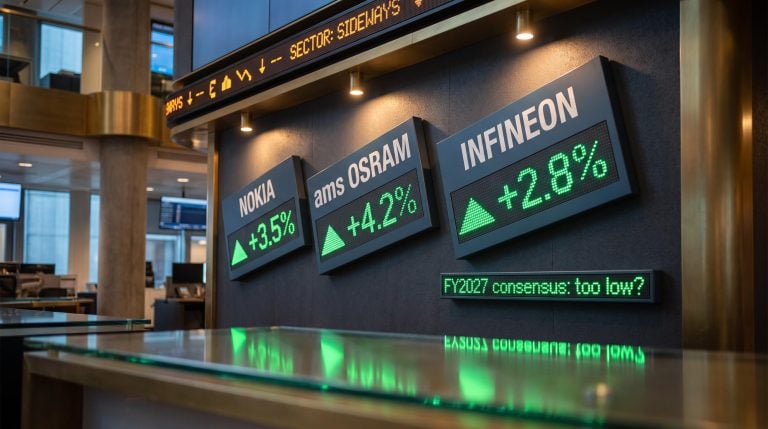
Jefferies’ January 2026 outlook downgraded ASM International and VAT Group to Underperform, citing limited scope for further re-rating after the 2025 run-up. In the same note, the firm kept a Buy on Infineon, pointing to underappreciated 2027 earnings potential. STMicroelectronics and Melexis were flagged as likely to meet near-term expectations, and Jefferies raised its SUSS Microtec price target to EUR 56 with a Buy rating on 13 January 2026.
| Company | Jefferies rating | Key rationale | Primary risk factor |
|---|---|---|---|
| Infineon | Buy | Underappreciated 2027 earnings potential | Broad cycle-peak de-rating |
| ASM International | Underperform | Limited scope for further re-rating | Multiple compression without earnings support |
| VAT Group | Underperform | Limited scope for further re-rating | Multiple compression without earnings support |
| SUSS Microtec | Buy | Selective upside, target raised to EUR 56 | High valuations, sluggish non-AI demand |
| STMicroelectronics / Melexis | Neutral framing | Near-term expectations achievable | Limited upgrade fuel at cycle maturity |
Beyond single names, European semis carry region-specific risks that amplify volatility during cycle transitions:
- Demand exposure: they trade on a global-cycle narrative but sell into a demand mix that can shift regionally.
- Currency risk: earnings translation and competitiveness swing with the euro, adding a second layer of volatility.
- Cycle-narrative sensitivity: as global-cycle proxies, they move hard on any shift in the peak-timing story.
Jefferies also noted improving order trends in industrial and automotive chips, a partial offset to sluggish non-AI demand, while warning of a “potentially choppy year” for European semiconductor stocks in 2026.
The split between Infineon on one side and ASM International or VAT Group on the other tells you something practical: at a cycle peak, stock selection matters far more than it did on the way up. In a rising-tide upcycle, everything floats. Now, exposure to visible 2027 earnings is the variable that separates the names likely to hold from those most exposed to compression.
BofA’s European tech framework, published in late July 2026, offers a complementary lens on the same names: ASML holds the anchor position with proprietary 2027-2028 EPS forecasts running 6-7% above Street consensus, while STMicroelectronics earns a Buy on manufacturing efficiency gains expected to add roughly four percentage points to gross margin by mid-2028.
The AI tail risk and what it would take for the cycle to extend or collapse faster
The AI capex slowdown is not a distant hypothetical. Jefferies identifies a deceleration in AI spending as the single largest tail risk across the entire semiconductor supply chain, and it is already contributing to valuation pressure as of September 2026.
The primary tail risk According to Jefferies’ Q3 2026 preview, AI spending deceleration is the most significant risk to the semiconductor supply chain, chiefly through the inventory accumulation it would trigger. Power availability and data-centre construction constraints are named as factors already weighing on sector valuations.
The channel is inventory. If AI capital spending slows, chips ordered against expected demand pile up, and that overhang hits everything from GPUs and high-bandwidth memory (HBM) down to conventional DRAM and NAND. Compounding the risk, demand outside AI remains uneven: industrial and automotive orders are improving, but non-AI markets are weak. There is no broad-based restocking upcycle waiting to absorb any slack.
There is a genuine counterargument. Intuition Labs’ analysis (5 September 2026) makes the structural-tightness case: HBM and advanced DRAM supply constraints could keep the memory sub-cycle elevated longer than the broader cycle, because AI workloads keep rising while short-term capacity investment stays limited. As evidence, spot-market DRAM is trading at significant premia to contract prices, a sign that buyers are hedging against future shortages.
That spot-contract divergence is the market telling you sophisticated buyers still fear scarcity, even as growth moderates. Watching the two paths matters more than betting on one:
The structural case for extended tightness rests on a memory chip price forecast confirmed by S&P Global Ratings through at least 2028, driven by HBM capacity constraints and the redirection of Samsung, SK Hynix, and Micron output toward high-margin AI customers.
Signals that the cycle extends:
- HBM and spot DRAM prices stay at premia to contract levels
- Hyperscaler capex guidance holds or rises in Q3 results
- DRAM contract prices keep climbing beyond the projected Q4 2026 plateau
- Structural tightness persists into 2027 as Intuition Labs suggests
Signals that compression accelerates:
- Hyperscaler capex is cut on weak AI return on investment
- Data-centre approvals or power availability stall build-outs
- DRAM contract price increases flatten or reverse
- Earnings upgrades dry up across the European names
You are not being asked to predict which path wins. Knowing which data points to watch means a shift in AI capex intent shows up in your decisions before it shows up in earnings.
What historical cycle turns reveal about the road ahead for European names
History does not repeat exactly, but it does sharpen your expectations about how a late-cycle transition actually feels. Two episodes are worth holding in view.
The 2018-2019 memory downturn is the cautionary parallel. Elevated multiples, aggressive capex, and extraordinary price gains were followed by an abrupt reversal once supply caught up and demand growth slowed. Jefferies frames the sharp 2025 re-rating as echoing the pre-correction phase of prior cycles like this one.
The 2021-2022 post-pandemic digestion phase teaches a different lesson. Strong pockets of demand, then smartphones and PCs, masked building vulnerability elsewhere until those strong pockets also cooled, producing sharper-than-expected drawdowns. Today the strong pocket is AI and data centres, but the structure is familiar.
Three lessons carry directly into the current context:
- Memory-driven upcycles can end abruptly. Once price increases become extreme, they encourage new capacity and dampen demand at the same time, which is how the 2018-2019 reversal happened.
- Valuation discipline is decisive in late-cycle phases. High expectations plus uneven fundamentals typically produce choppy performance, exactly the “potentially choppy year” Jefferies warns of for 2026.
- AI demand can extend a cycle but not rescue it indefinitely. A strong structural trend cannot fully offset a broad macro or inventory correction, so volatility should be expected even if the AI story stays intact.
For European names specifically, leading stocks including ASML, Infineon, STMicroelectronics and BE Semiconductor have historically seen valuations peak ahead of fundamental peaks, with share prices lagging even while earnings still grew. Late-cycle risk repricing, amplified by currency and demand-mix exposure, is why.
Applying the historical lens to decisions in Q4 2026
The pattern tells you that quarters where earnings still beat and prices still fall are not anomalies. They are the normal shape of a late-cycle de-rating, and expecting otherwise is the most common mistake at this stage.
Translate that into concrete behaviour for the current moment:
- Watch earnings upgrade frequency across the European names, not just whether they meet consensus.
- Monitor the DRAM contract price trajectory in TrendForce’s monthly updates for signs the plateau is turning.
- Track AI capex commentary in hyperscaler results as the leading tell on the tail risk.
- Follow Jefferies’ rating actions on named European stocks as a real-time read on the cycle-peak thesis.
Reading the cycle correctly before the peak arrives
Pull the strands together and the Jefferies view is coherent: the peak is projected for Q4 2026, multiples are already compressing, earnings upgrades will be limited, and any further upside has to come from selective stock-level positioning rather than a broad sector re-rating.
Q3 2026 earnings season is the near-term test. Results that broadly meet consensus without meaningful upgrades confirm the cycle-maturity thesis. A broad-based upgrade cycle, on the other hand, would challenge it. With the cycle this mature and only a single quarter remaining in 2026, Jefferies anticipates that positive surprises and upward revisions will be too modest to drive meaningful multiple expansion.
The maintained Buy on Infineon is the clearest expression of the “selective within cautious” posture, and Intuition Labs’ structural-tightness case is the reason not to make a blanket bearish call on every memory-adjacent name.
Through Q4 2026, these are the signals worth monitoring:
- Earnings upgrade frequency across the European semiconductor names
- DRAM contract price trajectory via TrendForce’s monthly updates
- AI capex guidance from hyperscalers in Q3 results
- Jefferies rating actions on named stocks as a leading signal
- Spot-contract price divergence as a structural-tightness indicator
The decision in front of you is not whether to hold European chip stocks at all. It is a shift in the criteria you use to select them, away from broad cycle exposure and toward 2027 earnings visibility and specific upgrade potential. Framed that way, the next two quarters become a test you can actually score, name by name, rather than a directional bet on a sector.
This article is for informational purposes only and should not be considered financial advice. Investors should conduct their own research and consult with financial professionals before making investment decisions.
Past performance does not guarantee future results. Financial projections are subject to market conditions and various risk factors. Forward-looking statements referenced here are speculative and subject to change based on market developments and company performance.