Mid-market enterprises have long occupied an awkward middle ground: too complex for the vendors built around small business, yet without the internal governance to manage the sprawling multi-specialist arrangements that large corporations coordinate as a matter of routine. On 17 September 2026, one of the world’s largest IT firms decided that gap was worth building a business around.
HCLTech launched HCLTech Pulse, a dedicated unit targeting enterprises in the $500 million to $5 billion annual revenue band with a single-provider answer to AI-led transformation. The timing is not incidental. Large IT firms are converging on mid-market AI transformation as a distinct category, with Accenture having already established a comparable unit, and the segment is crossing from AI experimentation into scaled deployment.
This covers what Pulse actually offers, why HCLTech is chasing this specific revenue band now, and what the intensifying competition means for mid-market technology buyers and anyone tracking where the company allocates its next phase of growth.
What HCLTech Pulse actually offers mid-market enterprises
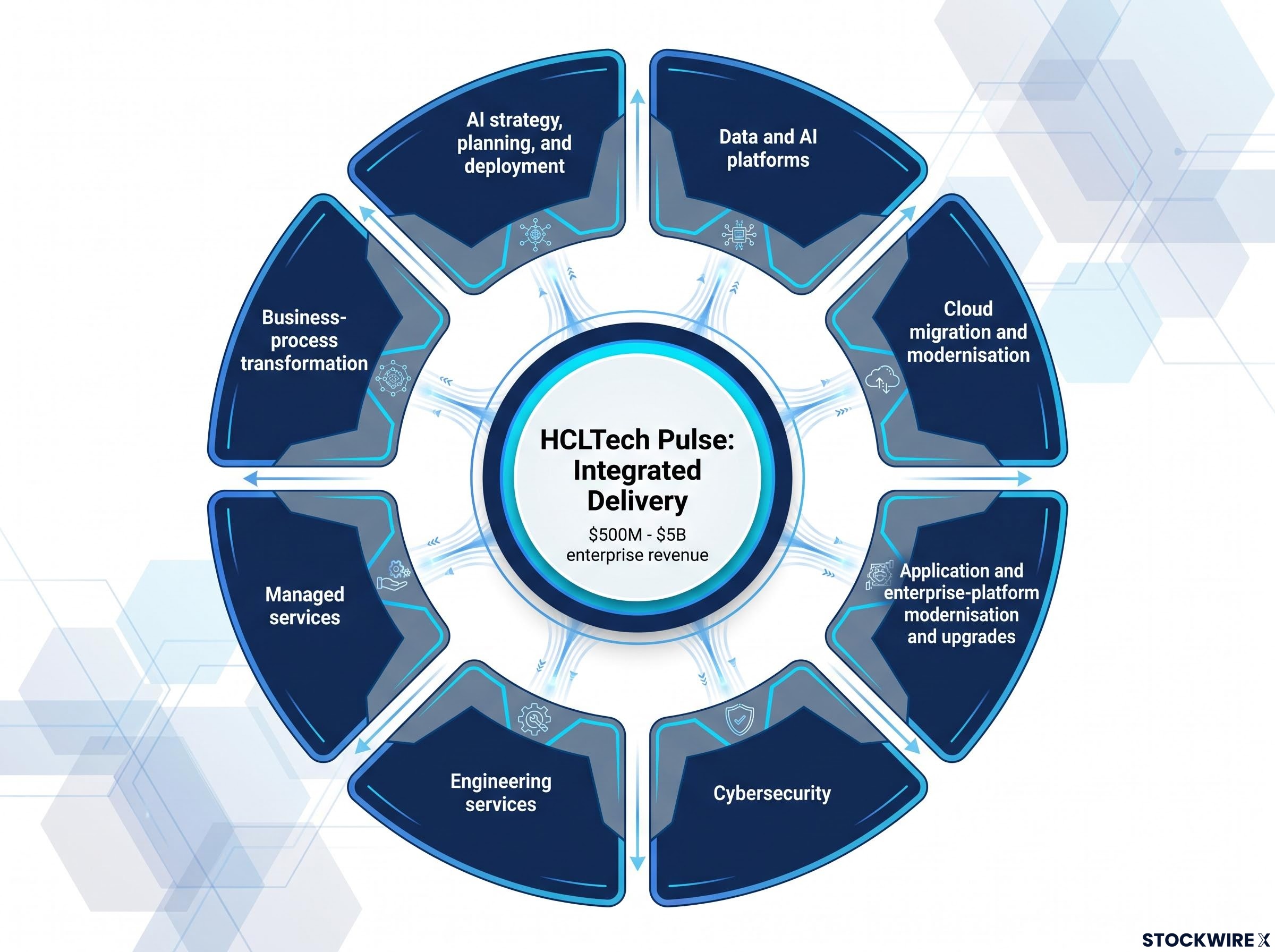
Pulse is a single integrated transformation unit, and the point of it is consolidation. Where a mid-market enterprise has historically stitched together separate vendors for strategy, platforms, implementation, and operations, Pulse folds those disciplines into one operating model with one point of accountability.
The unit brings together eight named service disciplines:
- AI strategy, planning, and deployment
- Data and AI platforms
- Cloud migration and modernisation
- Application and enterprise-platform modernisation and upgrades
- Cybersecurity
- Engineering services
- Managed services
- Business-process transformation
What separates Pulse from a conventional services offering is its delivery model. Company materials and executive commentary describe it as productised and platform-based rather than traditional project-services, built to fit mid-market budgets and governance structures.
That productised design is the operative detail. It signals Pulse is meant to be repeatable and scalable across many clients rather than rebuilt bespoke for each one, which is precisely what makes it commercially interesting and, if the packaging proves difficult, operationally risky to execute.
Ashish Kumar Gupta, Global Head of HCLTech’s New Business Incubation Group, is the executive sponsor for the unit, which was characterised as immediately available at launch.
Closing the service gap Ashish Kumar Gupta has framed Pulse as addressing a persistent service gap: mid-market clients must currently coordinate many specialists without the governance and integration capabilities of large enterprises. An integrated operating model, in his framing, gives them a clearer path to scaling AI and modernisation.
C Vijayakumar, CEO and Managing Director of HCLTech, is also cited in launch coverage, with responsible AI and the reimagining of business processes positioned as the unit’s philosophical pillars.
For technology buyers, understanding what Pulse consolidates is the first test of whether it represents a genuine alternative to their current multi-vendor arrangements. For investors, the same detail reveals whether HCLTech has engineered this for scale or for positioning.
When big ASX news breaks, our subscribers know first
Why the $400 billion mid-market opportunity is drawing the industry’s biggest players
The scale of the prize explains the strategy. HCLTech, citing Everest Group, estimates that enterprises in the $500M-$5B band represent a ~$400 billion global technology-services opportunity, growing at 7-9% annually.
The addressable market “Enterprises with $500 million to $5 billion in annual revenue represent a roughly $400 billion global technology-services opportunity, growing at 7 to 9 percent a year,” is the market sizing attributed to Peter Bendor-Samuel, Founder and Executive Chairman of Everest Group.
Mid-market, specifically, is the contested ground because these firms carry enterprise-level transformation complexity without the internal governance to run a multi-specialist vendor stack effectively. They have validated AI use cases but lack the integrated provider relationships to operationalise them at scale. That structural mismatch is the demand Pulse is built to capture.
The structural divide in enterprise AI transformation has widened considerably in 2026, with BCG research finding that early adopters building on shared data foundations delivered 3.6x higher three-year total shareholder return than laggards, a gap that reflects exactly the kind of integration deficit Pulse is designed to close for mid-market firms.
HCLTech has stated it expects Pulse to grow at double-digit rates, explicitly ahead of the underlying segment.
| Metric | Figure | Source |
|---|---|---|
| Global addressable market | ~$400 billion | Everest Group (Peter Bendor-Samuel) |
| Segment growth rate | 7-9% annually | Everest Group |
| Pulse growth target | Double-digit (above segment) | HCLTech |
That double-digit target against a 7-9% underlying rate is the signal worth reading. HCLTech is telling the market it expects to take share from existing vendors, not merely ride the segment upward. That is a meaningful strategic statement even with no specific revenue forecast attached to it.
HCLTech is not alone. Accenture’s comparable mid-market AI unit confirms this is an industry-wide convergence rather than a solo bet, which both validates the opportunity and sharpens the competition. HCLTech brings weight to the fight: consolidated revenue of $14.8 billion for the 12 months to June 2026, and more than 223,000 employees across 60 countries.
HCLTech is not alone in targeting this segment, and the competitive framing matters: Accenture’s comparable unit sits inside a company that issued a profit warning in June 2026 and absorbed an 18% single-session share price collapse, a reminder that mid-market ambition must be weighed against the broader revenue-mix pressures reshaping the IT services sector.
For strategists and investors, the sizing and competitive framing answer whether this is a legitimate growth category or a defensive move, and exactly who HCLTech will be fighting for the same clients.
What Pulse still needs to prove, and where the risks sit
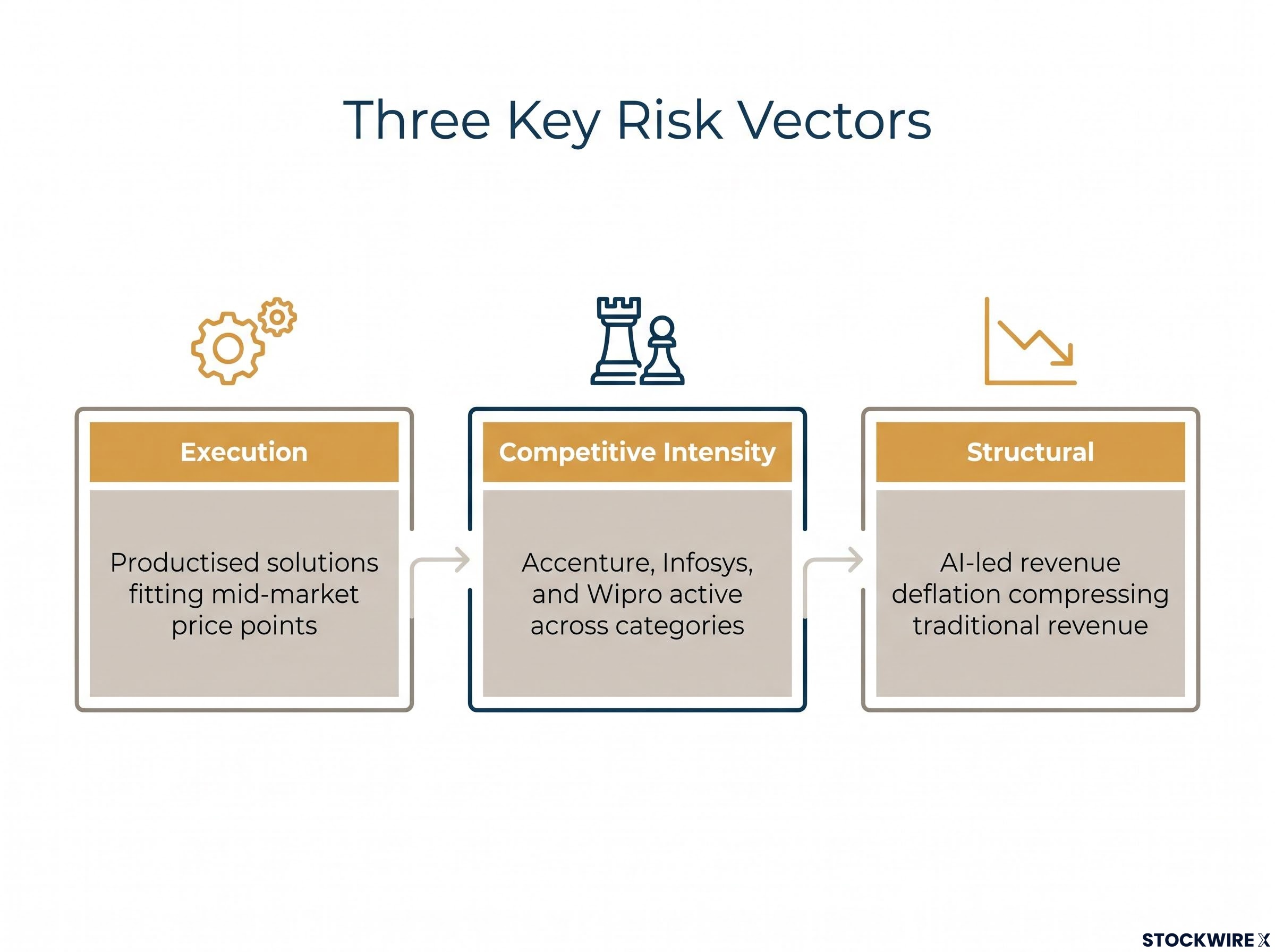
The opportunity is real, but the launch is a commitment, not an outcome. Three risk vectors sit between the ambition and the result.
The first is execution and packaging. Designing repeatable, productised solutions that fit mid-market price points while still covering complex AI, data, and cloud requirements is genuinely hard, and it demands internal alignment across service lines that have historically sold and delivered separately.
The second is competitive intensity. Accenture is already in the market with a comparable unit, while Infosys and Wipro, along with hyperscaler-aligned partners, are active across every category Pulse covers.
The third is structural. Coverage frames HCLTech’s ambitions against AI-led revenue deflation, the dynamic where AI-driven productivity gains compress traditional time-and-materials revenue. Pulse’s productised model is implicitly the response, but the risk is that automation reduces billable effort faster than platform revenue can offset it.
The risk of AI-driven revenue deflation is not hypothetical: consumption-based AI-native pricing models are already undercutting incumbent enterprise software costs by 80-90% in documented enterprise deployments, precisely the compression dynamic that Pulse’s productised delivery model is designed to offset before it erodes HCLTech’s own labour-intensive revenue base.
There is also a client-side adoption challenge. Mid-market buyers are accustomed to best-of-breed, multi-specialist arrangements. Shifting to a single integrated vendor requires organisational change, contract restructuring, and internal stakeholder buy-in, and if Pulse cannot demonstrate superior outcomes, it risks being seen as an overlay rather than a genuine operating-model shift.
What HCLTech has not yet disclosed about Pulse
The absence of hard commercial detail is notable. At launch, HCLTech has not disclosed:
- Pricing structures or unit economics
- Revenue and margin targets for Pulse
- A go-to-market timeline beyond the launch date
- A geographic rollout schedule
- A target client count
- Named case studies with quantified outcomes
None of this is unusual for a newly launched unit. It does mean investors cannot yet model Pulse’s contribution to overall growth, and that ambiguity sits directly alongside the above-segment growth ambition HCLTech has publicly set for itself. The credible signals to watch would be a pricing model announcement, named client wins, and any Pulse-specific commentary in upcoming earnings calls.
What Pulse signals about HCLTech’s growth strategy from here
Strip away the launch language and the strategic logic is straightforward. HCLTech is taking the full-stack capability it honed with large enterprises and pointing it at the mid-market through a productised model built to win at scale rather than one engagement at a time.
Crucially, this is not a cold start. Executive commentary confirms many mid-market firms are already HCLTech customers, and Pulse restructures how the company engages with them rather than beginning from zero. That changes the risk profile: Pulse is partly a retention and deepening play on existing relationships, not purely a new-client acquisition bet against a 7-9% growing segment.
The launch also fits a broader shift. Large IT firms are rebuilding their go-to-market models to capture mid-market AI spend before hyperscaler-aligned partners and specialist vendors lock up those relationships, with Accenture, Infosys, and Wipro all circling overlapping territory.
Three milestones will validate or challenge the strategy:
- Pulse-specific revenue disclosure in earnings commentary
- Named client wins in the $500M-$5B band
- Evidence that the productised model holds margins as AI automation compresses labour-intensive delivery
For investors and strategists, the open question is whether HCLTech can turn mid-market AI tailwinds into measurable revenue diversification before the competitive field narrows around a handful of dominant integrated providers.
The unknowns that will define whether Pulse delivers on its promise
The $400 billion addressable market and the double-digit growth ambition are credible on their face, given the structural service gap and the industry’s convergence on this segment. They remain targets, however, with no financial architecture yet disclosed to support or test them.
Three variables will determine Pulse’s credibility over the next 12-18 months:
- Client adoption velocity, and whether mid-market buyers actually shift from multi-specialist arrangements to a single integrated vendor
- Margin performance under the productised delivery model as AI compresses billable effort
- Competitive differentiation against Accenture’s comparable unit and other peers
For mid-market decision-makers, Pulse warrants evaluation as a consolidation option, with clear-eyed awareness that it is a newly launched unit without a verified track record in this exact configuration. Those three variables are the framework for tracking whether HCLTech’s bet is paying off, turning a single announcement into an ongoing story worth monitoring.
For investors wanting to stress-test the growth assumptions behind any AI-oriented IT services commitment, our deep-dive into AI market valuation risks examines how circular financing arrangements and deferred depreciation are quietly flattering the earnings multiples that underpin the sector’s expansion narrative.
This article is for informational purposes only and should not be considered financial advice. Investors should conduct their own research and consult with financial professionals before making investment decisions. Financial projections and growth targets are subject to market conditions and various risk factors, and forward-looking statements are speculative and subject to change based on market developments and company performance.