


CLEO secures early IP position in ovarian cancer screening
Cleo Diagnostics Limited (ASX: COV) has filed two provisional patent applications covering candidate biomarker combinations and their application to the early detection of ovarian cancer. The filings establish an initial IP priority position ahead of proof-of-concept screening data expected in early Q4 CY2026, with the company also intending to file an international application under the Patent Cooperation Treaty (PCT) within the 12-month priority period to seek protection across key commercial markets.
The timing is deliberate. By securing IP protection before initial screening data enters the public domain, CLEO preserves the commercial value of its biomarker discoveries at the earliest possible stage. The company continues to progress development while protecting IP generated through the program.
When big ASX news breaks, our subscribers know first
Understanding patent protection in biotech diagnostics
For investors less familiar with the IP lifecycle in medical technology, this filing sequence follows a well-established strategy in the sector. Key concepts to understand:
- Provisional patent applications lock in a priority date, giving the applicant 12 months to develop the technology and gather data before committing to a full patent filing. They do not require complete disclosure of results, which is why companies file them before publishing scientific data.
- PCT filings allow a company to pursue patent protection across multiple countries through a single international application, rather than filing separately in each jurisdiction. This is how diagnostics companies establish commercial defensibility in major markets simultaneously.
- Pre-data filing protects IP before results enter the public domain. Once data is published, unprotected discoveries can become public knowledge, removing the ability to claim exclusivity.
For investors, IP protection is often a prerequisite for licensing arrangements, commercial partnerships, and distribution deals. A robust patent position signals that the company is managing its assets with commercial intent, not just scientific progress.
Building on an established biomarker platform
The screening program does not represent a standalone initiative. It builds directly on the biomarker platform and clinical expertise developed through CLEO’s more advanced Pre-Surgical Ovarian Cancer Test program, which is progressing towards FDA submission.
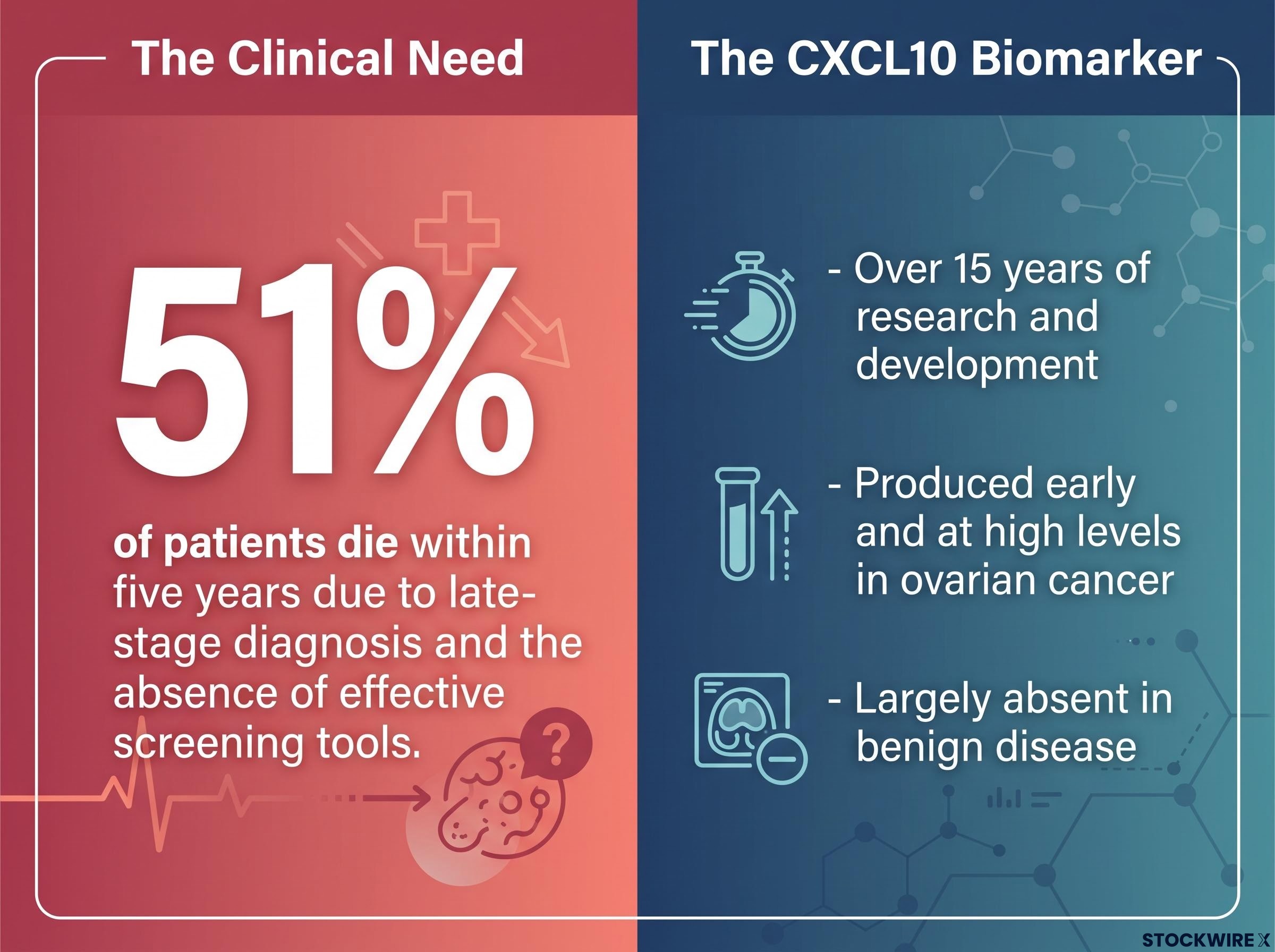
The scientific foundation is the CXCL10 biomarker, supported by over 15 years of research and development. CXCL10 is produced early and at high levels in ovarian cancer but is largely absent in benign disease, making it a capable discriminator between malignant and non-malignant growths. The new provisional filings expand CLEO’s existing IP portfolio and support the company’s broader strategy to apply its biomarker technology across multiple applications of the ovarian cancer detection pathway.
The ovarian cancer screening program targets a $150B global addressable market and is built on biobank access already secured across two world-class collections, including UKCTOCS via University College London and the U.S. PLCO biobank, removing a bottleneck that commonly delays early-stage diagnostics development.
That strategy follows a staged development sequence:
- Pre-surgical triage test (pivotal clinical trial underway; FDA submission expected next year)
- Recurrence monitoring
- Global population screening (the stage to which the current patent filings relate)
The pre-surgical test is the more advanced program. The screening filings represent the earliest stage of that development pipeline, with proof-of-concept data still pending.
What comes next for CLEO investors
With today’s date being 30 September 2026, the anticipated proof-of-concept screening data is now imminent. The company has guided to early Q4 CY2026 for initial results, meaning investors may have a relatively short wait for the next material data point from the screening program.
Alongside the screening data, the PCT international filing is expected within the next 12 months, extending the company’s IP reach across key commercial markets. Concurrently, the pre-surgical test program continues toward an FDA submission expected in CY2027, representing the company’s most near-term commercial milestone.
CLEO’s FDA Analytical Validation program, which formally commenced in September 2026 using 125 commercially manufactured test kits from Bio-Techne, represents the first formal FDA-framework regulatory study in the company’s history and sits two steps ahead of the planned 510(k) submission.
The two programs operate in parallel rather than in competition. Progress on the screening IP front does not appear to slow the pre-surgical pathway, and together they represent pipeline breadth across different stages of the ovarian cancer detection pathway.
| Milestone | Program | Expected Timing |
|---|---|---|
| Proof-of-concept screening data | Screening test | Early Q4 CY2026 |
| PCT international patent filing | Screening test | Within 12 months of 30 September 2026 |
| FDA submission | Pre-Surgical Test | CY2027 |
Ovarian cancer carries the highest five-year mortality rate of all cancers affecting women, with 51% of patients dying within five years, primarily due to late-stage diagnosis and the absence of effective screening tools. CLEO’s dual-track approach, covering both near-term surgical triage and longer-term population screening, positions the company across multiple points of the detection pathway as it advances toward potential commercialisation.
Don’t Miss the Next Healthcare Breakthrough in Your Inbox
Big News Blast delivers FREE breaking ASX healthcare news directly to your inbox within minutes of release, complete with in-depth analysis already done. Join 20,000+ subscribers who stay ahead of the market the moment announcements drop. Click the “Free Alerts” button at StockWire X to start receiving alerts today.