
When you buy shares in a company, you assume you are buying a piece of it. A slice of ownership. A vote, however small, in how the business is run.
The next wave of artificial intelligence listings is quietly rewriting that assumption. As firms like Anthropic prepare to go public, the fine print reveals a growing preference for dual-class shares, a structure that hands you the financial risk while keeping the steering wheel firmly in founder hands.
This matters right now because the money involved is staggering. AI companies are burning through capital at a pace not seen in modern corporate history, and many are racing to public markets while building governance structures specifically designed to keep public investors out of major decisions.
The result is a strange bargain. You get economic exposure to one of the biggest technology bets ever made. You get almost no say in how that bet is managed.
Here is the framework for evaluating these founder-controlled listings: what you actually surrender when you buy in, why the numbers behind the AI buildout should give you pause, and how to spot the governance red flags in a prospectus before you commit your capital.
The new standard for absolute founder control
Look at how the newest AI companies are drawing up their share structures, and a pattern emerges that would have been unthinkable in an ordinary business.
According to Reuters reporting from 24 September 2026, Anthropic is asking existing shareholders to approve a structure that would give CEO Dario Amodei and his six co-founders a combined 50.1% of the company’s voting power. That control would run through a single super-voting share, modelled on Palantir’s founder-control framework.
The mechanism is elegant and total. All seven co-founders hold their power through one Class F share sitting inside a founders’ LLC, and they decide by majority vote how that single share gets cast on major corporate matters. One share. Half the votes. Seven people in a room.
The proposed design would create five separate classes of stock. Here is where you fit in.
Class A shares, the stock expected to be sold to the public in the offering, carry one vote each. That is the standard deal, the one-share-one-vote arrangement most investors assume they are getting.
Sitting above you are the strategic partner shares held by large cloud providers and major investors. These holders carry, in the words of the reporting, “very few” votes despite holding enormous economic exposure. There is even a distinct employee share class designed to act as a tie-breaker on certain governance questions.
Stack these classes together and the picture sharpens. Public capital pours in from the bottom. Voting power concentrates at the top. The two rarely meet.
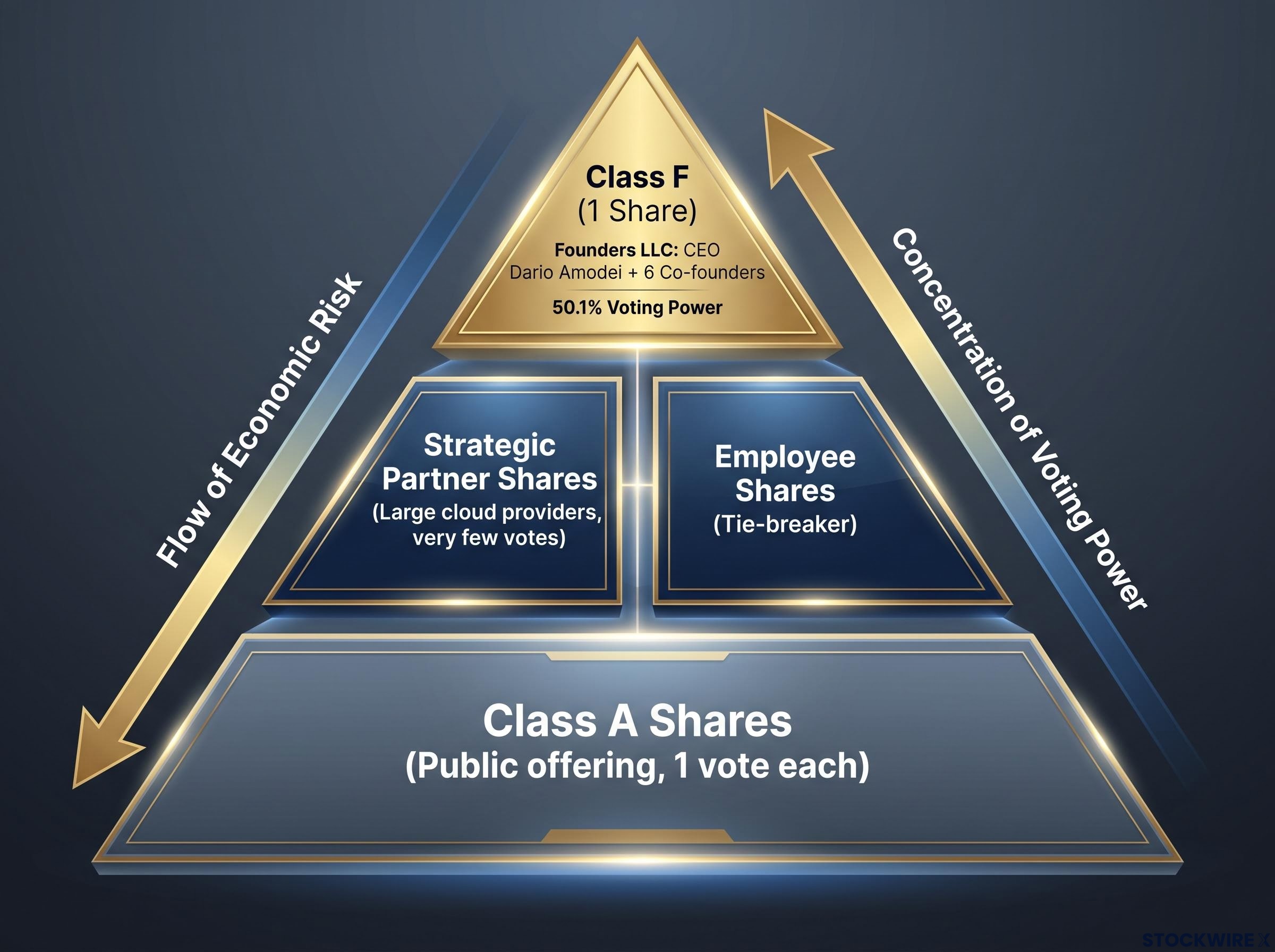
The durability of this arrangement is the part worth reading twice. The founders’ collective control would persist as long as at least three of the seven co-founders continue to hold a minimum number of shares. That means the founders can sell down their economic stake, taking money off the table, while keeping their grip on the company intact.
Read plainly, this tells you the founders are treating public money as a utility, a source of funding, rather than a partnership of owners. You are buying a return, not a relationship, and understanding that dynamic is the first step before committing your capital.
CFA Institute warning The CFA Institute’s research on dual-class shares highlights that separating voting power from economic ownership increases the risk of minority shareholder expropriation and reduces the market discipline that normally keeps management accountable.
When big ASX news breaks, our subscribers know first
How dual-class share structures actually work
To understand what you are giving up, you need to separate two things that most people assume travel together: economic exposure and voting power.
Economic exposure is the money. It is the risk you carry and the reward you stand to gain if the company succeeds. Voting power is the control, the ability to influence who sits on the board, how capital gets spent, and whether management stays or goes.
In a conventional company, these move as one. One share gives you one dollar of exposure and one vote. Dual-class structures deliberately pull them apart.
The corporate governance hierarchy in a standard public company places shareholders at the top, with the power to elect the board and vote on major decisions, but dual-class structures invert this by decoupling that vote from the capital underneath it.
Companies achieve this split through a few core mechanisms. Insiders receive super-voting shares that might carry ten votes each, or in Anthropic’s case, a single share holding half the total. The public receives standard shares, or in the most extreme cases, non-voting shares that carry no governance rights at all.
Here is how the three main share types compare.
| Attribute | Standard shares | Super-voting shares | Non-voting shares |
|---|---|---|---|
| Voting power | One vote per share | Multiple votes per share, or concentrated control | No votes |
| Economic rights | Full exposure to gains and losses | Full exposure, often a smaller stake | Full exposure to gains and losses |
| Typical holders | Public investors | Founders and insiders | Public investors |
The mechanical reality is stark once you see it laid out. You underwrite the risk. The founders hold the insurance policy of absolute control.
This is why governance experts push hard on specific safeguards. The CFA Institute recommends investors demand protections before buying in, and there are three worth committing to memory.
- Time-based sunsets: super-voting rights automatically collapse into ordinary shares after a set number of years.
- Event-based sunsets: enhanced voting ends once insiders fall below a defined ownership stake, so control cannot outlive real economic commitment.
- Majority-of-minority voting: major control-increasing decisions and related-party deals require approval from public shareholders specifically, not just the founder bloc.
The proxy advisory firms reinforce the point. Institutional Shareholder Services (ISS) recommends against new dual-class IPOs that lack a credible plan to phase out super-voting shares. Glass Lewis treats these structures as a material governance risk and may recommend voting against directors where public holders cannot meaningfully influence the board.
With these mechanics in hand, you can scan a prospectus and answer one question quickly: does this company offer you a fair governance deal, or permanent disenfranchisement?
The historical trap of the visionary founder
The pitch for founder control always sounds compelling. Give the visionary room to think in decades, insulate them from short-term market pressure, and let the long-term bets pay off. Sometimes it works. The problem is what happens when it does not.
Consider the track record. Google went public with a dual-class structure that handed founders Larry Page and Sergey Brin ten-vote shares, later adding non-voting Class C stock. Public shareholders enjoyed strong returns, but had little leverage over governance, corporate restructuring into Alphabet, or how capital was allocated.
Meta Platforms offers the sharper warning. Mark Zuckerberg’s voting power vastly exceeds his economic stake, and that control enabled the company’s expensive pivot toward the metaverse despite loud investor concerns about profitability. Governance researchers point to Meta as a case where founder control drove tens of billions in capital spending that ran against the near-term preferences of public shareholders.
Snap produced the cleanest example of the extreme end. Its 2017 IPO sold non-voting Class A shares to the public while founders kept the high-vote stock, giving retail investors no formal voice whatsoever.
The market responded. Major index providers S&P Dow Jones and FTSE Russell introduced rules restricting non-voting companies from key indices, which reduced passive fund demand and can weigh on valuations. Investors who bought at IPO absorbed both the governance risk and the market’s discount for it.
The FTSE Russell index eligibility criteria require that at least 5% of a company’s voting rights sit with unrestricted public shareholders, a threshold that companies issuing non-voting or heavily diluted public shares may struggle to clear, directly affecting passive fund demand and long-term liquidity.
The structural risks retail investors have faced in these listings follow a consistent shape.
- Economic exposure without meaningful voting rights, leaving you reliant on founder competence.
- Asymmetric outcomes: you share the upside when the vision is right, but carry the downside with little recourse when it is wrong.
- Index exclusion and valuation discounts that can directly reduce long-term returns.
- Inability to force leadership or strategy changes during extended underperformance.
When the vision fails
The real danger is not the good years. It is the bad ones.
When a founder-controlled company underperforms for a prolonged stretch, public shareholders normally have a tool: they can pressure the board, back an activist campaign, or vote for change. Dual-class structures remove that tool.
This matters most around capital allocation. If management pours money into a strategy that markets clearly reject, and Meta’s metaverse spending is the reference point here, you cannot force a course correction. The historical record shows that when the visionary gets it wrong, you bear the financial loss while lacking the leverage to change the strategy.
Funding the trillion-dollar AI infrastructure bill
Governance risk is one half of the bargain. The other half is the sheer scale of spending you are effectively signing up to fund, without a vote to slow it down.
The numbers are difficult to overstate. According to Forbes reporting from June 2026, citing CreditSights, the five largest hyperscalers are on track to spend between $700 billion and $900 billion on capital expenditure in 2026, roughly a 36% increase over the prior year. Futurum Group estimates the five biggest US AI and cloud providers will lift combined capex from around $380 billion in 2025 toward $660 billion to $690 billion in 2026, nearly doubling the figure.
Here is how the scale of that increase looks side by side.
| Source estimate | 2025 capex | 2026 projected capex |
|---|---|---|
| Futurum Group (5 providers) | ~$380 billion | $660 billion to $690 billion |
| Forbes / CreditSights (5 hyperscalers) | Not disclosed | $700 billion to $900 billion |
| American Century (7 firms) | Not disclosed | ~$775 billion |
The way this is being financed should sharpen your attention. Capital spending is running ahead of what these companies generate in cash, so they are turning to debt, and some of it is remarkably long-dated.
In February 2026, Alphabet sold a rare 100-year sterling bond as part of a $31.51 billion debt sale, according to Reuters. The century tranche was priced at a 6.125% coupon and is structured to mature in 2126. CNBC characterised the issuance as emblematic of a debt-fuelled AI arms race.
The context that should trouble you is the mismatch between cost and return. Capital intensity, meaning capex as a share of revenue, has reached 45% to 57% for major firms, a level closer to capital-hungry utilities than to software businesses. American Century openly questioned whether the economic payback will justify spending on this scale.
Put the two halves together. You are funding a front-loaded, highly speculative build-out where the returns remain unproven, inside companies designed so you cannot pull the emergency brake if the spending runs away. You must weigh the promise of the technology against the balance sheet you are actually buying.
This article is for informational purposes only and should not be considered financial advice. Investors should conduct their own research and consult with financial professionals before making investment decisions.
Navigating asymmetric risk in the AI era
The tension at the heart of these listings is real, not manufactured. AI genuinely may require patient, long-horizon investment that quarterly markets would punish. Yet the structures built to enable that patience also strip you of accountability when the bet goes wrong.
So the decision framework comes down to pricing the risk honestly.
When a company hands founders permanent control and pairs it with a debt-heavy, speculative spending programme, you should discount the valuation to reflect what you are giving up. Governance risk is not abstract. It has shown up in index exclusion, valuation discounts, and years of stranded underperformance.
The AI listing surge is not just a governance story: BCA Research’s analysis of roughly 40 years and 12,000 IPOs finds that elevated IPO volumes have historically preceded weaker forward equity returns, a dynamic that could compress valuations across incumbent AI names as new public supply absorbs institutional capital.
Read the prospectus for the safeguards that matter: sunset clauses, a meaningful free float of voting stock, and majority-of-minority protections. Their absence is a signal, not a detail.
And remember the option that is always available. Walking away from an IPO costs you nothing. When the rules are written so that you carry the risk and someone else holds the control, choosing not to play is a perfectly rational way to protect your capital.
For readers wanting to stress-test that walk-away instinct with historical data, our full explainer on IPO structural risks for retail investors covers Jay Ritter’s longitudinal underperformance findings and the mechanics of why insiders consistently hold the pricing advantage.
Past performance does not guarantee future results. These statements are speculative and subject to change based on market developments and company performance.