Most people picture a central bank doing one of two things: raising interest rates or cutting them. That picture is not wrong, but it is incomplete. When the COVID-19 pandemic froze interbank lending in 2020, banks stopped trusting each other enough to lend overnight, and the Bank of Canada’s rate lever alone could not thaw the freeze. It reached for something bigger.
That something bigger is the balance sheet. The Bank of Canada holds eight scheduled rate-setting meetings a year and aims to keep inflation inside a 1%-3% band, but the overnight rate has limits. When it hits its floor or when markets seize up, quantitative easing and its reversal, quantitative tightening, become the tools that do the heavy lifting, and both leave measurable fingerprints on the Canadian dollar.
After reading this, you will have a working model for how the Bank expanding and contracting its balance sheet moves through the financial system and shows up in the CAD. That model changes how you read a Bank of Canada announcement, from a headline number into a layered signal.
What the Bank of Canada actually does when interest rates are not enough
The overnight rate is the Bank’s primary instrument, and for most of its history it has been enough. Adjust the price of money, and borrowing, spending, and inflation respond over the following months. The trouble arrives when the rate is already near zero and the economy still needs support, or when markets stop functioning regardless of where the rate sits.
That is where quantitative easing (QE) enters. QE is the Bank of Canada creating Canadian dollars to buy assets, mainly government bonds, from financial institutions. It is not a routine move. It is a last-resort tool, reached for only when the standard toolkit has run out of room.
The Bank typically turns to QE under three conditions:
- The overnight rate is already at or near its effective floor, leaving little room for further cuts.
- Financial markets have stopped functioning normally, with lending or trading seizing up.
- Demand has collapsed severely enough that conventional rate policy cannot restore price stability on its own.
In 2020, all three pressures converged. Interbank lending froze as banks grew wary of each other’s credit risk, and cutting the rate could not fix a plumbing problem. QE addressed the blockage directly by injecting cash into the system in exchange for bonds.
From QE to QT: the policy sequence explained
Quantitative tightening (QT) is the reversal. Once recovery takes hold and inflation begins to accelerate, the Bank stops adding to its holdings and starts letting them shrink. Between the two phases sits a reinvestment stage, where the Bank keeps its balance sheet flat by replacing bonds as they mature, before eventually stopping.
The Bank formally ended reinvestment and began QT on 13 April 2022, with operations commencing 25 April 2022. It did this exclusively through passive runoff: maturing Government of Canada bonds were simply not replaced, rather than being actively sold. At the same launch, the Bank confirmed it would keep using a floor system to implement monetary policy.
The takeaway is that QE and QT are not exotic emergency inventions. They are structured extensions of the same inflation mandate, and knowing they exist is what turns a Bank of Canada press release from a single number into something you can actually read.
The Bank of Canada QE explainer published in early 2025 defines both tools within the institution’s inflation mandate, confirming that QE and QT are structured extensions of conventional policy rather than emergency departures from it.
When big ASX news breaks, our subscribers know first
Why QE weakens the Canadian dollar, and why QT does the opposite
The link between the balance sheet and the currency is not obvious at first, so it helps to follow the mechanics in order. When the Bank buys bonds under QE, it pushes their prices up and their yields down. Lower yields on Canadian government debt make those assets less rewarding to hold.
That compression sets off the portfolio-balance channel. Investors sitting on newly low domestic yields start looking abroad for better returns, selling Canadian dollars to buy foreign assets. More CAD offered on foreign-exchange markets means downward pressure on its value.
Real yield differentials, not nominal rate gaps alone, are what move sustained currency positioning, and the same portfolio-balance logic that applies to the CAD under Bank of Canada QE operates through an analogous chain when the Fed expands or contracts its own balance sheet against its major trading partners.
Running alongside is the signalling channel. A QE announcement tells markets the Bank expects to keep short-term rates lower for longer, which narrows the interest-rate gap between Canada and other countries. A smaller gap makes CAD assets less attractive to foreign capital, reinforcing the same downward drift.
QT works as the mirror image. Shrinking the balance sheet supports higher domestic yields, drains Canadian dollars out of the financial system, and signals a tighter stance. Each of those tends to pull capital in rather than push it out, which is broadly supportive of the currency.
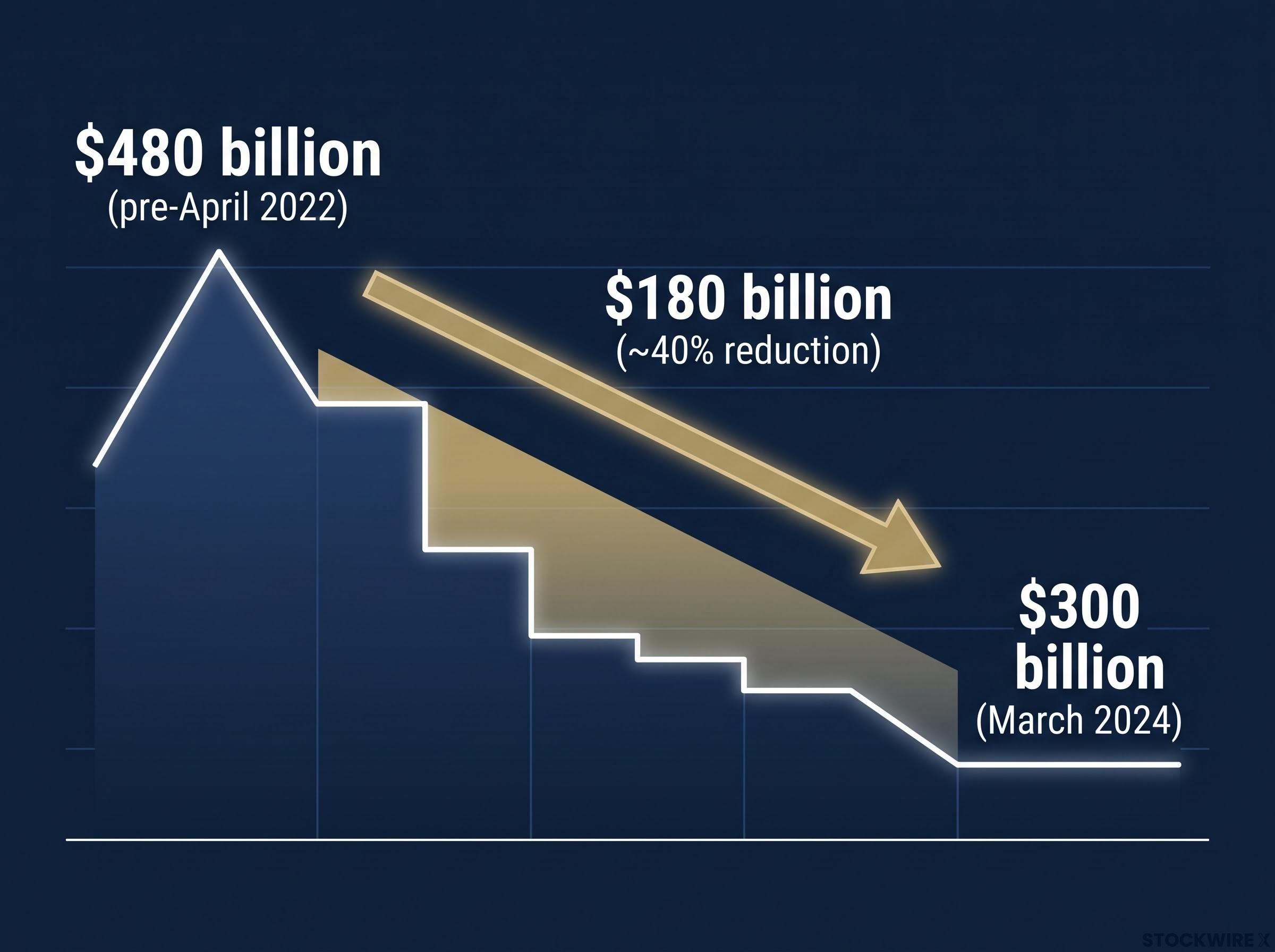
The scale of the recent cycle shows how large these moves can be. From a peak of roughly $480 billion before April 2022, the Bank’s asset holdings fell by about $180 billion, close to 40% from the top, to approximately $300 billion by March 2024. A drawdown of that size is not a rounding error in the financial system.
| Dimension | Quantitative easing (QE) | Quantitative tightening (QT) |
|---|---|---|
| Balance-sheet action | Buys bonds, expands holdings | Lets bonds mature, shrinks holdings |
| Yield effect | Pushes domestic yields down | Supports higher domestic yields |
| CAD directional tendency | Tends to weaken | Tends to strengthen |
| Primary channel | Portfolio rebalancing plus signalling | Reversal of both channels |
Here is the important qualification. The direction is a tendency, not a guarantee, because the CAD answers to more than the Bank’s balance sheet.
The caveat that matters most for USD-CAD exposure In global stress events, safe-haven flows can dominate, and when the Federal Reserve is running larger simultaneous QE of its own, the bilateral CAD-USD effect can be muted or even reversed. Oil prices and US monetary policy often exert a stronger pull on the loonie than the Bank’s balance-sheet stance alone.
So the channels tell you which way the pressure leans. What they cannot tell you is the magnitude in any given cycle, because commodity prices, global risk sentiment, and the Fed are all filtering the signal at the same time. That is why precise CAD predictions built on balance-sheet policy alone tend to disappoint.
The portfolio-balance and signalling channels are two inputs into a broader set of Canadian dollar drivers that also includes commodity prices, US tariff risk, and the Canada-US rate differential, and the relative weight of each shifts depending on the macro environment the loonie is navigating.
The Bank of Canada’s pandemic QE program and how it unwound
Theory is one thing. The COVID-19 cycle is the only complete QE-to-QT arc the Bank of Canada has run in the modern era, which makes it the definitive case study for watching these tools behave in the real world rather than on a whiteboard.
The trigger in 2020 was specific. Interbank lending froze as institutions grew nervous about each other’s credit, and no amount of rate cutting could restore a market that had stopped functioning. QE stepped in to buy bonds, supply cash, and get the plumbing working again.
By April 2022, the recovery was well established and inflation was climbing, so the Bank reversed course. It designed QT as passive runoff, deliberately choosing not to sell bonds into the market.
Why the Bank chose passive runoff over active bond sales
That design was a risk-management decision, not a passive one. Active sales into a mid-sized market like Canada’s risk jolting yields and draining liquidity; keeping QT in the background preserves the overnight rate as the primary policy signal rather than layering on a second tightening shock; and letting bonds simply mature is operationally cleaner and looks less like debt management. The Bank of England reinforces the point: even where active gilt sales have been used, they are tightly managed to avoid destabilising markets, which is why passive runoff remains the safer default.
Passive balance-sheet runoff avoids the market-disruption risk that active bond sales carry, but it also means the timeline for normalisation is governed entirely by the maturity schedule of existing holdings rather than by policy intent, a constraint the Federal Reserve confronts acutely through its $1.93 trillion mortgage-backed securities portfolio.
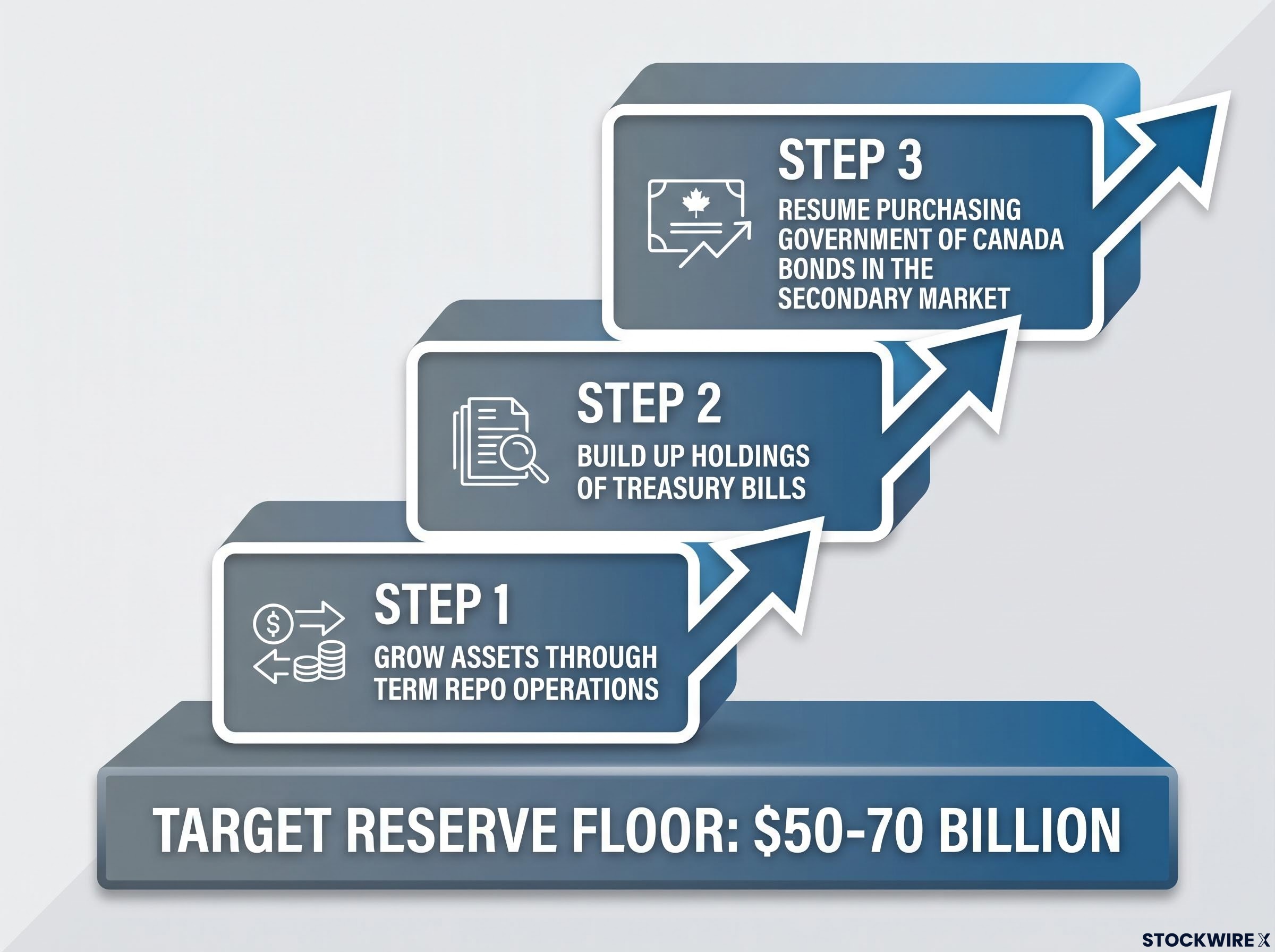
By January 2025, the Bank judged that settlement balances, the reserves commercial banks hold at the central bank, were “close to where we want them to be,” inside a target range of $50-70 billion. It stated it expected QT to end in the first half of 2025, after which business-as-usual asset purchases would resume.
The Bank laid out a three-step transition once QT concludes:
- Begin growing assets through term repo operations.
- Build up holdings of Treasury bills.
- Resume purchasing Government of Canada bonds in the secondary market rather than at primary auctions.
The design of the exit matters as much as the decision to exit. The Bank’s focus on that $50-70 billion reserve floor is a direct lesson from the Federal Reserve’s 2017-2019 QT, when reserves fell too far and the US repo market seized up. Canada built its floor precisely to avoid repeating that funding stress.
As of the 2 September 2026 decision, the overnight rate sat at 2.25%, and the accompanying commentary announced no changes to QT or reinvestment policy. Formal confirmation that QT has ended remains unconfirmed in the available record as of late September 2026, a reminder that policy transitions are often quieter than the announcements that start them.
What to watch in Bank of Canada communications beyond the rate decision
Most people read a Bank of Canada release for one number: the rate. That habit misses an entire layer of information sitting in the same document. If you care about where the CAD is heading, the balance-sheet signals are at least as telling as the headline.
The reason is timing. Balance-sheet stance changes rarely arrive as dramatic announcements. They show up first in technical language about reserves, reinvestment, and market operations, well before they register in the rate itself.
Here is what to track in the Bank’s communications:
- Settlement-balance language, especially any reference to the $50-70 billion target range and whether balances sit above or below it.
- Reinvestment status, meaning whether the Bank is replacing maturing bonds, letting them run off, or resuming purchases.
- Term-repo operations and volumes, which are the first step in the Bank’s post-QT transition plan.
- “No changes to balance sheet policy” formulations, which are not filler. They signal the Bank is content with current liquidity conditions.
- Hedged guidance such as being “prepared to adjust monetary policy as needed,” the language the Bank used at its September 2026 decision.
That last phrasing is worth internalising, because it is the kind of signal that trains your reading. Consider what the Bank told markets at the start of 2025.
Canada-US rate divergence reached its widest point since 2022 by September 2026, with the Bank sitting 175 basis points below the Fed after the Fed’s September hike, a gap that independently pressured CAD lower regardless of where the Bank’s balance sheet stood in its normalisation sequence.
A balance-sheet signal worth noticing In January 2025, the Bank of Canada stated it expected QT to end in the first half of 2025, then resume business-as-usual asset purchases. That single sentence told attentive readers the tightening phase was drawing to a close, months before any rate implication became clear.
With eight scheduled meetings a year, you have a regular calendar to monitor. Knowing which phrases carry weight is what turns each release from noise into a structured signal about the CAD’s likely direction.
What this means for how you read Canadian monetary policy from here
Step back and the picture is a two-layer toolkit. The overnight rate is the primary signal, fast-moving and headline-grabbing. The balance sheet is the slower, secondary layer that shapes financial conditions over months rather than weeks.
The two-layer model in one line The rate tells you what the Bank is doing this week; the balance sheet tells you what it has been doing all along.
For the currency, the split matters. Rate decisions move CAD quickly. Balance-sheet changes move it gradually and are frequently offset by the Federal Reserve’s stance and by commodity prices, which is why the loonie’s response to QT is real but noisy.
The full arc makes the scale concrete: a peak near $480 billion, a drawdown of roughly $180 billion to about $300 billion by March 2024, and a $50-70 billion settlement-balance floor as the end-state target. By the 2 September 2026 decision, the overnight rate had settled at 2.25%, close to a neutral stance, while balance-sheet normalisation continued quietly in the background. Both tools ultimately serve the same 1%-3% inflation mandate.
The practical payoff is this. Once you read both layers together, you can tell the difference between a Bank that is genuinely tightening and one that is simply holding its rate while the balance sheet finishes normalising. That distinction is the whole game.
This article is for informational purposes only and should not be considered financial advice. Investors should conduct their own research and consult with financial professionals before making investment decisions.
These statements are speculative and subject to change based on market developments and central bank policy. Past performance does not guarantee future results.