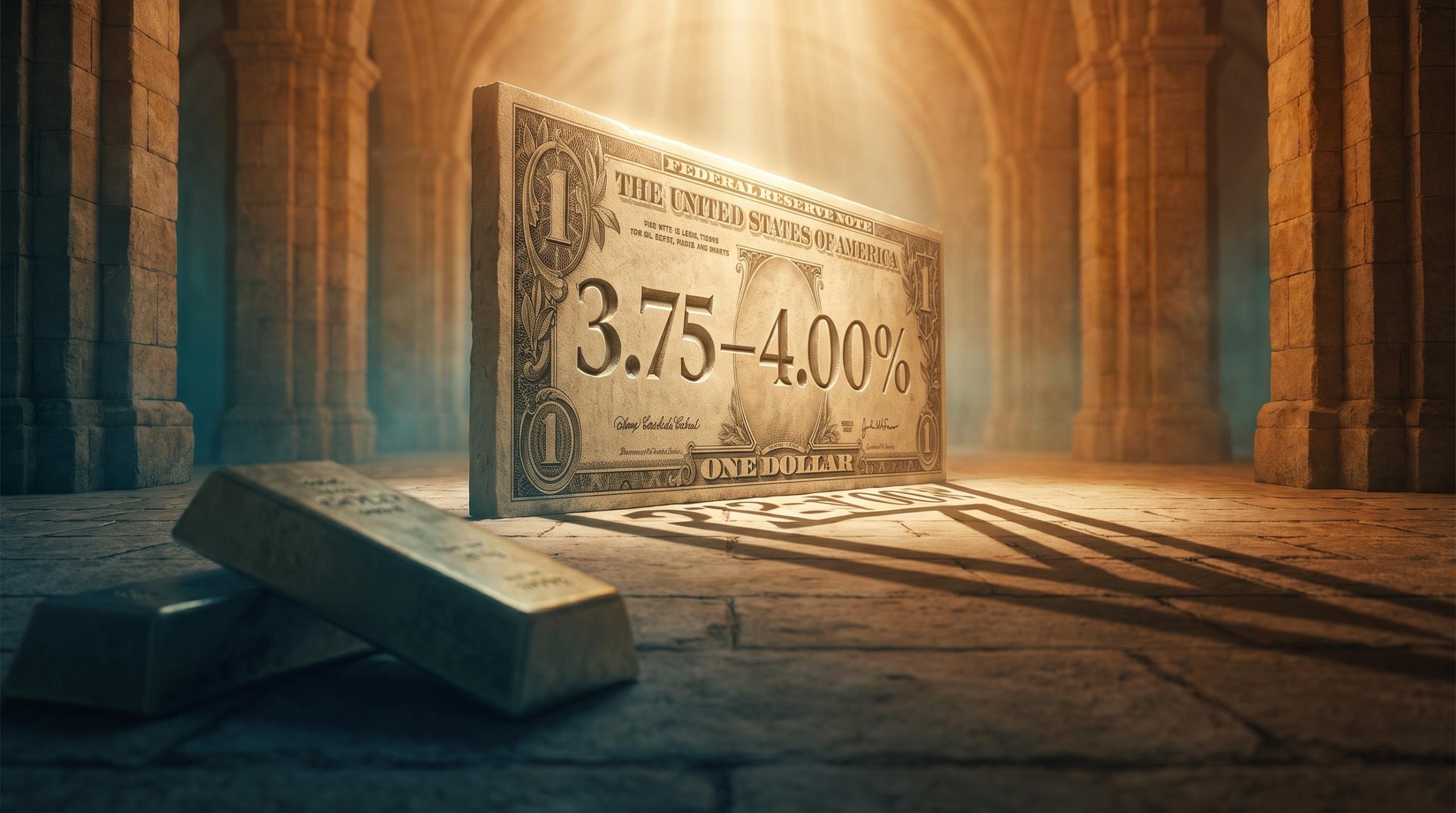
Here is a situation that should not make sense. When the US rejected Iran’s truce offer in late September 2026, gold fell and the dollar rose. Not because anyone felt safer, but because the plumbing of global finance was doing exactly what it always does.
If your instinct says risk-off events should send both gold and the dollar higher together, you are half right and half about to lose money. The relationship is more conditional than the headlines suggest.
Geopolitical events are now a near-permanent feature of the investing environment, yet most self-directed investors lack a durable way to read them. The Qatar-brokered US-Iran negotiations of 2026 offer a live, well-documented case study in how diplomatic signals, risk sentiment, and currency flows actually interact.
This gives you a practical framework for reading geopolitical headlines before you trade on them, using a real 2026 episode to show how the mechanics work. Learn it once, and it applies to the next event, whatever form it takes.
Why geopolitical shocks move markets: the mechanics beneath the headlines
Safe-haven flows are not about emotion. They are about structure. Once you see the wiring underneath, the counterintuitive moves stop looking arbitrary.
The dollar’s structural advantage in a crisis
The US dollar is the world’s dominant reserve and invoicing currency, and that status is not sentimental. Large asset managers such as BlackRock and banks such as Goldman Sachs have long pointed to the depth of US Treasury and money markets as the reason capital defaults toward the dollar in stress.
When risk spikes, portfolios need somewhere deep and liquid to park. Treasuries, bills, and dollar cash absorb enormous flows without moving prices much, which is exactly what a fleeing investor wants.
There is a second, less visible driver. Research from the Bank for International Settlements (BIS) notes that a large share of global funding and derivatives positions are denominated in dollars. When leveraged investors deleverage, margin calls force them to raise dollar cash and high-quality collateral, which pushes the dollar up even further.
BIS research on dollar dominance confirms that a large share of global funding and derivatives positions are denominated in dollars, meaning that when leveraged investors deleverage, margin calls force them to raise dollar cash and high-quality collateral, pushing the dollar higher even when the triggering shock has nothing to do with the US economy.
Now add yield. The Federal Open Market Committee raised its target range to 3.75-4.00% on 16 September 2026, the first hike since 2023 according to U.S. Bank commentary. When rates are high and expected to stay restrictive, strategists at institutions such as JPMorgan and Citi note the dollar can rally on yield advantage and haven demand at the same time. That is a powerful combination stacked in the dollar’s favour.
The Fed policy tools now operating simultaneously, a 3.75-4.00% funds rate and active quantitative tightening, create a compounding effect on dollar strength that geopolitical safe-haven flows layer on top of, not replace.
Gold’s different but complementary role
Gold plays a related but distinct role. The World Gold Council describes it as a hedge against tail risk and policy uncertainty, and the reason is simple: gold carries no credit risk and is recognised everywhere.
Gold tends to outperform when real yields fall or when investors fear monetary or geopolitical instability. It benefits both from risk aversion and from expectations of looser future policy, according to World Gold Council framing.
Here is the part that trips people up. Gold and the dollar do not always move together. When a shock is seen as forcing the Fed into rapid easing, gold can outperform while dollar strength fades. When rates are rising sharply, gold’s appeal can be muted even during a crisis.
The three drivers to hold in your head:
- USD liquidity: deep Treasury and money markets attract capital in stress
- Gold as a non-credit hedge: no default risk, responds to real yield expectations
- Collateral and funding dynamics: deleveraging forces dollar and Treasury demand
The takeaway is this. These flows appear even in crises that seem unrelated to the US, because the system is wired to default toward dollar liquidity and non-credit stores of value. Expect them, and you will stop being surprised.
When big ASX news breaks, our subscribers know first
How diplomatic signals translate into market moves: reading the escalation ladder
Not every headline carries the same weight. Diplomatic events sit on a spectrum, from full conflict at one end to normalisation at the other, and each rung on that ladder moves risk sentiment differently. Learn to locate a headline on the ladder, and you can anticipate the directional response before you check prices.
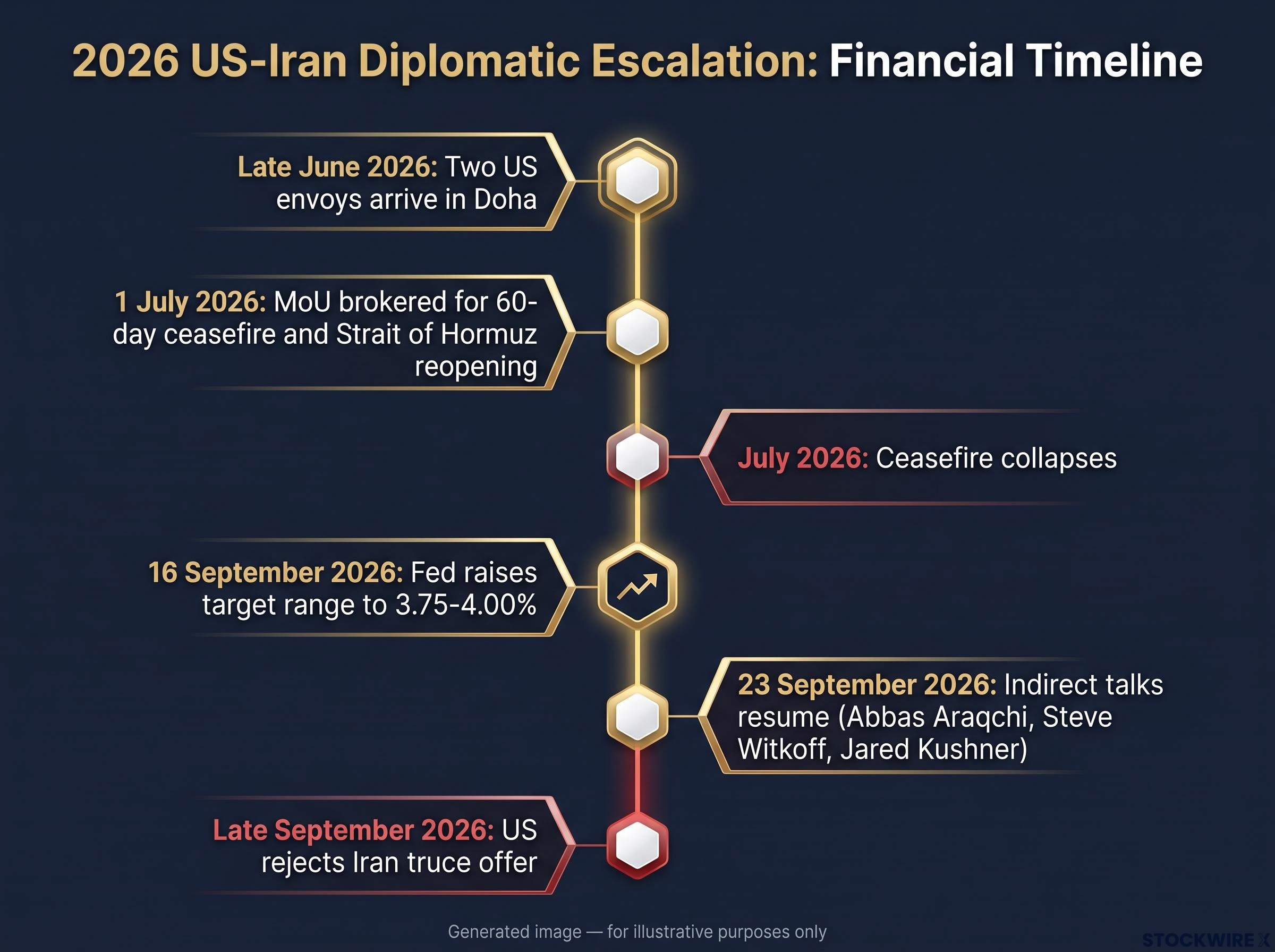
The 2026 US-Iran process is a clean illustration. In late June, two US envoys arrived in Doha for mediator-led talks. On 1 July 2026, Al Jazeera reported a memorandum of understanding (MoU) brokered by Qatar and Pakistan: a 60-day ceasefire, the reopening of the Strait of Hormuz, and a timetable for a final deal addressing Iran’s nuclear programme.
That ceasefire collapsed in July. Then, on 23 September 2026, Reuters reported the first known indirect talks since the collapse, again with Qatar shuttling messages between Iran’s Foreign Minister Abbas Araqchi and US envoys Steve Witkoff and Jared Kushner. Iran set conditions: ending the war on all fronts, halting US acts of aggression, and releasing frozen Iranian assets.
Notice what moves markets here. A mediated MoU with named intermediaries and specific terms carries more weight than a vague statement of willingness to talk. Credibility is the variable, not tone.
| Ladder stage | 2026 US-Iran example | Expected USD move | Expected gold move | Risk-asset sentiment |
|---|---|---|---|---|
| Escalation / ceasefire collapse | July 2026 ceasefire breakdown | Higher | Higher | Risk-off |
| Indirect talks resume | 23 September UN General Assembly round | Mixed | Mixed | Cautious |
| Credible MoU with terms | 1 July Doha MoU (60-day ceasefire) | Softer | Softer | Risk-on tilt |
| Durable agreement / normalisation | Hypothetical final deal | Lower | Lower | Risk-on |
Why the Strait of Hormuz matters to currency traders
One detail recurs through the entire process: the Strait of Hormuz. This is not a side note. It is the single most important shipping channel for global oil, and any headline touching it feeds straight into an oil-supply risk premium.
That gives energy disruption its own channel into safe-haven demand, independent of direct military escalation. Fears about shipping through the Strait can lift oil, and higher oil feeds inflation expectations, which loops back into what the Fed might do next.
For you, this means one thing. When a geopolitical story touches an energy chokepoint, watch it specifically, not just generally, because it links currencies, commodities, and central-bank policy in a single thread.
The Hormuz shipping disruption running through mid-2026 illustrates exactly why chokepoint exposure is not a peripheral concern: commercial transits collapsed to 3-14 vessels per day against a pre-war baseline of 120-140, and war-risk insurance premiums ran at approximately 30 times normal rates, embedding an oil and inflation channel that no diplomatic statement alone could quickly close.
When the framework breaks down: conditions where safe-haven rules reverse
You now have a framework, which is exactly the moment to stay humble. The relationships above are reliable until they are not, and knowing when they invert is as valuable as knowing the rule itself.
Four conditions reliably break the pattern:
- US-centric shocks: if the risk directly targets US assets or institutions, the dollar can weaken even amid global risk aversion, as investors diversify away from US exposure rather than into it
- Forced deleveraging: in extreme stress, such as the early stages of the 2008 crisis, gold can sell off alongside risk assets because investors liquidate everything to raise dollar cash for margin calls
- Regime change in policy: the Japanese yen is a traditional haven, but under aggressive Bank of Japan yield-curve control it did not always behave that way, showing how policy can suspend a historically reliable relationship
- Crowded positioning: when speculative long positions in the dollar or gold are already stretched, a shock can trigger profit-taking rather than fresh buying
There is a deeper reason to stay calibrated. FX strategists at HSBC and Deutsche Bank argue that medium-term currency trends are driven by interest-rate differentials, growth, and inflation, not headlines. Geopolitical spikes tend to fade back toward these fundamentals.
Options strategists add that implied volatility often overshoots realised volatility around geopolitical news, meaning investors frequently overpay for protection against scenarios that never fully materialise.
Practitioner commentary from firms such as Vanguard and Charles Schwab stresses that retail investors systematically overestimate how long safe-haven rallies last, assuming gold or the dollar will keep climbing as long as the news stays bad.
History backs this up. The 2019 Strait of Hormuz tanker attacks and the January 2020 Soleimani killing both produced sharp initial spikes, then markets stabilised quickly once escalation was contained.
Equity market resilience during acute geopolitical shocks follows a consistent pattern: markets process events as probability-adjusted inputs to future earnings rather than proportional headline shocks, which is why the S&P 500 closed near record levels even as a drone strike disrupted 1.7 million barrels per day of Kazakh crude in April 2026.
Here is the most dangerous mistake you can make after correctly reading the direction: buying gold or the dollar after the initial spike rather than at the onset. That often means entering near the local extreme, just as macro fundamentals reassert themselves and the move reverses.
A practical checklist for reading the next geopolitical headline
Enough theory. The next time a geopolitical headline breaks, you want a process, not a panic. Here is a sequence you can run through before deciding whether a trade is even warranted.
- Verify the source. Prioritise named, verified reporting over social media. Early reports can be incomplete or wrong; “ceasefire rejected” may actually mean talks are ongoing, as the ambiguity around the 2026 US rejection report showed.
- Locate the event on the escalation ladder. Is this a collapse, a resumption, a credible MoU, or vague talk? The rung tells you the likely direction.
- Assess energy-supply exposure. Does the story touch the Strait of Hormuz or a comparable chokepoint? If so, expect an oil and inflation channel.
- Check the rate and Fed context. With the funds rate at 3.75-4.00% and a possible October move in view, the dollar already has a yield tailwind independent of geopolitics.
- Check positioning and valuation. Is the dollar or gold already crowded or richly valued? Crowded trades reverse on profit-taking.
- Estimate likely duration. Compare with precedent. Most event-driven spikes fade within days to weeks unless the shock changes energy flows, trade, or policy for the long term.
Two structural risks deserve their own flag. The CFA Institute and advisory firms warn that retail investors anchor on dramatic narratives while ignoring valuations and macro drivers. And leveraged products such as CFDs, options, and leveraged ETFs can amplify losses badly when volatility exceeds expectations or the market moves against consensus.
Timing is the other trap. Headlines often break outside trading hours, so prices gap on the open, which makes chasing the move after the initial reaction especially risky.
| Common mistake | Why it happens | Disciplined alternative | US-Iran 2026 example |
|---|---|---|---|
| Trading on unverified news | Speed pressure, social media | Wait for named-source confirmation | Ambiguous truce-rejection report |
| Chasing the move late | Fear of missing out | Assess entry versus local extreme | Post-July ceasefire-collapse spike |
| Assuming rallies persist | Narrative over fundamentals | Estimate duration from precedent | 2019 and 2020 quick stabilisation |
| Over-leveraging the trade | Conviction plus product access | Size for gap and volatility risk | Hormuz-driven oil volatility |
The checklist does not hand you a trade. It hands you a process for deciding whether a trade is warranted, which is the discipline that separates you from reactive traders.
What the US-Iran case teaches you about geopolitics and markets going forward
Step back from the detail, and the 2026 episode is a complete worked example of everything above. Escalation-ladder movement from the July Doha MoU through the ceasefire collapse to the September resumption. Energy-supply risk via the Strait of Hormuz. Concurrent Fed tightening compounding dollar strength. And, consistent with history, a tendency for sharp moves to stabilise once the shock is contained.
The most useful distinction to carry forward is between two very different kinds of risk:
The dollar reserve currency risks accumulating in the medium term, including a hedge-fund basis-trade position of $830 billion in Treasuries nearly double its prior peak and the first OMFIF survey showing more central banks planning to reduce than increase dollar allocations, sit beneath the surface of short-term safe-haven flows and create fragility that episodic geopolitical spikes do not reveal.
- Structural shifts: sanctions regimes, trade fragmentation, and persistent changes in energy flows that can support gold or certain currencies over years
- Episodic headlines: flare-ups and ceasefire wobbles that typically fade within days to weeks
Certain think-tank economists and long-volatility managers argue that markets underprice long-term geopolitical shifts while overreacting to visible, episodic events. That reframes the conventional wisdom: the durable money is often in the structural change, not the headline.
Precedent supports the payoff for reading de-escalation correctly. The 2015 Joint Comprehensive Plan of Action and the 2020 Abraham Accords both lowered energy risk premia and unwound safe-haven flows, rewarding investors who anticipated calm rather than only reacting to conflict.
Two near-term variables are worth watching as this story continues: further Qatar-mediated progress or breakdown as a live read on the oil and safe-haven risk premium, and the interaction between any diplomatic development and the Fed’s October rate decision.
Watch for Qatar-mediated progress or breakdown rather than reacting to raw headlines, and you will interpret the next development through a framework rather than instinct. That is the durable advantage this guide is built to give you.
This article is for informational purposes only and should not be considered financial advice. Investors should conduct their own research and consult with financial professionals before making investment decisions.
Past performance does not guarantee future results. Financial projections are subject to market conditions and various risk factors.