The ASX 200 added 14 points on Monday. That tidy close conceals almost everything worth knowing about where the Australian market actually stands right now.
The index inched up less than 0.2% to finish at 8,679 points, its second modest step forward after four straight weeks of losses and the morning before the most consequential Reserve Bank decision in months. This was a holding session, not a recovery.
Investors were reluctant to commit ahead of Tuesday’s rate call, and end-of-quarter positioning layered on further caution. Beneath the flat headline number sat a deeply divided market, with defensive sectors pulling one way and resources pulling hard the other.
What comes next explains which parts of the market are still standing, what the RBA is expected to deliver on Tuesday and why the statement matters more than the rate itself, and which events across the next four trading days will decide whether the index closes the quarter on firmer ground or carries its losing streak into October.
A fragile recovery built on financials and healthcare
The 8,679 close was up just 14 points on the day, a gain of less than 0.2% that arrived only after the market surrendered part of its morning strength. At the session high, the index had been up close to 0.5% before the afternoon pared it back.
That retreat is the whole story in miniature. The advance came from a narrow band of the market, and it did not hold.
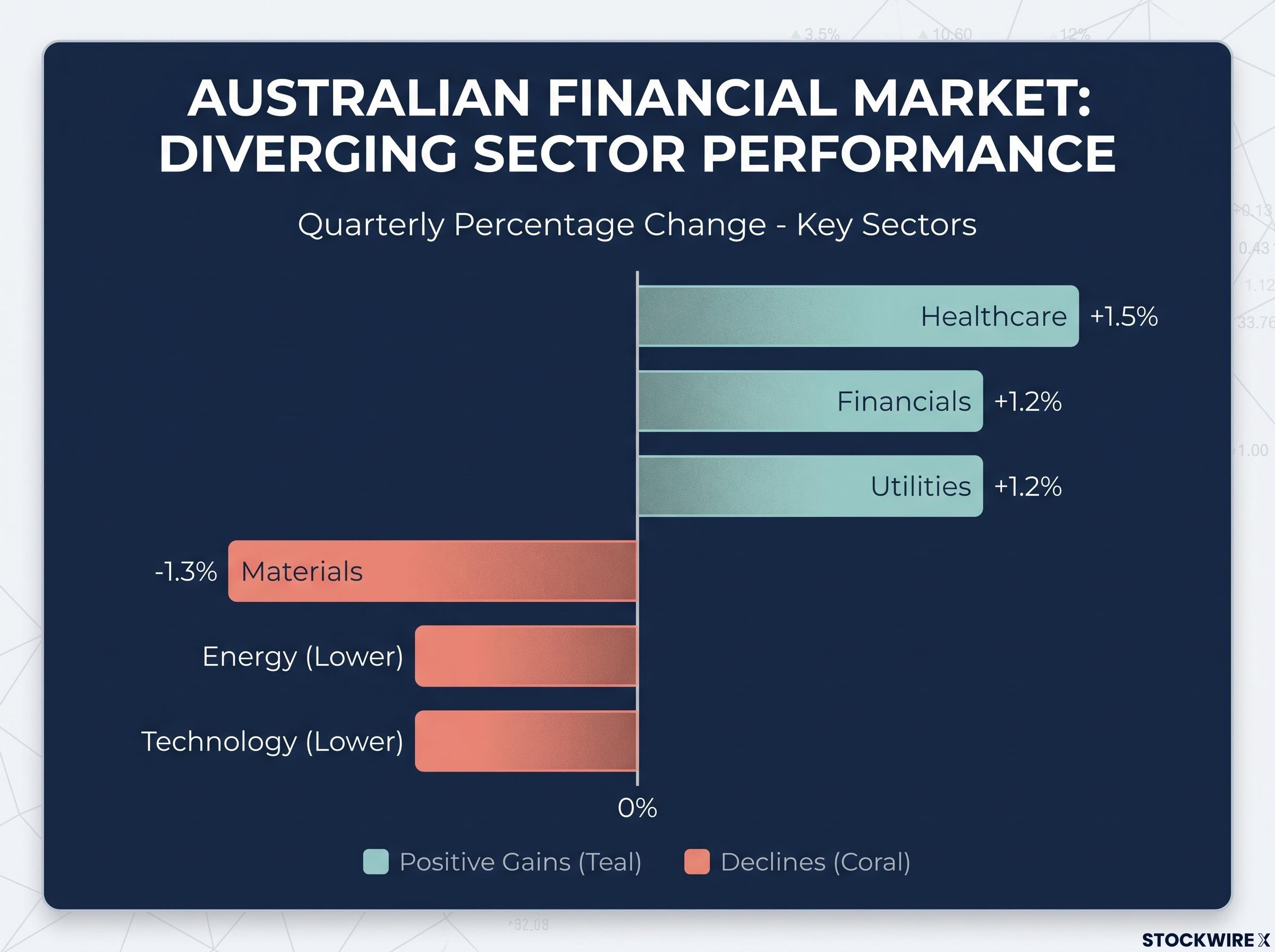
Financials rose approximately 1.2%, recovering meaningfully after a bruising month. Healthcare climbed around 1.5%, and utilities added roughly 1.2%. Those three sectors did the lifting.
Working against them, materials fell about 1.3%, with energy and technology also finishing lower. In a market where mining and financials are the two heavyweight sectors, having them split in opposite directions leaves the index going almost nowhere.
The sector breakdown for the session:
- Financials: approximately +1.2%
- Healthcare: approximately +1.5%
- Utilities: approximately +1.2%
- Materials: approximately -1.3%
- Energy: lower
- Technology: lower
The materials drag traces straight back to the iron ore price, which has been unable to build on any strength.
The materials sector collapse in the second week of September, which drove the ASX 200 to its second-worst weekly loss of 2026, traced directly to a copper rout that pulled iron ore and gold lower in sequence, establishing the pattern of commodity-led index weakness that September has continued to extend.
Iron ore: Trading near US$95.40 per tonne, extending its retreat from the US$100 level it recently failed to clear. That softness continues to pressure the earnings outlook for Australia’s large-cap miners.
For an investor reading the flat close, the message is that this is a defensive rotation, not a broad-based bounce. Money moved into financials, healthcare and utilities while it left resources. Treat the index number as the average of a market pulling in two directions, not as evidence the selling is over.
What the RBA is expected to do tomorrow, and why the market is already positioned for it
If there is a foregone conclusion in markets, Tuesday’s Reserve Bank decision is about as close as it gets. Money-market pricing put a 93% probability on a rate increase at the meeting.
The economist consensus is even starker.
Bloomberg survey: All 29 economists polled anticipated a rate hike at Tuesday’s meeting. A unanimous 29 of 29.
The RBA’s Monetary Policy Board met across Monday 28 and Tuesday 29 September 2026, with the Monetary Policy Decision Statement scheduled for release at 2.30 pm AEST on Tuesday. When both traders and forecasters are lined up this heavily on one side, the arithmetic changes.
The rate move itself is already in the price. A hike will surprise almost nobody, which means the decision alone is unlikely to shift the market much.
What a unanimous consensus cannot tell you is what happens after this meeting, and that is where the real information sits. The next scheduled RBA meeting is not until early November, on Melbourne Cup Day, and Wednesday’s monthly inflation figures will immediately become the key input feeding that November call.
For an Australian investor, that reframes Tuesday afternoon entirely. If you hold rate-sensitive positions, in the banks or in real estate investment trusts, the language of the statement matters more than the number attached to it. The tone the Board strikes on inflation and on the path ahead is what will set direction after 2.30 pm, not the widely expected hike itself.
The RBA statement tone has functioned as the primary market mover at recent meetings, with rate-sensitive equities in real estate, utilities, and consumer discretionary repricing within the same session whenever the Board shifts even modestly between explicit tightening conditionality and a neutral posture.
Five events in four days that will shape the quarter’s final scorecard
The rate decision is only the opening act. Four trading days now carry a stack of market-moving events, and they arrive back to back.
| Date | Event | Significance |
|---|---|---|
| Tue 29 Sep, 2.30pm AEST | RBA rate decision | Hike near-certain; statement tone is the market mover |
| Wed 30 Sep | Monthly inflation data | Key input for the November RBA meeting |
| Wed 30 Sep | Chinese manufacturing data | Demand signal for materials and resources |
| Wed 1 Oct | End of quarter | Quarter-end positioning across portfolios |
| Fri 3 Oct | US non-farm payrolls | Major global risk event |
Thin liquidity meets the biggest global print
The complication lands late in the week. Mainland Chinese equity markets close on Thursday 2 and Friday 3 October for national holidays, with several other Asian markets shut over the same stretch.
That matters for timing. By the time US non-farm payrolls hit on Friday morning, the ASX will be trading with reduced Asian liquidity and no Chinese price discovery to act as a buffer.
Thinner markets amplify moves in both directions. A payrolls surprise could translate into an outsized ASX reaction precisely because the usual regional cushion will be absent.
For investors wanting to prepare for Friday’s release into thin Asian liquidity, our dedicated guide to reading the non-farm payrolls report covers how wages, revisions, and consensus deviations drive the cross-asset reaction that typically emerges in the 5-15 minutes after the print lands.
Income investors have their own date to note.
Dividends: Approximately AUD 6.3 billion is scheduled to be paid on Tuesday 29 September, with Commonwealth Bank of Australia and Fortescue Metals the primary contributors, alongside Super Retail Group, TPG and Netwealth.
The Australian dollar, meanwhile, traded around 70.1 US cents during the session, firmer against the euro and yen. For anyone holding ASX-listed miners or banks, this is not a week to set and forget. The sequence from Tuesday through Friday will decide whether the four-week losing streak ends at quarter close or rolls into October.
Whether today’s tentative bounce marks a turning point or a pause before more pressure
A 14-point gain does not undo September. The index remains down roughly 4.50% month-to-date, more than double the historical September average of -1.78%, and Monday’s close at 8,679 sits at the tail of four consecutive losing weeks.
So the honest read holds both possibilities in view. The move up from Friday’s 8,665 represents tentative stabilisation, nothing more. Whether it becomes something firmer depends on inputs the market has not yet seen.
The ASX 200 support band in the 8,656-8,708 range has previously separated genuine buying conviction from index-level drift sustained by institutional closing-auction flows, a distinction that matters when Monday’s 8,679 close sits directly inside that zone.
The materials sector’s fate is tied to iron ore holding support above US$95.40 and to whether Wednesday’s Chinese manufacturing data offers any genuine demand signal. Without that, the heaviest drag on the index stays in place.
The three signals worth watching over the next 72 hours:
- RBA statement tone (Tuesday): The forward guidance, not the hike, sets direction
- Chinese manufacturing data (Wednesday): The demand read that materials stocks need
- US non-farm payrolls (Friday): The global risk event landing into thin liquidity
Today’s gain is not the all-clear. For anyone holding resource stocks or financials, the next four trading days carry far more information than a typical week, and knowing exactly which prints to watch is the edge.
This article is for informational purposes only and should not be considered financial advice. Investors should conduct their own research and consult with financial professionals before making investment decisions. Past performance does not guarantee future results. These statements are speculative and subject to change based on market developments.