
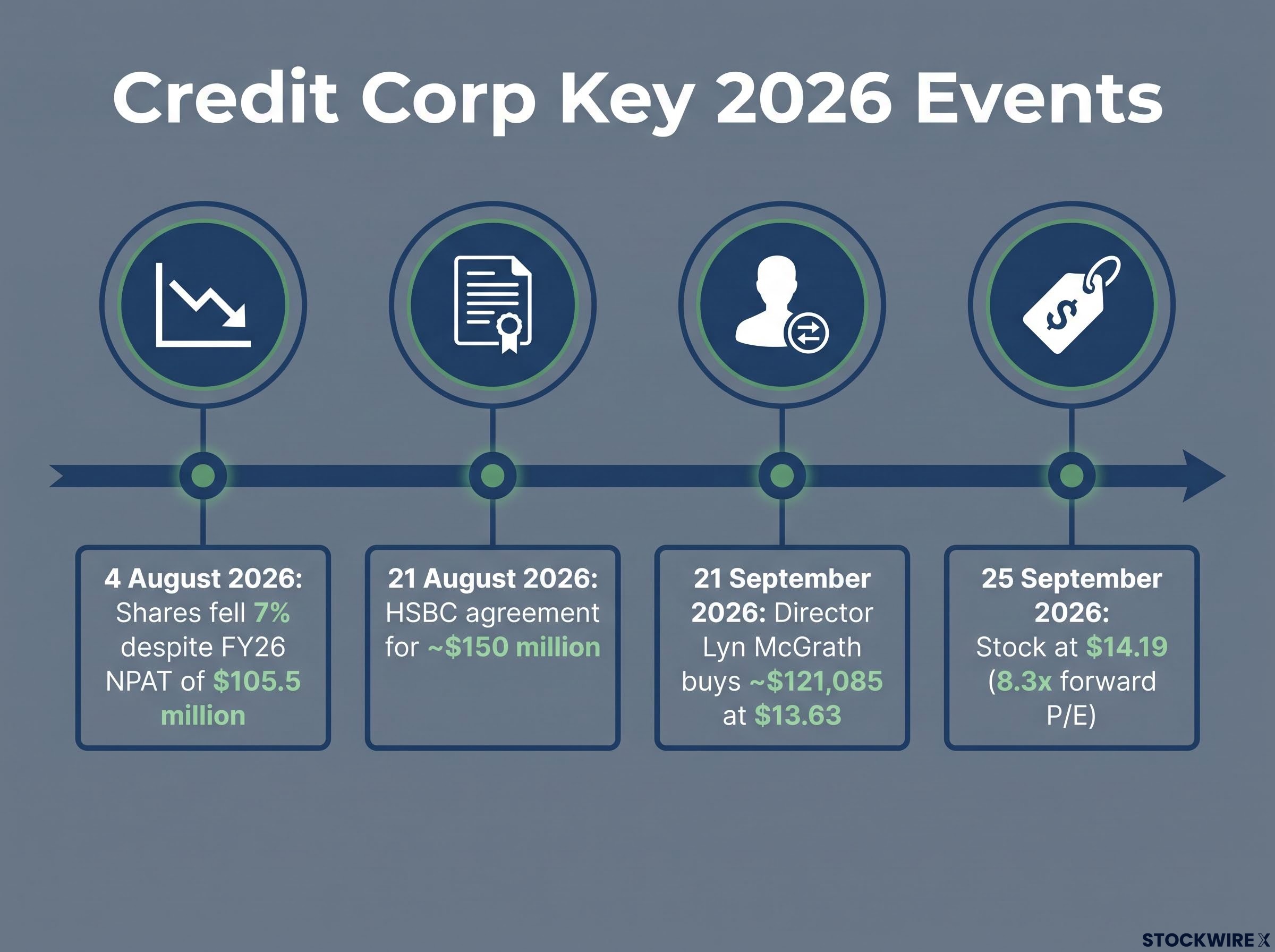
Credit Corp shares fell 7% on 4 August 2026 despite the debt purchaser reporting FY26 net profit after tax of $105.5 million and edging past the earnings consensus by roughly 1%. The market was not selling the result. It was selling the guidance.
The FY26 result that preceded the sell-off was itself a strong one: the record FY26 result included a 57% constant-currency surge in US debt buying NPAT, a 14% dividend lift, and record AU/NZ loan book volumes, which makes the market’s negative reaction to the guidance a more precise read of investor concern than a general loss of confidence in the business.
Two events since then have reshaped the calculus. On 21 August 2026, Credit Corp signed a binding agreement to buy HSBC’s Australian credit-card run-off book for approximately $150 million, lifting its FY27 purchased debt ledger acquisition guidance from $200-280 million to $300-380 million. Then, on 21 September 2026, incoming independent director Lyn McGrath bought about $121,085 worth of shares on-market at $13.63, her first significant holding in the company.
The stock has since recovered to $14.19, implying a forward price-to-earnings ratio of roughly 8.3x on the upgraded guidance midpoint.
This piece works through what the HSBC deal actually does to Credit Corp’s earnings engine, whether that 8x multiple is a genuine discount or a well-priced set of risks, and what the director purchase adds to the case. The aim is to give you a framework for deciding whether this is a value opportunity or a value trap.
What the HSBC deal actually adds to Credit Corp’s earnings engine
A run-off book is not a stack of debts a bank has already given up on. It is a live portfolio in wind-down: HSBC stops issuing new cards, deactivates the ones on issue, and lets the balances repay or write off over time with no new originations feeding in.
Credit Corp is buying that closed book and taking on the collection risk. What matters for the investment case is duration. These receivables carry a shorter duration than a typical charged-off ledger, which means the cash comes back faster and the tail risk is lower.
For a $150 million outlay where the final consideration is set closer to completion, faster realisation is exactly what you want. It shortens the window between paying out capital and getting recoveries back through the door.
The guidance revision on 21 August 2026 makes the impact unusually clean to trace. The entire uplift in Credit Corp’s acquisition guidance came from the Australia and New Zealand PDL component, which jumped from $100-150 million to $200-250 million. The US allocation did not move at all, holding steady at $100-130 million.
| Metric | Pre-HSBC guidance | Post-HSBC guidance |
|---|---|---|
| Total PDL acquisitions | $200-280 million | $300-380 million |
| AU/NZ component | $100-150 million | $200-250 million |
| US component | $100-130 million | $100-130 million (unchanged) |
| FY27 NPAT | $110-118 million | $112-120 million |
| FY27 EPS | $1.61-$1.73 | 164-176 cents |
The FY27 NPAT guidance now sits at $112-120 million, up from $110-118 million before the deal.
The growth read The upgraded FY27 NPAT midpoint of roughly $116 million represents approximately 10% growth on the FY26 result of $105.5 million, with the entire lift attributable to a single transaction.
Here is the interpretive point. The AU/NZ PDL segment contributed about 22% of group profit in FY26, per Macquarie, and this one deal roughly doubles its guidance allocation. That tells you Credit Corp’s FY27 earnings profile is now substantially event-driven, resting on one large ledger completing in early calendar 2027 rather than on a steady pipeline of smaller purchases.
When big ASX news breaks, our subscribers know first
How purchased debt ledger economics work, and why this deal fits the model
The core of a debt purchasing business is simple to state and hard to execute. Credit Corp buys non-performing consumer receivables, mostly credit-card debt, at a steep discount to face value, then collects on them over years using its own internal teams.
Value is created when the cash recovered exceeds the purchase price plus the cost of collecting and funding it, at a return that clears the company’s cost of capital. Pricing is driven by expected net recoveries discounted back at a target hurdle rate, so the discipline sits entirely in how accurately management prices what it can actually collect.
The HSBC portfolio applies that model with one important structural twist. It is a run-off book, not a fully charged-off one, so the accounts carry live balances that will amortise down rather than debts the bank has already written off entirely.
That distinction shapes the cash-flow profile:
- Shorter duration: recoveries are realised faster than on an older, aged ledger.
- Front-loaded cash flows: capital returns to Credit Corp over a compressed near-term window.
- Live balances amortising: the book winds down as customers repay, rather than being a pool of long-dead accounts.
Credit Corp states the portfolio is priced to achieve its internal hurdle return. That is the confidence the deal rests on.
But there is a limit to what you can verify. No gross face value for the HSBC book has been publicly disclosed, which means the implied purchase-price-to-face-value ratio cannot be checked independently. For now, backing this deal is an act of informed trust in management’s pricing discipline, not something you can confirm with arithmetic.
Why shorter duration changes the risk profile
Faster recovery cuts both ways. It reduces tail risk, because Credit Corp is not waiting years for cash and exposed to a long tail of uncertainty.
The trade-off is timing sensitivity. With recoveries locked in over a compressed window, there is less runway for weak macro conditions to improve before the collections happen. That makes the HSBC portfolio more sensitive to the current interest-rate and cost-of-living environment than a longer-duration book would be, which feeds directly into the risk picture later.
Is 8x earnings a genuine discount, or does the multiple price the risk correctly?
Start with the bull case, because it is the easier one to make. At the $14.19 close on 25 September 2026, and an FY27 EPS midpoint of $1.70, the stock trades on an implied forward P/E of roughly 8.3x.
The broker view Macquarie retained its Outperform rating after the HSBC agreement and lifted its target price to $14.37 from $13.34, describing the valuation as attractive at around 8x forward earnings while flagging limited visibility on FY27 acquisition volumes.
Then there is the director signal. McGrath paid $13.63 on 21 September 2026 for her first substantial holding, roughly 7% above the post-result low of $12.78. Australian equity investors generally read net director buying as a confidence signal, and academic and practitioner evidence supports the idea that insider purchases tend to precede positive returns on average. Treat it as informative, not determinative: it is a supplementary input to the valuation, not a substitute for one.
Director buying patterns across the August 2026 reporting season showed that the strongest signals came from purchases made into share price falls, particularly where multiple directors acted within a narrow time window, a configuration that gives McGrath’s single purchase at Credit Corp a more modest signal weight in isolation.
Now the pivot. There are structural reasons the market may be right to cap the multiple here rather than mispricing the stock.
That pattern has precedent: the share price valuation gap that opened after Credit Corp’s 1H FY26 result, when the stock fell despite management reaffirming full-year guidance, followed the same structure of the market pricing a probability-weighted downside scenario rather than the stated guidance midpoint.
- Deal concentration: the FY27 upgrade depends heavily on one large transaction completing on schedule, not a diversified pipeline.
- Wide guidance range: the acquisition guidance spans $80 million, from $300 million to $380 million, signalling that outcomes hinge on deal execution rather than operational certainty.
- Cyclical sensitivity: earnings tied to consumer-debt recoveries move with the credit cycle, and the FY24 US PDL impairment of $65 million is fresh enough in memory to keep investors cautious.
So the question the multiple poses is a clean one. A stock on 8x forward earnings with an Outperform rating and a director buying her first stake looks like value on the surface. What you have to decide is whether the wide guidance range and single-deal dependency justify that modest multiple, or whether those risks are already more than priced in at current levels.
What could go wrong, and which risks carry the most weight
Not all of these risks are equal, so it helps to move from the broadest to the most specific and finish on the one that actually moves near-term numbers.
PwC Australia’s 2026 M&A outlook for financial services identifies value concentration in large single transactions as a defining feature of dealmaking this year, a pattern the HSBC run-off book acquisition fits precisely given its outsized share of Credit Corp’s upgraded acquisition guidance.
- Consumer-credit stress: rising rates and cost-of-living pressure reduce recovery rates on credit-card portfolios, and the HSBC book’s shorter duration concentrates that exposure in the near term rather than spreading it across years.
- Regulatory delay on HSBC completion: the deal is conditional on regulatory approval and on HSBC deactivating its cards before transfer, both of which sit between now and early 2027.
- Competitive compression: multiple buyers compete for Australian bank ledgers, and elevated competition risks compressing returns on future deals beyond HSBC.
- US segment volatility: the US PDL allocation is unchanged at $100-130 million, a segment that has historically been more volatile for Australian debt buyers and carries its own execution risk.
For investors wanting to situate the US PDL segment’s volatility within the broader macro backdrop, our dedicated guide to US credit cycle risk examines how rising rates and compressed consumer debt serviceability translate directly into recovery-rate pressure on non-performing receivables portfolios.
Consumer-credit conditions are the biggest structural risk, because they drive recovery rates across the whole book. Regulatory scrutiny of collections in Australia, covering hardship practices, communications, and data handling, is a persistent overhang: any tightening or enforcement action compresses PDL returns.
But the risk that most directly moves FY27 guidance is regulatory delay on the HSBC transaction itself. The revised earnings case leans substantially on that one deal completing in early calendar 2027. Any slippage would push actual PDL acquisitions toward the lower end of the $300-380 million range and soften the NPAT uplift the market is now paying for.
That is the practical takeaway. Investors in debt purchasers tend to watch the acquisition pipeline and underweight execution risk at the individual deal level. Here, the timeline to HSBC completion is the single most important data point to monitor between now and early 2027.
What the combined picture means for investors weighing the stock today
Put the four threads together and the decision sharpens into a straightforward trade-off.
The bull case:
- Trades at roughly 8.3x forward earnings at $14.19.
- Macquarie Outperform with a $14.37 target.
- A director backing the stock with personal capital at $13.63.
- A binding deal that lifts FY27 NPAT guidance by approximately 10% at the midpoint.
The bear case:
- Guidance range is wide, spanning $80 million.
- The upgraded case depends on one transaction completing with regulatory clearance.
- Consumer-credit conditions are the primary driver of returns.
- The modest multiple may be a rational read of these uncertainties, not a mispricing.
The numbers frame just how fine the margins are. Macquarie’s $14.37 target implies only about 1% upside from the 25 September 2026 close, while McGrath’s $13.63 entry sits roughly 4% below current levels, a thin buffer to the director’s own price.
What you are actually betting on At $14.19, you are paying a modest multiple for a business with a credible 10% growth catalyst, a board member backing it with her own money, and a broker Outperform. The near-term outcome, though, is close to binary on a single regulatory and operational event.
That risk profile suits investors comfortable with event-driven concentration, not those wanting a smooth earnings ramp. Two events will most sharpen the case from here: confirmation of regulatory approval and completion of the HSBC transaction, and any trading update that clarifies how the AU/NZ PDL pipeline is tracking outside the HSBC deal.
This article is for informational purposes only and should not be considered financial advice. Investors should conduct their own research and consult with financial professionals before making investment decisions. Past performance does not guarantee future results. Financial projections and forward-looking guidance are subject to market conditions and various risk factors, and remain speculative until confirmed.