A technology company just agreed to pay roughly 60% above forward market rates for electricity, and it locked that premium in for 22 years. Both parties described the arrangement not as a one-off but as the template for what comes next.
That is a strange thing for a rational buyer to do. It is stranger still when you consider that the seller is a nuclear operator, an asset class that most of Europe was trying to phase out a decade ago.
The Google-Fortum deal, signed on 9 September 2026, is one visible data point in a thesis that has been quietly converging. AI infrastructure is generating electricity demand that renewables alone cannot reliably serve, European nuclear policy has reversed course, and the European Commission now estimates roughly €241 billion in capital is required to fund the sector through 2050. Investors who read that convergence early are positioned differently from those still treating nuclear as politically toxic.
What follows here gives you the components to assess whether the case holds up: the demand mechanics that created the opportunity, the deal structure as a valuation signal, the policy shift that removed the political risk premium, and the risks that genuinely complicate the bull narrative.
The electricity gap that nuclear is being asked to fill
Before anyone proposes a solution, look at the size of the problem. European data centre electricity demand is already large and growing faster than firm supply can keep up.
AI energy demand is not a soft projection: the IEA estimates combined data centre and AI electricity consumption will exceed 1,000 TWh by 2026, more than doubling in four years and creating a structural mismatch between intermittent renewable supply and the continuous load profiles that hyperscale infrastructure requires.
Here are the four numbers that frame the gap:
- Current European data centre electricity usage: approximately 70 TWh, according to European Commission projections cited by J.P. Morgan
- Projected usage by 2030: approximately 115 TWh
- Announced development pipeline at end-2025: 66.1 GW, against just 10.8 GW of operational capacity
- The Nordics and Iberia together account for around 45% of the projected demand increase
The single figure that best conveys the scale is the incremental requirement.
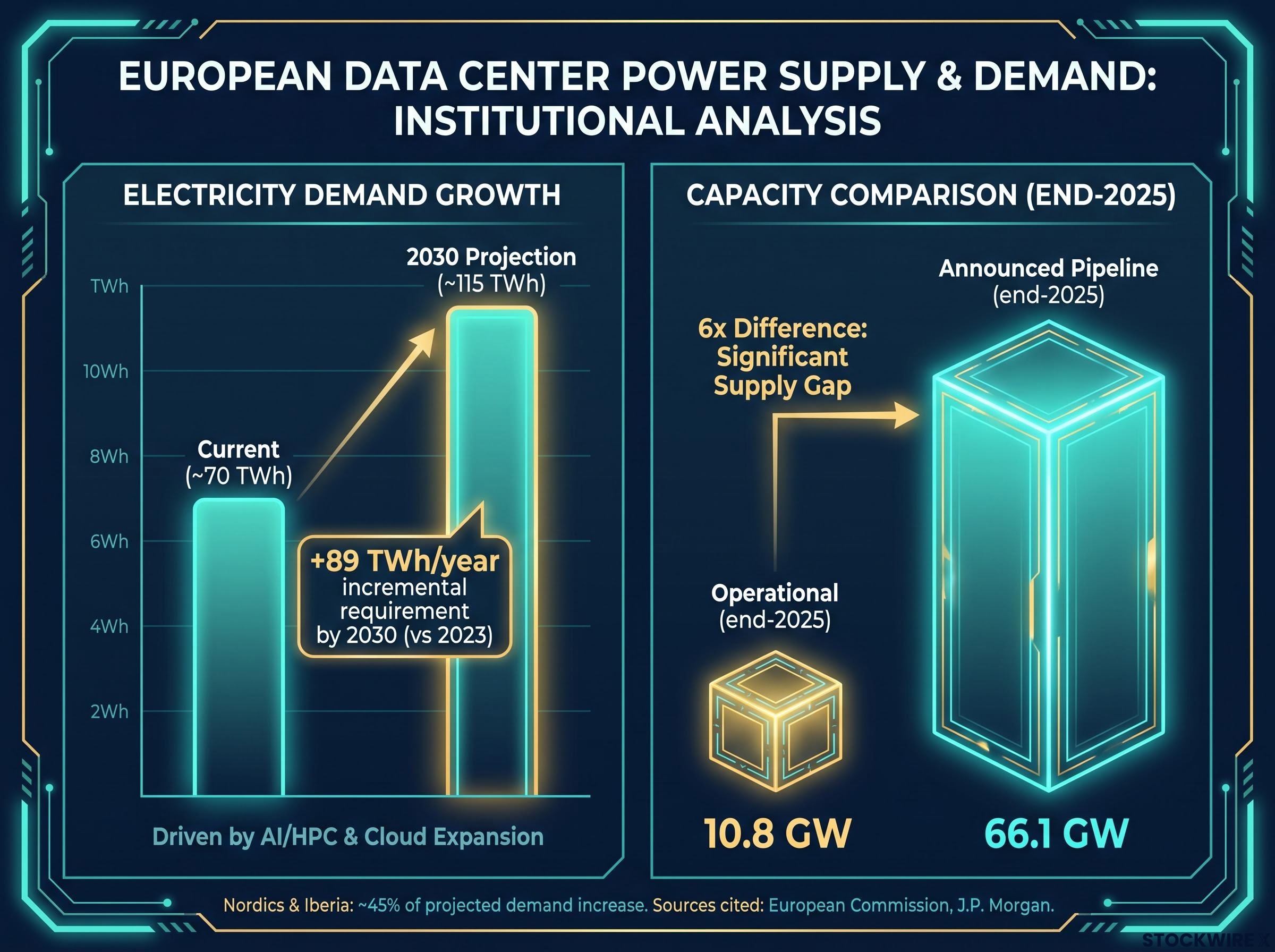
89 TWh per year. J.P. Morgan estimates that is how much additional annual power European data centres will need by 2030 relative to 2023 levels.
The gap between committed investment and deployed infrastructure is itself a pricing mechanism. A pipeline of 66.1 GW sitting on top of 10.8 GW operational tells you that demand in high-growth regions is not a forecast, it is a structural condition already forming. Assets that can deliver firm, schedulable output into that environment carry a scarcity premium that is becoming measurable.
| European data centre metric | Current state vs 2030 projection |
|---|---|
| Annual electricity demand | ~70 TWh today, rising to ~115 TWh by 2030 |
| Operational capacity (end-2025) | 10.8 GW deployed against a 66.1 GW announced pipeline |
| Incremental annual requirement | +89 TWh/year by 2030 vs 2023 levels |
Why does this profile favour nuclear specifically? AI-focused data centres run close to 24 hours a day with highly inelastic demand, meaning they cannot simply switch off when supply tightens. That continuous, high-volume load has very little tolerance for the gaps that intermittent wind and solar leave behind.
In tight bidding zones, the regional pricing areas where wholesale electricity is bought and sold, concentrated demand outpacing local firm supply pushes peak-hour prices higher. That improves the revenue case for existing nuclear and makes long-term offtake contracts economically rational for both buyer and seller.
For an investor, this determines whether the thesis is cyclical or structural. If it were tied only to current AI enthusiasm, it would fade with sentiment. The evidence points to physics and grid architecture, which changes how you should think about the duration of the opportunity.
When big ASX news breaks, our subscribers know first
What the Google-Fortum deal actually signals about nuclear asset pricing
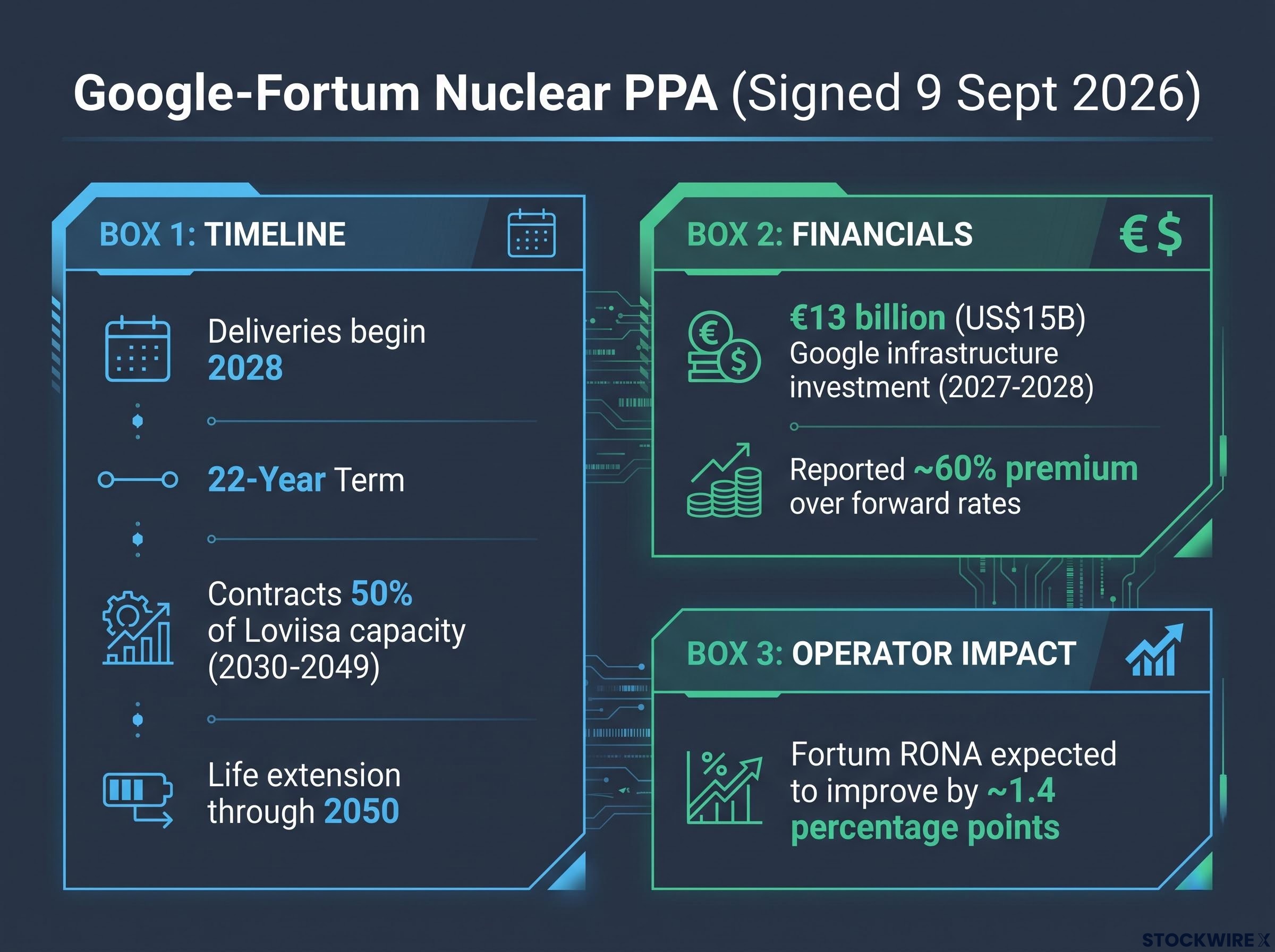
The deal is a concrete object you can hold. Fortum and Google signed a 22-year power purchase agreement, or PPA, tied to the Loviisa nuclear plant in Finland. A PPA is a contract where a buyer agrees to purchase a set volume of electricity at agreed terms over a fixed period.
Deliveries to Google’s Finnish data centre infrastructure begin in 2028 at reduced volume, then ramp so that Google contracts up to 50% of Loviisa’s operating capacity across 2030-2049. Fortum describes it as a life extension PPA, one that provides the revenue certainty needed to fund Loviisa’s operation through 2050.
Alongside the contract, Google announced a €13 billion (approximately US$15 billion) investment in Finnish data centres and supporting infrastructure over 2027-2028.
Why pay a premium when spot markets exist?
The obvious objection: if electricity trades on open markets, why lock in a premium reported at roughly 60% above forward rates? (That figure came from the original source reporting and was not independently confirmed in the broader research layer, so treat it as indicative.)
The answer sits in the difference between annual net-zero pledges and genuine 24/7 carbon-free procurement. Spot markets cannot guarantee clean supply at every hour, and buying carbon credits is not the same as procuring firm clean energy. Nuclear covers night-time and low-wind periods without offsets.
There is also an asymmetry worth naming. A known premium today hedges unknown upside price risk in a tightening European power market. For a company committing €13 billion to physical infrastructure, price certainty over the asset’s operational life is worth paying for.
And 22 years of contracted volume removes a planning dependency entirely. The data centre build can proceed without ongoing energy procurement as a live variable.
The financial impact on the operator is where the deal stops being a headline and becomes an investor metric.
Fortum’s Group comparable return on net assets (RONA) is expected to improve by approximately 1.4 percentage points once 50% of Loviisa’s capacity is contracted, according to Fortum’s corporate announcement.
RONA measures how efficiently a company generates returns from the assets it owns. A 1.4 percentage point uplift from a single long-term contract demonstrates that a contracted nuclear revenue stream can move a utility’s return profile by a measurable increment. That is the kind of evidence that changes how institutional capital weights the sector.
This is not without precedent. US hyperscalers got here first:
- Microsoft, Meta, Amazon, and Google have all completed nuclear offtake deals within the United States
The Fortum agreement extends that proven US model into Europe. Its replicability across other European operators is the central question for anyone assessing sector exposure, and the terms here provide a benchmark for what future contracts might look like.
Europe’s nuclear policy reversal and the €241 billion capital requirement
The demand argument only matters if the policy environment allows nuclear to answer it. It now does. A number of European nations have reversed earlier anti-nuclear stances, either extending reactor operational lifespans or endorsing new construction.
That reversal removes a category of risk that previously kept institutional capital away. For mandates operating under environmental, social and governance (ESG) constraints, the political normalisation of nuclear takes a structural deterrent off the table.
The scale of what needs funding is where the opportunity becomes concrete. The European Commission estimates approximately €241 billion in investment will be required through 2050, covering both new large-scale reactors and life extensions of existing plants.
The European Commission nuclear investment needs assessment, drawn from the 8th Nuclear Illustrative Programme published in June 2025, sets the €241 billion figure across lifetime extensions and new reactor construction, giving investors a formally endorsed capital deployment map through 2050.
Do not read that as a cost to fear. Read it as a capital deployment pipeline to map. Knowing where the money flows first, into life extensions before selective new builds, tells you which part of the value chain captures returns earliest and with the least execution risk.
The nuclear supply chain carries constraints that are distinct from uranium pricing or reactor policy: reactor pressure vessels and heavy forgings have procurement lead times of four to five years, and only a handful of qualified global manufacturers can supply them, meaning the capital deployment timeline is shaped as much by manufacturing capacity as by financing.
| Investment type | Rationale | Timeline horizon |
|---|---|---|
| Life extensions | Cost-effective relative to new fossil capacity; lower execution risk on proven assets | Near-term, revenue often already contractable |
| Selective new builds | Meet demand where extensions are exhausted; higher capital intensity | Medium to long-term |
| SMR potential | Siting flexibility near demand; commercialisation unproven (detail follows) | Early 2030s at the earliest |
The IEA and OECD Nuclear Energy Agency (OECD-NEA) have argued that extending the life of existing reactors can be cost-effective relative to building new fossil fuel capacity. That framing points capital toward regulated utilities and long-term investors first.
The opportunity spreads across three categories of beneficiary:
- Operators with existing plants and extension potential, who capture contracted revenue soonest
- Project financiers funding the front end of the build-out
- Supply-chain participants serving construction, components, and maintenance across the cycle
The Google-Fortum partnership hints at how this deepens. Beyond the PPA, the two signed a Memorandum of Understanding covering joint development of new nuclear, renewable capacity, flexibility solutions, and energy portfolio management. That is Big Tech beginning to de-risk the front end of the capital formation problem, not just buying power at the back.
The bear case: cost overruns, SMR uncertainty, and what the bull narrative glosses over
None of the above is worth much if the capital cannot be deployed on time and on budget. On that question, European nuclear has a documented record that deserves genuine weight, not a polite caveat.
Three projects sit at the centre of the sceptical case: Flamanville 3 in France, Olkiluoto 3 in Finland, and Hinkley Point C in the UK. Each became a byword for delay and cost overrun. That history is not rhetorical decoration; it is rational grounds for caution about any new large-scale build.
Energy economists add regulatory uncertainty to the pile. Shifting policy in some EU member states and complex EU taxonomy debates can alter project economics late in the planning cycle. Combined with front-loaded capital expenditure and long development timelines, investors absorb technology, policy, and market risk for years before a single euro of revenue arrives.
There is also a subtler point hiding inside the bull case itself. The reported 60% PPA premium validates nuclear’s scarcity value, but it also confirms that nuclear power is now priced as a premium asset rather than a cheap baseload commodity. Scarcity cuts both ways.
SMRs: the 2030s solution that may not arrive on schedule
Small modular reactors, or SMRs, are the part of the story most likely to be oversold. The potential is real: a smaller physical footprint allows deployment closer to load, near data centre hubs or industrial clusters, which reduces transmission dependency and could make projects faster to finance than conventional reactors. That is why system planners and data centre operators are watching them.
The reality is more constrained. No commercially operating SMRs exist anywhere in Europe, most designs remain in pre-commercial or early licensing phases, and first European projects are targeted only for the early 2030s.
The specific risks fall into three buckets:
- Technology readiness: licensing frameworks were designed for large reactors and must be adapted, creating lengthy, uncertain approval processes
- Financing model uncertainty: real-world SMR cost data is limited, making it hard to assess whether they genuinely reduce risk versus conventional reactors
- Grid integration complexity: small units still pose local cooling, safety, and waste-management challenges and require careful coordination with existing generation and transmission
The most authoritative bear-case voice comes from the institutions themselves.
The IEA and OECD-NEA have warned that over-reliance on unproven SMR deployment timelines in decarbonisation scenarios could create a supply gap if projects slip, necessitating more aggressive deployment of renewables, efficiency, and demand-side resources as a backstop.
The framing to leave with is straightforward. SMRs are a plausible future layer of the investment thesis, not its current foundation.
Put the two halves together, a proven cost-overrun record for large builds and an unproven commercialisation path for SMRs, and the headline thesis cannot simply be bought wholesale. The question is not whether nuclear is valuable. It is whether the capital required to unlock that value can be deployed on time and on budget. On that, the evidence is genuinely mixed.
A credible bear case does not invalidate the thesis. It sharpens it. Investors who understand these specific failure modes are better placed to separate operators with credible life-extension programmes, where execution risk is lower, from those leaning on new builds or SMR timelines that remain speculative.
Making a considered call on European nuclear exposure
The evidence resolves into two investor-relevant sub-theses, and they carry very different risk profiles. Life extensions of existing plants are where the Google-Fortum model applies most directly: revenue certainty is demonstrated, and execution risk is comparatively low. New builds and SMRs sit at the other end, where capital intensity and timeline uncertainty are substantially higher.
| Sub-thesis | Evidence base | Key risk | Timeline |
|---|---|---|---|
| Life extensions | Google-Fortum PPA; ~1.4pp RONA uplift; IEA/OECD-NEA cost-effectiveness view | Policy stability in key jurisdictions | Near-term, actionable now |
| Selective new builds | €241bn capital requirement; demand demonstrated | Cost overruns (Flamanville, Olkiluoto, Hinkley) | Medium to long-term |
| SMR plays | Siting advantages; hyperscaler interest | Unproven commercialisation and licensing | Early 2030s, speculative |
The corporate PPA trend is itself a structural de-risking mechanism for operators. As more hyperscalers replicate the Google-Fortum template across other European nuclear assets, revenue visibility improves and the case for institutional capital strengthens progressively. The 1.4 percentage point RONA uplift is the benchmark for what one contracted stream can do; the MOU on co-developing new nuclear, renewables, and flexibility shows how much deeper a Big Tech-operator relationship could go.
Three variables will determine whether the bull case holds through the decade:
- Policy stability across key European jurisdictions, since late-cycle regulatory shifts remain the most immediate threat to project economics
- Actual versus targeted SMR commissioning timelines, which decide whether the longer-duration layer of the thesis materialises at all
- The pace of additional Big Tech PPAs for European nuclear capacity, the clearest signal that the US-proven model is genuinely crossing the Atlantic
The read to take is this: the case is strongest and most immediately actionable in life-extension plays backed by contracted revenue. The further along the timeline you look, toward new builds and SMRs, the more it depends on execution that has not yet been demonstrated.
This article is for informational purposes only and should not be considered financial advice. Investors should conduct their own research and consult with financial professionals before making investment decisions.
Past performance does not guarantee future results. Financial projections are subject to market conditions and various risk factors. Forward-looking statements are speculative and subject to change based on market developments and company performance.