The United States and China agreed to cut tariffs on $30 billion of goods on each side during Xi Jinping’s Washington summit, and the truce that frames it now runs to a hard deadline of 10 January 2027.
That single arrangement sits inside a trade conflict that opened in early 2025 and has never fully cooled. This is not a comprehensive reset. The $30 billion figure applies to each direction and covers only goods both governments have labelled “non-sensitive,” which leaves the most contested technology and security sectors exactly where they were.
What follows here is a breakdown of which sectors see relief, which institutional mechanisms are now live, where the truce actually ends, and what the agreement pointedly does not cover. Read it as portfolio context, not diplomatic commentary.
What the Washington summit actually agreed to
The headline deliverable is the reciprocal tariff cut. According to a White House fact sheet and Chinese state agency Xinhua, both governments agreed on more favourable tariff treatment for $30 billion of non-sensitive goods in each direction, reported across outlets between 25-27 September 2026.
That tariff arrangement is one element of what Chinese state media and U.S. outlets both describe as an “eight-point consensus.” The framework bundles the tariff cuts together with new institutional bodies and a fresh dialogue channel rather than treating tariffs as the entire story.
The four concrete deliverables are worth separating:
- A reciprocal tariff-reduction arrangement covering $30 billion of non-sensitive goods per side
- The operationalisation of two bilateral bodies, the U.S.-China Board of Trade and the U.S.-China Board of Investment
- The launch of a new U.S.-China artificial intelligence (AI) dialogue, described as consultative rather than binding
- An extension of the existing trade truce to 10 January 2027
Beijing has signalled it takes the follow-through seriously. Commentary tied to CCTV, as reported by Bloomberg, pressed government agencies to act on the agreement:
Chinese state media called on government agencies at all administrative levels to take concrete steps to implement the bilateral consensus.
For investors, that directive matters more than the ceremony. It tells you Beijing is framing this as an active obligation, which makes implementation, not announcement, the variable to watch in the months ahead.
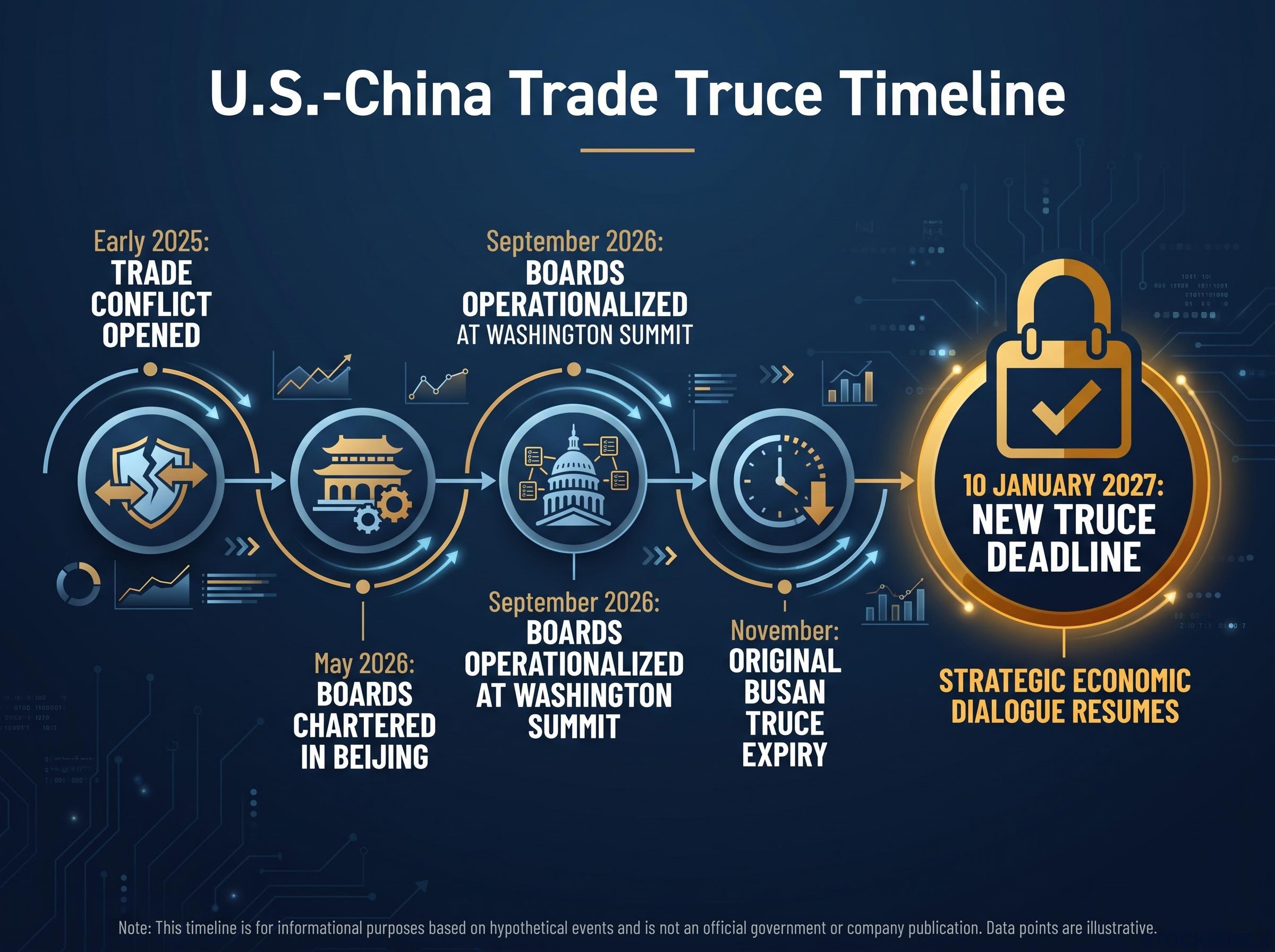
The gap between summit announcements and Beijing’s confirmed commitments has been a recurring theme since the trade conflict opened, with the May 2026 Beijing summit producing a preliminary consensus on tariffs and bilateral councils but no formal published agreement, tariff schedule, or implementation timeline from either government.
The truce extension and Kuala Lumpur carryover
The Washington deal does not stand alone. CNBC reports that an earlier truce struck after the two leaders met in Busan had already lowered U.S. tariffs and suspended Chinese controls on rare earths and critical minerals.
That Busan truce was due to expire in November. The Washington summit pushed it out to 10 January 2027, buying both sides roughly a year of reduced friction.
Both leaders also endorsed extending the outcomes of earlier negotiations held in Kuala Lumpur under the Washington framework, per Yahoo News. The specific substantive commitments carried over have not been publicly disclosed, so the extension is confirmed in principle but opaque in detail.
When big ASX news breaks, our subscribers know first
Which sectors see direct tariff relief, and which do not
The relief runs in two directions, and the asymmetry is the point. U.S. exporters gain on farm and industrial categories heading into China, while Chinese exporters gain on consumer goods heading into the United States. Neither list touches the sectors that started the fight.
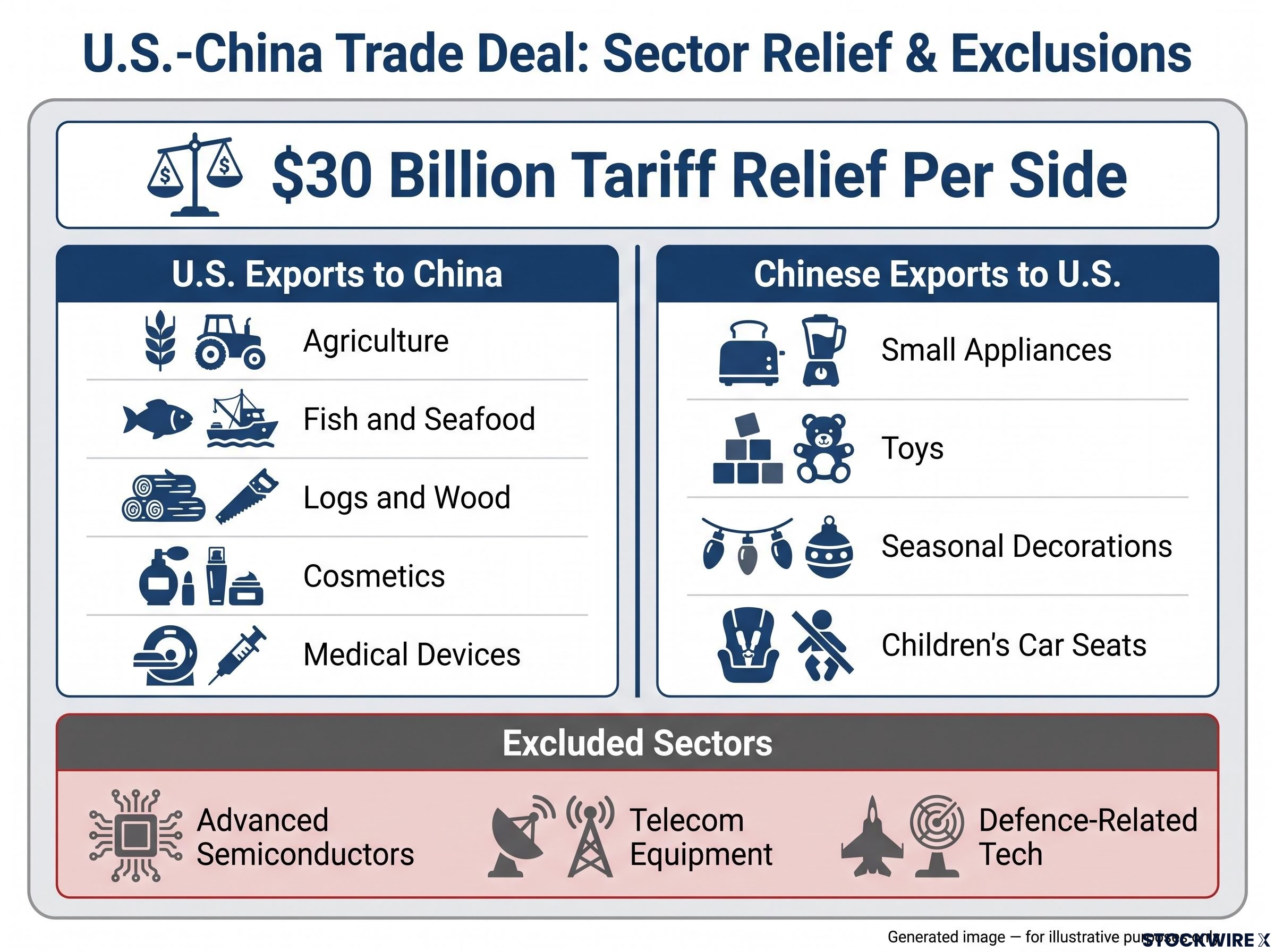
On the U.S. side, the goods set to see better Chinese tariff treatment include agricultural products, fish and seafood, logs and wood products, cosmetics, and medical devices. On the Chinese side, U.S. tariff relief covers small household appliances, toys, holiday and seasonal decorations, and children’s car seats.
| Trade direction | Sector | Notes |
|---|---|---|
| U.S. exports to China | Agriculture, fish and seafood, logs and wood | Broad farm goods and forestry products gain favourable Chinese treatment |
| U.S. exports to China | Cosmetics, medical devices | Personal care and medtech exporters see improved access |
| Chinese exports to U.S. | Small appliances, toys, seasonal decorations, children’s car seats | Consumer-goods categories gain lower U.S. tariffs |
| Excluded (both directions) | Advanced semiconductors, telecom equipment, defence-related tech | Strategic sectors remain outside the arrangement entirely |
The exclusions carry the real signal. Advanced semiconductors, telecom equipment, and defence-related technologies sit outside the deal, which tells you the structural sources of U.S.-China tension are intact. Any equity positioning built on the idea of a broader technology thaw finds no support in the deal’s actual text.
The headline tariff reduction from 57% to 47% excludes all strategic sectors, with Chinese electric vehicles remaining at approximately 102.5% total duties and lithium-ion EV batteries at 25%, none of which received any relief under the Busan framework that Washington has now extended.
One caveat governs the entire arrangement:
No specific tariff rates, HS-coded product lines, or reduction percentages have been publicly disclosed. The $30 billion aggregate per side is the only confirmed figure.
If you hold U.S. agribusiness, seafood, forestry, cosmetics, or medical-device names, this deal gives you the clearest near-term read-through. If your exposure sits in technology and semiconductors, summit optimism is not a signal of relief in your corner.
The institutional architecture: what the new trade and investment boards are designed to do
Step back from the tariff lines and a longer-term structure comes into view. The boards are both the mechanism that produced this deal and the channel through which future concessions or disputes will run.
The U.S.-China Board of Trade and the U.S.-China Board of Investment were first chartered during Trump’s Beijing visit in May 2026. They were operationalised only during Xi’s Washington visit in September 2026, which makes this summit the moment they became active rather than the moment they were conceived.
A separate trade council was also announced, linked to the extension of the Kuala Lumpur negotiations. Its detailed remit has not been made public.
| Body | Chartered | Status |
|---|---|---|
| U.S.-China Board of Trade | May 2026 (Beijing) | Operationalised September 2026; produced the tariff deal |
| U.S.-China Board of Investment | May 2026 (Beijing) | Operationalised September 2026; parallel investment mandate |
| Trade council | Announced September 2026 | Linked to Kuala Lumpur; remit not public |
| AI dialogue | Launched September 2026 | Consultative, not binding |
Much of the machinery remains a blank page:
- Leadership across all three bodies is undisclosed
- Membership composition is undisclosed
- Meeting schedules are undisclosed
- Detailed mandates and governance rules are undisclosed
The four-month gap between charter and activation tells you the institutional architecture was always the intended deliverable here. For your purposes, the useful posture is to track what these bodies actually produce, not to treat their creation as a resolution. They are the first standing bilateral channel of this trade-war cycle, but output is what will move market conditions.
What the deal does not resolve, and why that matters for portfolios
After three sections of anatomy, the structural reality reasserts itself. The deal’s own “non-sensitive goods” framing means the sectors that defined the trade war, advanced semiconductors, critical defence technologies, and telecom equipment, are simply not in it. Axios notes the core U.S. complaints about Chinese industrial policy and technology practices go unaddressed.
The reporting splits on how much this matters, and the divide is worth seeing plainly:
CNBC characterised the visit as “state visit spectacle over substance,” while Headtopics called the agreement “one of the most significant cooldowns in the trade war that began in early 2025.”
DW landed somewhere in between, running its coverage under the question of whether the summit produced results or just symbolism. Reuters and Xinhua-mediated accounts emphasised the pragmatic institution-building instead.
The unresolved items are the ones to keep on file:
- Strategic sectors excluded from any relief
- Implementation dependent on active follow-through across multiple levels of Chinese government
- Truce expiry fixed at 10 January 2027
- Kuala Lumpur specifics still undisclosed
- AI dialogue explicitly consultative, with no binding commitments
For anyone holding trade-sensitive equities, that expiry date is the single most actionable takeaway. The window of reduced tension has a confirmed close, and the sectors sitting outside the deal stay exposed to the underlying conflict throughout. Treating this summit as a durable settlement rather than a managed pause would misread both the text and the precedent.
The deal in context: where trade tensions stand heading into 2027
Look at Busan and Washington side by side and a pattern emerges: targeted sectoral relief plus a temporary truce extension, run twice. This is how both governments have chosen to manage the relationship rather than resolve it.
| Summit | Sectoral relief | Controls adjusted | Truce extended to |
|---|---|---|---|
| Busan | Reduced U.S. tariffs | Chinese rare earth and critical mineral export controls suspended | Was due to expire November |
| Washington | $30 billion non-sensitive goods per side | Boards operationalised; AI dialogue launched | 10 January 2027 |
The pattern tells you both sides have opted for managed tension over resolution. The most useful portfolio posture treats each truce extension as a bounded window of reduced risk, not evidence the structural conflict is closing.
Tariff pass-through costs from the 2025-2026 escalation have landed primarily on American households, with estimates attributing an additional $1,830-$2,600 in annual expenses per family and the St. Louis Fed attributing approximately 0.5 percentage points of annualised PCE inflation directly to tariff effects, a baseline context against which the Washington relief must be measured.
Three indicators deserve a place on your watchlist:
- Actual output from the Board of Trade and Board of Investment, not just their existence
- Signals around truce extension or expiry as November-December 2026 approaches
- Any disclosure of specific tariff rates or HS-coded product lines
The practical takeaway is clean: near-term relief is real but time-limited, the covered sectors are specific and disclosed, and the next catalyst is a date already on the calendar.
This article is for informational purposes only and should not be considered financial advice. Investors should conduct their own research and consult with financial professionals before making investment decisions.
These statements are speculative and subject to change based on market developments and policy decisions.