Tuas Limited reported a 30% net profit beat, grew revenue 24%, and lifted EBITDA 22%. On the day those numbers hit the market, the share price fell 23%.
That collision is the whole story. A company delivering its strongest financial year on record watched its shares crater to a three-year low, because the market is no longer trading on earnings. It is trading on an unresolved regulatory investigation.
The chain that got Tuas here is short and brutal. Singapore’s regulator opened a probe into spectrum use by Simba Telecom, Tuas’ Singapore subsidiary, then froze its review of the S$1.43 billion M1 acquisition, and the deal lapsed. The result is a year-to-date share price decline of roughly 75% at a company whose underlying operations kept growing throughout.
What follows here is an assessment of a single question. Has the market correctly priced the regulatory risk, or has it overshot? For an Australian investor holding TUA (ASX: TUA), the answer sits in the gap between what Simba earns and what Singapore’s regulator might eventually decide, and this analysis maps the variables that will determine which side of that gap proves right.
How Tuas went from a transformative deal to a 75% share price collapse
The collapse was not one event. It was a chain, and each link made the next one worse.
It started with capital. In August 2025, Tuas raised S$359.8 million specifically to fund the M1 acquisition, and it did so at no discount to the prevailing share price. That detail matters more than it first appears. A no-discount raise signals a company confident enough in its deal that it did not need to sweeten the terms to get money in the door.
Then the deal that money was raised for evaporated. Singapore’s Infocomm Media Development Authority (IMDA) opened an investigation into Simba’s spectrum use, and in May 2026 it suspended its review of the M1 merger. Reuters and CNA reported Tuas shares falling around 60% intraday, to approximately A$2.46, on the news alone.
The acquisition was subsequently confirmed as lapsed and terminated. For shareholders, this is where the no-discount raise turns from a confidence signal into a wound. The full amount of that capital was mobilised for a transaction that will now never happen, meaning shareholders absorbed the complete opportunity cost of money deployed for nothing. That is a wealth destruction event entirely separate from the falling share price.
The M1 collapse is a textbook demonstration of takeover speculation risks, where capital raised for a specific transaction becomes a liability the moment the deal dies, leaving shareholders with the opportunity cost of mobilised funds and no acquiree to show for it.
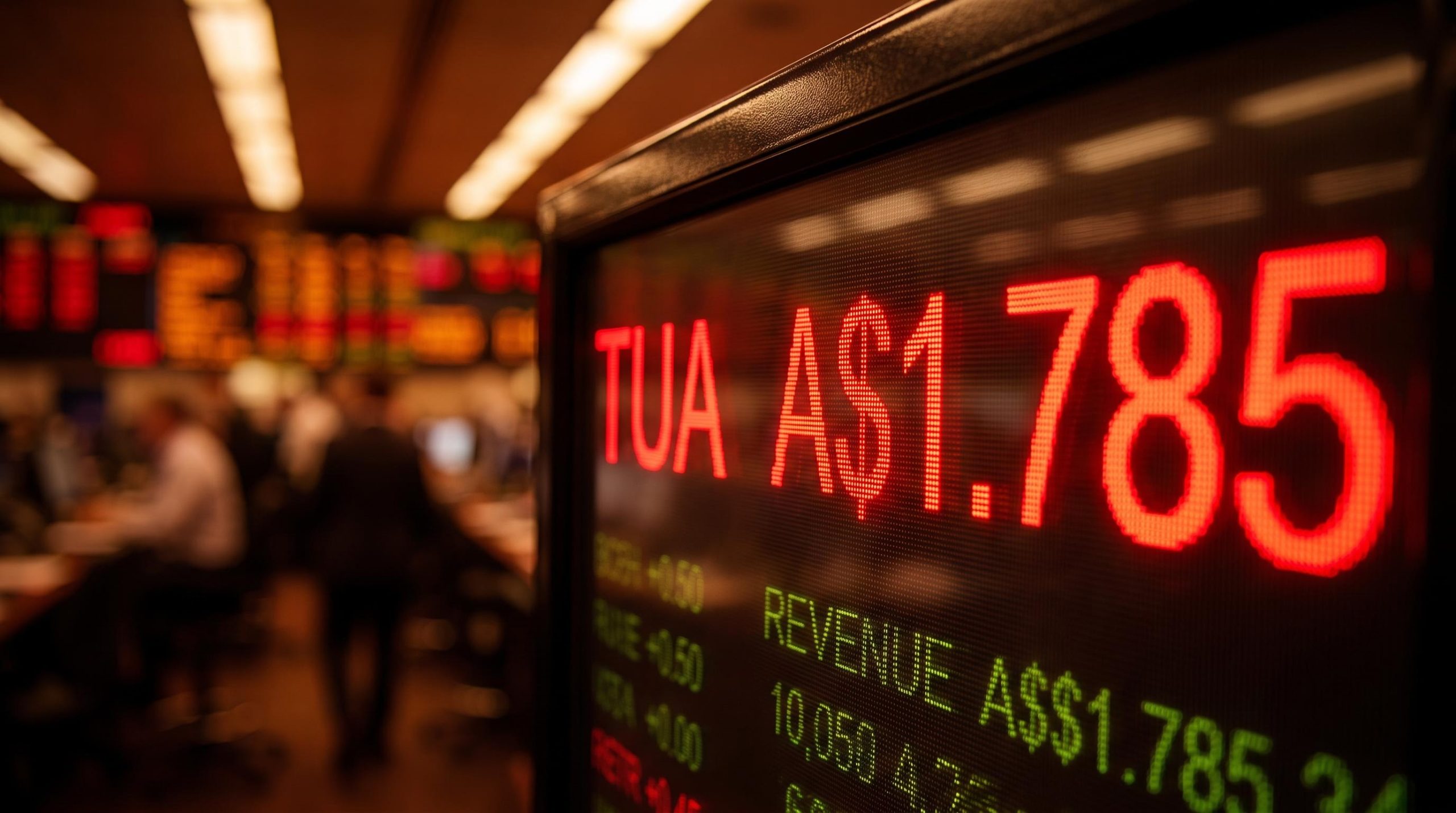
The final link came with the FY26 results. On 23 September 2026, Tuas shares opened at A$1.91 and closed at A$1.785, a fall of approximately 23.4%, hitting their lowest level in around three years. The results were strong. The market sold anyway.
Here is the sequence of shocks in order:
- August 2025: S$359.8 million raised at no discount to fund the M1 deal
- May 2026: IMDA suspends its M1 review; shares fall around 60% intraday to approximately A$2.46
- Mid 2026: The S$1.43 billion M1 acquisition confirmed as lapsed and terminated
- 23 September 2026: FY26 results released; shares fall approximately 23.4% to A$1.785 despite an earnings beat
What makes the probe impossible to dismiss as vague regulatory noise is that Tuas itself has conceded the underlying issue.
Company secretary Tony Moffatt acknowledged that some of Simba’s spectrum use went “outside the limitations” of what IMDA had permitted.
That admission is why each shock compounded rather than reversed. This is not a speculative overhang waiting to be cleared by a favourable ruling. The company has confirmed the conduct that triggered the investigation, which tells you the open question is not whether a breach occurred but what the consequences will be.
When big ASX news breaks, our subscribers know first
What the FY26 numbers actually show about Simba’s standalone health
Strip away the regulatory noise and look only at what Simba earned. The picture complicates the market’s verdict considerably.
The headline surprise was profit. FY26 underlying net profit after tax (NPAT) came in at S$29.6 million, against just S$6.9 million in FY25. That is a jump of roughly 277%, and it landed approximately 30% above Morgan Stanley’s S$22.7 million estimate. This was not a small beat around the edges. It was a substantial outperformance on the metric that most directly reflects the health of the business.
Revenue and earnings before interest, tax, depreciation and amortisation (EBITDA) told a consistent story. Revenue rose 24% to S$187.6 million, about 1% ahead of Morgan Stanley’s S$185.7 million forecast. Underlying EBITDA grew 22% to roughly S$83.7 million, again marginally ahead of the S$83.0 million estimate.
| Metric | FY25 Actual | FY26 Actual | Morgan Stanley Estimate | vs Estimate |
|---|---|---|---|---|
| Revenue | Not stated | S$187.6M | S$185.7M | +1% beat |
| Underlying EBITDA | Not stated | S$83.7M | S$83.0M | +1% beat |
| Underlying NPAT | S$6.9M | S$29.6M | S$22.7M | +30% beat |
| Mobile subscribers | Not stated | 1.458M | 1.505M | 3% miss |
What this tells you is important. A 30% NPAT beat delivered in the same period the deal collapsed and the investigation continued means Simba’s core economics are working even under significant duress. The bear case, whatever its merits, does not rest on operational failure. It rests entirely on what the regulator does next.
Subscriber growth slowed, but revenue per user improved
There was one soft spot in the results. Mobile subscribers grew 16% to 1.458 million, but net additions of approximately 204,000 fell short of the 251,000 Morgan Stanley had modelled.
That miss is worth watching, but it does not negate the earnings story. The reason is gross mobile average revenue per user (ARPU), a measure of how much revenue each subscriber generates, which came in at S$9.42 in FY26.
Slower subscriber growth alongside a 277% profit surge tells you Simba is monetising the base it has more effectively, rather than relying purely on adding customers. For an investor, that is the mechanism that underwrites the margin improvement and gives you a baseline for what the business is worth if the regulatory risk resolves without a severe penalty.
What the IMDA investigation could actually mean for Simba
The financials establish what Simba is worth if the probe passes without heavy sanction. The problem is that nobody, including Tuas, knows whether it will.
The alleged breach is specific. IMDA found that Simba could have been using radio frequency bands not assigned to it to provide mobile services. Spectrum is a scarce, regulated input, and using bands you have not been allocated is a potential breach of Singapore’s Telecommunications Act and the conditions of Simba’s Facilities-Based Operations Licence.
The status of the investigation is equally clear, and unhelpfully open. A written reply from Singapore’s Ministry of Digital Development and Information (MDDI) on 30 July 2026 confirmed the investigation was “ongoing” and that due process had to run its course. In the week of the FY26 results, an IMDA spokesperson confirmed the regulator was “still investigating the matter.” Tuas’ own annual report states IMDA “has yet to advise Simba on what consequences should follow.” No public timeline exists.
The MDDI parliamentary response on the Simba probe confirmed that IMDA’s investigation was ongoing and that due process had to run its course, providing the clearest official statement that no resolution timeline exists for investors to anchor to.
Executive chairman David Teoh has said Tuas remains “fully cooperative” and is “awaiting their formal decision.” Cooperation may help. It guarantees nothing.
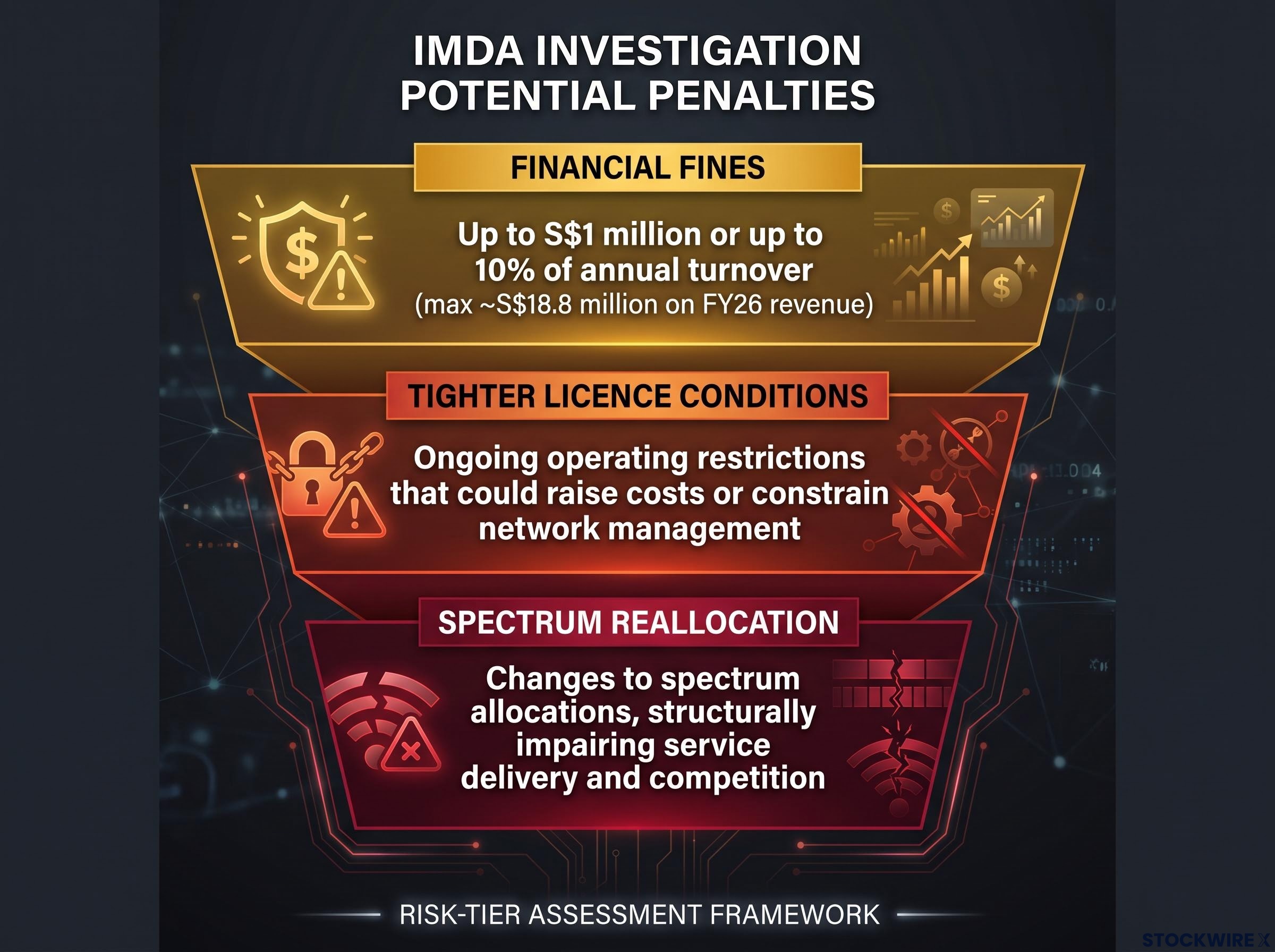
The penalties, if a breach is found, fall into three distinct categories, each with its own implications:
- Financial fines: Up to S$1 million or up to 10% of annual turnover, a direct hit to earnings but a one-off cost.
- Tighter licence conditions: Ongoing operating restrictions that could raise costs or constrain how Simba runs its network.
- Spectrum reallocation: In extreme cases, changes to spectrum allocations, which would structurally impair Simba’s ability to deliver service and compete.
Here is the interpretive point that separates the survivable from the serious. Applied to FY26 revenue of S$187.6 million, the 10% turnover ceiling produces a maximum fine of roughly S$18.8 million. That is large, but given the company’s cash position, it is survivable. The genuinely consequential risk is not the fine. It is the possibility of spectrum reallocation or tightened licence terms that permanently weaken Simba’s competitive footing.
The same investigation is also what killed the M1 deal, which is why its outcome reaches beyond one enforcement action.
IMDA stated that its investigation findings “may be material” to its assessment of the proposed consolidation, and suspended its M1 review until the investigation concluded.
For an Australian holding TUA, this is the uncomfortable core of the position. You are exposed to an outcome with no public timeline, no stated precedent from IMDA, and no visible floor on the downside. Mapping these three penalty categories is the only way to judge whether the risk premium already in the price compensates you for each scenario.
Morgan Stanley’s bull case versus what the market is pricing
Two credible interpretations of the current price exist, and they point in opposite directions.
The bull case belongs to Morgan Stanley. As reported in The Motley Fool Australia’s summary on 25 September 2026, the broker carries an overweight rating and a price target of A$4.35 per share. Against a price of roughly A$1.78, that implies approximately 140% upside. Critically, the target rests on Simba’s standalone financial performance, the revenue and EBITDA beats, not on any assumption that the investigation resolves favourably.
Underpinning that view is the balance sheet. Net cash backing sits at approximately A$1.00 per share following the deal’s collapse, which is more than half the current share price in cash alone.
Net cash backing of approximately A$1.00 per share means over half of what you pay at today’s price is covered by cash on the balance sheet.
Holding TUA is itself an exercise in buying international shares from Australia, with currency exposure, foreign regulatory jurisdiction, and a business domicile outside the ASX’s home-market disclosure norms all layered on top of the standard equity risk an investor would carry in a domestic telco.
The bear case does not need a research report. It is written into the trading itself. Shares fell around 60% intraday in May 2026, then a further 23.4% on 23 September 2026 in the face of a clear earnings beat. That is not a modest discount for uncertainty. It is a steep risk premium, applied by institutional investors who are pricing the possibility of severe sanction rather than a manageable one.
| Metric | Bull case view | Bear case view |
|---|---|---|
| Regulatory outcome | Resolves without crippling sanction | Severe fine or spectrum impairment |
| Simba standalone trajectory | Growing earnings, working economics | Capacity structurally constrained |
| Net cash significance | Material floor near A$1.00/share | Floor irrelevant if licence impaired |
| Price implication | Deeply undervalued at A$1.78 | Discount justified by open risk |
Here is how to read the floor. At A$1.00 per share in net cash and a price near A$1.78, you are paying roughly 78 cents per share above cash for the operating business. Even in a worst-case licence impairment, that gives a rough sense of your downside and an embedded option on a benign regulatory outcome.
The gap between A$4.35 and A$1.78 is not noise. It is a genuine disagreement about how to price an enforcement action with no precedent, no timeline, and no floor.
What resolves the TUA investment case from here
None of this delivers a verdict, and it should not. What it delivers is a set of variables to watch.
The single most important is the IMDA investigation, and specifically the category of penalty. A financial fine, even at the 10% turnover ceiling of roughly S$18.8 million, is survivable. Spectrum reallocation or materially tightened licence conditions are a different order of threat, because they touch Simba’s structural ability to compete rather than just its cash.
Structural policy risk in listed companies often becomes visible in the share price before it appears in earnings, and the gap between Tuas’ operational performance and its trading price echoes a pattern seen across ASX sectors where regulatory ambiguity gets priced as a permanent discount rather than a recoverable overhang.
David Teoh’s stated full cooperation and Simba’s continued operating momentum both matter to the eventual outcome. Neither guarantees a benign result. IMDA has committed to due process and given no signal on either the penalty or the timing, which is precisely what makes the risk hard to price.
The strategic question comes down to this. Does A$1.78 already price in a material adverse outcome, or is it pricing in something closer to total loss? With net cash near A$1.00 per share as the downside anchor and Morgan Stanley’s A$4.35 as the single available upside reference, the honest answer is that the market has not resolved it either.
For an Australian investor, the practical judgement is not whether to trust a single broker’s target. It is whether an unresolved Singapore enforcement action, with no public timeline, is a risk you are being adequately paid to carry at the current price. Watch these variables:
- The IMDA investigation conclusion and, above all, the specific penalty category imposed
- Any subsequent IMDA guidance on Simba’s operating licence conditions
- Whether Singapore telco consolidation, and the M1 opportunity, ever returns to the table
- Simba’s subscriber growth trajectory through FY27 as a test of the standalone case
This article is for informational purposes only and should not be considered financial advice. Investors should conduct their own research and consult with financial professionals before making investment decisions. Past performance does not guarantee future results, and financial projections are subject to market conditions and various risk factors.