On a $40,000 savings balance sitting in a standard account, you are losing roughly $1,204 in purchasing power this year. Not because of a bad trade. Not because of a market crash. Because of no decision at all.
Here is the environment you are working with. The national average savings account pays roughly 0.37-0.38% APY, according to FDIC data, while inflation ran at 3.4% year-over-year through August 2026, based on Bureau of Labor Statistics figures reported by the New York Times on 11 September 2026. That gap is the problem, and it works against you twice: inflation erodes your entire balance, while taxes take a bite out of the tiny interest you do earn.
This is not a moment where cash grows in real terms. The realistic goal is minimising how fast it shrinks.
This piece lays out the specific moves, in the right order, that close most of that $1,200-plus gap without locking up cash you might actually need next month. You will finish knowing which step applies to you today.
The math on what your savings account is actually doing to you
Start with the interest you earn, because it is smaller than you think.
On a $40,000 balance at the national average of 0.37%, you earn roughly $148 in interest over a year. That is before the government touches it.
Now apply tax. Interest income is taxed as ordinary income, so at a 22% federal rate you keep approximately $115 of that $148.
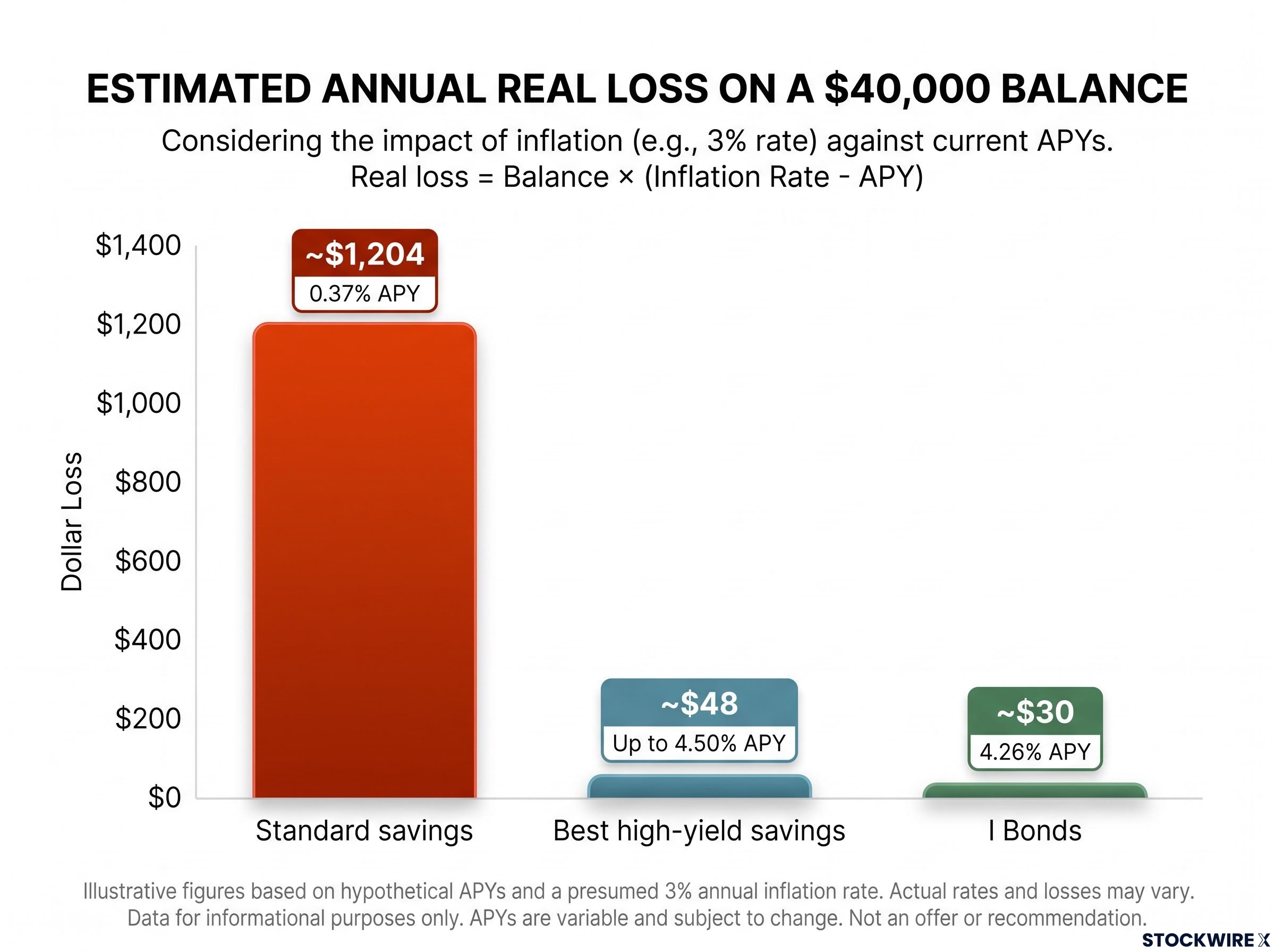
Then apply inflation to the whole balance. At 3.4%, the purchasing power of your full $40,000 shrinks by far more than the $115 you kept in interest. The net result is a real annual loss of roughly $1,204, or about 3.01% of your balance, in today’s dollars.
That $1,204 is not hypothetical. It is the approximate price you are paying right now, every year, for the convenience of doing nothing with a $40,000 balance in a below-inflation account.
Here is how the same balance behaves across three options.
| Account type | APY / rate | Annual interest ($40,000) | After-tax interest (22%) | Est. annual real loss |
|---|---|---|---|---|
| Standard savings | 0.37% | ~$148 | ~$115 | ~$1,204 |
| Best high-yield savings | Up to 4.50% | ~$1,800 | ~$1,404 | ~$48 |
| I Bonds | 4.26% | ~$1,704 | State-tax exempt | ~$30 |
The message is stark. Simply moving the money reduces your annual real loss from over $1,200 to under $50.
Why taxes make the problem worse than the headline rate suggests
The headline inflation number understates your true drag, and taxes are the reason.
Interest income is taxed as ordinary income at the federal level, and in most states at the state level too. So the small amount you earn shrinks before it even fights inflation, while inflation simultaneously erodes the full, uninflated principal sitting in the account.
That is the dual drag: two forces working on your money at once. Your real after-tax return ends up lower than either the inflation figure or the tax rate would suggest on its own, which is exactly why the breakeven bar sits so high.
To fully preserve purchasing power after federal income tax, a savings account would need to yield at least 4.36% APY in the current environment.
When big ASX news breaks, our subscribers know first
Why so many savers stay stuck in accounts that cost them money
If the math is this clear, why do so many people leave the money where it is? The answer is not laziness. It is a set of predictable, documented patterns, and recognising which one is yours is the fastest way to clear it.
- Inertia and status-quo bias: Once you set up a bank account, you tend to leave it alone. Greg McBride, chief financial analyst at Bankrate, has repeatedly pointed to a “set and forget” habit where savers rarely revisit their cash even as rates change around them.
- Perceived switching hassle: Moving banks means updating direct deposits, auto-payments, and logins, and that admin feels tedious enough to make a better rate seem “not worth it.”
- Relationship banking and trust concerns: Many savers, older ones in particular, stick with a familiar brick-and-mortar bank because online-only institutions feel less safe or less real.
- Low awareness of opportunity cost: Christine Benz of Morningstar has emphasised that cash drag is invisible day-to-day, so you never feel the loss and never get emotionally motivated to fix it.
- Fear of complexity and risk misperception: Because I Bonds involve a TreasuryDirect account, purchase limits, and tax quirks, some savers file them under “risky investments” and avoid them entirely.
The scale of cash drag on purchasing power compounds over time in ways the annual loss figure alone does not capture: Federal Reserve Survey of Consumer Finances data shows that wealthier households deliberately cap their cash holdings at around 6% of total assets, treating everything above a functional reserve as a liability rather than a safety net.
That third barrier, the trust one, is worth clearing directly, because it costs people the most for the least reason.
Online high-yield savings accounts at FDIC-insured institutions carry the same federal deposit protection as a traditional brick-and-mortar bank, up to applicable limits.
The switching friction is real, but now you can price it. The gap between doing nothing and switching is over $1,150 a year on a $40,000 balance. An hour or two of updating direct deposits and auto-payments has a clear dollar value to weigh against that, and the maths rarely favours standing still.
Understanding which barrier is actually yours turns a vague sense of “this is hard” into a single obstacle you can knock down. That is the difference between reading this and acting on it.
High-yield savings and I Bonds: what each one actually does for you
You have two main tools, and choosing between them is easier than it sounds because they answer different questions. High-yield savings is about access. I Bonds are about locking in inflation protection. Match the tool to the cash, not the other way round.
High-yield savings accounts: who they work best for
A high-yield savings account is the default home for any cash you might need soon. It is fully liquid, FDIC-insured, and currently pays up to 4.50% APY as of 18 September 2026, based on FDIC survey data reported by Fortune.
That combination makes it the correct vehicle for your emergency fund and anything you could need within twelve months. The advantages that matter here are not really about the rate:
- Immediate access with no penalties and no minimum holding period
- FDIC insurance up to applicable limits, online or in-branch
- No TreasuryDirect account to manage and no purchase caps
- Rates that tend to rise alongside Federal Reserve hikes, benefiting existing holders
The one caveat: these rates are variable. Today’s 4.50% is not guaranteed to be tomorrow’s, so if rates move significantly, be prepared to reassess where the best deal sits.
I Bonds: who they work best for
Series I Savings Bonds are a second-tier tool for cash you can genuinely leave alone. The current composite rate is 4.26% for bonds issued 1 May through 31 October 2026, per TreasuryDirect, built from a 0.90% fixed rate locked in for 30 years plus an inflation-indexed component that resets every six months.
Their standout feature is tax treatment. I Bond interest is exempt from state and local income tax, which makes them relatively more attractive if you live in a high-tax state. On a $40,000 balance, that state exemption is why the estimated real loss on I Bonds comes to about $30 a year, edging out even the best high-yield account.
They work best for cash tied to a goal at least a year out: tuition, a down payment, or a planned expense where inflation risk actually matters. But the constraints are firm:
- $10,000 per person annual electronic purchase limit, plus up to $5,000 in paper bonds via a federal tax refund
- No redemption at all in the first 12 months
- A penalty of the last three months of interest if you redeem in years one through five
The composite rate can also fall, since it resets with CPI, even though the fixed component is durable.
Here is the side-by-side.
| Feature | High-yield savings | I Bonds |
|---|---|---|
| Liquidity | Immediate, no penalty | Locked 12 months; penalty in years 1-5 |
| Current rate | Up to 4.50% APY | 4.26% composite |
| Backing | FDIC-insured | U.S. Treasury |
| Tax treatment | Federal + state on interest | Federal only; state-exempt |
| Annual purchase limit | None | $10,000 per person (electronic) |
Notice what the decision actually hinges on. The difference between the two on a $40,000 balance is roughly $18 a year, which is not the deciding factor. The deciding factor is whether you can genuinely leave the money untouched for at least twelve months. Both options drag your annual loss down from about $1,204 to under $50, so this is a liquidity question, not a return question.
The sequencing framework: what to move first and why order matters
Knowing the tools is not the same as knowing the order. Do this in the wrong sequence and you can force yourself into a costly redemption at the worst possible time. Here is the ranked path.
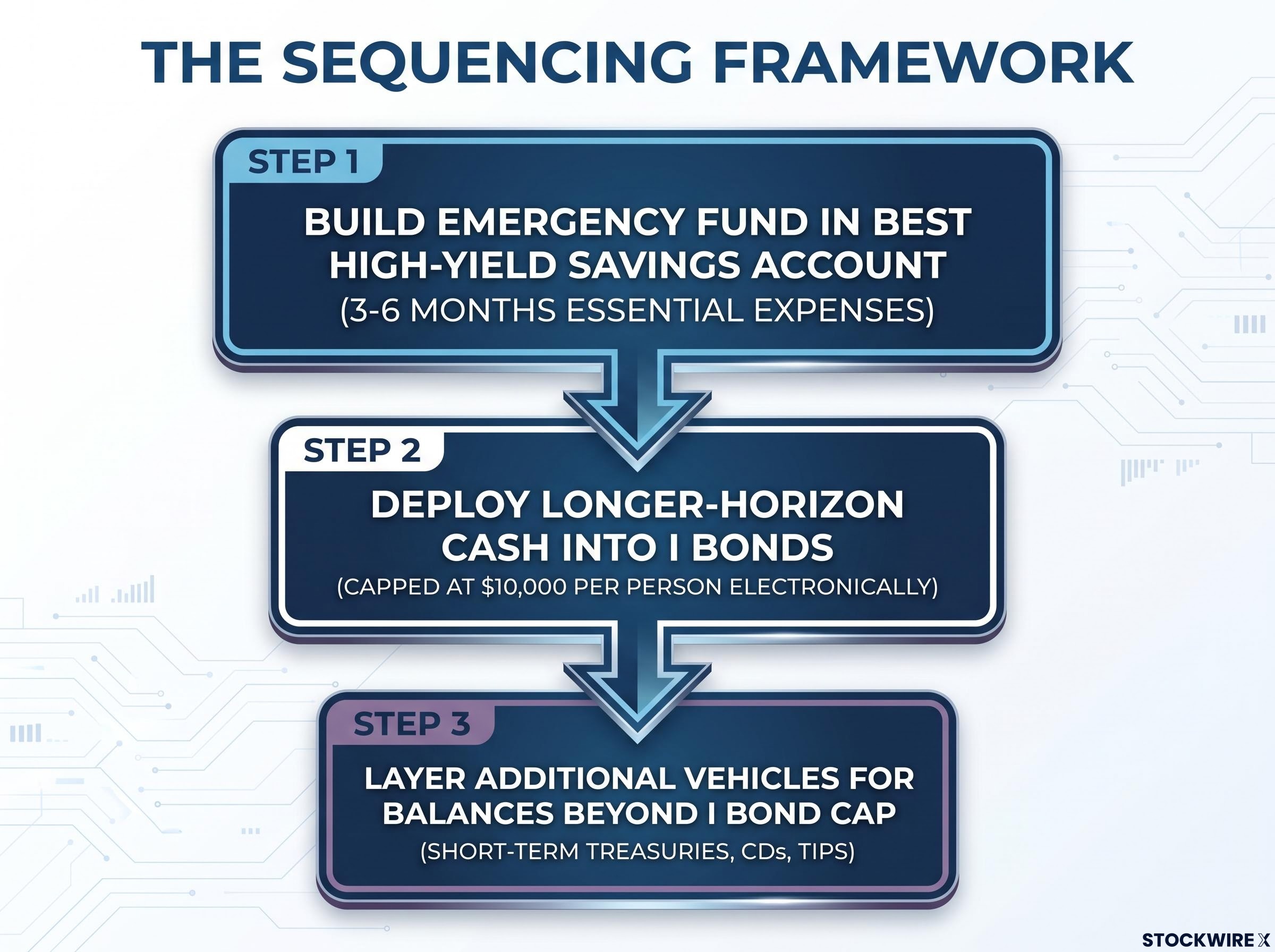
- Build and park your emergency fund in the best high-yield savings account. This applies to everyone; if you do not yet hold 3-6 months of essential expenses in liquid, FDIC-insured cash, this is your only first move.
- Deploy longer-horizon cash into I Bonds, up to the annual limit. This applies once your emergency fund is set and you have additional cash you will not need for at least a year, capped at $10,000 per person electronically.
- Layer additional vehicles for balances beyond the I Bond cap. This applies to larger cash holdings, where short-term Treasuries, CDs, and TIPS held through bond funds can absorb what I Bonds cannot.
Step one is non-negotiable as your starting point. Cash you might need within three to six months has to stay liquid, and the correct home for it is high-yield savings, never an I Bond or any product with a lockup.
For savers with balances that exceed the I Bond annual purchase cap, savings account alternatives including Treasury bills and CD ladders can absorb the overflow while preserving the state-tax advantages that make government-backed instruments more competitive than their headline yields suggest in high-tax states.
Deploying cash into I Bonds before an emergency fund is in place risks a forced early redemption that forfeits the last three months of interest.
That risk is exactly why the order is not arbitrary. It maps directly to your real financial exposure: liquidity first, inflation protection second, yield-hunting last.
Rates are part of the backdrop too. At its September 2026 meeting, the Federal Open Market Committee raised the federal funds rate target to 3.75%-4.00%, according to J.P. Morgan Asset Management’s FOMC commentary published 17 September 2026. That hike has supported today’s high-yield savings rates.
Federal Reserve rate decisions directly set the ceiling on what high-yield savings accounts can pay: the September 2026 hike to 3.75%-4.00% is what pushed top savings rates above 4.50%, and any future easing path will compress those variable yields on a similar lag.
Because those accounts carry variable rates, they will move with future Fed decisions. That makes it worth checking, once a year, whether the gap between high-yield savings and I Bonds has shifted enough to change where you park new cash. Remember what is at stake in getting this right: over $1,150 a year preserved on a $40,000 balance versus doing nothing.
What the math tells you to do with your cash in this rate environment
The reframe is the whole point. In this environment you are not trying to grow cash in real terms; you are trying to minimise how fast it shrinks while keeping the liquidity you actually need.
Be clear-eyed about the ceiling. Even the best options on offer, high-yield savings at up to 4.50% and I Bonds at 4.26%, do not fully close the gap with inflation after tax. The Cleveland Fed’s inflation nowcast pointed to roughly 3.57% for September 2026, a sign the pressure is not easing dramatically in the near term.
Savers in higher federal tax brackets face a steeper breakeven requirement, and fixed income alternatives such as FDIC-insured CDs currently sitting 0.5-1.0 percentage points above comparable Treasury paper can close part of that remaining gap for balances already deployed into a high-yield account and I Bonds.
Losing $48 a year instead of $1,204 is still losing money. But it is meaningful progress, and it is the realistic outcome genuinely available to a cash saver right now.
- The cost of inaction: roughly $1,204 a year on a $40,000 balance left in a standard account.
- The two tools: high-yield savings for liquid, near-term cash; I Bonds for money you can lock away for at least a year.
- The sequence: emergency fund first, I Bonds second, everything else after, revisited annually as rates shift.
Your one action today is simple: identify which step in the framework applies to you and take it, whether that means opening a high-yield savings account, moving your existing emergency fund, or setting up a TreasuryDirect account for next month’s I Bond purchase.
This article is for informational purposes only and should not be considered financial advice. Investors should conduct their own research and consult with financial professionals before making investment decisions. Past performance does not guarantee future results, and rates quoted are variable and subject to change with market conditions.