
European accounting firms are living through one of the strongest advisory demand environments on record. And they are turning work away.
Not because clients have stopped asking. Because the firms simply do not have the capacity to say yes.
Advisory work now accounts for at least 21% of total revenue for the overwhelming majority of firms across five European markets, and client expectations have shifted decisively toward proactive, strategic guidance rather than reactive compliance. The problem is that the operational machine underneath most firms cannot keep pace with what clients now want.
This is not a temporary staffing squeeze. It is a systemic mismatch between what the market demands and what firms can deliver, and it carries a measurable price tag.
What follows here is a precise reading of how much revenue that inefficiency is quietly absorbing, why the constraint on European accounting firm advisory capacity is structurally self-reinforcing, and what separates the firms widening their lead from those steadily ceding ground to more efficient competitors. It is a picture you can apply directly to how you assess professional services firms as businesses or as investments.
How big is the gap? The numbers behind a sector-wide capacity problem
Start with the headline finding. Across the five European markets surveyed by Silverfin in September 2026, 53% of accounting professionals said they routinely receive more advisory requests than they can fulfil.
A further 44% said this happens at least occasionally. The survey polled 500 mid- to senior-level respondents across the UK, Luxembourg, the Netherlands, Belgium and Denmark, and the pattern held everywhere.
The severity, however, is anything but uniform. Denmark and the Netherlands sit at the milder end, with 32% and 38% of professionals respectively saying they regularly exceed capacity. The picture darkens sharply as you move across the map.
| Country | Proportion regularly exceeding advisory capacity |
|---|---|
| Denmark | 32% |
| Netherlands | 38% |
| UK | 46% |
| Belgium | 72% |
| Luxembourg | 78% |
In Belgium, 72% of professionals regularly turn away more than they can handle. In Luxembourg, that figure reaches 78%, the most acute constraint in the study.
Country-level selectivity applies with equal force to professional services as it does to broad equity allocation: Belgium and Luxembourg are posting advisory capacity constraints nearly double those of Denmark and the Netherlands, meaning firm performance within Europe is far more dispersed than any continental aggregate would imply.
The single most revealing number, though, sits at the bottom of the distribution.
Not one professional surveyed across the five markets said that excess advisory demand never occurs. Zero.
That absence of a zero-pressure cohort tells you this is a structural condition of the market, not an episodic pressure that eases in quieter quarters. The direction is universal even where the intensity varies.
And it matters commercially because advisory is no longer a side business. Silverfin’s research found that 84% of firms draw at least 21% of their total revenue from advisory or consultancy services, a figure that climbs to 91% among UK respondents. When a fifth or more of firm income depends on work that firms are structurally unable to fully deliver, the stakes stop being operational and become financial.
When big ASX news breaks, our subscribers know first
What is actually consuming the time? The operational anatomy of the capacity crunch
If demand is universal, where does the capacity actually go? The answer is not primarily a talent shortage. It is a set of operational failures that quietly drain the hours advisory work needs.
Peel the problem apart and four distinct layers emerge, each compounding the one before it:
- Platform fragmentation: More than 50% of respondents routinely work across four or five separate bookkeeping platforms, and 9% juggle between six and ten disconnected systems. In the UK, 56% operate across four or five systems.
- Manual reconciliation: 44% of European accountants still rely on Excel for manual reconciliation, dropping to 31% in the UK. This locks skilled staff into low-value data entry rather than client-facing advisory.
- Data transfer time: 41% of respondents spend at least 31 minutes every working day simply moving data between systems, with the UK close behind at 37%.
- Process inconsistency: Only 21% are strongly confident that consistent workflows are followed across every team, partner and office. In the UK, that confidence collapses to just 10%.
The commercial logic behind accounting workflow automation is already being tested at scale: Xero’s XeroForce agent builder, launched in May 2026, targets exactly the manual reconciliation and data-transfer steps that consume the recoverable hours identified in Silverfin’s research, with monetisation structured around usage volume rather than flat subscription pricing.
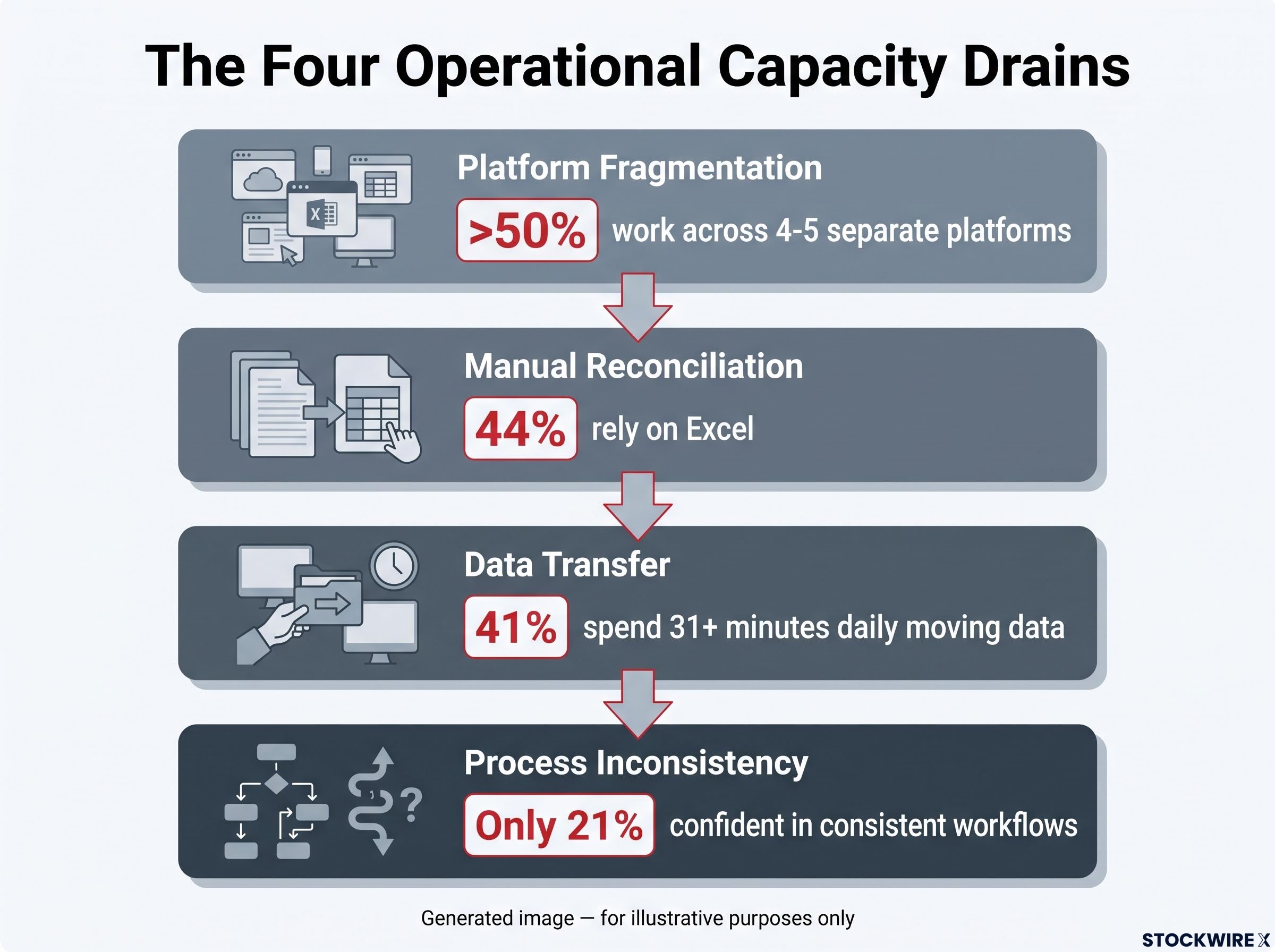
Read those first three points together and the mechanics become clear. When your data lives in five places, someone has to move it between them, and someone has to reconcile it by hand when it does not match. That someone is often a senior professional whose time is worth far more deployed on advisory.
Why the process failure is the hardest to fix
The consistency finding is the one that should worry firm leaders most.
When only one in ten UK professionals is confident that workflows run the same way across their firm, the capacity problem stops being something individual effort can solve. It is an organisational failure, and organisational failures do not yield to a single motivated partner working longer hours.
That distinction matters for how you read any firm’s turnaround story. Technology investment alone will not close this gap if the underlying processes remain inconsistent from one office to the next. The tool amplifies whatever process it sits on top of.
The upside is quantifiable. Silverfin’s Efficient Firm 2026 Performance Report found that firms operating with automated, standardised workflows reclaim an average of 3 hours per file. Each of these four failure points, in other words, is a lever, and the firms pulling them are already recovering meaningful time.
What does the lost time actually cost? Translating inefficiency into billable revenue
Now for the financial reckoning. All that fragmented, manual, inconsistent work adds up to a specific quantity of recoverable time, and Silverfin’s respondents estimated it precisely.
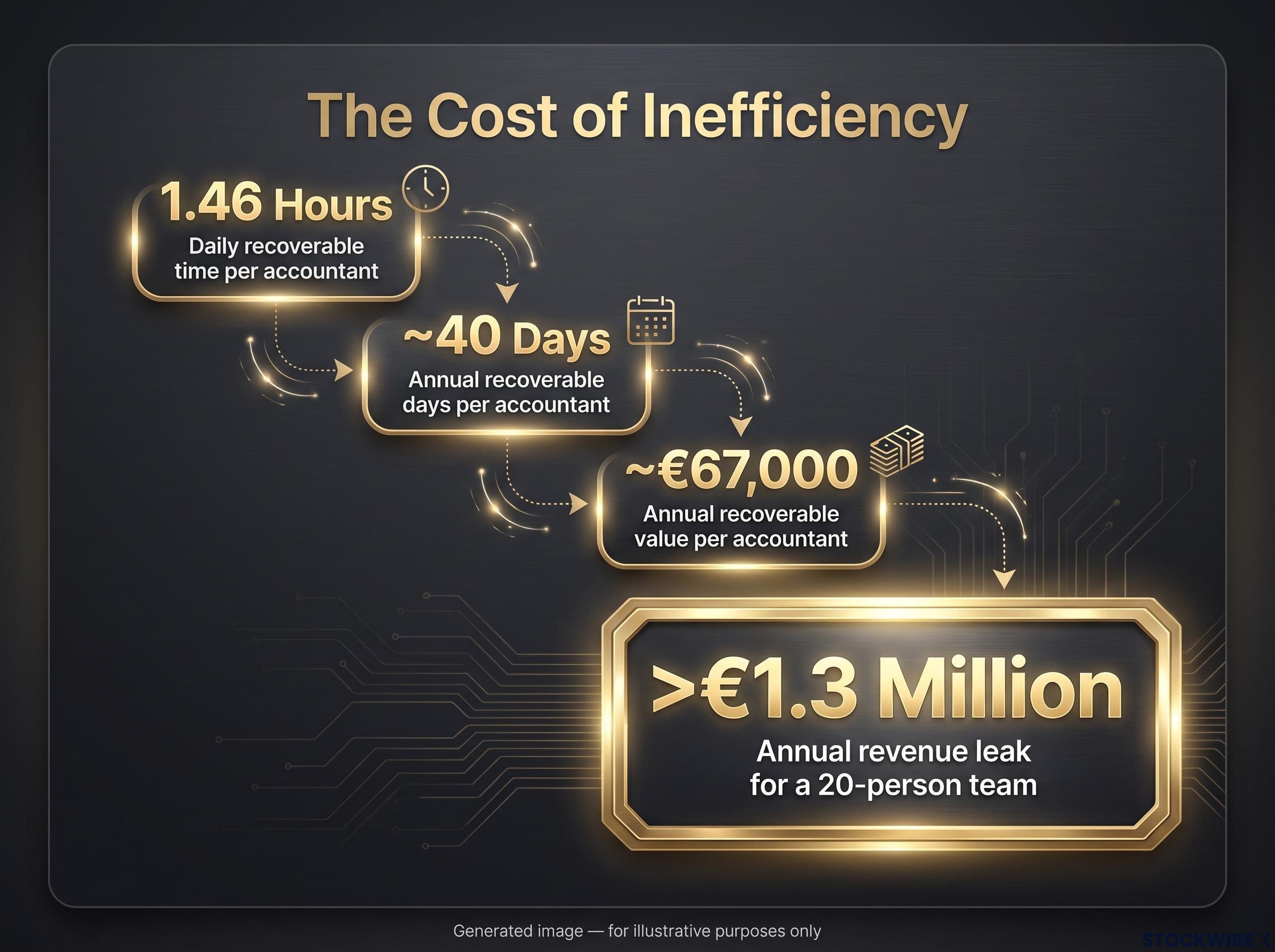
Across the five surveyed markets, accountants believed that eliminating operational inefficiencies could reclaim an average of 1.46 hours per working day. Compounded across a year, that is roughly 40 full working days of recoverable time per accountant.
Convert those hours into billable value and the picture sharpens considerably.
At prevailing charge-out rates, the reclaimed time represents approximately €67,000 in potential billable value per accountant, every year, across European markets.
In the UK, the September 2026 survey put the equivalent figure at approximately £55,000 per accountant annually. That sits above the roughly £48,000 estimate from Silverfin’s earlier All Accounted For research, a difference that reflects distinct study timeframes within the same research programme rather than any conflict in the data.
| Geography | Daily recoverable time | Annual recoverable days | Annual recoverable value |
|---|---|---|---|
| European average | 1.46 hours | ~40 days | ~€67,000 |
| UK (five-market survey) | ~1.4 hours | ~40 days | ~£55,000 |
| UK (All Accounted For baseline) | 1.2 hours | ~40 days | ~£48,000 |
Now scale that per-head figure to a team. At €67,000 of forgone billable value per accountant, a 20-person advisory team represents over €1.3 million in potential revenue absorbed by inefficiency every year. That single calculation reframes the entire technology investment conversation for firm leaders: the spend is no longer weighed against a vague productivity benefit but against a concrete seven-figure leak.
The scale of the opportunity matters more given how quickly advisory demand is rising. Wolters Kluwer data shows the share of firms offering advisory as a key service climbed from 49% in 2024 to 65% in 2025. For context on the size of the pool, Europe’s broader accounting services market was estimated at approximately US$196.92 billion in 2025, according to Fortune Business Insights, though that figure is flagged as unverified in the underlying source material.
Three structural forces driving the gap, and why the problem compounds
Understanding the cost is one thing. Understanding why it persists, and worsens, is what matters for anyone assessing where a firm is heading.
Three structural forces are driving the advisory capacity gap, and each is significant on its own:
- Workflow and systems failure. Skilled time is locked inside manual compliance and data processing rather than freed for advisory, the operational anatomy documented above.
- Expanding client demand and regulatory complexity. Advisory has moved to the centre of client engagement, driven by mounting complexity around IFRS, GDPR and cross-border VAT, alongside clients seeking proactive strategic guidance in a difficult economic climate.
- Talent strain. Sustained capacity pressure is contributing to burnout, and according to ITBrief’s September 2026 reporting, unmet advisory demand is pushing some UK accountants to consider leaving the profession entirely.
The demand-side shift alone is striking.
Wolters Kluwer’s Future Ready Accountant Report found that 65% of firms now offer advisory as a key service, up from 49% just a year earlier in 2024.
The real danger is what happens when the three forces interact. Here is the loop worth understanding. Overloaded staff burn out and leave, which reduces future capacity, which deepens the gap, which piles more pressure onto the professionals who remain, which drives the next departure.
That talent attrition loop is the most underappreciated risk in the entire dataset. A firm that cannot resolve its capacity constraints is not merely forgoing today’s advisory revenue; it is likely accelerating the exit of the very people it would need to capture tomorrow’s. The problem gets structurally harder to escape the longer a firm delays acting on it.
Meanwhile, the firms that have broken the loop are pulling away. According to Wolters Kluwer, high-growth firms are 53% more likely to have highly integrated systems and 38% more likely to be fully cloud-based, while nearly half of European firms are actively expanding their advisory offerings. That tells you the gap between digital leaders and constrained laggards is not narrowing. It is widening.
The widening divide between firms that solve this and firms that do not
This is where the story shifts from a problem to be managed into a fork in the road. Firms are already diverging in ways that will be difficult to reverse.
The evidence sits in the performance data from Silverfin’s Efficient Firm 2026 research. The most efficient firms are not marginally better off; they are operating on a different plane:
- They reclaim an average of 3 hours per file through automated, streamlined workflows.
- They report reduced work pressure for 60% of teams.
- They increase client capacity by an average of 48%.
- Over 80% of firms using the platform described it as a direct catalyst for growth.
That 48% client capacity increase is the clearest available measure of what the gap is costing constrained firms in competitive terms. It is not just €67,000 per accountant in forgone revenue. It is the structural ability to serve nearly half again as many clients as they currently can.
What the divide means competitively
The competitive risk follows directly. Firms that repeatedly decline advisory work do not simply lose that revenue; they risk losing the client relationship to a more advisory-centric competitor.
Once that happens, the firm drifts from high-margin strategic work back toward commoditised compliance at ever-thinner margins, exactly the segment automation is squeezing hardest. The wider adoption context reinforces the direction of travel, with 53% of European firms expanding cloud adoption in 2025 and 48% investing in technology integration, according to Wolters Kluwer.
The trajectory of the market makes this divergence more consequential, not less. Mordor Intelligence projects the European financial advisory services market growing from USD 30.91 billion in 2025 to US$39.97 billion by 2031, a compound annual growth rate of 4.37%, though that projection is flagged as unverified in the source material.
The read for anyone assessing these firms is straightforward. The revenue pool is expanding, yet a growing tier of firms is structurally unable to access it. A two-tier market is forming: integrated, cloud-based practices pulling ahead on capacity and retention, and constrained competitors facing gradual margin compression.
European equity positioning among institutional investors remains structurally light even as sector-level earnings revisions have turned positive, a backdrop that makes the capacity-driven divergence between digitally mature and operationally constrained professional services firms a more consequential selection variable than top-down allocation alone would suggest.
What the capacity crisis tells us about where European professional services is heading
Step back from the individual data points and the shape of the argument becomes clear. The advisory capacity crisis is not a temporary demand spike that will normalise. It is a structural misalignment between legacy operational models and a client and regulatory environment that has fundamentally changed.
For firm leaders, the cost of inaction extends well beyond the roughly €67,000 in forgone advisory revenue per accountant each year. It compounds through talent attrition, client relationship erosion and a steadily weakening competitive position relative to digitally mature peers.
The most useful signal for timing your read of this sector is the pace of change itself. Advisory moved from a key service at 49% of firms to 65% in a single year, according to Wolters Kluwer. That is not a gradual shift; it is an accelerating one, and firms that have not reconfigured operationally are losing ground faster than annual snapshots suggest.
With the European financial advisory market forecast to approach US$40 billion by 2031, the durable frame is this: capacity and digital maturity are now the leading indicators of competitive position, and the advisory revenue gap is the measurable cost of the distance between them.
European financial services encompass a much broader opportunity set than any single segment, and investors assessing professional services firms alongside the wider continental allocation debate will find the valuation discount that persists across European equities relevant context for sizing positions in this sector.
This article is for informational purposes only and should not be considered financial advice. Investors should conduct their own research and consult with financial professionals before making investment decisions. Past performance does not guarantee future results, and financial projections are subject to market conditions and various risk factors.